
On a Milton estate where the pool deck sits 11 feet above a named tributary, the drainage plan is not a detail — it is the project. Get it wrong and the city levies $2,400–$6,800 per incident in stormwater fines plus full restoration cost, and the stone you just set becomes a liability rather than a legacy.
Here is the problem nobody warns Milton homeowners about before the excavator shows up. Your 3-acre parcel in Crooked Creek or The Manor Golf Club drops six to fourteen feet from the house pad down toward a creek corridor. That same corridor — Cooper Sandy Creek, Chicken Creek, Lake Creek, or an unnamed Etowah tributary — is wrapped in a protected buffer that runs 25 to 75 feet from top of bank. Inside that buffer you cannot discharge stormwater. Not a downspout. Not a French drain outlet. Not a deck channel. Nothing.
And the slope wants to send every gallon exactly there.
That collision — dramatic grade plus hard discharge line — is why Milton hardscape drainage is its own engineering problem. It is not a scaled-up version of what works in Alpharetta or Johns Creek. The buffers are wider. The grade changes are sharper. The soils shift from Cecil clay on the ridge to silty bottomland near the water. And the city that reviews your permit — Milton Community Development at 2006 Heritage Walk — enforces a preservation ordinance that Fulton County itself does not write.
This post walks through how we design, layer, and discharge drainage for pool decks, patios, and retaining walls on rolling Milton equestrian land without ever touching the creek buffer. If you are building inside AG-1 zoning on one to five acres, this is the piece.
Why Milton Is Not Alpharetta — Grade, Buffer, and the 2006 Incorporation
Milton incorporated as a separate city in 2006, carved out of the northern tip of Fulton County. That single political fact changes how your permit moves. You do not file with Fulton County Community Development in downtown Atlanta. You file with Milton at 2006 Heritage Walk, and they run a different playbook — 10 to 14 business day turnarounds on a clean submittal, but an explicit preservation review layered on top that looks specifically at tree canopy, equestrian character, and creek buffers.
The second thing to understand is the grade. Alpharetta sits at roughly 1,070 ft and its lots are mostly subdivision-scale with 2–5 ft of fall across the back yard. Milton sits around 1,150 ft and its lots are estate scale — one to five-plus acres in AG-1 equestrian preservation zoning, with 6 to 14 ft drops across a single project footprint. That much fall is not a nuisance. It is a governing design constraint. Every square foot of impervious hardscape you add — pool coping, decking, patio, driveway extension, pool house pad — is pointed downhill at something. That something, in Milton, is almost always a tributary.
The third thing is the preservation ordinance itself. AG-1 zoning sets a minimum lot size of one acre and, on most parcels inside the equestrian corridor, three acres. That keeps houses far apart and tree canopies wide. It also means the stormwater is supposed to stay on your land — infiltrating, not discharging. The city does not want concentrated flow leaving your property and certainly does not want it entering a stream through a pipe.
The Creek Buffer Rule — 25 to 75 Feet, No Discharge, Hard Line
Georgia’s Erosion and Sedimentation Act establishes a 25-foot undisturbed state buffer on all perennial streams. Milton layers additional local buffers on top. Named tributaries inside city limits — Cooper Sandy Creek, Chicken Creek, Lake Creek, plus mapped Etowah tributaries — carry protection ranging from 50 to 75 feet depending on classification and whether the parcel falls inside a sensitive overlay. In the Chicken Creek floodplain on some north Milton parcels, the buffer effectively expands with the FEMA floodway line.
Inside that buffer, the rules are not negotiable:
- No land disturbance beyond what is explicitly permitted.
- No discharge of concentrated stormwater. No pipe outlets. No channelized flow.
- No impervious hardscape. No structures. No pavement.
- No grading or fill that alters existing drainage patterns entering the buffer.
For hardscape drainage this translates into one sentence: your entire drainage system must collect, convey, and discharge every gallon outside the buffer. The daylight point — the place where the pipe opens to atmosphere — must sit on the buffer side closer to the house, never the stream side. And the discharge cannot be a concentrated point source. It has to be dispersed, usually across a rip-rap apron or a level spreader that converts pipe flow back into sheet flow before the water ever gets near the protected zone.
Penalty structure: Milton code enforcement issues stormwater violations at $2,400–$6,800 per incident, plus mandatory restoration cost — which on a disturbed creek bank typically runs $8,000–$22,000 depending on bank length and vegetation replacement. Repeat offenders on the same parcel have seen stop-work orders that add 30–60 days of carrying cost on an active build.
The Three-Layer Drainage Stack We Build on Every Milton Estate Project
Every Primetime hardscape drainage design on a Milton project with grade and a creek follows the same three-layer logic. The materials vary by budget and site, but the sequence does not.
Layer 1 — Surface Capture at the Hardscape
At the pool deck, patio, or any large impervious surface, we run a continuous linear channel drain along the downhill edge. On 90% of our Milton builds that means NDS Spee-D Channel — the 3-inch polymer channel with a stainless or decorative cast-iron grate keyed into the pool coping joint. It sits flush with the deck, catches sheet flow before it hits the lawn, and ties directly into a sealed 4-inch solid SDR-35 or Schedule 40 PVC lateral running downgrade inside a trenched corridor.
Spee-D is not the only option — Zurn, Jonite, and ACO make comparable channel systems — but NDS holds up best in our experience against the freeze cycles Milton sees (USDA Zone 8a, about 22 freeze events per year) and the landscape crews who hit grates with edgers for the next 30 years.
Layer 2 — Subsurface French Drain and Footing Drains
Below grade, a 4-inch perforated PVC (perf-down installation, rocked and wrapped) runs in a trench 18–24 inches deep along retaining wall footings and along the uphill side of pool shells. We wrap the stone fill in 8 oz non-woven geotextile — Mirafi 140N or equivalent — to prevent Cecil clay fines from migrating into the gravel and clogging the system within five years. The stone is #57 washed granite per Fulton standards, the trench is backfilled in lifts, and the sock-wrapped pipe ties into the same conveyance lateral as the surface drain.
French drain on its own is not the system. French drain is the subsurface branch of the system. Treating it as the whole answer — the single most common hardscape drainage mistake we see on Milton retrofits — leaves every gallon of surface water still running across the deck and into the lawn.
Layer 3 — Conveyance and Daylight Discharge Outside the Buffer
The lateral runs downgrade in solid pipe with cleanouts every 75 feet or at every directional change greater than 45 degrees. We pitch it at a minimum of 1%, target 2%, and we never exceed 8% without an energy-dissipation step to prevent scour at the outlet. The pipe daylights on the upslope side of the creek buffer line — surveyed, flagged, and documented on the permit drawings — onto a rip-rap apron or a level spreader that converts the concentrated flow back into sheet flow across vegetated ground.
That sheet flow then traverses the buffer itself as diffuse, filtered water, which is exactly what the ordinance contemplates. Water is allowed to cross the buffer. Pipes are not.
Budgeting the Work — What Proper Milton Drainage Actually Costs
Homeowners ask this before they ask anything else, so let’s name the number. Proper layered drainage on a typical Milton estate pool-and-hardscape project runs $12,000 to $24,000, separate from the pool, the decking, and the retaining walls themselves. That range covers:
- 150–400 linear feet of channel drain at the hardscape perimeter
- 200–600 linear feet of perforated French drain at walls and pool shells
- 300–900 linear feet of solid conveyance pipe to the daylight point
- Rip-rap apron or level spreader at discharge
- Surveyed buffer flagging and permit documentation
- As-built drawings for Milton Community Development
The low end of that range covers a cleaner site with a shorter run to daylight — a Bethany Creek or Cogburn Estates parcel where the buffer sits 150 feet from the hardscape. The high end handles longer conveyance runs on properties in White Columns or along Hopewell Road where the nearest acceptable daylight point is 500+ feet from the house pad.
The number we will not write for you is anything under $12,000 on a true estate project with grade and a buffer. If a contractor is quoting $4,000 to $7,000 for “pool drainage” on a three-acre Milton lot, they are quoting a surface channel and calling it done. That is not drainage. That is a grate tied to a short pipe dumping behind the pool equipment pad — and on a rolling lot it will either erode a gully into the lawn within two seasons or find its way across the buffer line and put you on the wrong end of a code enforcement letter.
Retaining Walls on Rolling Lots — Drainage Is the Wall’s Structural System
On a Milton estate with 10 ft of fall across the pool footprint, you are almost certainly building at least one retaining wall to create a level pad. That wall is the most drainage-dependent structure on the site. A retaining wall without proper drainage is not a wall — it is a schedule for its own failure. Hydrostatic pressure from saturated Cecil clay behind the wall multiplies the lateral load by 3x to 5x over the dry-soil design load, and segmental walls are not rated for that pressure.
Our standard assembly on Milton retaining walls 3 ft and taller:
- Compacted crushed-stone leveling pad, 6 inches minimum on engineered subgrade
- Geogrid reinforcement tied back into the retained soil at every third course, length calculated per wall height
- #57 washed stone drainage chimney 12 inches deep behind every wall face
- 4-inch perforated PVC at the base of the chimney, pitched to daylight or to the conveyance lateral
- 8 oz non-woven geotextile separating the drainage chimney from the Cecil clay backfill
- Backfill compacted in 6-inch lifts, capped with 6 inches of topsoil
On saprolite shelves — the weathered granite we occasionally hit during pool excavation on higher-elevation Milton parcels — the wall footing gets re-engineered because the bearing capacity jumps dramatically and the leveling pad requirements change. That is not a place to guess.
Permits, The Manor Review Committee, and the 10–14 Day Clock
Because Milton reviews its own permits, the timeline moves faster than most homeowners expect — 10 to 14 business days on a clean hardscape permit submittal that includes drainage plans, buffer survey, and as-built commitment. Compare that to parcels one county over in Forsyth where the clock can run 18–25 business days. That is one reason Milton estates move fast.
The catch is what gets reviewed. Milton Community Development looks at:
- Tree survey and canopy protection — every tree over 8-inch DBH inside the work zone
- Creek buffer delineation — must be surveyed, not estimated
- Stormwater management — your drainage plan is reviewed, not rubber-stamped
- Equestrian preservation compliance — particularly on parcels in the AG-1 overlay
- Impervious coverage calculation against the lot’s allowable percentage
If your parcel sits inside The Manor Golf Club, add a second review on top. The Manor’s Architectural Review Committee — a structural and aesthetic committee separate from the city — runs a four- to five-week process with its own submittal requirements. Material samples, color boards, elevation drawings, and a drainage narrative are all standard. Skip this step and your build will stop before it starts. The committee has and does reject submittals for drainage plans that show concentrated discharge toward shared amenity areas or downslope neighbors.
Milton permit intake: Community Development Department, 2006 Heritage Walk, Milton, GA 30004. Clean hardscape drainage submittals with surveyed buffer, tree plan, and as-built commitment typically clear in 10–14 business days. The Manor ARC adds 4–5 weeks on top and runs independently.
A working submittal on a Milton estate drainage project includes: topographic survey at 2-ft contour intervals, creek buffer delineation stamped by a licensed surveyor, drainage plan showing surface capture, subsurface collection, conveyance routing, and daylight point with elevation, plus an as-built commitment that the contractor will return post-construction with verified as-built drawings. Miss the as-built commitment and your Certificate of Completion hangs up indefinitely.
Integrated Design — Why Milton Drainage Decisions Happen on the Napkin, Not the Jobsite
The final point is the one most new clients resist until they hear it explained. On a Milton estate project, drainage is not a trade that gets scheduled after the pool and the hardscape are laid out. Drainage is a design input that shapes the pool and hardscape layout from the first sketch. Three examples of how this plays out:
Pool position. On a lot with a 12-ft drop toward Chicken Creek, moving the pool 18 ft uphill from the homeowner’s first-choice location can add 60 ft of conveyance run but avoid 4 ft of retaining wall height — net cost savings in five figures plus a simpler drainage chimney.
Hardscape geometry. A rectangular 1,800 sq ft pool deck with a single downhill edge concentrates all runoff along one line. The same 1,800 sq ft split into a deck plus a loggia plus an outdoor kitchen plateau with independent drainage points reduces peak flow at every discharge by roughly 60% and makes the daylight zone easier to integrate with planting.
Pool-pavilion-kitchen integration. Milton’s rural character and large lot sizes drive demand for fully integrated outdoor programs — pool, pavilion, outdoor kitchen, fire feature, pool house — laid out across 3,000–5,000 sq ft of hardscape. Designing those as a single drainage watershed with one or two daylight points beats designing them as four separate projects that each need their own pipe to daylight.
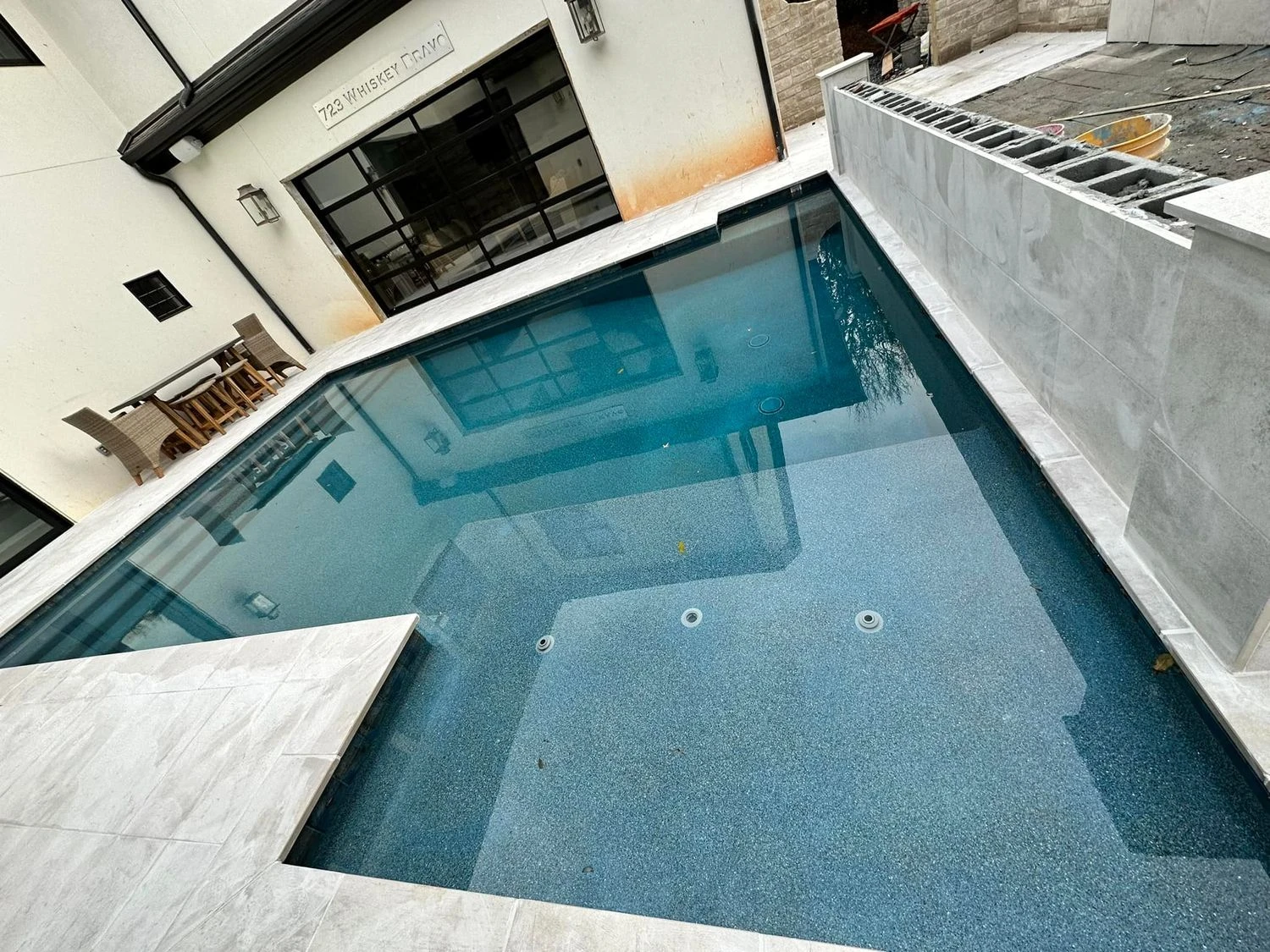
The bigger picture is simple: Milton is not a place to value-engineer drainage out of the budget. The grade, the soils, the buffer rules, the preservation ordinance, and the enforcement posture all point the same direction. Do the drainage correctly the first time, document it in the as-built, and the hardscape you build on this land will still be working in 30 years when the next owner buys the estate.
Do it carelessly, and the next owner will be the one paying the restoration invoice.
Hardscape design and construction across 20+ cities within 30 miles of Winder, GA
If your Milton estate sits on rolling equestrian land with a creek corridor, your hardscape is a drainage problem first and a stonework project second. We design it that way from the first sketch.