
Four Alpharetta zip codes. One identical 800-square-foot hardscape package — deck, coping, retaining wall, fire feature. Four wildly different invoices. Below are the four cost tiers we see every quarter when the same plan set crosses the GA-400 corridor, and the structural reasons the spread exists.
Here is the scope we are pricing, so there is no confusion about what is on the table: 800 square feet of pool deck or patio hardscape, perimeter coping or soldier course, one freestanding retaining wall of modest height (roughly 18 to 24 linear feet at 30 to 36 inches tall), and one fire feature — either a gas fire bowl on a masonry pedestal or a small in-grade fire pit with seat-wall surround. No pool. No outdoor kitchen. No pergola. Just the hardscape shell that most Alpharetta backyards actually need to turn a sloped Piedmont yard into a livable room.
That scope, installed to the same specs by the same crew with the same materials, costs anywhere from $42,000 to $235,000 depending entirely on which pocket of Alpharetta the driveway is in. Historic Downtown behind Academy Street sits at the bottom. Country Club of the South and Hutchinson Farm sit at the top. And the jump is not linear — there are four distinct tiers, each shaped by different forces: site access, ARB review cycles, scope creep through approval, and the underlying land cost that sets the tone for material selection.

Tier 1 — Historic Downtown Alpharetta (30009): $42,000 to $58,000
The smallest tier, and the one that surprises people. The blocks around Academy Street, the Alpharetta City Center, and Wills Park hold a mix of 1940s cottages, 1980s infill, and a handful of newer townhome conversions. Lots are compact — typically 0.18 to 0.32 acres — and the hardscape scope tends to match: a small rear terrace, a single seat wall, and one modest retaining wall to level the back half of the lot where it falls toward the interior streets.
Material selection here leans toward the practical end of the catalog. We see a lot of Techo-Bloc Blu 60 pavers or standard tumbled concrete paver blends in the $4 to $6 per square foot material range, matched with stamped or cut concrete coping and split-face segmental retaining block. The fire feature is almost always a gas fire bowl on a small stacked-stone pedestal rather than a built-in masonry pit — faster to install, easier to move if the homeowner ever flips the property, and roughly $2,400 to $3,800 all-in with the line set and regulator.
Permits here go through City of Alpharetta Community Development at 2 Park Plaza, not unincorporated Fulton. That is a real advantage. The in-city review calendar typically turns a straightforward residential hardscape permit in five to nine business days, which means projects stay on the schedule instead of bleeding into the next month’s crew rotation. Unincorporated Fulton permits on comparable scope can easily add two weeks of calendar time.
Downtown permit reality: City of Alpharetta in-city permits for residential hardscape typically clear in 5–9 business days. The same scope under unincorporated Fulton County runs 12–20 business days. On a 3-week install, that is an entire project cycle of schedule difference.
Tier 2 — Windward, Deerfield, Ashebrooke, Haynes Manor (30005, 30004): $55,000 to $82,000

This is the volume tier. The 1990s to 2005 HOA subdivisions along Windward Parkway, inside Deerfield, and up through Haynes Manor and Ashebrooke make up the bulk of Alpharetta’s hardscape demand by unit count. Lots here are larger — typically 0.4 to 0.9 acres — and the backyards have enough grade fall (our 3 to 6 feet of typical residential drop) that a real retaining wall is not optional. It is the thing holding the outdoor living area above the drainage swale.
Materials climb a tier. We see travertine in the $9 to $13 per square foot range, premium concrete paver blends like Techo-Bloc Industria or Blu Grande around $7 to $11, and more frequent use of segmental wall systems like Belgard Diamond Pro for the retaining element instead of budget split-face block. Coping moves from stamped concrete to real travertine bullnose or cut bluestone. The fire feature starts showing up as either a built-in masonry fire pit with a full seat-wall perimeter or a gas bowl set on a custom pedestal that matches the retaining wall veneer — a detail the subdivision ARBs appreciate because it ties the backyard visually together.
The ARB review is where this tier’s time and cost pressure lives. Windward and Deerfield both run 3 to 4 week architectural review cycles, and the committees are genuine about revision requests. A plan submitted with Belgard Dimensions will sometimes come back with a request to switch to a warmer-toned unit. Cut-sheet submittals matter. Landscape buffer drawings matter. And the cost of a second review cycle is real — four weeks of crew reshuffling, material order delays, and frequently a 6 to 9 percent material price creep if the submission happens near a manufacturer pricing update.
Tier 3 — Avalon-Adjacent Luxury Townhomes (30009, 30022): $68,000 to $94,000
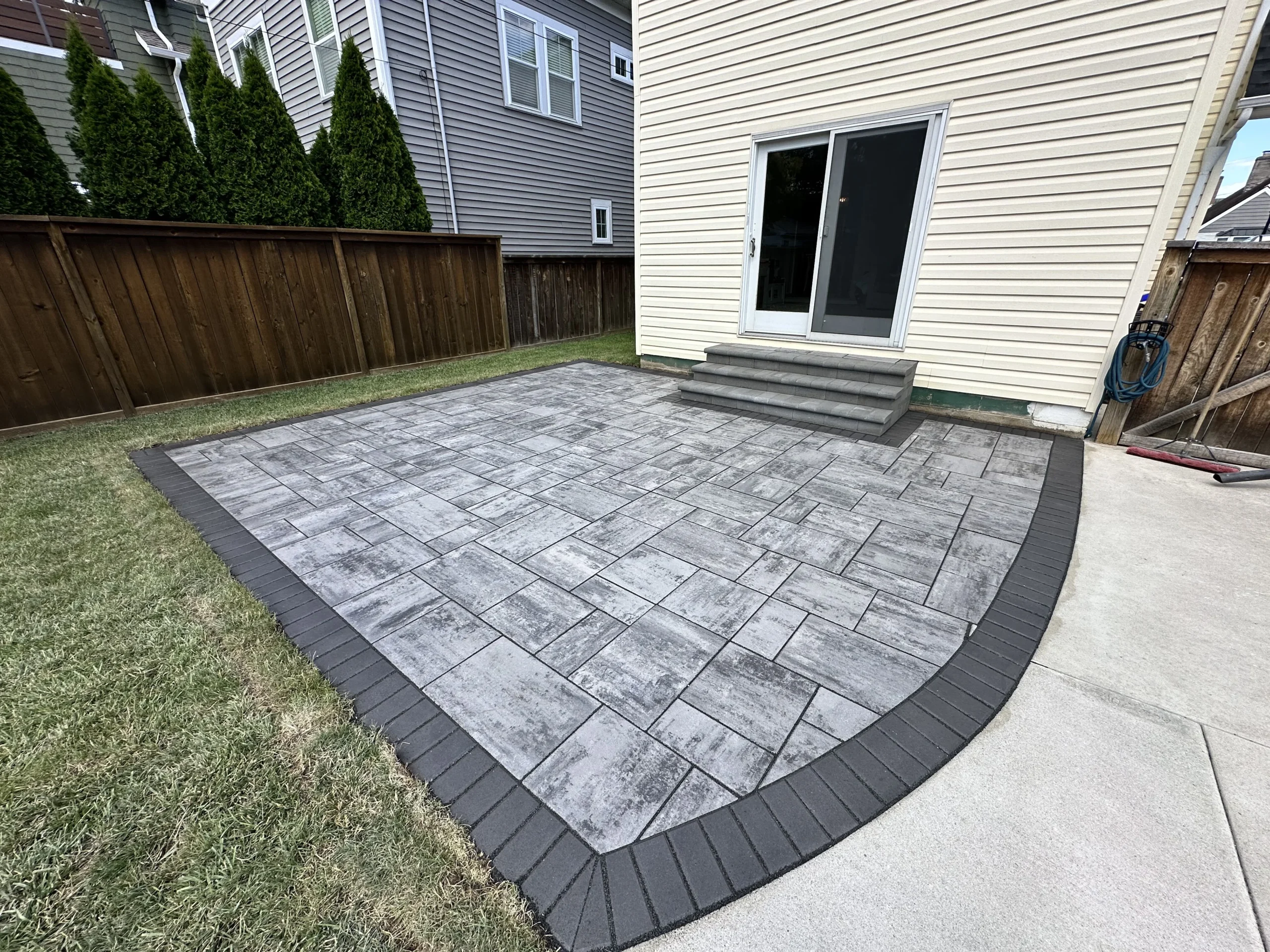
Here is the tier that confuses everyone who has not worked it. The square footage is often smaller than a Windward backyard. The scope is often simpler. And the invoice is $13,000 to $22,000 higher than a comparable suburban build. The reason is almost entirely site access.
The Avalon-adjacent luxury townhome infill along Old Milton Parkway and the pockets between North Point Parkway and Haynes Bridge Road have created a dense custom-hardscape demand zone, driven largely by the tech-corridor relocation buyers from Microsoft, CDW, and the other corporate offices that have moved into North Fulton over the last five years. These are homeowners who want the material spec of a Country Club of the South backyard compressed into 600 square feet of usable outdoor space on a zero-lot-line site.
The physical reality of the work is brutal on pricing. No rear yard access. Shared driveways mean no staging area for pallets. Every cubic yard of base stone is hand-barrowed from a street-side dumpster delivery. A standard 800-square-foot install that takes 14 days in Windward will take 22 to 26 days in an Avalon-adjacent townhome because of the access alone. That labor premium is a real 18 to 24 percent adder on top of the base build number, and it shows up in every line item — demolition, base prep, paver set, and cleanup.
Material-wise, this tier almost always specifies the premium end: large-format Techo-Bloc Blu Grande 60mm or imported travertine with thermal-finish coping, integrated LED strip lighting along retaining walls, and specialty fire features (linear gas troughs or hammered-finish bowls) that run $4,800 to $7,500 installed. The owners in this tier tend to have pre-researched the catalog thoroughly — they come in with Pinterest boards and Houzz saves, and they want the specific product on the board, not the best-available substitute.
Tier 4 — Country Club of the South, Hutchinson Farm, White Columns (30022, 30004): $125,000 to $235,000
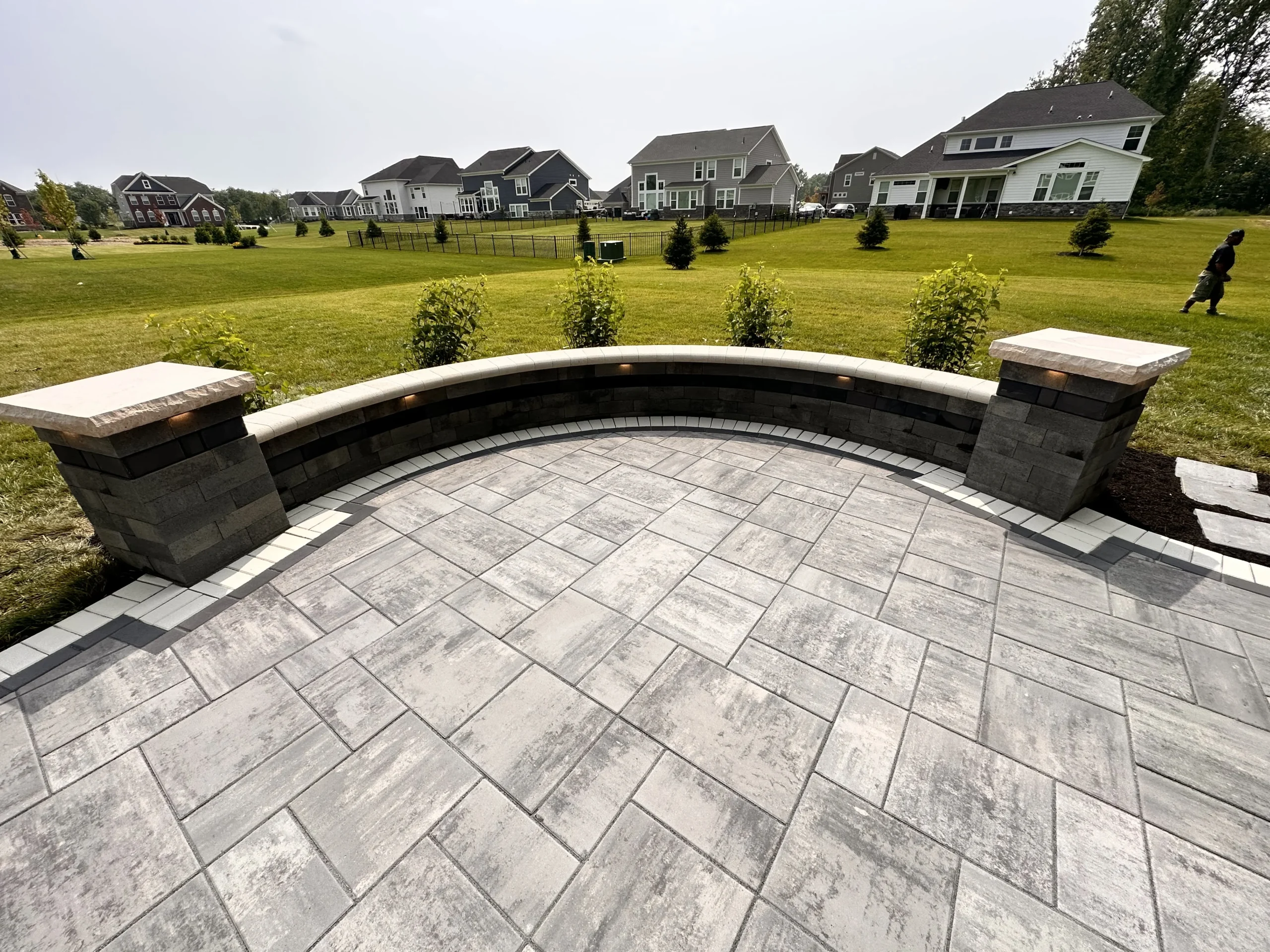
The estate tier operates on different rules. Home values in Country Club of the South range $750K to $3.5M+, and the hardscape scope almost never stays inside the 800-square-foot boundary we used to frame this discussion. What starts as a deck-coping-wall-fire package grows through the ARB approval cycle into something substantially larger — frequently adding a pergola, an outdoor kitchen rough-in, a second retaining tier, a plunge spa, or an irrigation rework of the adjacent landscape beds.
This is the defining feature of the tier: scope does not stay fixed. The Country Club of the South ARB runs a genuine 3 to 4 week architectural review with real revision loops, and each loop tends to add rather than subtract. A homeowner who submits a deck-and-wall plan gets a polite committee note suggesting the back elevation would benefit from a pergola to tie into the house’s existing trim detail, and now the project has a $24,000 to $38,000 cedar or IPE pergola with structural footings that tie into the hardscape base. The same thing happens at Hutchinson Farm and White Columns, where the architectural standards document explicitly favors integrated masonry detailing over bolted-on accessories.
Specialty features are the norm, not the exception. An estate-tier package typically includes 2 to 4 specialty features that a subdivision-tier package rarely sees: a linear gas fire trough on a veneered pedestal, a built-in outdoor kitchen with paver-integrated counter, a pergola with integrated drop-down screens, a raised planter with flush landscape lighting, or a plunge spa with travertine coping tied into the main deck. Each of those features adds $18,000 to $45,000, and they stack.
Material spec is top-shelf and uncompromising. Large-format Techo-Bloc Aberdeen or imported 24×24 travertine in the $14 to $22 per square foot range is standard. Retaining walls are almost always full veneer over CMU or poured concrete — not segmental block — because the ARBs prefer the look of real stone joinery. Coping matches the retaining wall veneer. Lighting is specified at design time and runs on a dedicated low-voltage transformer with zone control, typically adding $6,500 to $12,000 to the base electrical scope.
Why the estate-tier spread is so wide ($125K to $235K): the bottom of the range is the base scope as submitted. The top is what the scope becomes after two to three ARB revision cycles — pergola added, outdoor kitchen roughed in, irrigation rework folded in, second retaining tier added for grade resolution. Budget for the top of the range, not the middle.
Travertine vs Techo-Bloc — The Material Choice That Drives 30% of the Spread
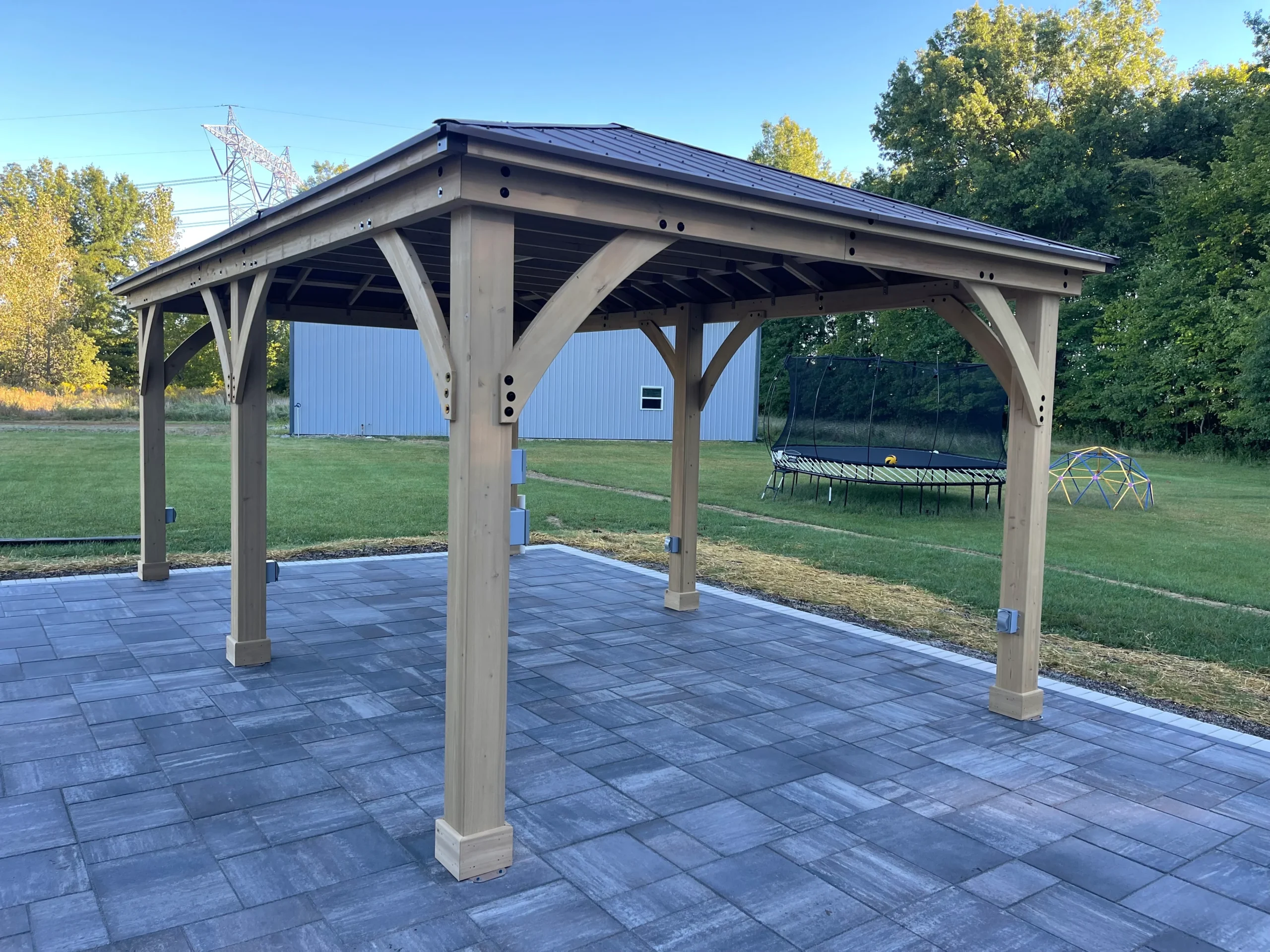
Across all four tiers, the single biggest swing factor inside a given tier is the paver versus natural-stone choice. Roughly 30 percent of the cost variance inside any one tier comes down to whether the homeowner specs a premium concrete paver system or imported travertine.
Concrete paver systems — Techo-Bloc, Belgard, Pavestone at the premium end — run $18 to $28 per installed square foot in Alpharetta right now including base, sand, cut-and-set labor, and polymeric joint sand. Imported travertine runs $26 to $42 per installed square foot for 3cm thermal-finish pavers, with the spread determined by which quarry the material comes from and whether it is gang-sawn or hand-cut edges.
On 800 square feet, that material-level spread alone is $6,400 to $11,200. Stack that on top of the coping choice (travertine bullnose coping runs about $48 per linear foot installed versus $28 for cast concrete coping) and you have a $15,000 to $18,000 swing inside the same tier, on the same footprint, for the same scope. Which is why the tiers we quoted above have 40 percent ranges inside them — the material spec inside a tier is as much of a variable as the tier boundary itself.
Our recommendation by tier: Historic Downtown and the volume subdivision tier usually land best on Techo-Bloc Blu 60 or Blu Grande, which holds up beautifully against Alpharetta’s USDA Zone 8a freeze cycle (roughly 20 freeze events per year) and does not require sealing to keep its color. Avalon-adjacent townhomes and estate-tier builds land best on travertine, partly because the scope usually includes coping and wall veneer that coordinate with the deck, and travertine delivers a single-material cohesion that concrete pavers struggle to match across verticals.
Cecil Clay, Grade Fall, and the Retaining-Wall Cost Nobody Budgets For
The last cost driver that cuts across all four Alpharetta tiers is the one nobody plans for at the first estimate: the Cecil-series Piedmont clay that dominates the soil profile here, and its interaction with grade fall on the ~1,100 ft elevation ridge-and-valley topography along the GA-400 corridor.
Cecil clay has moderate to high shrink-swell behavior. In plain English: it expands when saturated, contracts when dry, and will push a poorly-designed retaining wall out of plumb inside four to six seasons. That is why the retaining-wall line item on every serious Alpharetta hardscape proposal should include a geotextile separator layer, a real drainage course behind the wall (4-inch perforated pipe, clean stone backfill, daylight or dry-well termination), and either geogrid reinforcement every two block courses or a full engineered drawing on walls over 36 inches.
This infrastructure is invisible once the wall is built. It is also where the cost difference between a $140-per-linear-foot retaining wall and a $320-per-linear-foot retaining wall actually lives. Budget hardscape quotes that come in 30 percent under the tier ranges above almost always achieve that by deleting the drainage and reinforcement layer behind the wall. The wall looks identical on day one. It looks crooked in year four.
What to verify in writing: For any retaining wall over 24 inches tall in Cecil clay soils, the contract should specify — in writing, not verbally — a non-woven geotextile separator, 4-inch perforated drain pipe with positive discharge, clean stone backfill to within 6 inches of grade, and geogrid reinforcement spacing (if segmental) or engineered drawing (if over 36 inches). If those four items are not on the line-item scope, the price is not comparable to the tier ranges above.
Quick reference: the four tiers side by side
One practical note on utilities: the Georgia Power / Sawnee EMC boundary runs roughly through the northern Alpharetta/Milton border, and a handful of Windward and Deerfield sub-pockets sit on Sawnee service. The two utilities run different inspection calendars, and scheduling a service-drop relocation with Sawnee on a hardscape that requires it can add 2 to 3 weeks compared to Georgia Power. Verify the meter sticker before the install scheduling conversation, not after.
Hardscape design and construction across 20+ cities within 30 miles of Winder, GA
From Historic Downtown Alpharetta to Country Club of the South, we scope every hardscape package to the specific site, soil, and ARB realities of the neighborhood — not a one-size invoice.