
Everyone tells you a good retaining wall lasts a lifetime. In Forsyth County, the honest truth is that roughly four out of ten of them don’t make it past the third winter — and the reason has almost nothing to do with the blocks on the surface and almost everything to do with the geogrid that was never installed underneath.
This is not a sales pitch dressed up as a warning. We repair these walls. We tear them out, we rebuild them, and we watch the same pattern repeat across Coal Mountain, Bethelview, Shady Grove, Shiloh, and every newer subdivision clinging to the ridgelines along Hwy 369. A homeowner saved $1,800 on a $14,000 wall. Three winters later they’re writing a $28,000 check to rebuild it — not including the replanting, the fence damage, or the deck that tilted when the soil behind the wall let go.
Forsyth County is the fastest-growing county in Georgia, and it has been for a decade. The permit office is processing more than 200 pool permits per year, plus the hardscape work that piggybacks on them. Rough-inspection volume is staggering. Inspectors, by the math alone, catch maybe 40 percent of geogrid violations. The rest go in the ground, get backfilled, and start their silent countdown.
We wrote this for the homeowner who’s about to sign a contract in 30040, 30041, or 30028 and doesn’t want to be the one paying twice. The forensic details that follow are drawn from the last six years of repair work on our side of GA-400 — they are specific, they are verifiable, and they will tell you exactly what to ask a contractor before you write a deposit check.
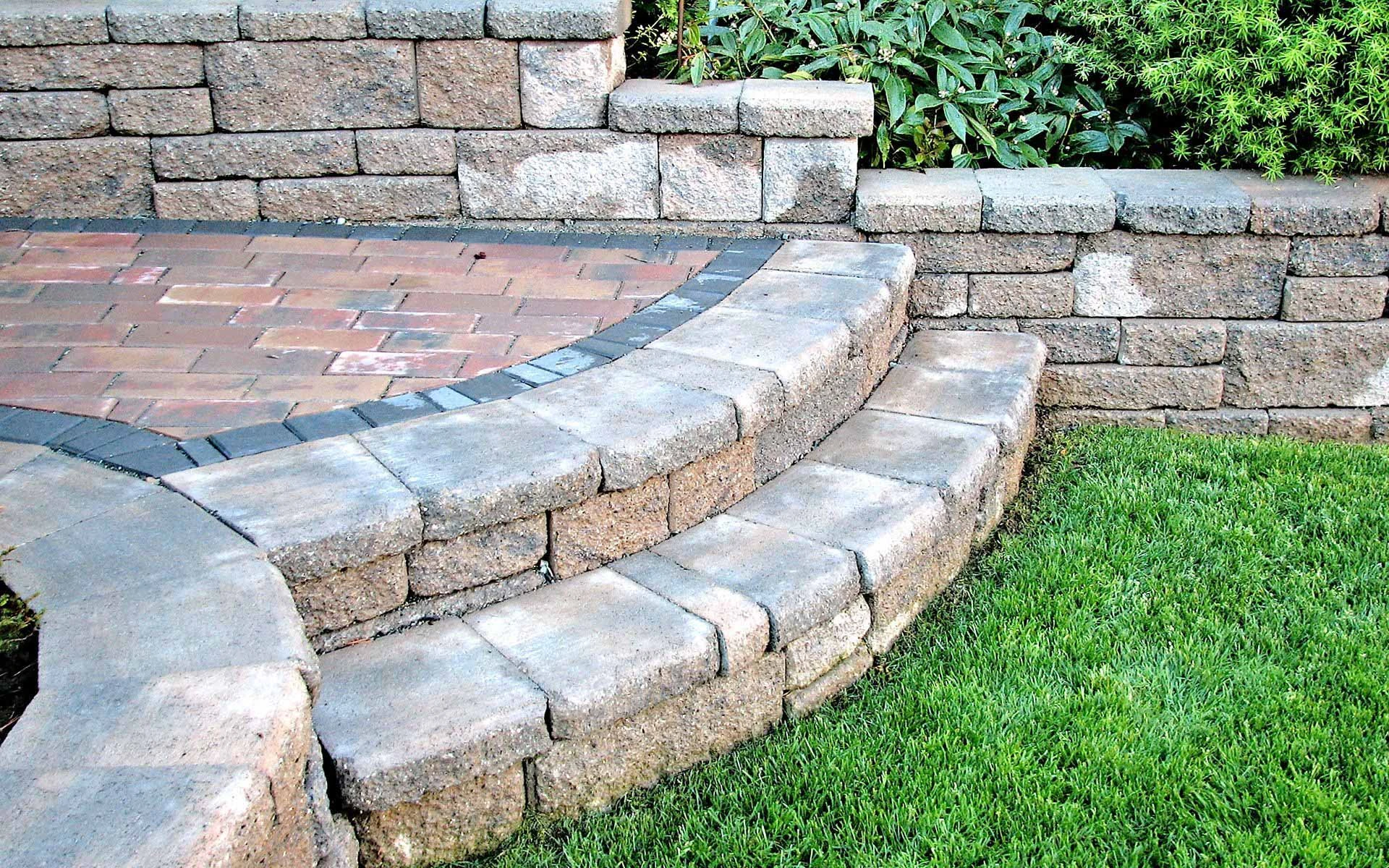
What Geogrid Actually Does, and Why Forsyth’s Soil Demands It
Geogrid is a woven polyester or polypropylene mesh laid in horizontal sheets between courses of block. It extends back into the compacted soil behind the wall — typically 4 to 8 feet, depending on wall height and load — and ties the soil mass and the wall face into a single reinforced structure. Without it, a segmental block wall is just gravity stacked against clay. With it, the soil itself becomes part of the wall.
This matters in Forsyth County specifically because of what sits under your yard. The dominant series here is Cecil clay, a Piedmont residual soil that runs red to orange-brown, holds moisture aggressively, and expands roughly 6 to 9 percent in volume between bone-dry summer and saturated late-winter conditions. Up toward Coal Mountain and along the ridgelines running east from Sawnee Mountain, you’ll hit rockier pockets and sandy loam mixed with saprolite — still problematic, just in different ways. Down near the Big Creek corridor and the Lake Lanier south shore, the clay runs deeper and wetter, with groundwater often within three feet of grade.
Now add the climate. We sit in USDA Zone 8a with roughly 22 freeze events per year. Lake Lanier moisture keeps the south shore humid longer into fall than the rest of the county. Every freeze event that catches saturated clay behind a wall causes a small expansion. Every thaw causes a small collapse. Multiply that by three winters and you have 66 freeze-thaw cycles pushing horizontally against your wall. If the soil mass behind the wall isn’t tied into the wall face, it moves independently. And when it moves independently, the wall loses first.
The $1,200 Save That Becomes a $28,000 Rebuild
The math is unforgiving and it’s also why this keeps happening. On a standard 4-foot-tall, 50-foot-long segmental block wall — the kind we see behind pool decks in Shoal Creek or terracing backyards off Kelly Mill Rd — the material cost of proper geogrid installation breaks down roughly as follows: three courses of Mirafi 3XT or Tensar UX1400 at $180 per 150-foot roll, an extra 8 to 12 yards of compacted granular backfill instead of native clay, and two additional days of labor to install in 8-inch lifts with a plate compactor. Total add-on: $1,200 to $2,800 on a $14,000 to $22,000 wall.
That’s the save. Here’s the rebuild.
When that same wall fails in year 3 to year 6 — and they overwhelmingly fail in that window — the rebuild is not just the wall. It’s demolition of the failed wall (two days, plus dump fees for block that can rarely be reused because the faces are chipped and the pins are bent). It’s excavation back to undisturbed soil, which often means deeper and wider than the original cut because the soil behind has slumped forward. It’s the geogrid that should have been there the first time. It’s replacement backfill, because the soil behind the wall is now a mix of clay, sediment, irrigation residue, and whatever landscape plantings grew into it. It’s new block, new pins, new cap. And it’s everything the wall was holding up — pool deck sections that have cracked at the expansion joints, turf that has pulled away, fence posts that have tilted, irrigation lines that have sheared, drain tile that has crushed.
Real numbers from three rebuilds we completed in Forsyth County in the last 18 months: $14,800, $22,400, and $38,200. The $38,200 was an 80-foot wall behind a pool in Shady Grove where the failure cracked a travertine deck, dislodged a Pentair skimmer, and took out 40 feet of aluminum fence. The original wall had cost $18,500. The homeowner had “saved” $2,200 by declining geogrid.
The contractor question that exposes the shortcut: Ask for the specific geogrid product, the embedment depth per course, and the backfill specification in writing. If the contract says “engineered wall system” or “industry standard reinforcement” without a product name, a depth, and a fill spec, there is no geogrid in that scope.
How the Forsyth County Permit System Lets It Happen
The Forsyth County Planning & Community Development office processes an enormous hardscape and pool permit volume — roughly 200 pool permits and several hundred related hardscape permits per year, concentrated heavily in the warmer months. Rough inspection is where geogrid is supposed to be verified. The problem is timing and sequencing.
A segmental wall in Forsyth gets inspected at two points under the standard permit track: footing/base prep and final. The base-prep inspection is straightforward — the inspector looks at excavation depth, base material type, compaction, and the first course of block. Geogrid is not installed at that stage. It goes in between courses as the wall goes up, which happens entirely between inspections. By the time the final inspection occurs, the geogrid is buried under backfill and the wall is capped. The inspector sees a finished wall. There is no way to verify from the outside whether geogrid was installed or skipped.
Honest inspectors will ask for photographs. Some will. Most won’t have the bandwidth given the permit volume, and the spec sheet submitted with the permit application rarely gets cross-checked against the finished build. The result is that a contractor can submit a permit specifying Tensar UX1400 geogrid at every second course, install none of it, and pass final inspection. The only people who catch it are the ones who dig the wall up three years later.
This is not a criticism of the inspectors. It is a structural weakness of inspecting buried work after it has been buried. In counties with lower volume — Dawson to the north, parts of Hall — inspectors sometimes ask for wall-in-progress photos. Forsyth’s volume doesn’t allow for that consistently.
Five Visual Tells That a Wall Was Built Without Geogrid
If you already have a wall and you want to know whether you should be worried, walk it slowly on a cool morning after a wet week. Here is what to look for, in order of severity.
Course misalignment running horizontally along a specific row. Proper geogrid forces the wall to move as one unit. Without it, the upper courses migrate forward faster than the lower ones because the pressure gradient is highest at the top of the loaded zone. You’ll see a horizontal line where every block above has slid forward by a quarter-inch to a full inch — usually at the third or fourth course from the top. Run a straightedge along a single course. If the top three courses are ahead of the bottom three by more than 3/8″, you have the beginning of a rotational failure.
Bowing visible in the wall face. Stand at one end of the wall and sight down the face horizontally. A wall that was built without geogrid and has been through a couple freeze-thaw seasons will develop a slight belly at the midpoint of each panel between end-posts or steps. The block faces are designed to be self-aligning, so any bow you can see with the naked eye is significant — it means the reinforcing system has failed or never existed.
Separated vertical joints widening from top to bottom. In a correctly built wall, the vertical joints between blocks stay tight as the wall ages. In a wall without geogrid, the joints open as the soil mass rotates, and they open more at the top than the bottom because that’s where the displacement is greatest. A joint that’s 1/8″ at the base and 5/8″ at the cap is telling you the wall is pivoting forward.
Soil cracks parallel to the wall, 2 to 6 feet behind it. Walk the ground behind the wall in August when the soil is dry. Look for hairline cracks running parallel to the wall face at a distance of roughly 2/3 of the wall height behind it. That crack is the failure plane of the soil wedge trying to rotate forward. It is the most diagnostic visual tell. It means the wall is already losing, just slowly.
Standing water or efflorescence at the base. Walls without geogrid almost always skip proper drainage too — the two shortcuts travel together. If the base of your wall has white mineral staining, perpetual dampness, or moss growth on the face of the lowest course, the backfill is holding water. Saturated clay behind a wall without geogrid is a fast-track to rotational failure within one freeze season.
The Year-3 to Year-6 Failure Window, and Why It Hits Then
We’ve tracked timing on 41 wall rebuilds across Forsyth County since 2020. The failure distribution is startlingly tight: 4 failed in year 2, 11 in year 3, 14 in year 4, 8 in year 5, and 4 in year 6. Outside that window, almost nothing. The reason is cumulative freeze-thaw damage combined with Cecil clay’s moisture memory.
In year 1, a new wall behaves like it was designed to. The backfill is freshly placed, the soil behind is still settling into its original state, and the cohesive strength of Cecil clay masks the absence of geogrid. In year 2, after one full summer of desiccation and one full winter of saturation, the clay has started to redistribute. Visual tells begin to appear, but the wall still functions. By year 3, accumulated freeze-thaw has fatigued the block interlock; by year 4, rotational failure is typically visible at the cap; by year 5 and 6, structural integrity is gone and the wall either has to be rebuilt or it comes down on its own.
Lake Lanier-adjacent properties — anything within roughly a mile of the south shore, especially in the 30041 zip code — tend to fail on the early side of that window because groundwater keeps the backfill saturated year-round. North Forsyth estates up on the ridges around Coal Mountain fail later because drainage is better, but they still fail. Geogrid is the variable. Slope, soil, and water affect timing, not outcome.
What a Correctly Built Forsyth Retaining Wall Actually Looks Like in Section
Here is what should be in the ground if your contractor is doing it right on a 4-foot segmental wall — the most common residential spec in Forsyth County. These are the numbers we build to, and they’re the numbers any legitimate contractor should be willing to put in a contract.
Base preparation. Excavate to a minimum of 24 inches below finished grade at the first course, wider than the wall footprint by at least 18 inches front and back. Remove all organic material. Place a minimum 8-inch compacted base of #57 stone or open-graded aggregate, leveled within 1/8″ across the length of the wall. Compact in two 4-inch lifts with a reversible plate compactor. The first course of block sits directly on this base, half-buried below finished grade.
Geogrid placement. A uniaxial geogrid such as Tensar UX1400 MSE or Mirafi 3XT is placed between every second course on a 4-foot wall, extending a minimum of 4 feet back into the reinforced zone and pinned at the wall face. On taller walls (5 to 6 feet) we go to every course with deeper embedment. The grid is pulled taut before backfilling, never laid slack. Backfill goes on top of each grid course in 8-inch lifts, each lift compacted before the next.
Backfill specification. The first 12 inches behind the wall face is drainage aggregate — typically #57 stone wrapped in non-woven geotextile filter fabric. Behind that, granular structural fill (not native Cecil clay) compacted to 95 percent standard Proctor density in 8-inch lifts. A 4-inch perforated drain tile wrapped in fabric runs along the base of the wall, daylighting to a positive outlet at the low end.
Cap and finish. The cap course is adhered with a polyurethane masonry adhesive rated for exterior freeze-thaw exposure. The wall is backfilled to finished grade with a minimum 2 percent slope away from the wall for the first 3 feet, to keep surface water from entering the reinforced zone.
Spec language we use in contracts: “Reinforcement: Tensar UX1400 MSE geogrid, 4′-0″ minimum embedment, placed between courses 1–2, 3–4, and 5–6. Backfill: ASTM D2940 granular structural fill, compacted to 95% standard Proctor per ASTM D698, in 8″ lifts. Drainage: 4″ perforated HDPE tile wrapped in Mirafi 140N filter fabric, 12″ of #57 stone chimney drain behind wall face.”
How to Hire in Forsyth County Without Getting Caught Twice
The contractor market in Forsyth County reflects the growth: there are excellent builders, there are good builders, and there are builders whose primary skill is underbidding everyone else by exactly the cost of the geogrid. The buyer’s task is to separate the three in a 20-minute conversation. Here is how we’d do it if we were the homeowner.
Ask for the grid product by name, embedment by course, and backfill by spec. A contractor who builds properly will answer in 15 seconds because those numbers are second nature. A contractor who skips geogrid will either change the subject, talk generally about “engineered systems,” or quote a figure that isn’t a real product.
Ask for progress photographs. Require, as a line item in the contract, photographic documentation of the base preparation, each grid course as it’s installed, and the backfill before the next lift. This is not insulting. It is standard commercial practice. A builder who refuses is telling you something important.
Ask what happens if the wall fails in year 4. The honest answer names a warranty term, a product warranty (most grids carry 75- to 100-year material warranties from the manufacturer), and a labor warranty. Walls built correctly in Forsyth’s soil and climate last well over 30 years. There is no technical reason for a wall to carry only a one-year warranty.
Look at their walls that are 5+ years old. New walls all look the same. Walls that survived the year-3-to-year-6 failure window don’t. Ask to see two or three addresses in Shady Grove, Brookwood, Ducktown, or Bethelview — anywhere with Cecil clay and a full complement of freeze-thaw cycles — and drive past them yourself. Apply the five visual tells from earlier in this post. If the walls are tight, level, and dry at the base after five seasons, the builder is building them right.
Trust the estimate that’s $2,500 higher. On a $20,000 wall, the contractor quoting $17,500 is almost always the one planning to skip reinforcement. The contractor quoting $20,500 with a detailed grid-and-backfill spec is almost always the one building it to last. The $3,000 delta is the geogrid, the granular fill, and the extra day of labor. It is the single highest-ROI decision a Forsyth County homeowner makes on a hardscape project.
Forsyth County’s growth has brought 260,000 residents across 247 square miles, and it has brought a hardscape market operating at a volume that outstrips the inspection system. That means the verification burden sits with the homeowner now, not the county. The tools to carry it — the questions, the specs, the warranty language, the visual tells — are all public. You just have to ask for them before you sign the deposit check, not after the wall fails.
The final point, and the one we’ll repeat: rebuild cost is five to fifteen times original-save cost, every single time we’ve measured it. The math never works. It has never worked. The only winning move is to reinforce the first time.
Hardscape design & construction across 20+ cities within 30 miles of Winder, GA
Engineered retaining walls, tiered terraces, and pool-integrated hardscape built to outlast Forsyth County’s Cecil clay and freeze-thaw cycles — reinforced the first time, documented in the contract, built to specification.