
A homeowner on Sycamore Ridge emailed us with a question that arrives almost weekly by late summer: “We want a firepit off the back patio — gas or wood-burning? My wife wants the smell, I want it to turn on with a key. What’s the real tradeoff in Dacula?” The answer isn’t preference. It’s code, prevailing wind, and how many nights per year you’ll actually sit out there with a drink.
That question is the framing for this whole post. We’ll treat it as a running Q&A — the same way we walk through it in a client’s backyard before we ever price the job. The upgrade from a portable steel bowl to a permanent installation is where Dacula homeowners quietly spend $1,000 to $3,400, get surprised by Gwinnett County’s burn-ban calendar, or put a wood firepit ten feet upwind of their screened porch and regret it by the second cookout.
By the end of this post you’ll know what each fire feature actually costs in Dacula, what Gwinnett County will and won’t allow on a residential lot, how Hamilton Mill’s HOA written-approval rule changes the timeline, and which fire media survives the Piedmont humidity cycle versus the media that explodes the first time you light it.
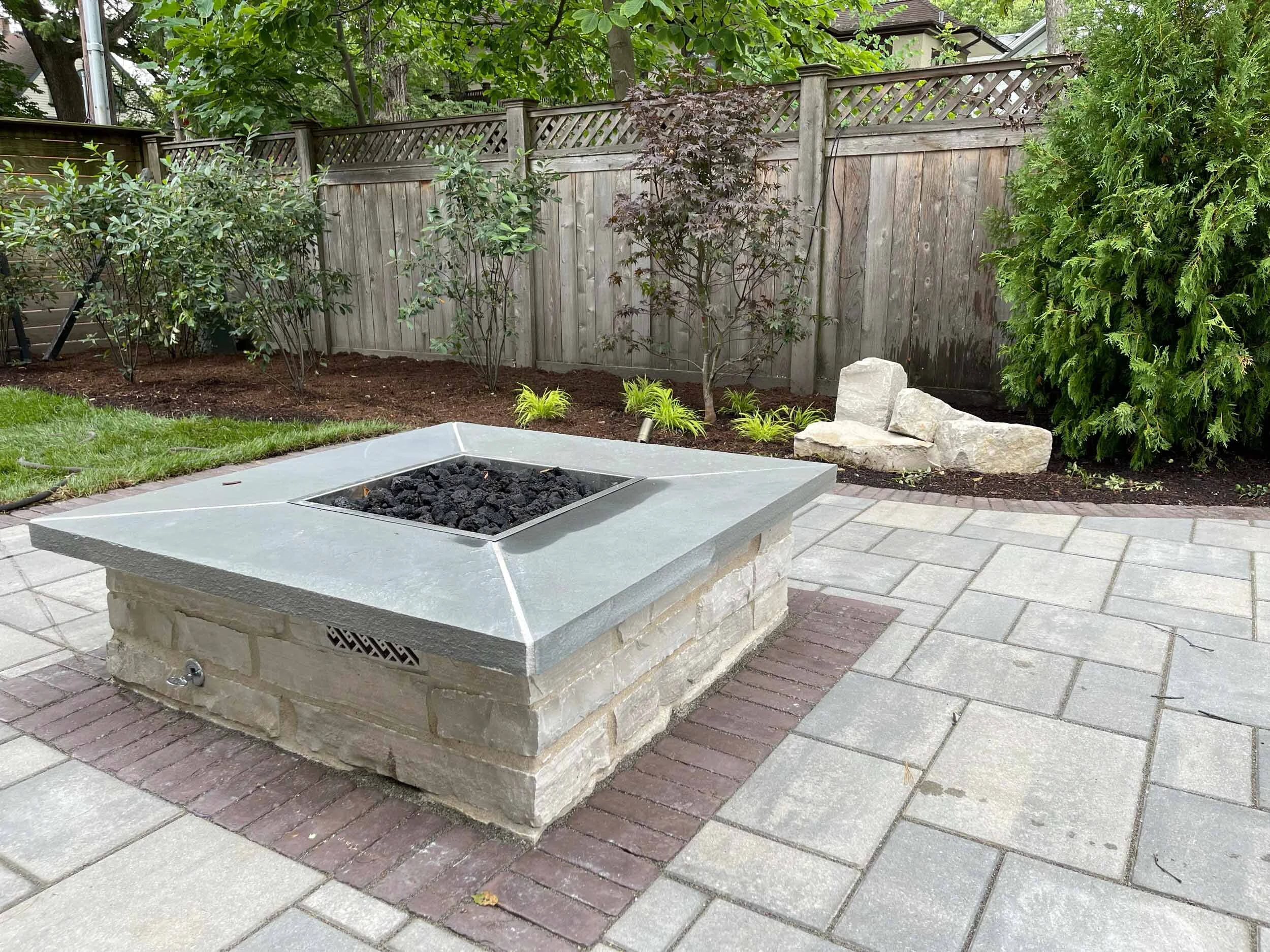
Q&A: The Decision That Actually Matters — Convenience or Smell?
We keep flipping between gas and wood. What’s the one question that makes the answer obvious?
How many nights per year will you use it? If the answer is more than twelve, go gas. If it’s six or fewer, go wood.
Gas isn’t “better.” Wood isn’t “more authentic.” Both fire features do the same job — produce heat and a focal point — but they ask a very different price in setup time. A gas firepit turns on with a key or a switch in about four seconds. A wood firepit takes fifteen to twenty-five minutes to build heat, another ten to settle into usable coals, and roughly forty minutes of cleanup the next morning if you want the paver joints to stay clean.
That time cost is invisible when you imagine yourself using it. It becomes the entire conversation once you own it. We’ve watched $12,000 wood fireplaces in Hamilton Mill sit cold for two years because the homeowner never had energy after work to split kindling and wait out the smoke phase. We’ve also watched gas firepits in Providence Club run four or five nights a week through October and November because the barrier to ignition is zero.
If you have small kids and want a ten-minute marshmallow session on a school night, gas wins. If your weekend ritual is already a three-hour outdoor project and you’d enjoy tending a fire for its own sake, wood becomes the better pick. The rest of this post is the cost and code detail underneath that single decision.
Cost, Side by Side — What Dacula Homeowners Actually Pay
Price is where the two fire features split the hardest. These are the installed-and-finished numbers we quote for Dacula projects in 2026, assuming a permanent build (not a portable steel bowl) with proper base prep over Piedmont clay.
$1,800 – $3,400 installed
Included: stainless steel burner ring, gas valve and key-valve shutoff, fire media (glass or lava rock), paver or stone surround, ignition method.
Gas line: 1/2″ supply line sized for 65,000–120,000 BTU burner rating.
Fuel source: natural gas tap from the house meter, or a dedicated propane tank buried or screened nearby.
Recurring cost: roughly $8–$18 a month in gas during heavy use season.
$800 – $1,800 installed
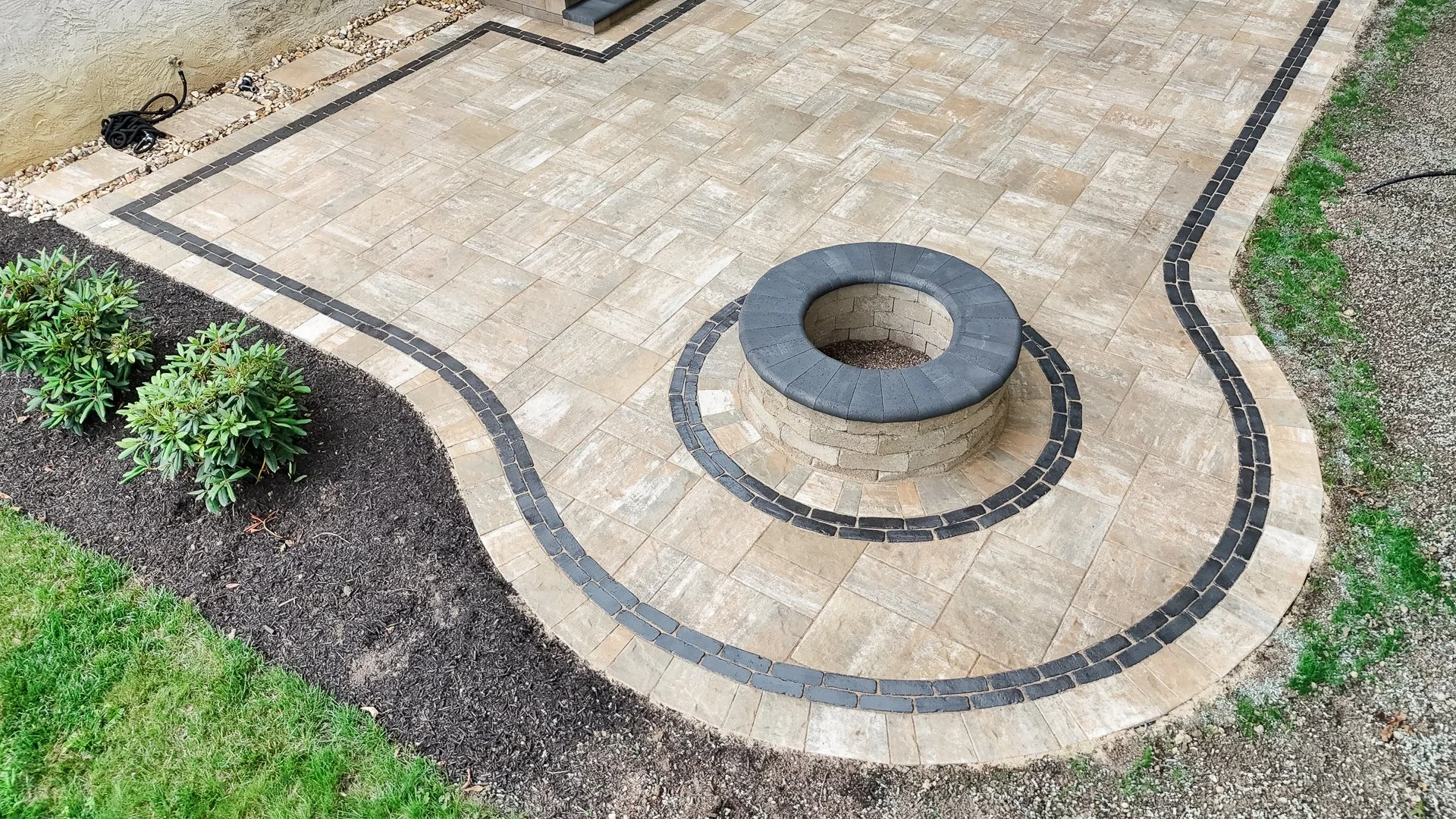
Included: raw steel fire ring or CMU block form, stone or paver surround, drainage base, no gas supply.
Gas line: none required.
Fuel source: seasoned hardwood — oak, hickory, pecan. Expect $60–$120 per quarter-cord delivered in Gwinnett.
Recurring cost: firewood plus roughly one hour of ash removal and cleanup per three uses.
The sticker-price gap looks like $1,000 — and that’s what catches homeowners off guard. The real cost isn’t the firepit. It’s the gas service. If your Dacula home already has a natural gas meter with spare capacity, running a 1/2″ supply line thirty or forty feet to the firepit adds $600 to $1,200 depending on trench length and whether we’re boring under an existing patio. If you’re on propane, the dedicated tank and regulator add another $700 to $1,400.
Flip the comparison around. A $1,500 wood firepit with a $120 annual firewood budget costs you $1,620 the first year. A $2,800 gas firepit with $150 in gas costs you $2,950. By year five, the gas setup totals $3,550 and the wood is $2,100. On pure cash, wood wins. On cash-per-hour-of-actual-use — the number that matters — gas wins because it gets used three to five times more often.
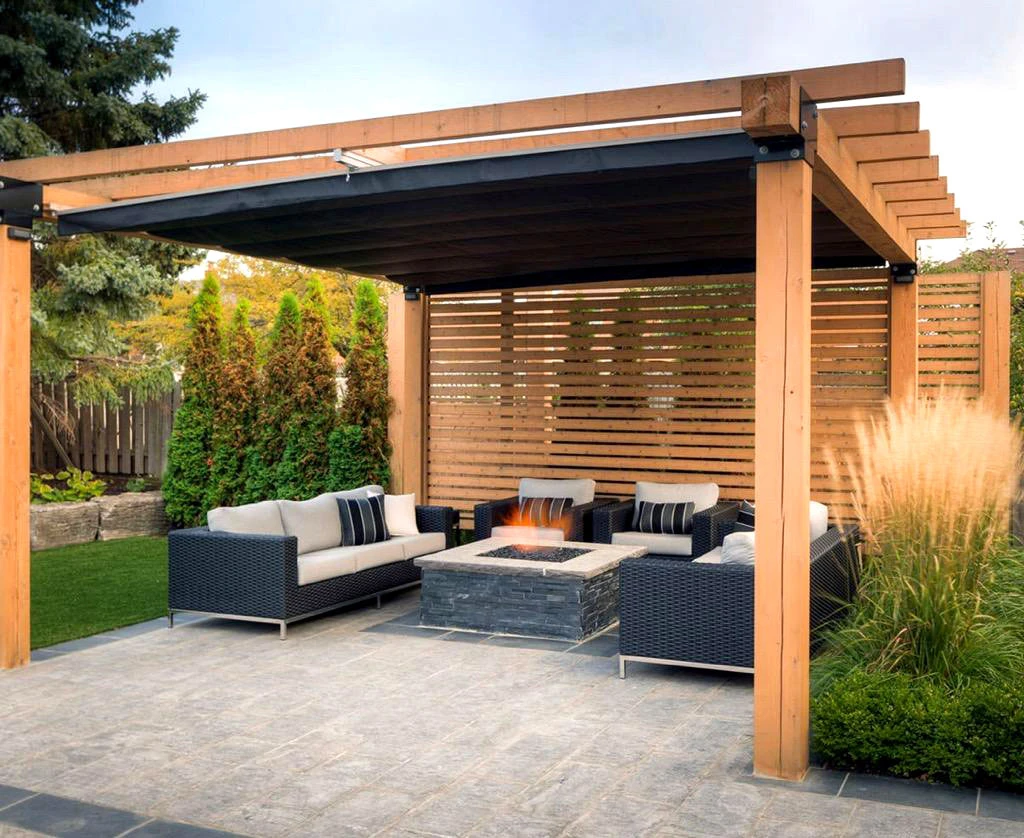
Budget rule we give every Dacula client: if the gas-line run is less than 25 feet and you already have a natural-gas-fed home, gas comes in under $3,000 all-in. If the run is over 40 feet or requires trenching under an existing patio, add $800–$1,400 to the quote before you compare to wood.
Q&A: What Does Gwinnett County Code Actually Say?
Does Gwinnett County even allow an open-flame firepit in a residential backyard? My neighbor said you need a permit and the fire marshal has to inspect it.
Gwinnett County allows residential open-flame fire features on single-family lots. A portable wood firepit under three feet in diameter generally doesn’t require a permit. A permanent masonry fireplace with a gas line always does. Your HOA is usually stricter than the county.
The rules get cleaner once you separate the two jurisdictions. Gwinnett County Dept. of Planning & Development at 446 W. Crogan St. in Lawrenceville handles the permit side. The county’s open-burning ordinance handles the fuel side. Then the HOA — if you have one — writes whatever rules it wants on top of county code.
For wood-burning firepits, the county’s position is straightforward: residential recreational fires are legal as long as they’re contained in an approved structure (fire ring, masonry pit, chiminea), are a safe distance from structures, and aren’t burning materials other than seasoned wood. A portable unit doesn’t require a permit. A permanent masonry pit does.
For gas firepits, the county requires a mechanical permit when we run a new gas line from the meter, and a building permit when the firepit is a permanent masonry structure. If your home is already plumbed for gas and we’re adding a capped stub during your patio build, we file both permits as part of the hardscape job and the inspection happens before the pavers go down over the line.
The part that catches Dacula homeowners sideways is the burn ban. Gwinnett County prohibits open burning from May 1 through September 30 each year — that’s the state air-quality season under Georgia EPD rules. During those five months, a wood firepit technically isn’t allowed. Gas firepits are exempt because they’re not classified as “open burning” — they’re a controlled appliance fueled by a gaseous source.
Burn-ban reality check: Gwinnett County bans open burning May 1 through September 30. A wood-burning firepit is legally restricted during Dacula’s entire summer and early-fall pool season. A gas firepit runs year-round with zero ordinance conflict.
That single fact has decided more gas-versus-wood arguments in our client meetings than anything else on this page. If the main use case for the firepit is summer pool nights — and for most Hamilton Mill homeowners with a pool, it is — then wood simply doesn’t serve. You’d be lighting a fire inside a county-wide restriction window and hoping nobody calls it in.
The Hamilton Mill HOA Problem — and What It Requires
Hamilton Mill is the upscale golf-community landmark of Dacula and the neighborhood we field the most fire-feature questions from. The HOA is active, and its architectural review process is the step where fire-feature projects either move forward on time or sit in limbo for three weeks waiting on written approval.
Hamilton Mill’s HOA requires written approval before any permanent fire feature is installed. That means a signed architectural-review form stating the fire feature type, placement on the lot, surround materials, and elevation relative to neighboring property lines. The board reviews applications at scheduled intervals, not on demand, so the approval window tends to run two to four weeks.
The good news: they don’t say no to fire features. They say no to poorly placed ones — particularly wood-burning installations placed within easy smoke-path distance of neighbors’ windows. We’ve had Hamilton Mill homeowners asked to pivot from wood to gas after an initial submission, or to relocate a planned firepit twenty feet farther from a property line, on HOA feedback alone.
Other Dacula neighborhoods — Sycamore Ridge, Chandler Ridge, Providence Club, Ivey Chase, Auburn Park — have lighter HOA processes. Some require only a courtesy notification. A few have no HOA at all for backyard features, particularly the older 1995-era infill lots off Hog Mountain Rd and Harbins Rd. If you’re not sure where your neighborhood falls, the first call before a quote should be to the HOA, not the contractor. The answer reshapes budget and timeline more than any other variable.
Q&A: Setback, Placement, and the Smoke Path Nobody Plans For
How close to the house can the firepit go? Our patio ends ten feet from the back wall and that’s where we want it.
NFPA 1143 sets the minimum at 10 feet from any structure for wood-burning, 5 feet for gas. Your HOA may require more. What you actually want is 12–15 feet for wood and 8–10 feet for gas, because setback is the wrong number to optimize — smoke path is.
Here’s the part people miss. The setback distance keeps heat radiation off the siding and keeps flying embers away from eaves. It doesn’t control where the smoke goes. Smoke goes wherever the prevailing wind takes it. In Dacula, the prevailing wind direction is southwest in summer and northwest in winter. If your patio is on the back of the house and your house faces south, the summer wind pushes smoke straight at your back door. If your screened porch is on the northeast corner, the winter wind loads it with smoke every time you light the pit.
Gas firepits don’t generate meaningful smoke. The smoke-path issue is entirely a wood-burning problem. So when we site a wood firepit in a Dacula backyard, we do two things the homeowner rarely thinks about: we map the dominant wind direction to the seating area and the house openings, and we place the firepit downwind of both. That usually means tucked toward the back corner of the lot, not centered on the patio.
5 ft from structure minimum
8–10 ft is better for heat comfort and keeping tempered media debris clear of seating edges.
No smoke-path calculation needed. Wind direction doesn’t affect the install.
Seating can wrap 270° around the pit safely at 4–5 ft distance.
10 ft from structure minimum
12–15 ft is what we actually install, with 20+ ft from any screened porch or covered outdoor kitchen.
Smoke path matters more than setback. Place downwind of the house and seating area relative to Dacula’s SW summer / NW winter prevailing wind.
Seating should be open on the upwind side so smoke drifts away, not across.
One practical test: stand in your backyard on a day when there’s a light summer breeze. Walk to where you’re considering putting the firepit. Face the direction the wind is coming from. Now imagine everything downwind of you is catching smoke for three hours. If that downwind zone includes your patio furniture, your neighbor’s open windows, or your own back door, the location is wrong regardless of how it looks on a site plan.
This is also where Dacula’s lot sizes interact with fire-feature placement. Many Hamilton Mill lots are half-acre with neighbor houses close on the sides. A wood firepit in the center of that backyard is dumping smoke onto a neighbor’s property eight months a year. Gas sidesteps the problem entirely.
Fire Media — Glass vs. Lava Rock vs. River Rock (Gas Only)
This section only applies to gas firepits. Wood firepits burn wood. Gas firepits burn through a bed of non-combustible media that conceals the burner and distributes the flame pattern. There are three common options, and one of them will hurt you if you pick it wrong.
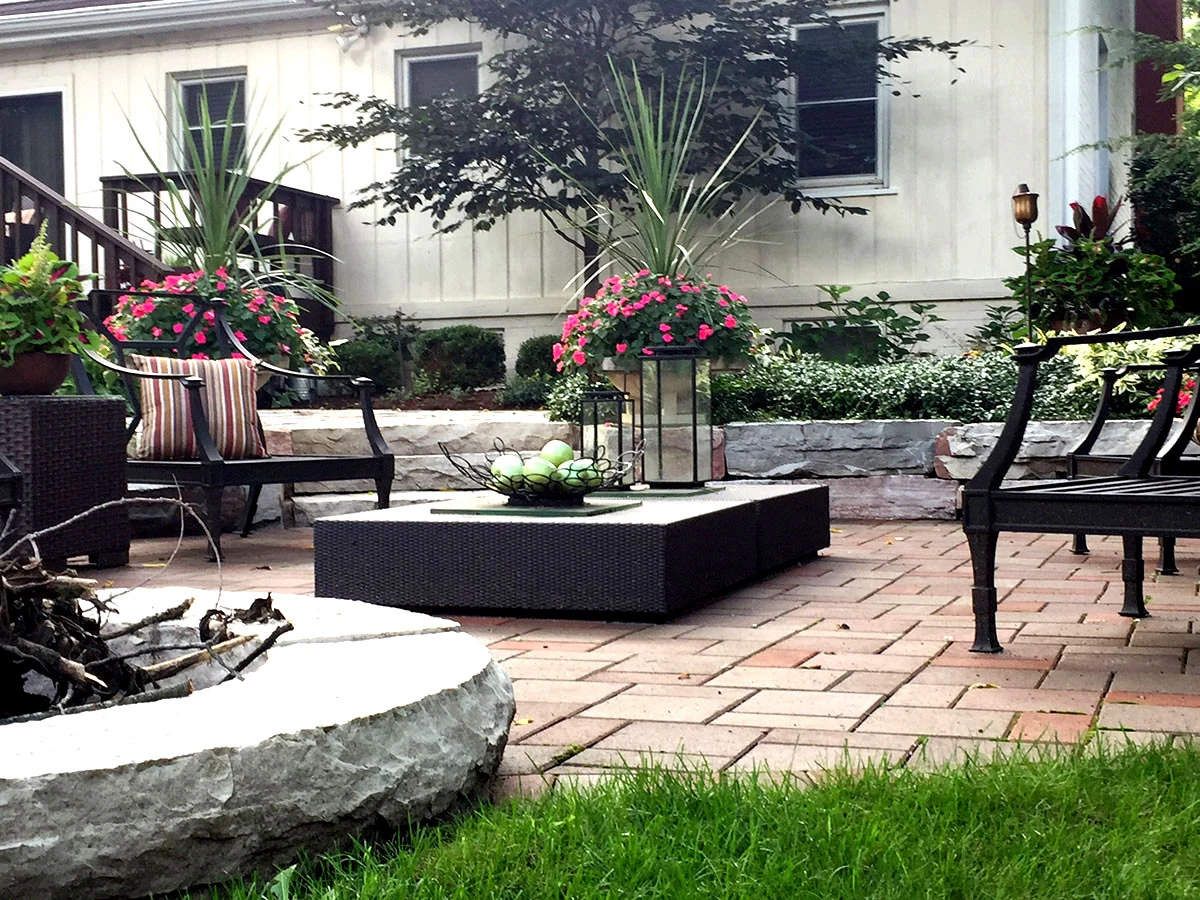
$45–$80 per 10 lbs
Tempered, reflective, color-customizable (cobalt, copper, bronze, clear).
Lasts 10+ years without replacement — the longest-lived option.
Best look at night — the flame reflects through the glass and picks up its color.
Our default recommendation for 90% of Dacula gas firepit builds.
$12–$18 per 10 lbs
Natural volcanic stone, porous, absorbs and releases heat slowly.
Replace every 2 years in Dacula’s humidity — the pores hold moisture and the rock cracks during thermal cycles.
More rustic look, flatter flame profile than glass.
Cheaper up front, more expensive over a decade of ownership.
The third option — and the one that causes the most damage — is standard river rock from a landscape yard. Do not use it. River rock picks up groundwater over time and holds moisture inside the stone. When a gas burner heats that rock from 70°F to 900°F in a few minutes, the trapped moisture flashes to steam inside the stone and the rock explodes. We’ve seen river-rock fragments thrown 15 feet from a DIY gas pit in Dacula. It’s not theoretical.
If you want the look of river rock on a gas firepit, you buy fire-rated river rock — the same stone source, kiln-dried to remove internal moisture and certified for fire use. It costs about three times as much as landscape-yard rock and it’s worth every dollar. Some homeowners still pick landscape rock to save money. They get a burn scar, a cracked pit, or a glass table shattered by a flying fragment.
For a Dacula build over Piedmont clay soil and high summer humidity, our default media recommendation is tempered fire glass for 90% of gas firepits. The only exceptions are rustic-style builds where lava rock fits the design language of the surround, and those clients get told about the two-year replacement cycle before they sign the proposal.
Which One Is Right for Your Dacula Backyard? — The Honest Filter
After 250 fire-feature conversations across Dacula, Hamilton Mill, and the surrounding Gwinnett County neighborhoods, we’ve gotten the decision down to four filter questions. Answer them honestly and the gas-versus-wood call makes itself.
- Will you use it more than twelve nights a year? If yes, gas. The convenience delta makes it happen. If no, wood.
- Is the primary use case pool season (May–September)? If yes, gas. Gwinnett County’s burn ban makes wood a five-month legal problem.
- Do you live in Hamilton Mill or another active-HOA neighborhood with neighbors within 30 feet of the planned pit location? If yes, gas. Smoke-path and HOA objections usually force the switch anyway.
- Is tending a fire part of the appeal, or is it the part you’d skip? If tending is the appeal, wood. If you’d skip it, gas.
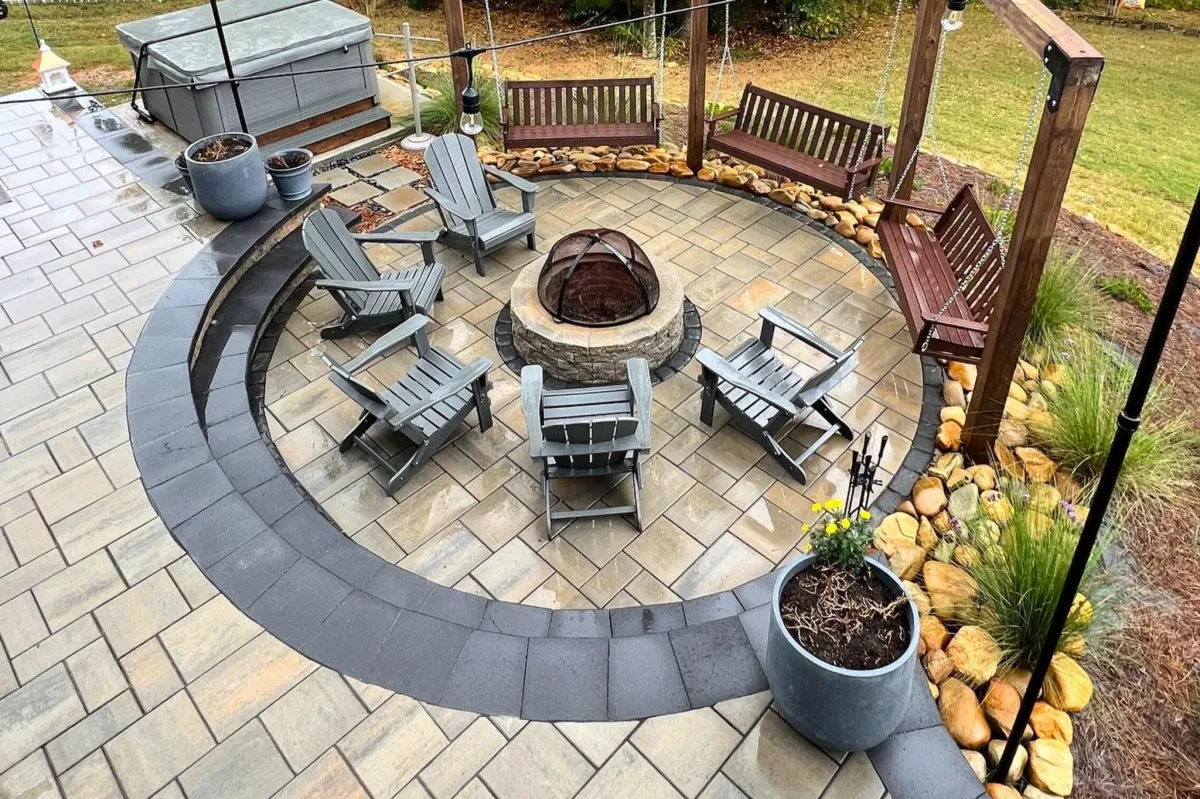
Roughly 70% of the Dacula fire features we install are gas. Ten years ago that number was closer to 50/50. What shifted wasn’t aesthetics — it was the burn ban becoming a bigger factor, the rising cost of good firewood, and honest conversations with clients about how often they actually sit outside on a Tuesday in October with a dying fire.
The remaining 30% who go wood are specific. They have open lots with no neighbors close by. They enjoy the process of building a fire. They use the firepit mostly in the October-through-April window when the burn ban is lifted. They usually have an outdoor lifestyle already built around weekend time outside rather than weeknight convenience. Wood works beautifully for those homeowners and we build it gladly.
What we don’t do is sell a wood firepit to a family with young kids, a screened porch on the downwind corner, and plans to use it mainly in July. We’ve watched that build sit unused too many times. If that’s your profile and you hear a contractor quote wood without asking about your prevailing wind direction or your HOA’s fire-feature policy, ask harder questions before you sign.
Can we do both — a gas firepit on the patio and a small wood one farther back for the fall?
Yes, and it’s the best answer for Dacula homeowners who can afford it. A $2,800 gas pit on the patio for year-round convenience and a $900 wood pit at the far corner of the lot for October weekends. Different tools, different jobs. We’ve built this combo on four Hamilton Mill projects in the last eighteen months.
If you’ve read this far, you’ve done more research than 80% of Dacula homeowners who hire a contractor on vibes. You know the installed cost ranges, the BTU and gas-line sizing, the NFPA setback minimums, the Gwinnett burn-ban window, the HOA reality, the prevailing-wind smoke-path logic, and the fire-media rules. That’s enough context to have a real conversation with a builder — or to look at a proposal and see whether the person writing it understands Dacula-specific conditions or is working off a generic template.
The best fire feature in Dacula isn’t the one with the biggest flame or the tallest stone surround. It’s the one that gets used four times a week for ten years without fighting the county, the neighbors, or the weather.
Custom firepits and outdoor fireplaces across 20+ cities within 30 miles of Winder, GA
Gas or wood, built with the right setback, the right fire media, and the right Gwinnett County permits in hand — every fire feature we install is sized for how you’ll actually use it, not how it photographs.