
The backyard looks perfect on the day it’s poured. Two inches of rain later, the pavers are holding a lake — and the polymeric sand is washing into the grass. On a 3-6% grade Alpharetta lot, gravity isn’t going to save you. You have to engineer the water out.
If your house sits inside the GA-400 corridor between exits 9 and 12 — Windward Parkway down through Old Milton and Haynes Bridge — there’s a good chance your backyard is noticeably flatter than what a contractor in Milton or Cumming is used to building on. That flat ground is the reason you can put a 1,200-square-foot pool deck behind a four-bedroom house without terracing. It is also the reason ordinary “slope it toward the yard” drainage guidance falls apart on the first real storm.
This post is about what flat-lot hardscape drainage actually looks like when it is engineered for the specific conditions along the GA-400 corridor in Alpharetta, GA. The linear drains. The daylight discharges. The drywell sizing. The paver base assembly. The failure modes that show up in year three or four when someone cut the spec to save a few hundred dollars during the bid. If you are planning a pool deck, paver patio, or outdoor living buildout in 30004, 30005, 30009, or 30022, the details below are the difference between hardscape that looks like year-one photography a decade later and hardscape that’s on a remove-and-replace timeline by 2033.
Why the GA-400 Corridor Drains Differently Than the Rest of North Fulton
Drive north on GA-400 out of Sandy Springs and the topography does something distinct at each exit. Around exit 7 and 8 (Roswell/Holcomb Bridge), you’re still in the rolling hills that define the Chattahoochee River valley — 8-12% grades in the backyards, creek drainages cutting through subdivisions, natural fall every direction. Push north through exits 9, 10, 11, and 12 — North Point, Haynes Bridge, Old Milton, Windward — and the land flattens out onto the Piedmont ridge that sits at roughly 1,100 feet of elevation. Keep going to exit 13 or 14 and you’re climbing again into the Milton/Cumming hills with 10-15% grades back in play.
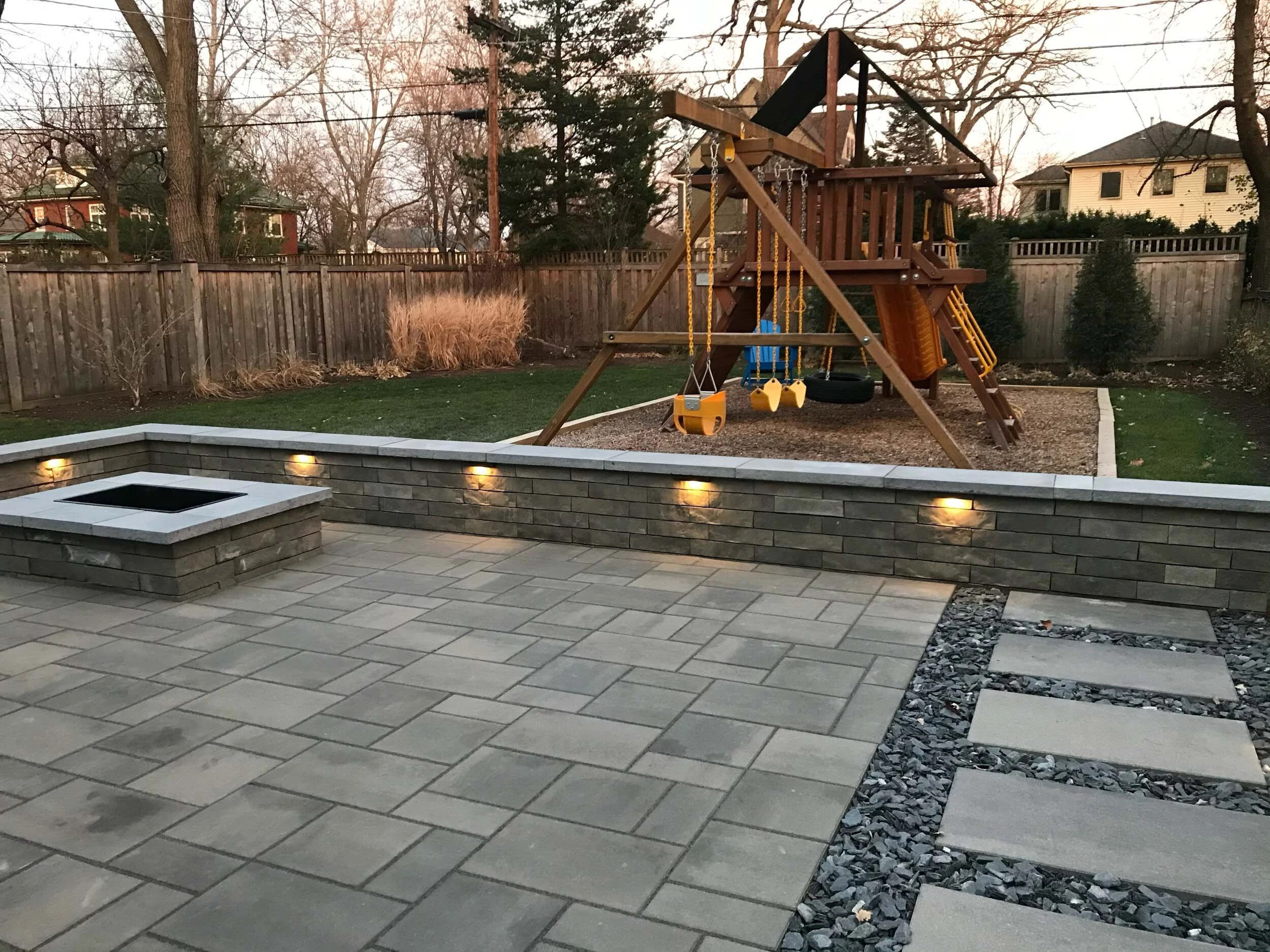
Alpharetta proper sits on that flat middle band. Subdivisions like Windward, Country Club of the South, Hutchinson Farm, Ashebrooke, and Haynes Manor were developed across the 1990s and early 2000s on graded-flat residential tracts where the back-of-house to rear-lot-line fall is often 3-6 feet total across 80-120 feet of yard. That’s 3-6% grade on the outside — and once you subtract the flat pad the house sits on, what’s left behind the house is frequently under 2%. Some Windward lots are essentially dead flat behind the pool pad.
Flat is beautiful for hardscape design. You can build a 1,400-square-foot paver patio with a pool, a raised spa, a covered pavilion, and an outdoor kitchen without a single retaining wall. You can set coping elevation in one plane and run deck drains in straight lines. What you cannot do is let gravity do the drainage work for you. On a Cumming hillside, you pitch the deck 1/4″ per foot toward a fall line and the rain handles itself. On a flat Alpharetta backyard, 1/4″ per foot across 30 feet only creates 7.5 inches of total fall — and if the rear of the lot is lower than the ground beyond the property line, that fall ends in a puddle against a wood fence, not in a swale that carries water to a creek.
What Actually Happens When Flat-Lot Drainage Fails
When a hardscape drainage system is undersized or omitted on a flat Alpharetta lot, the failures follow a predictable calendar. Understanding that calendar is how you underwrite the drainage budget in the first place — because the cost of fixing these problems in year five is not comparable to the cost of engineering them out during the original build.
Year 1, first heavy storm. A 2-inch rain event — not unusual here, given the ~51 inches of annual rainfall Alpharetta receives across an average of 112 wet days — drops somewhere around 1,250 gallons onto a 1,000-square-foot deck. With no linear drain, that water sits on the pavers for 24-72 hours depending on how bad the grade is. The polymeric sand in the joints — the stuff that makes the installation look finished — starts to migrate under standing water. You’ll see thin gray slurry running off the deck edge. That’s your joint sand washing away.
Year 2, persistent efflorescence. Standing water pulls calcium carbonate out of the concrete paver body and deposits it on the surface as white haze. Pressure washing removes it temporarily; it comes back after the next big storm. Once the haze cycle starts, it doesn’t stop until the water stops sitting on the stone.
Year 3, base saturation and edge settling. Water that sheets off the deck edge saturates the compacted base along the outside perimeter. The Cecil-series Piedmont clay underneath — high shrink-swell, notorious for seasonal dimensional change — starts cycling wet-dry with each storm. Pavers at the deck perimeter begin to tilt outward. Joints open. The edge restraint spikes loosen. A once-crisp border turns into a scalloped, uneven lip.
Year 4-5, contract-failure territory. Full base failure. Entire sections of deck need to be pulled up, the base re-graded, re-compacted, and reset. The typical remove-and-replace cost on a 1,000-square-foot travertine or concrete paver deck in Alpharetta runs $18,000 to $34,000 depending on stone replacement and disposal. The drainage system that would have prevented it would have added somewhere in the range of $3,800 to $6,500 to the original build.
The math nobody shows you in the bid meeting: A properly engineered flat-lot drainage system on a 1,000-square-foot hardscape deck adds roughly 4-7% to the total hardscape budget. Omitting it saves you that money for year one. In year five, you pay 300-500% of the savings back to remove and reset the deck — not including the downtime, the access damage to the landscaping, or the pool filter replacement if the pump pulled silt during the flooding event.
The Linear Drain Spec That Works on a 3-6% Alpharetta Grade
The core move on a flat-lot hardscape deck is a linear trench drain running the full perimeter of the hardscape on the low side, tied to a discharge point that either daylights at the rear of the lot or terminates in a sized drywell. There are two drain products we specify depending on context.
NDS Spee-D Channel (3-inch) — a polyolefin modular trench drain with a matching grate system. It comes in 4-foot sections, connects with interlocking tongue-and-groove, and accepts standard 4-inch SCH 40 outlets. It’s our go-to on residential pool decks up to about 1,500 square feet. Depending on grate selection (decorative metal, slotted plastic, or wood-grain composite) the channel sits flush with the paver top and is functionally invisible from four feet back.
Stegmeier Deck-O-Drain trench — a site-formed channel using their pre-cast frame-and-grate system, embedded directly into the concrete bond beam that locks the pool coping. This is the right spec when the pool coping itself is becoming part of the drain channel — which is often what we do on raised-beam pools where the deck steps up to the coping and the water needs to be caught at the step.
The minimum we specify on a flat Alpharetta lot: 80 linear feet of trench drain per 1,000 square feet of hardscape deck. That’s the rule of thumb. In practice, the actual length comes out of a site plan that traces the low-side perimeter of every hardscape surface that collects water — pool deck, patio, outdoor kitchen floor, spa surround, cover-deck transitions. Any flat surface larger than about 80 square feet on its own gets a capture point.
The trench drain itself is only half the system. The other half is what happens to the water once it’s captured.
Discharge: Daylight vs. Drywell on a Flat Lot
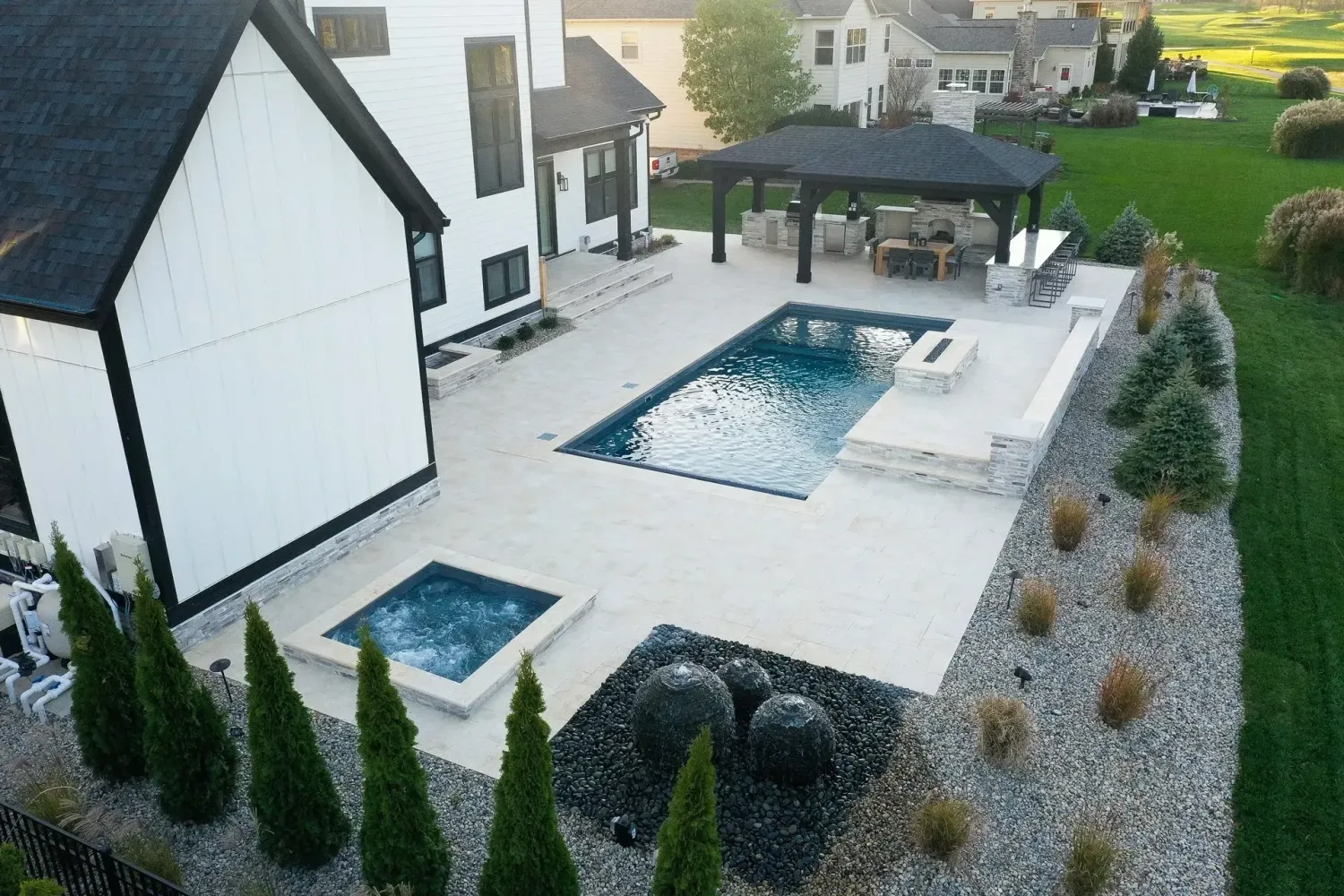
A trench drain that terminates in a pipe going nowhere is a trench drain that fails. Every linear foot of capture has to move to a discharge that can receive the water — and on a flat lot, both of the available options require engineering.
Option 1: Daylight discharge. The drain line exits the back of the property above grade, at a point where the ground beyond falls fast enough to carry the water away without eroding the neighbor’s lot. On the GA-400 corridor, daylight works best on lots that back up to a drainage easement, a neighborhood creek tributary, or a rear detention area — common in Windward and parts of Deerfield where the HOA master plan included rear-lot drainage corridors. Minimum exit pipe: 4-inch SDR-35 or SCH 40 PVC, pitched at 1/8″ per foot minimum from capture to exit.
The problem with daylight discharge on most Alpharetta lots is that there’s nowhere for it to go. The rear lot line often terminates in another flat backyard, or a wood fence, or a HOA green-space buffer that isn’t rated to receive stormwater.
Option 2: Drywell. When daylight isn’t available, you build an underground reservoir that holds the captured water long enough to let it infiltrate into the surrounding soil. A drywell is, in its simplest form, a hole in the ground packed with open-graded stone and wrapped in non-woven geotextile, into which the drain line empties.
Drywell sizing on a flat Alpharetta lot is the single most skipped step in residential hardscape drainage. The rule of thumb we use: 1,000 gallons of drywell capacity per 1,000 square feet of deck, sized for a 2-inch storm event. In practical construction terms, that’s a pit roughly 8 feet long × 4 feet wide × 5 feet deep, packed with #57 crushed stone, wrapped in non-woven geotextile to keep silt from migrating into the void space. The inlet pipe enters the top of the drywell through a distribution manifold; the overflow daylights to grade at a higher elevation if the drywell ever saturates.
The Cecil clay that underlies most of Alpharetta is not a good infiltration medium on its own — its saturated permeability is often under 0.2 inches per hour. The drywell works because it’s sized to store the storm event, not to infiltrate it in real time. Water sits in the void space between the #57 stone and drains out slowly over the following 24-48 hours.
Drywell overflow spec: Every drywell we install includes a secondary overflow pipe that daylights at grade 6-12 inches above the drywell top elevation. In a 4-inch storm event (which Alpharetta sees roughly once every 2-3 years), the drywell saturates and the overflow takes over. Without the overflow, the drain system backs up into the deck drain, and the water ends up on the pavers anyway. The overflow is non-negotiable.
The Base Assembly Under Flat-Lot Pavers — What Has to Change
A paver deck is only as stable as the base under it. On a steep lot, a conventional 6-inch compacted crusher-run base with 1-inch of bedding sand is adequate — water that finds its way into the base flushes out naturally because the base slopes. On a flat lot, the base has to hold up without that gravity assist, which means the assembly changes.
Here’s the spec we put in every flat-lot Alpharetta contract:
- Sub-grade prep: Strip topsoil to competent Cecil clay. Proof-roll the exposed sub-grade — any soft spots get excavated and replaced with crusher-run. On clay lots this is not optional; the shrink-swell cycling below a pavered deck is what eats bases over time.
- Separator layer: Mirafi 140N non-woven geotextile directly on the sub-grade, seams lapped 12 inches minimum. This is what keeps clay fines from pumping up into the base under load cycling.
- Base: 8-inch compacted open-graded base (#57 or #78 crushed stone), placed in 2-inch lifts, compacted with a 3,000-lb plate compactor. Open-graded — not crusher run — because open-graded drains. Crusher-run holds water and pumps under load.
- Bedding layer: 1-inch ASTM No. 8 chip stone, screeded flat. No sand. Sand holds water; chip stone drains.
- Pavers: Set, compacted with a rubber-mat plate, joints swept with polymeric sand compatible with the specific paver manufacturer (Techo-Bloc, Belgard, or Unilock — each brand’s warranty specifies approved sand types).
- Edge restraint: Continuous 3/16″ × 2″ aluminum edge with 10-inch spiral spikes at 10″ on center. No plastic restraint on flat lots — the lateral forces from load cycling pull plastic restraints out.
The open-graded base under a flat-lot deck is doing double duty: it’s the structural bearing layer for the pavers, and it’s the secondary drainage layer that catches water the linear drain misses. Any water that gets through the joints — and some always does — drains through the #8 chip stone, through the #57 open-graded base, and into the sub-grade over time. On a crusher-run base, that water has nowhere to go; it sits, saturates, and pumps with every vehicle pass across the coping line.
Permitting, HOA Review, and the Alpharetta-Specific Timeline
Hardscape work inside the City of Alpharetta proper — which covers most of what sits along the GA-400 corridor — is permitted through City of Alpharetta Community Development at 2 Park Plaza. That’s different from Fulton County unincorporated, where most of Milton and parts of Roswell permit. The Alpharetta city process is generally faster than Fulton County — we see plan review complete inside 10-14 business days on a clean submittal, versus 3-5 weeks for unincorporated Fulton.
The faster timeline is the good news. The wrinkle is that the architectural review boards inside gated communities like Windward and Country Club of the South run their own parallel review, and an ARB review in a strict community adds 3-4 weeks on top of the city permit. Country Club of the South’s ARB, in particular, requires stamped landscape plans, elevation drawings, materials samples, and — critically for this post — a drainage narrative showing how stormwater leaves the property. They have rejected submissions for omitting drywell overflow details.
The other local wrinkle is utility coordination. Most of Alpharetta is served by Georgia Power, which has its own service-drop inspection calendar. A small pocket along the northern Alpharetta/Milton border near Bethany Road sits inside Sawnee EMC territory, and Sawnee’s inspection calendar doesn’t line up with Georgia Power’s. Bonding deadlines for the pool electrical inspection need to account for which utility you’re working with — NEC §680 grounding requirements are the same, but who inspects and when differs.
Build the schedule with both timelines in mind. For a typical Windward or Country Club of the South hardscape project, we quote 6-8 weeks from contract signing to ground-breaking, accounting for ARB plus city permit plus utility coordination. Build faster than that and something got skipped.
What a Properly Drained Flat-Lot Hardscape Costs in Alpharetta (2026 Pricing)
Transparent numbers — not ranges that mean nothing, actual figures from current Alpharetta installs. All prices assume a flat-lot site with standard access, no retaining wall work, and no existing deck demolition.
1,000 sq ft travertine or premium concrete paver deck, fully drained.
- Demolition + sub-grade prep: $2,400-3,200
- Geotextile + 8-inch open-graded base + bedding: $4,800-6,400
- Travertine or premium concrete pavers, installed with polymeric sand: $22-34 per square foot (material dependent — French pattern travertine lands around $28/sq ft all-in; Techo-Bloc Blu Grande runs about $26/sq ft)
- Linear trench drain system (NDS Spee-D, 80 LF, grates, connectors, 4-inch discharge piping): $2,200-2,900
- Drywell (1,000-gallon, #57 stone, geotextile wrap, distribution manifold, overflow daylight): $1,600-2,400
- Edge restraint, aluminum, installed: $600-900
All-in on a fully engineered 1,000-square-foot drained hardscape deck in Alpharetta: roughly $34,000-$48,000 depending on material selection and site specifics. A comparable deck without the drainage system runs about $30,000-$42,000 — so the drainage system is adding 10-15% to the build, and it is the single most important 10-15% you will ever spend on hardscape.
If you are getting bids well below that range — say, $22,000-$28,000 for 1,000 square feet with “drainage included” — the drainage is almost certainly getting cut. Common shortcuts: a single catch basin instead of a linear drain; crusher-run base instead of open-graded; no drywell, just a pipe running to a pop-up emitter in the lawn; no geotextile separator; plastic edge restraint instead of aluminum. Every one of those cuts will show up as a failure mode inside five years.

Questions We Get Asked on Every Alpharetta Flat-Lot Hardscape Consult
“Can we just use a single catch basin instead of a linear drain?”
On a flat lot, no. A catch basin requires surface flow toward the basin — which requires grade — which is the thing you don’t have enough of. Linear drains capture water along the entire length of the fall line, which is what you need when fall is 1% or less. The only lots where a catch basin works are steep enough that you’re not reading this post.
“How long does the drywell last before it needs to be replaced?”
A properly installed drywell — geotextile-wrapped, with an overflow, sized to the deck area, installed with adequate separation from building foundations — is a 30-year piece of infrastructure. The failure mode when drywells do fail is silt migration into the void space because the geotextile was cheap, thin, or omitted at the perimeter. Mirafi 140N or equivalent at 4 oz/sq yd minimum is the spec we’ve seen hold up across two decades of installations.
“What about French drains instead of a trench drain?”
They solve different problems. A buried French drain (perforated pipe in a gravel envelope) is for catching subsurface water — water moving horizontally through the soil. A surface trench drain is for catching surface water — the rain sitting on the pavers. On a flat Alpharetta lot you often need both: a surface trench drain along the deck perimeter to capture sheet flow, plus a buried French drain along the uphill side of the deck to intercept subsurface water before it reaches the pavers. The two systems can share a discharge but they are not interchangeable.
“Does this apply to a smaller 400-500 sq ft patio, or just big pool decks?”
It applies at any scale. The math scales down — a 400-square-foot patio needs roughly 32 linear feet of trench drain and a 400-gallon drywell — but the principles don’t change on a flat lot. If anything, small patios get drainage skipped more often than pool decks because the “it’s just a patio” logic kicks in. That logic is how you end up with 400 square feet of settled, efflorescent pavers in year three.
“Our HOA won’t approve a drywell. What do we do?”
Most ARBs we deal with in Alpharetta — Windward, Country Club of the South, Hutchinson Farm — explicitly prefer drywells to daylight discharge because the drywell keeps the stormwater on the lot instead of flowing onto a neighbor’s. If a specific ARB is pushing back, it’s almost always a documentation issue: they want a stamped site plan showing drywell location, depth, capacity, and overflow path. Provide the documentation and approval follows.
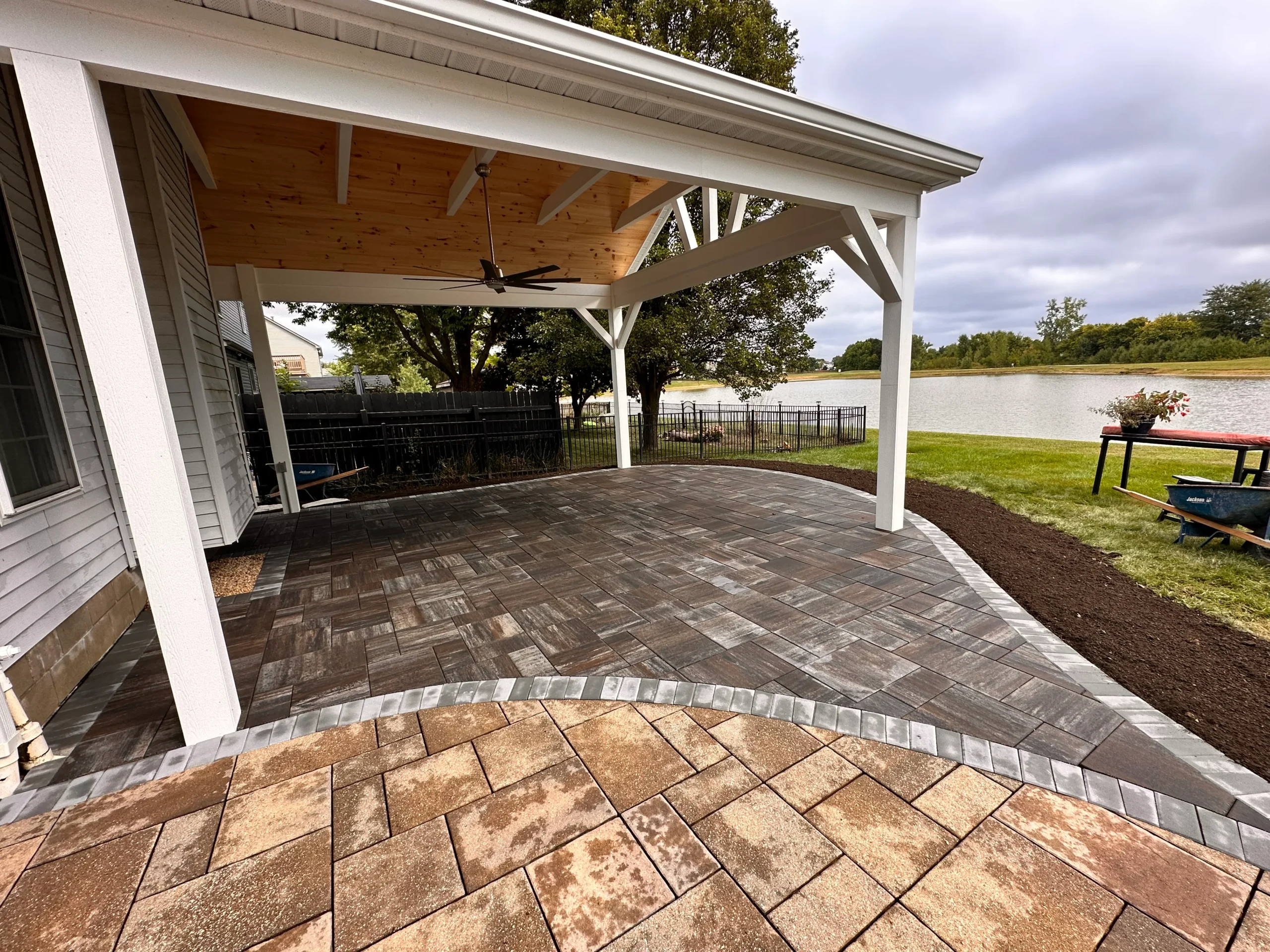
The short version of everything above: on a flat Alpharetta lot along the GA-400 corridor, hardscape drainage isn’t an add-on — it’s the structural system the deck is built on top of. Get it right at the beginning and the deck looks like year-one photography in year fifteen. Get it wrong and you’re writing a check to remove and replace by year five. The $3,800-$6,500 that a properly engineered drainage system adds to the build is the most durable spend in the entire project.
Hardscape Design and Construction across 20+ cities within 30 miles of Winder, GA
Flat-lot drainage engineering, linear drain and drywell systems, and pool deck hardscape built to outlast the second owner — across the GA-400 corridor and the whole of North Fulton.