
A French pattern travertine deck looks deceptively simple in the rendering — four stone sizes, one repeating module, a warm cream field hugging the pool. On paper, the budget says $28–$38 per square foot installed. On the job site, it turns into a sourcing puzzle, a cutting puzzle, and a labor puzzle that catches inexperienced installers three out of four times.
Most French pattern failures in Laurel Springs and The River Club at Suwanee are not design failures. They are math failures — specifically overage math, pallet-allocation math, and cut-waste math. The French pattern is a four-piece modular system (typically 8″x8″, 8″x16″, 16″x16″, and 16″x24″) that only works when the four sizes arrive at the job site in the correct ratio and when the installer understands how the pattern recovers at a curve. If either of those pieces is missing, the deck either runs short at 85% complete or gets finished with awkward filler cuts the homeowner spots the first time they walk it barefoot.
We have installed French pattern travertine on four Laurel Springs pool decks in the past three seasons and two River Club projects across McGinnis Ferry Road. This is the arithmetic we wish every Suwanee homeowner had in front of them before they sign a deck contract — the quarry question, the pallet question, the 18–25% overage rule, and the reason your installer’s skill level is the biggest single variable in whether this deck ages like the ones you saw on a Santorini vacation or like a driveway at year three.
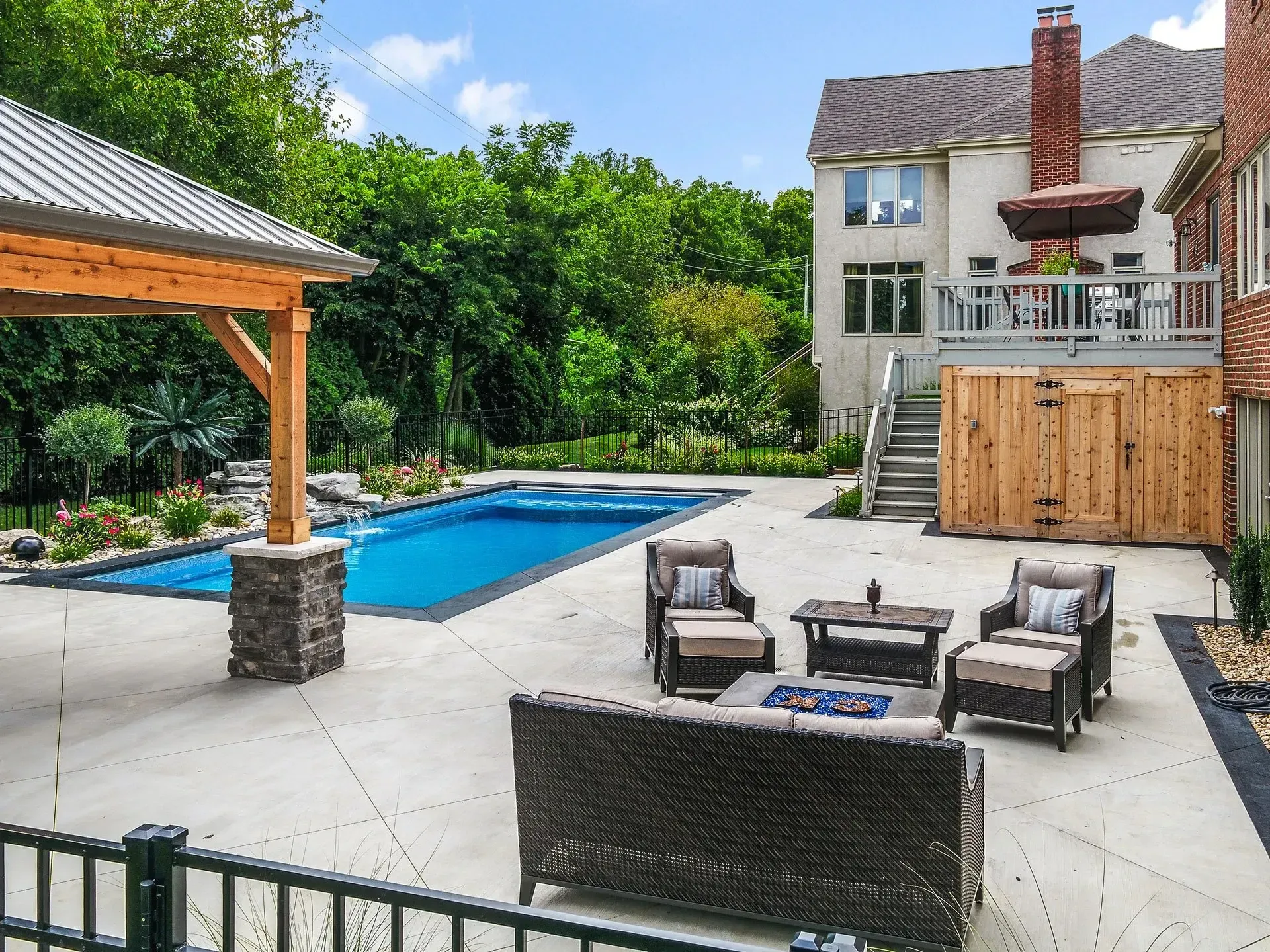
Why Laurel Springs ARB Pushes Travertine French Pattern
The Laurel Springs Architectural Review Board reviews every pool and hardscape submission in the community. Their review turnaround runs three to four weeks — one of the longest and strictest in Gwinnett County. What sets their process apart is not speed. It is specificity. They do not just check setbacks and square footage. They look at material palettes, and they prefer natural stone that sits quietly against the community’s architecture rather than competing with it.
In roughly seven out of ten approvals we have seen in Laurel Springs over the past four seasons, the approved deck material was either tumbled travertine or French pattern travertine in the cream/ivory or walnut color families. Concrete pavers get approved too, but the review tends to require a warmer palette — tans and creams, not grays — and a larger-format unit that reads as stone from a distance. Stamped concrete with travertine texture appears in a handful of approvals, but it is generally the exception, not the rule.
Why travertine specifically? Three reasons. First, it is naturally cool underfoot — the stone stays roughly 10–12°F below ambient on a 92°F Suwanee summer afternoon, compared to concrete pavers that can hit 130°F in direct sun. Second, the French pattern is a signature classical layout — the repeating module reads as old-world Mediterranean rather than trendy. It will not date the house in 15 years. Third, travertine ages by softening, not by failing. A tumbled edge that gets walked on for a decade looks better, not worse. Concrete pavers tend to fade, stain, and show edge chipping by year seven.
That said: ARB preference is not ARB mandate. We have had French pattern approved for homes in the $1.8M–$3.5M range in Laurel Springs, and we have also had walnut-toned bluestone approved for a traditional brick house in Highgrove. The review is case by case. But if you are starting from a blank sheet and you want the path of least resistance, French pattern travertine in ivory is the path that gets approved fastest.
Laurel Springs ARB timing: Submit your deck material spec with your pool construction drawings, not after. Submitting them as a two-stage review package adds 2–3 weeks to your total approval window. Most of our Laurel Springs builds submit at week 0 and start excavation between week 5 and week 7.
Turkish Quarry Direct vs. U.S. Distributor Stock — The Sourcing Question
Nearly all commercial-grade travertine sold in the U.S. is quarried in western Turkey — primarily the Denizli and Afyon regions. The stone is cut, tumbled, palletized, and shipped to East Coast container ports (Savannah and Charleston for Georgia deliveries), then trucked inland to stone yards and direct jobsite drops. The same physical stone can reach your deck through three very different supply paths, and the path you pick changes the price by $4–$7 per square foot.
Path one: U.S. distributor stock at a local yard. This is the simplest option. A driver pulls pallets from a yard somewhere along Peachtree Industrial Boulevard or in Norcross, delivers them to your Laurel Springs driveway, and the installer sets them. Price lands in the $22–$28 per square foot range for the stone and install combined on a French pattern. The benefit is speed — stone is on site within a week. The drawback is pallet consistency. Yard stock often comes from mixed production runs, which means the cream tone shifts between pallets. On a small deck (under 600 sqft) you will not notice. On a 1,400 sqft wraparound in Laurel Springs, you will.
Path two: Turkish quarry direct, single lot. For decks over 1,200 square feet, we routinely recommend ordering a single production lot direct from the quarry, shipped as a full container or half-container. The tone variation inside a single lot is far tighter than yard stock. A 40-foot container holds roughly 1,700–1,900 square feet of French pattern depending on thickness. Cost including freight and duties adds about $2–$4 per square foot over yard stock, but on a large deck the tone consistency is worth the premium. Lead time runs 10–14 weeks from PO to jobsite.
Path three: U.S. Carrara import (not actually Carrara). A handful of U.S. importers market Italian-sourced travertine at a premium. Most is still physically Turkish stone that transits through an Italian processor. Price jumps to $36–$44 per square foot installed. Unless the homeowner has a specific architectural reason to insist on Italian-processed stone, we do not recommend path three for a Suwanee pool deck. The pricing reflects the middlemen, not a meaningful difference in performance.

The 18–25% Overage Rule (And Why Contractors Skip It)
This is the single biggest math error we see in competing French pattern bids. The rule: a French pattern install requires 18–25% overage on top of the finished square footage — not the 10% overage that is standard for straight-laid or running-bond paver patterns.
Why the bigger overage? Three compounding reasons. The French pattern has four different piece sizes (8″x8″, 8″x16″, 16″x16″, 16″x24″) and they are sold in a fixed ratio per pallet. If your deck layout needs a slightly different ratio than what the pallet provides — which is almost always the case — you end up short on one size and long on another. Second, the pattern has more cut lines than a running bond. Curves, step transitions, and spa bump-outs force more cut pieces, each of which produces unusable offcuts. Third, tumbled travertine has a 2–4% breakage rate in shipping and handling, and the French pattern’s larger 16″x24″ units are the most likely to crack.
We run overage at 22% as our standard on French pattern jobs in Gwinnett County. On a 1,200 sqft deck, that means ordering 1,464 square feet of stone. On a 1,800 sqft deck (typical for a River Club estate build), that means ordering 2,196 square feet.
The reason contractors skip this rule — or run it at 10–12% — is simple. A 25% overage makes their bid look $3,000–$7,000 higher than the cheaper contractor’s bid, and some homeowners choose on price alone. What happens next is predictable. The deck runs short around day four of install. The installer calls the supplier, who is out of the original lot. A second lot ships, arrives two weeks later, in a subtly different cream tone. The homeowner spots the mismatch the first weekend they have guests over.
Real jobsite math — 1,400 sqft Laurel Springs wraparound (2026):
Pool deck finished area: 1,395 sqft. Overage ordered at 22%: 1,702 sqft. Actual field waste at completion: 241 sqft (17.3%). Leftover stone delivered to homeowner for future patching: 66 sqft. Total stone line item on invoice: $29,764.
Cut Complexity — Where the French Pattern Gets Expensive
A running-bond paver pattern has one repeating unit and one cut line. Install speed is predictable. The French pattern has four repeating units and an asymmetric cut line that changes direction every module. Install speed is a function of the installer’s pattern literacy, not their wet-saw speed.
On our crews, an experienced French pattern setter lays about 180–220 square feet per day. On a straight running-bond pattern, the same setter lays 350–400 square feet per day. The pattern literally costs you half your daily square footage. That is where the labor premium comes from — not from a higher hourly rate, but from the fact that the stone goes down slower.
The places on the deck where cuts stack up and eat the day:
- Curved pool perimeter. Every pool cove, spa bump-out, and tanning ledge edge produces a curved cut line. French pattern does not want to curve — it wants to repeat in 24″ modules. The setter breaks the pattern at the curve, scribes each piece individually, and feathers the joint back into the repeating pattern within two module widths.
- Coping transition. The coping is usually a single 12″x24″ bullnose piece laid in a straight band around the pool. The field stone lands against the coping with a partial cut on every third piece. A clean coping transition takes two passes at the wet saw per module.
- Planter walls and column pier bases. Any vertical feature that rises out of the deck — a seat wall, a scupper column, a raised spa — breaks the field pattern. Each pier base requires four custom cuts to close the pattern cleanly around it.
- Step risers and tanning ledge edges. Wherever the deck steps up or steps down, the pattern terminates against a bullnose or a tread. These transitions consume the most cut pieces on any French pattern deck.
On a flat rectangular deck with clean corners, the cut rate is roughly 12%. On a Laurel Springs estate deck with a raised spa, tanning ledge, seat wall, and two column piers, the cut rate can hit 28%. That is why the same size deck can quote out at $34,000 on a simple layout and $52,000 on a complex one, with the same stone.
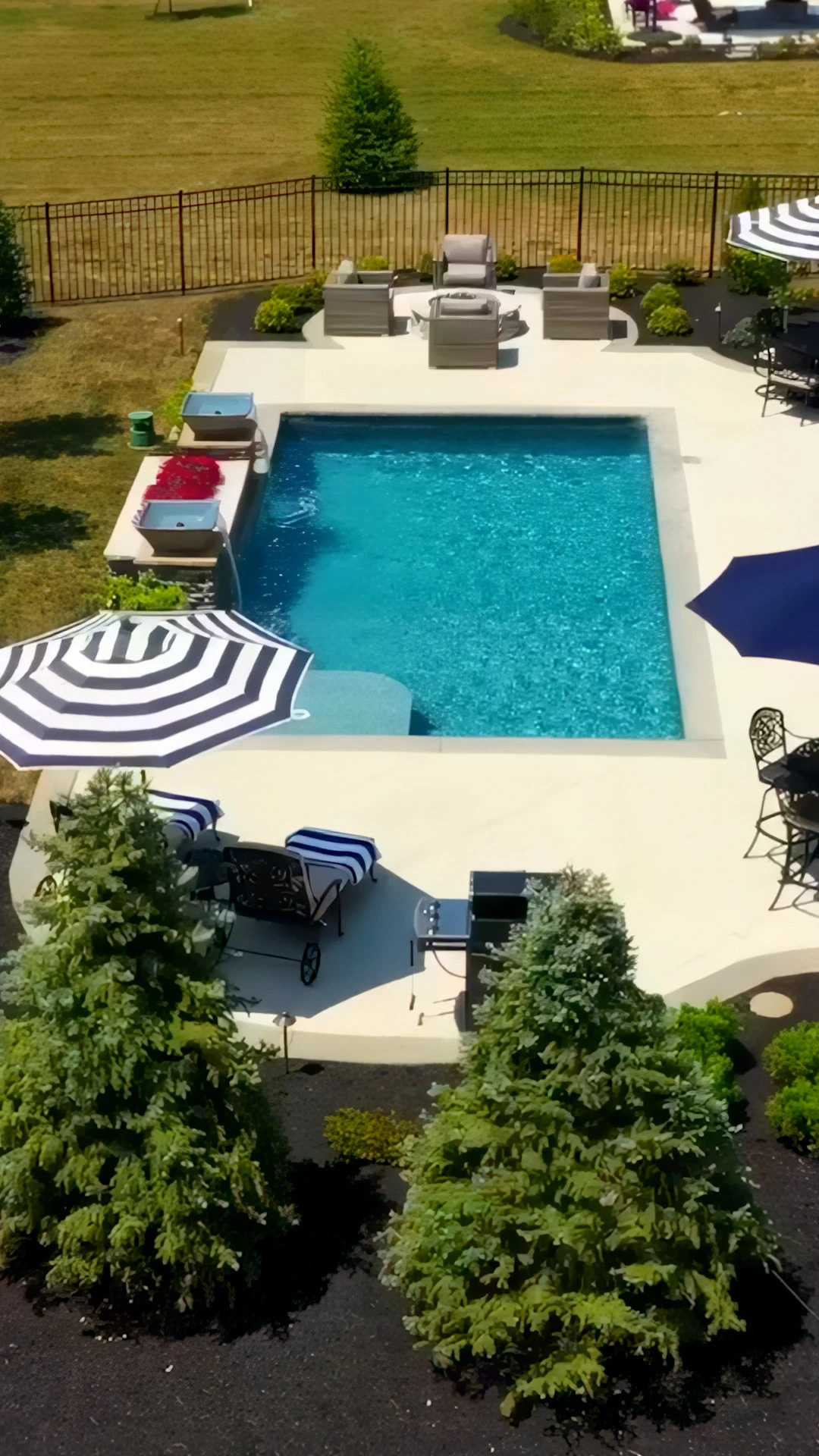
Installer skill premium — why it exists and how to verify it
A French pattern is not a hard pattern to understand in the abstract. The four-piece module repeats in a predictable way. What makes it hard in practice is the reading. An experienced setter reads the pattern three modules ahead at all times — deciding which 16″x24″ to lay next so that the joint line behind the next row does not align with the joint line two rows back. When that read breaks down, you get what installers call a “running bond leak” — two or three aligned joints in a row that make the whole field look misaligned from 20 feet back.
The skill premium on French pattern work runs roughly $8–$12 per square foot over straight-laid work. Some of that is slower install speed. Some is the simple fact that the number of crews in metro Atlanta who can set French pattern cleanly is a fraction of the number who can set running bond. When you call five pool deck contractors in Suwanee and three of them quote the same job at $22/sqft and two of them quote at $34/sqft, the $12 delta is almost always the installer skill tier.
How to verify you are hiring the skill tier, not just paying for it:
- Ask for three completed French pattern addresses within 15 miles. A real French pattern installer has a portfolio they will drive you to. Not renderings — addresses. In Suwanee, that likely means Laurel Springs, River Club, Bear’s Best, or one of the estate sections of Settles Bridge.
- Ask who sets the first row. On a French pattern, the first row (the course closest to the pool coping) defines the alignment of the entire deck. A careful contractor sets the first row with their lead setter, not a junior. The answer to this question tells you a lot about how the crew is structured.
- Ask how they handle pattern recovery at a curve. The honest answer is “we break the pattern two modules out and feather it back in.” The dishonest answer is “the pattern just follows the curve naturally.” French pattern does not follow curves naturally.
- Ask for the pallet-allocation sketch. Before delivery, your installer should hand you a one-page sketch showing how the pallet ratios distribute across the deck — where the 16″x24″ pieces go, where the 8″x8″ pieces land. If they cannot produce the sketch, they are not planning the install, they are improvising it.
Substrate, Joints, and What Happens in Suwanee Freezes
The deck you see is the top half of a two-layer system. The half you do not see — compacted base, bedding layer, and joint sand — is what decides whether the deck lasts 25 years or cracks at year five.
Suwanee sits on Cecil series Piedmont clay, the same soil series that runs through Dacula, Lawrenceville, and most of central Gwinnett. Cecil clay expands when wet, contracts when dry, and transmits every freeze-thaw cycle straight to the deck above it. Suwanee averages around 20 freeze events per year, most clustered between late December and mid-February. Each freeze pulls moisture out of the base, forms ice wedges in the joint sand, and pushes the pavers a fractional amount. Multiply by 20 events a winter, 10 winters, and an unreinforced French pattern deck can develop visible joint creep along the pool edge.
The substrate spec we run in Suwanee, per ICPI (Interlocking Concrete Pavement Institute) guidelines:
- Excavation depth: 10–12 inches below finished grade for pool deck applications (deeper than patio spec).
- Base: 6 inches of compacted GAB (graded aggregate base) in two 3-inch lifts, each compacted with a reversible plate compactor.
- Bedding layer: 1 inch of ASTM C33 concrete sand, screeded flat, not compacted.
- Joint sand: Polymeric sand swept into joints, activated with a fine mist, not a pressure-wash. Gator Super Sand Bond or equivalent.
- Perimeter restraint: Steel or hard-plastic paver edging spiked every 12 inches, concealed under the turf line.
Homes close to the Chattahoochee River — particularly parts of Settles Bridge that sit in Zone AE on the FEMA flood map — need an extra drainage layer below the GAB. We typically add 2 inches of #57 clean crushed stone below the base as a capillary break. It adds about $2/sqft to the deck cost but stops groundwater from wicking into the bedding layer during high-water events.
Joint sand gets the most questions from homeowners. On a French pattern deck with 3/16″ joints, polymeric sand is non-negotiable. Standard sweep sand washes out after one season of pool splashing and Georgia summer thunderstorms. Polymeric sand hardens into a flexible mortar that resists washout, weed growth, and ant colonization. Budget $0.80–$1.20 per square foot for premium polymeric installed and activated correctly.
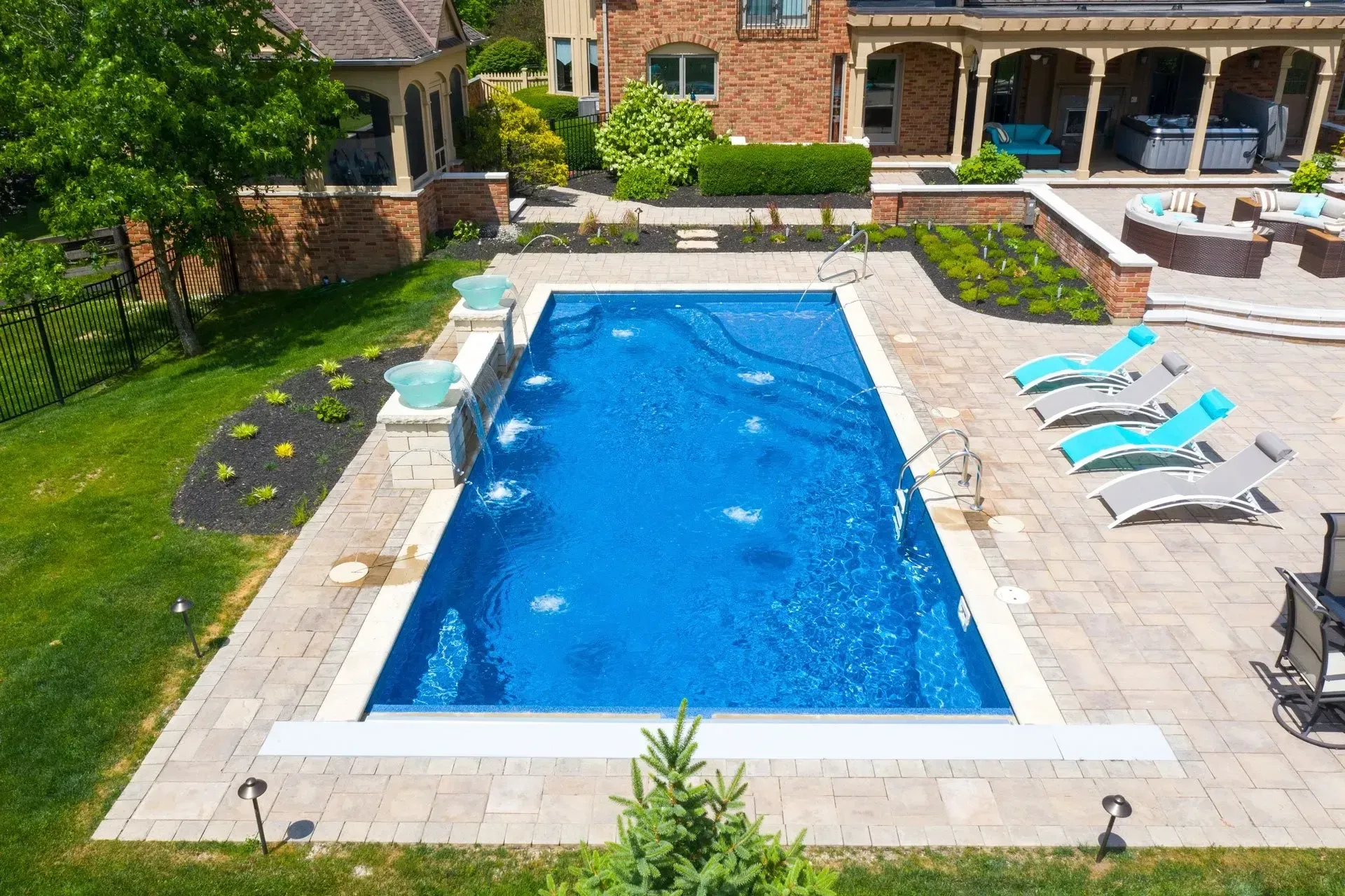
Budget Math for a Laurel Springs French Pattern Deck — Real Numbers
Here is how the money actually distributes on a typical Suwanee French pattern pool deck. These are 2026 numbers pulled from recent project invoices in the $40,000–$75,000 range.
Deck size: 1,400 sqft finished, moderate complexity (rectangular pool, one spa bump-out, one column pier, coping transition):
- Excavation and base prep — 1,400 sqft × $4.50/sqft = $6,300
- Stone material (22% overage, ivory French pattern, yard stock) — 1,708 sqft × $7.50/sqft = $12,810
- Bullnose coping (pool perimeter, ~80 linear ft) — 80 lf × $38/lf = $3,040
- Labor (setting, cutting, screeding, 14–16 crew days) — 1,400 sqft × $14/sqft = $19,600
- Polymeric sand + perimeter restraint — 1,400 sqft × $1.50/sqft = $2,100
- Permit, dumpster, equipment mobilization — $1,400
- Sealer (optional, enhancer-grade penetrating sealer) — $1,400 × $1.25/sqft = $1,750
Total: roughly $47,000 on a moderate-complexity 1,400 sqft French pattern deck in yard-stock ivory travertine. The same deck in single-lot quarry-direct stone with an enhancer sealer applied after a 30-day cure runs closer to $53,000. The same deck with a walnut-tone imported line runs $58,000–$62,000.
On a 1,800 sqft River Club wraparound with two column piers, raised seating wall, tanning ledge, and detached spa, the complexity multiplier runs about 1.35x. That moves the same-stone number from roughly $60,000 to closer to $82,000. Those are the projects where quarry-direct sourcing pays back — the tone consistency across a large unbroken deck field is where imported-lot stone visibly outperforms yard stock.
Permits through the Gwinnett County Department of Planning & Development at 446 W. Crogan Street in Lawrenceville add roughly $400–$700 to the job depending on deck size and whether the pool permit is filed concurrently. Laurel Springs ARB review is separate and carries no HOA fee, but the review window is the bottleneck, not the county permit. Plan on 5–7 weeks from initial submission to excavation-ready.
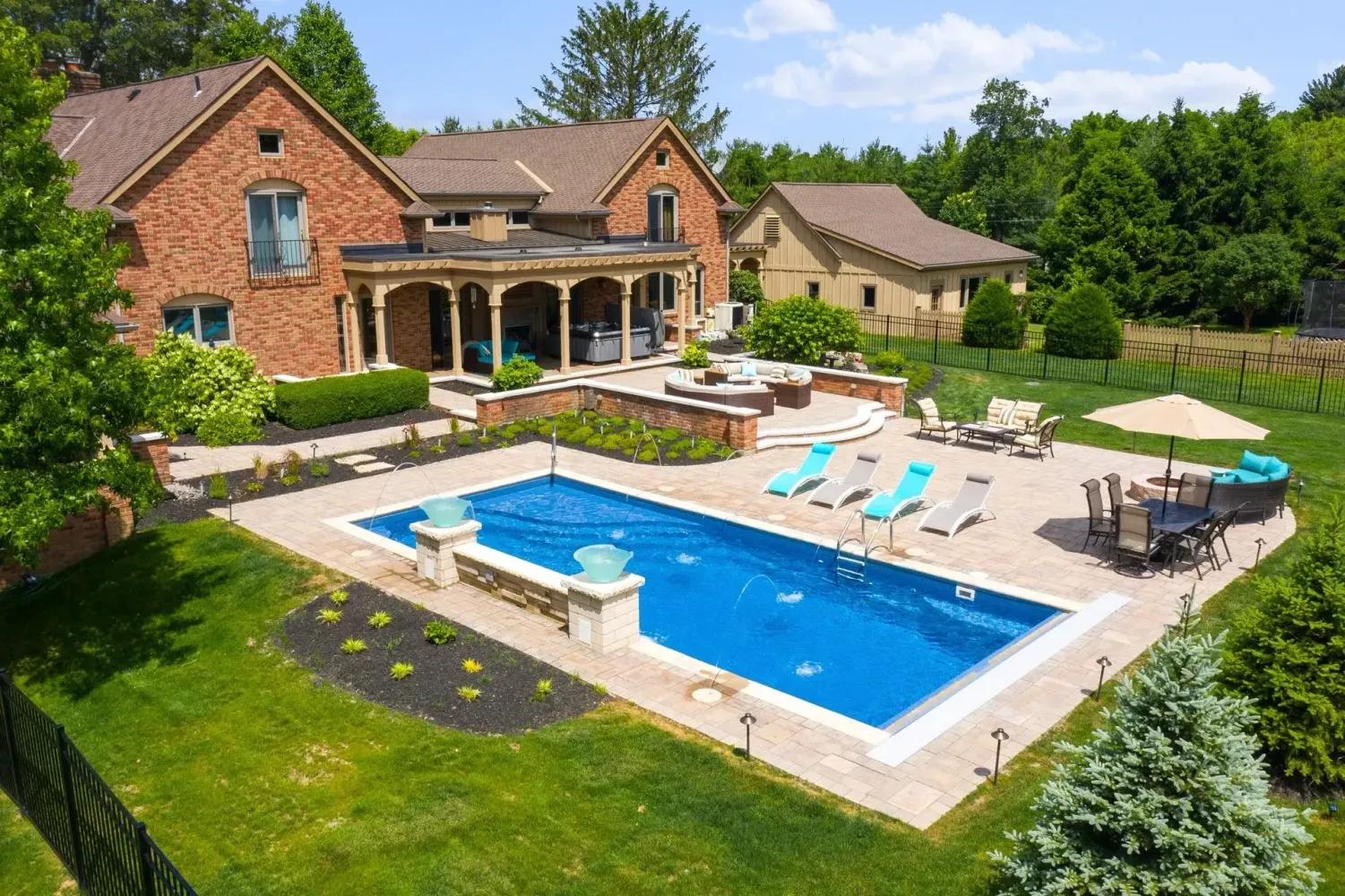
French pattern pool decks and custom hardscape across 20+ cities within 30 miles of Winder, GA
If you are planning a travertine pool deck in Laurel Springs, The River Club, Bear’s Best, or anywhere else in Suwanee, we will walk you through sourcing, pallet ratios, and the ARB submission process before we ever price the job.