
Q: My builder put the fire pit where the yard looked best. The HOA sent a violation letter six weeks later. What did we miss? A: In Windward, Country Club of the South, White Columns, and Hutchinson Farm, fire feature placement is not a design decision — it is a setback calculation that has to clear the ARB before the pool shell is even dug.
That question comes in almost monthly from Alpharetta homeowners who hired a landscaper or a general contractor to install a gas fire pit or a masonry fireplace after the pool was already in the ground. The fire feature looked great in the photos. Then the HOA inspector drove through, pulled the plat, and measured. The setback miss was three feet. The fix was rebuilding the entire feature on a new footing — because you can’t slide a 4,000-pound stone fireplace two feet to the left.
This post is not a general overview of fire pits and fireplaces. It is a tight field manual for one specific job: laying out a fire feature on an Alpharetta subdivision lot so that the Architectural Review Board approves it on the first pass and the installed feature actually survives without heat-damaging a neighbor’s fence or an eighty-year-old water oak.
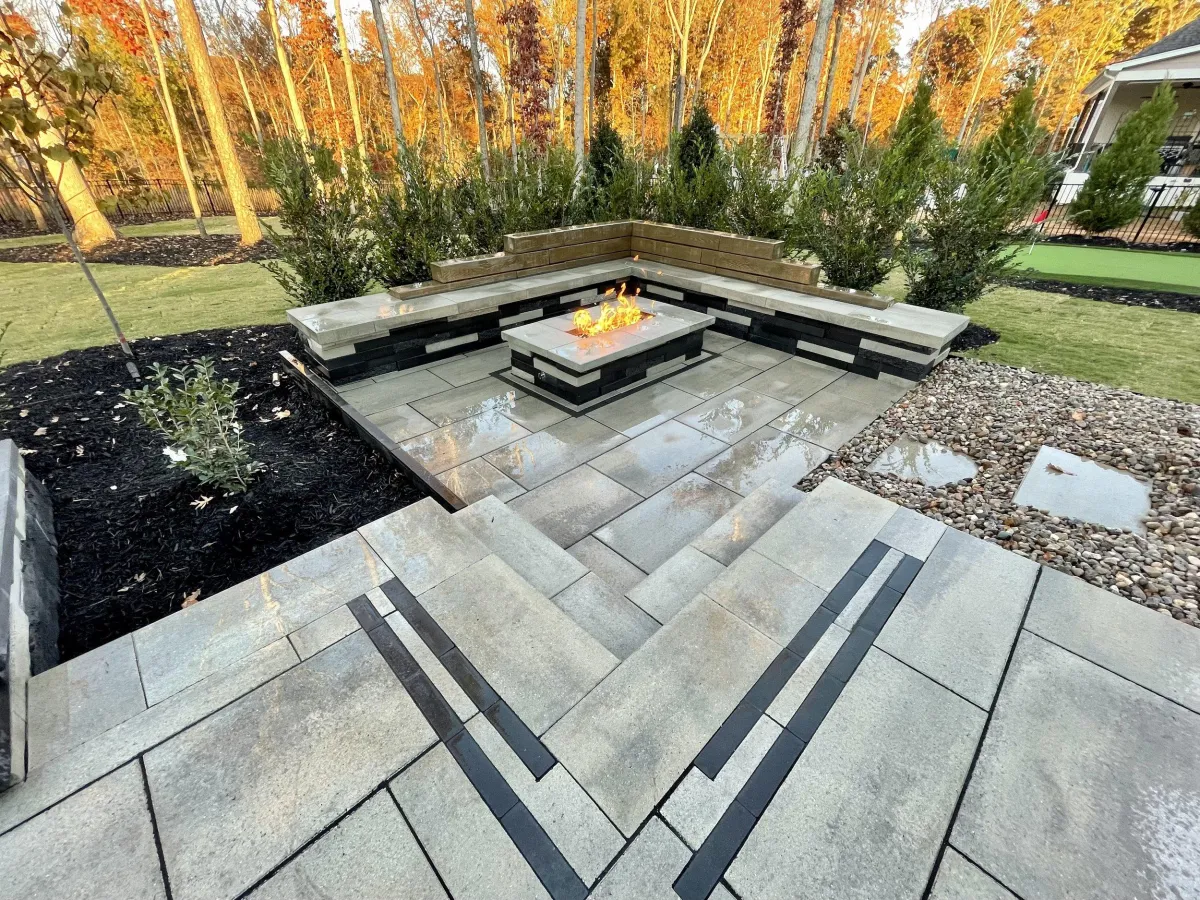
Why Alpharetta subdivision setbacks bite harder than city code
City of Alpharetta zoning gives you a baseline: permits pull through Community Development at 2 Park Plaza, and the mechanical permit for a gas line to a fire pit is processed in-city rather than through Fulton County unincorporated, which is faster by roughly a week in our experience. That’s the easy part. The city sets a floor for combustion clearances and gas line depth. The floor is low.
The HOA sits on top of that floor, and in the established Alpharetta subdivisions, the HOA setback numbers are three to five times stricter than what the city would let you do. A homeowner looking at the municipal code will see a 5-foot side setback and assume a fire pit 6 feet off the fence is fine. In Country Club of the South, that fire pit just failed an ARB review before it was even built.
Three structural reasons the covenants read the way they do:
- Fire risk to shared canopy. Most of the older Alpharetta subdivisions were platted inside mature oak, hickory, and pine stands. The HOAs wrote their fire-feature covenants to protect that canopy from radiant heat damage, because the trees are part of the community’s appraised value.
- Smoke and ember drift between lots. Wood-burning features on half-acre subdivision lots put smoke straight into the neighbor’s screened porch. HOAs learned this the hard way in the early 2000s and tightened setbacks accordingly.
- Resale and ARB consistency. The ARB’s job is to keep the community visually and functionally consistent for the next buyer. Fire features that sit wrong on the lot don’t appraise the same, and a violation on the title slows the next closing.
The four-subdivision setback table — what the ARBs actually require
These are the numbers we build to on Alpharetta fire feature projects. They are pulled from current covenants, ARB submittal packets, and direct review meetings during the permit cycle. Always pull the latest ARB checklist before submittal — HOAs update setback tables on their own timeline, typically every 18 to 36 months.
Windward: 15 ft from property line + 10 ft from structures + 5 ft from pool coping. Wood-burning features require a screened spark arrestor on any chimney over 6 ft tall.
Country Club of the South: 20 ft from property line + 15 ft from structures. Masonry fireplaces over 8 ft tall require engineered footing drawings stamped by a Georgia PE.
White Columns: 20 to 25 ft from property line depending on whether the lot abuts the equestrian easement or the interior street. Interior-street lots take the 20 ft; easement-adjacent lots take the 25 ft.
Hutchinson Farm: 10 ft from property line + 5 ft from any combustible (wood privacy fence, deck post, or any tree trunk over 8 inches DBH measured at 4.5 ft above grade).
Two notes that matter: first, the “structures” clause in Windward and Country Club of the South includes detached structures — pool cabanas, pergolas with solid roofs, sheds. Second, the 5-foot-from-pool-coping rule in Windward is the one that trips up retrofit projects most often, because the natural instinct is to tuck a fire pit right at the shallow end corner for the sightline.
The mistakes we see on Alpharetta lots — and what each one costs
Mistake patterns on fire feature placement cluster into predictable buckets. Each of these has cost an Alpharetta homeowner real money in the last three years. The rebuilds are not hypothetical. They are line items on change orders we’ve signed.
Mistake 1: Placing the fire feature inside a mature oak’s drip line
The most expensive mistake, and the hardest one to see on a flat site plan. A homeowner in a Hutchinson Farm lot sited a 48-inch gas fire bowl six feet from the trunk of a 62-inch-DBH willow oak. The trunk was outside the 5-foot combustible setback. The drip line — the canopy edge where the leaves extend — was not. By year two, the leaves on the lower branches over the fire bowl were browning, dropping early, and the HOA arborist cited canopy damage. The bowl was relocated eighteen feet west. The original footing was demolished, a new gas line was pulled, and the patio pavers were re-cut around the new location. Cost to the homeowner: over $14,000 beyond the original installed price.
The HOA covenant said “5 ft from any combustible.” A living oak is a combustible. The canopy matters more than the trunk for radiant heat exposure. Layout rule: if the fire feature is inside the vertical projection of a mature hardwood canopy, move it.
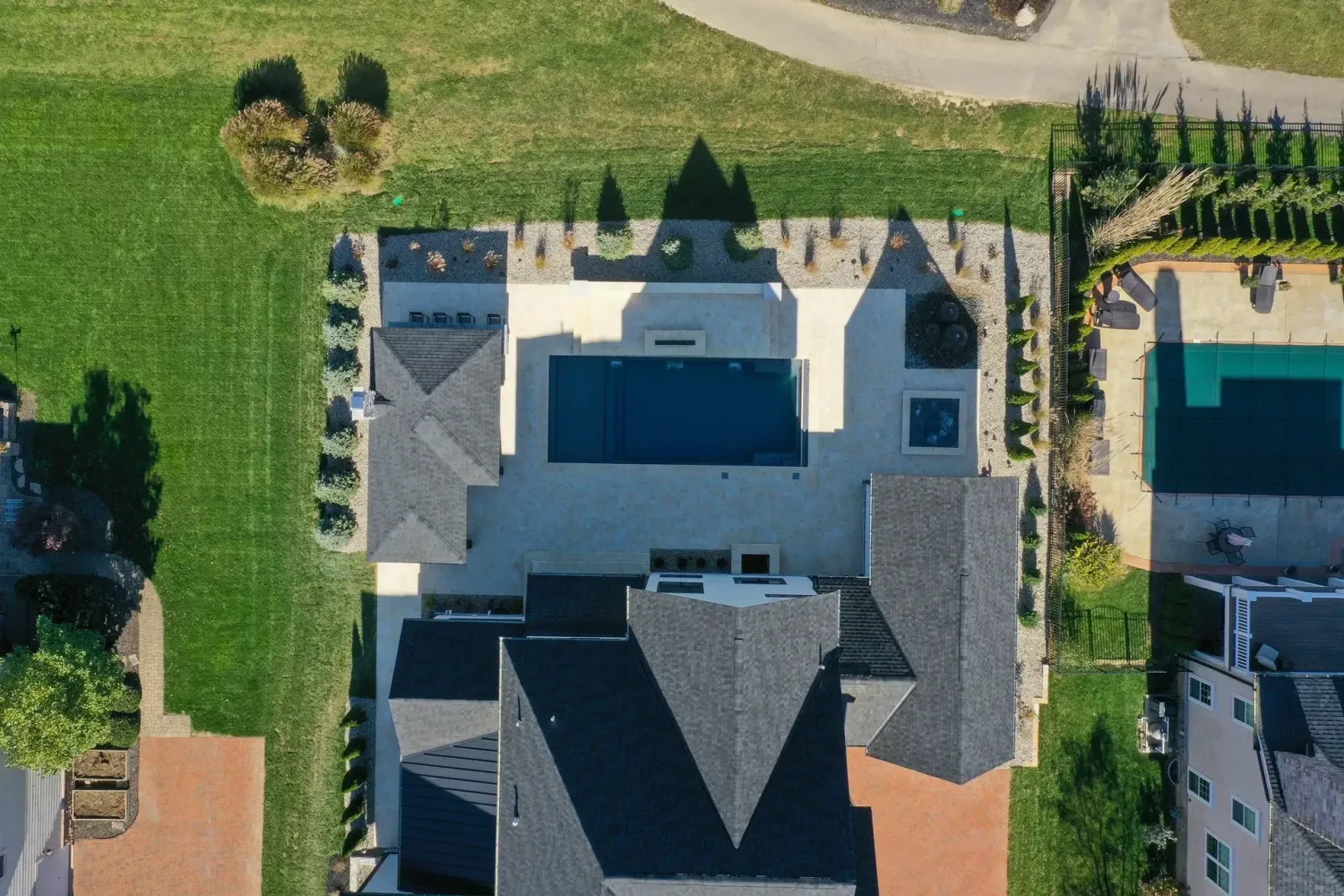
Mistake 2: Assuming the ARB setback is measured from the fire ring, not the hearth
Windward and Country Club of the South both measure setbacks from the outer edge of the permanent construction — the hearth apron, the stone face of the surround, the bench seat if it is masonry-integrated. Not from the flame ring. That’s usually another 18 to 36 inches of footprint you have to account for. Two Windward builds in the last eighteen months went back to the ARB for revision because the drawings measured from the burner.
Mistake 3: Running the gas line before the ARB signs off
Trenching a gas line is cheap. Abandoning a gas line and trenching a second one is not. We do not pull the mechanical permit or break ground on a gas trench until the ARB stamp is physically in the project folder. The three-to-four-week Windward review is not a delay — it is the step that protects the gas, electrical, and concrete work downstream.
Mistake 4: Forgetting that the gas line path counts as a disturbance inside the tree protection zone
In Country Club of the South, any excavation inside the critical root zone (typically 1.5 ft of radius per inch of DBH) of a specimen tree requires arborist sign-off. A gas line trenched 18 inches deep through the root zone of a 40-inch oak will show crown dieback by the third summer. Bore under the root zone instead of trenching — it’s about $900 extra in directional drilling, and it protects a tree that the ARB values at tens of thousands of dollars.
Mistake 5: Siting on fill without a separate footing design
Alpharetta’s Cecil-series Piedmont subsoil has moderately high shrink-swell behavior. A masonry fireplace sitting on disturbed fill — for example, the backfill behind a pool shell — will crack at the mortar joints within three to five winter freeze cycles. We pour an isolated spread footing for any masonry fire feature over 4 ft tall, sized and keyed per a PE-stamped detail, and we let it cure a minimum of ten days before the mason sets the first block.
Mistake 6: Ignoring the prevailing wind across the GA-400 corridor
Summer wind in Alpharetta runs predominantly southwest to northeast, funneled by the GA-400 ridge-and-valley topography. A wood-burning fireplace opening pointed northeast will push smoke directly into the neighbor’s second-story windows two houses over. We orient fireplace openings southwest on most Alpharetta lots — away from the downwind neighbors — unless the lot geometry makes that impossible.
How to lay the fire feature out during design — not after the pool is in
The single biggest process shift that prevents the mistakes above is layout sequencing. Most fire feature problems on Alpharetta lots happen because the fire pit or fireplace was treated as an add-on after the pool shell was already excavated and the coping was set. By that point, every good location is ruled out by some constraint that no one mapped up front.
Our sequence on Windward, Country Club of the South, White Columns, Hutchinson Farm, Ashebrooke, Haynes Manor, and Cambridge Parks lots:
- Pull the plat and the ARB setback table in week one. Overlay the rear and side property-line setbacks on the survey. Mark the specimen trees with their DBH and the drip-line radius.
- Draw the fire feature footprint before the pool shape is finalized. The pool can move a few feet. A masonry fireplace, once poured, cannot. Place the fireplace first if sightlines require it.
- Run the wind rose. For wood-burning features, check that the opening is oriented away from the closest downwind neighbor’s living space.
- Lay out the gas path. Route around critical root zones, not through them. If a bore is needed, price it into the original bid.
- Submit the ARB package with all four setbacks dimensioned. Front, rear, two sides — plus structure-to-structure and coping-to-fire-ring. The reviewer doesn’t want to do the math.
- Wait for the stamp. Don’t start the gas trench or pour the footing until the physical ARB approval is in the folder.
This adds two to four weeks to the front of the project. It saves four to twelve weeks on the back end when there is no change order, no rebuild, and no violation letter. On a 16-to-22-week Alpharetta pool-plus-fire-feature build, trading two weeks of planning for zero weeks of rework is a net win every time.
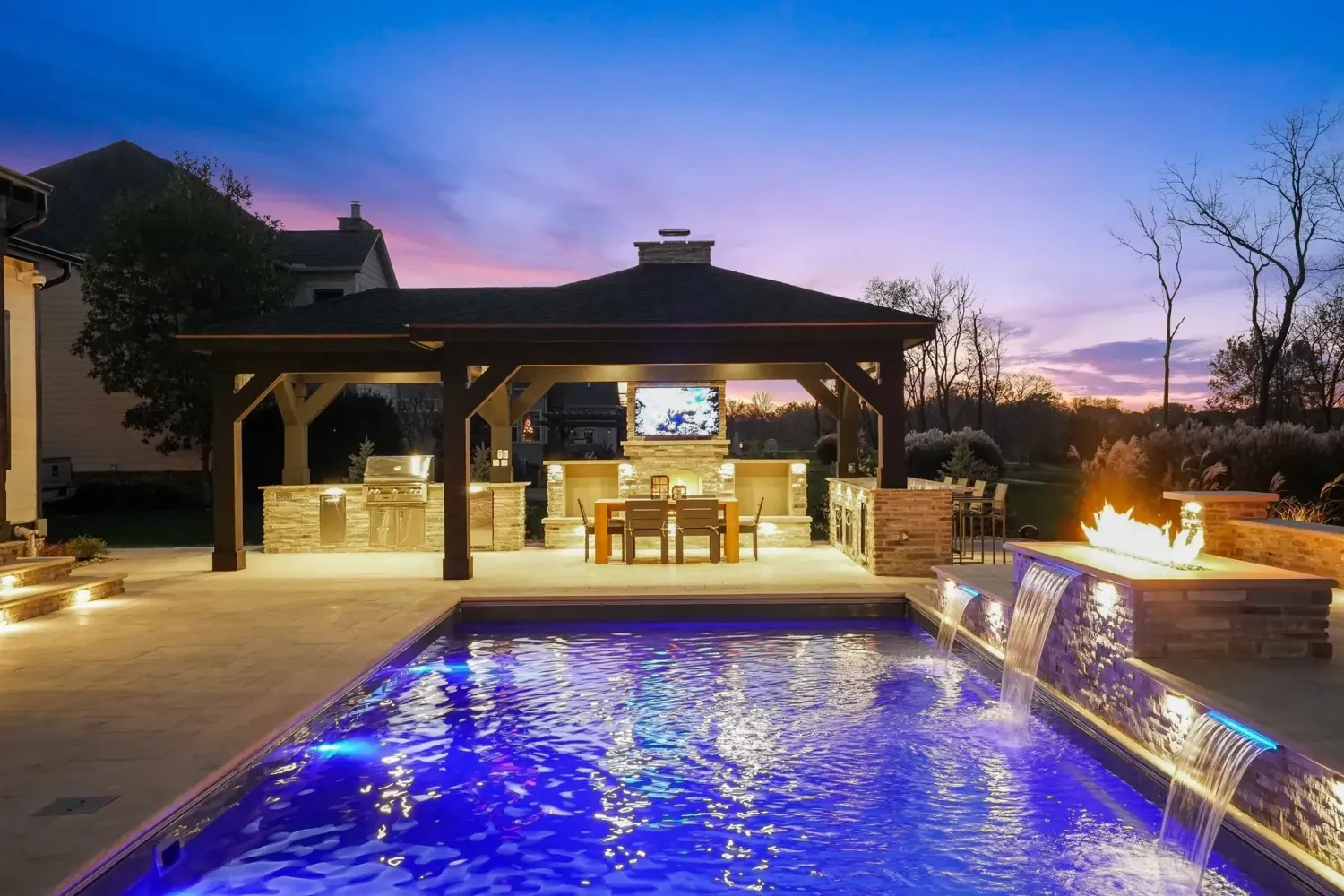
The materials decisions that actually matter for ARB approval
Alpharetta ARBs care about three material choices on fire features, and they don’t care much about anything else. Get these three right and the review is almost always a yes.
Stone veneer match. If the home has manufactured stone veneer or a specific natural stone band, the fire feature should use the same stone or a closely matched one. Windward and White Columns both flag veneer mismatches as the number-one reason for an ARB revise-and-resubmit. Bring a physical stone sample to the ARB meeting — photos don’t read correctly under fluorescent light.
Chimney cap and spark arrestor. For any wood-burning fireplace with a chimney over 6 ft, a stainless spark arrestor is required by most Alpharetta HOA covenants and by common sense given the mature canopy. A 304 stainless cap with a 5/8-inch mesh runs about $340 to $480 installed and will not rust-stain the chimney face over time.
Gas burner and pan. For gas fire pits, specify a Warming Trends Crossfire or equivalent brass burner with a stainless pan. The cheaper black-iron ring burners rust within two Alpharetta winters — Zone 8a gives you about 20 freeze events a year, and a rusted burner pan is a change-order waiting to happen. Brass plus stainless outlives the homeowner.
One spec that pays for itself: Install a dedicated gas shutoff valve within 6 ft of the fire feature and above grade. When the pilot goes out in January and the homeowner doesn’t want to crawl into the mechanical pit at the equipment pad, they will thank the installer every winter. Cost: about $180. Value: priceless on service calls.
Working the ARB process in Alpharetta — what speeds it up, what slows it down
The Windward, Country Club of the South, and White Columns ARBs meet on a set calendar — typically twice a month. Missing a submittal deadline by a day means waiting two weeks for the next meeting. That two-week slip cascades into a gas permit slip, which cascades into a concrete pour that hits a rainy week, which cascades into a delay that hits the equipment inspection calendar. In Alpharetta, Georgia Power handles most service drops; on the northern edge toward Milton, Sawnee EMC runs a separate inspection calendar. We confirm which utility serves the address before we build the schedule, because the two utilities do not share inspectors.
Three things that speed the review:
- Complete setback dimensions on every side of the fire feature. Not just the closest one. The reviewer doesn’t want to infer.
- A material board with physical samples. Stone veneer, coping, chimney cap, burner type. Photos are a last resort.
- A tree protection plan if any specimen tree is within 30 ft of the feature. Bore paths for gas, critical root zone boundaries, proposed fencing during construction.
Three things that slow it:
- A site plan that shows the fire feature in a generic rectangle with no dimensions to the property lines.
- A stone sample submitted as a Pinterest screenshot.
- Leaving the pool coping-to-fire-ring dimension off the drawing when the pool is on the same submittal.
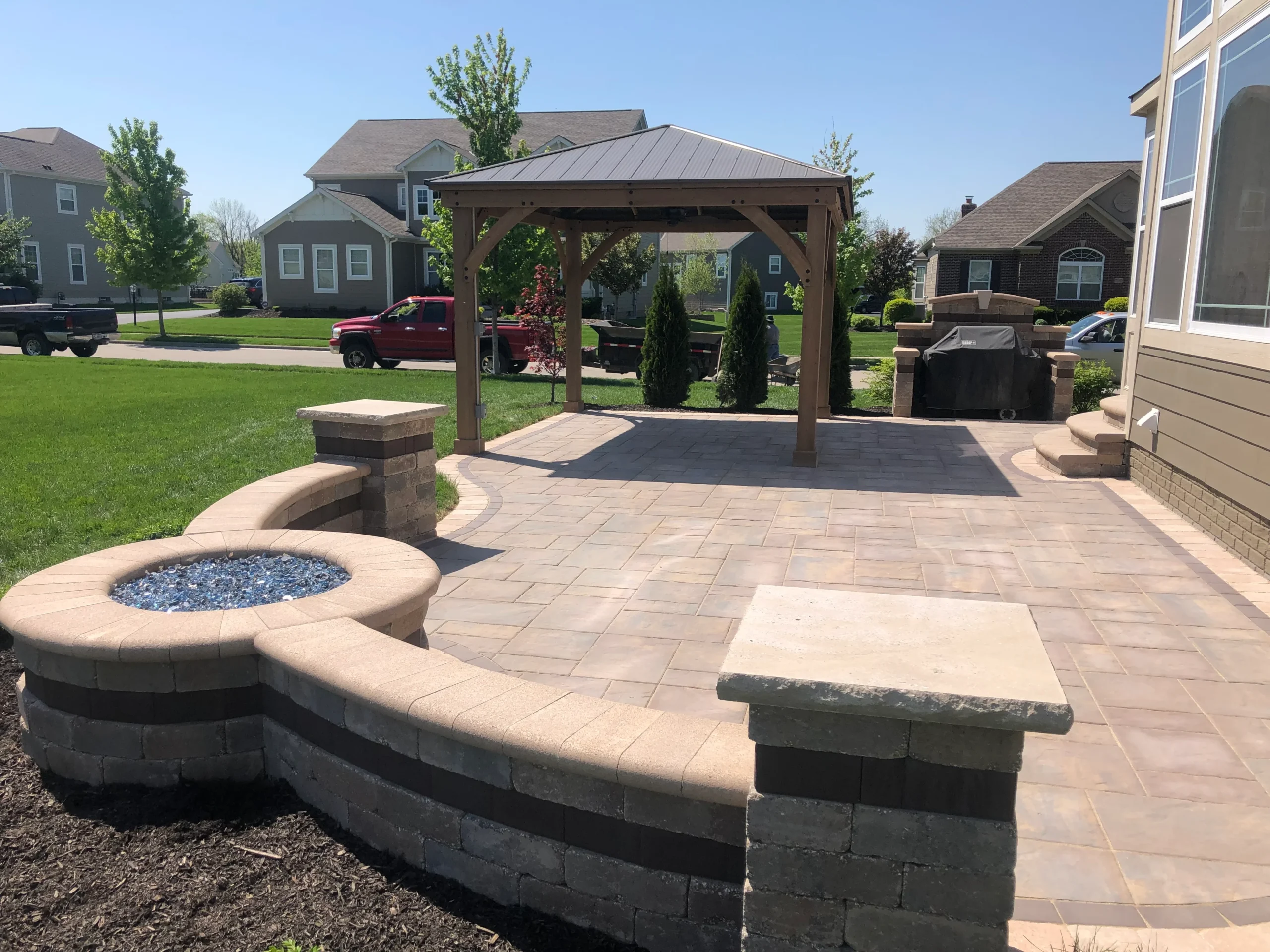
What this looks like in practice — three recent Alpharetta builds
Windward, 30005. A three-quarter-acre lot backing to a common-area tree line. The homeowner wanted a 10-ft-wide masonry fireplace with a built-in wood box, anchored on the rear property corner for the sightline. The rear setback was 15 ft from the property line, and the nearest specimen tree — a 38-inch hickory — had a drip line that extended 19 ft from the trunk. The approved location moved the fireplace 7 ft toward the house, which put it 16 ft off the rear line and clear of the drip line by 4 ft. The tradeoff: the fireplace lost a small amount of the rear view. The return: it was approved in the first ARB cycle.
Country Club of the South, 30022. A pool-plus-fire-pit new build on a half-acre interior lot. The fire pit was originally drawn at 14 ft from the side property line — short of the 20-ft requirement. The homeowner did not want to compromise the cabana footprint to move the fire pit. Solution: rotated the pool 8 degrees on the lot, which opened the fire pit corner and moved it to 21 ft off the side line. Cabana stayed put. ARB approved on resubmit.
Hutchinson Farm, 30004. A retrofit — existing pool, existing patio, homeowner adding a 42-inch gas fire bowl. The only location that cleared the 5-ft-from-combustible rule without moving the patio was directly over an existing irrigation manifold. Rerouted the manifold, poured a new isolated footing for the bowl, and ran a new gas line from the meter around — not through — the root zone of an 18-inch water oak. Total added cost over a simpler siting: about $2,800. Total cost if the bowl had damaged the oak: potentially $18,000 in replacement plus remediation.
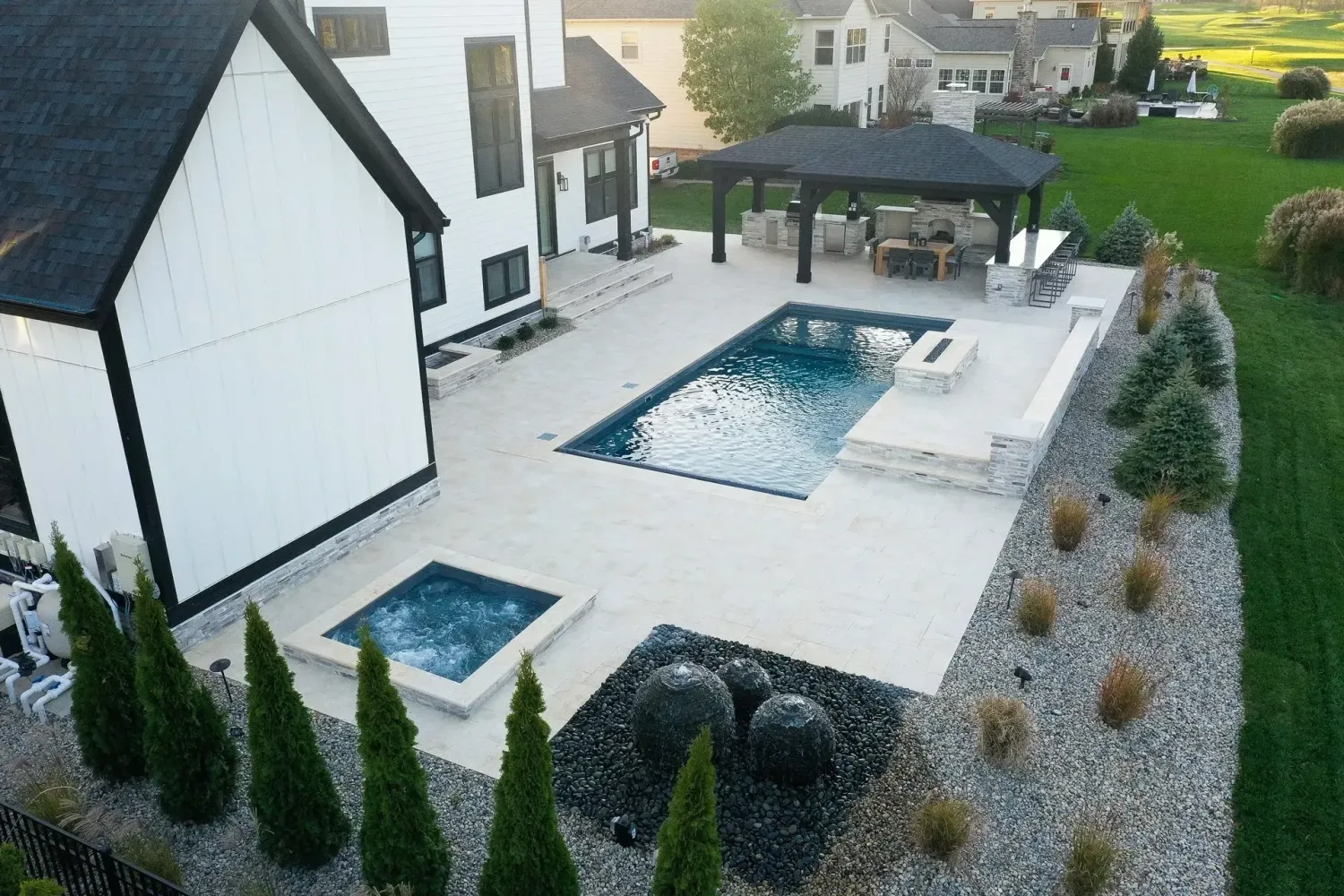
In every case the answer was to solve the setback problem on paper before anything was poured. The subdivisions along the GA-400 corridor — from Avalon and downtown Alpharetta north through Windward and the Hall County line — all share the same basic problem: strict ARBs, mature canopy, and half-acre lots where inches matter. The builds that go well are the ones where the setback is designed first and the pool geometry flexes around it.
If you’re planning a fire feature as part of a new pool build in Alpharetta or adding one to an existing backyard, the sequence is the same. Pull the ARB setback table. Survey the specimen trees. Draw the fire feature footprint before the pool shape. Submit a complete package with dimensions on every side. Wait for the stamp. Then build. That’s the whole job.
Fire pit and fireplace design across 20+ cities within 30 miles of Winder, GA
Setback-first layout, ARB-ready submittals, and footings engineered for Piedmont clay. We lay fire features out during design — not after the pool is set.