
Homeowners in Dacula almost always want the firepit closer to the house than it should be. The reasoning sounds logical — shorter walk from the kitchen, easier to supervise from the living room window, better sightline from the covered porch. The reasoning is also how we end up replacing scorched vinyl siding, soot-stained soffits, and — on two Hamilton Mill jobs in the last three years — a section of cedar eave that caught a stray ember on a dry October night.
The “closer is cozier” instinct has to die before a firepit gets designed, because physics doesn’t care about cozy. Radiant heat, smoke plumes, ember lofting, and the prevailing southwest summer wind pattern in Gwinnett County all work against a firepit that sits too near the home. What feels intimate on a drawing feels disastrous the first time a gust carries a glowing ember toward a combustible soffit.
We build firepits across Dacula, GA — in Hamilton Mill’s upscale half-acre lots, on the newer infill parcels near Sycamore Ridge, and on the tighter 1/3-acre Chandler Ridge layouts where setback becomes a real design constraint. The answer to “how far?” is almost always further than the homeowner pictured, and the right number is rarely a single number. It’s a stack of distances that each solve a different failure mode.
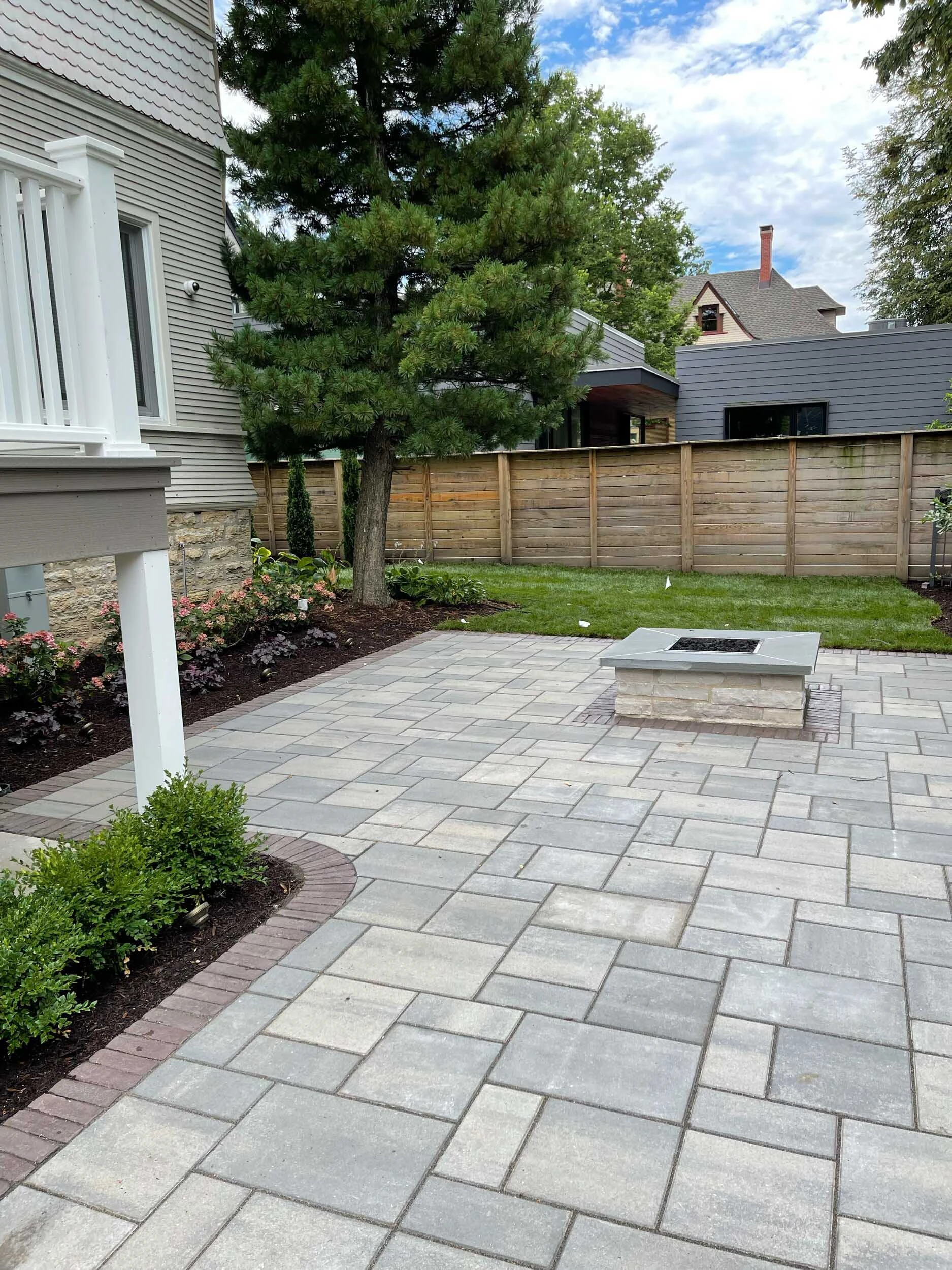
This post walks the actual clearance math — NFPA setbacks, the overhang adder nobody talks about, Dacula’s summer wind problem, the 12-foot ground-cover rule, tree canopy, patio surface, and the insurance documentation a Georgia homeowners policy quietly requires. Follow the full stack and the firepit lives where it should. Skip one and you’ve designed a hazard.
Step 1 — Start With the NFPA 1143 Baseline Number
NFPA 1143 — the National Fire Protection Association’s wildland fire standard — and its residential companion NFPA 1144 establish the defensible-space numbers most municipal fire codes cite or mirror. For a wood-burning firepit, the baseline minimum is 10 feet from any combustible structure. For a gas firepit, the baseline drops to 5 feet. That gap isn’t arbitrary. It reflects the difference between a fuel source that produces sparks, embers, and unpredictable flame height (wood) versus one with controlled BTU output and zero ember production (gas).
In Dacula specifically, “combustible structure” means more than the main house. It means the detached shed, the wood privacy fence, the cedar pergola, the composite deck, the wood storage lean-to, and — critically — the neighbor’s fence if your lot line is close. Hamilton Mill’s community privacy fencing, cedar and pressure-treated structures common in Auburn Park, and the resin-based composite decking that’s become standard in newer Dacula builds all count as combustible for firepit-clearance purposes.
The NFPA baseline: 10 ft minimum from any combustible structure for wood-burning fire features; 5 ft minimum for gas. These are floors, not targets.
Homeowners push back on 10 feet constantly. They’ll measure from the kitchen door to a spot they imagined on the patio and the spot is 7 feet away. They’ll argue the spark screen handles the ember problem. They’ll point to a neighbor’s installation that sits closer and say it’s been fine for years. None of that changes the number. The screen reduces ember production; it doesn’t eliminate it. The neighbor has been lucky. On jobs where we can’t hit the code, we move the firepit — not the code.
Gwinnett County’s fire marshal office defers to NFPA and IRC standards for residential fire features. There isn’t a separate “Gwinnett number” that’s more lenient. When the inspector shows up for a pool-adjacent firepit tied into a permit, he’s measuring to the 10-foot line.
Why Gas Gets a Shorter Setback
Gas firepits have three safety advantages over wood that justify the 5-foot minimum. First, the flame is controlled — when you turn the valve down, it goes down. Wood fires don’t obey valves. Second, no ember production: gas burns clean, no glowing fragments lifting on updrafts. Third, the BTU output is known. A 65,000 BTU gas firepit produces a predictable radiant heat curve; a wood fire’s intensity depends on the operator’s fuel choice, stacking pattern, and how recently they piled on oak versus pine.
That said — the 5-foot gas minimum still assumes a clear non-combustible zone around the burner. A gas firepit surrounded by pine straw isn’t safer than a wood firepit on concrete just because the fuel changed. The surface matters (Step 3) regardless of fuel type.
Step 2 — Add the Overhang Adder and Solve the Wind
Here’s the rule most designers skip and most homeowners have never heard: if there’s a combustible soffit or eave within 25 feet vertically above or diagonally adjacent to the firepit, add a minimum of 3 feet to the setback. For a wood-burning firepit near a home with vinyl soffits (the default on 1995-2010 Dacula subdivision homes), you’ve now moved from a 10-foot baseline to a 13-foot working minimum.
The reason is vertical ember travel. A wood fire’s updraft can loft a glowing ember 20 to 40 feet straight up on a calm night, and once airborne the ember can drift 15-30 feet laterally before landing. Hamilton Mill’s taller two-story homes with deep soffit returns create a landing platform. Dacula’s older ranch-style homes near Dacula Rd with open-eave construction can catch an ember inside the attic venting if the screen is compromised. The 3-foot adder gets you past the overhang’s lateral shadow.
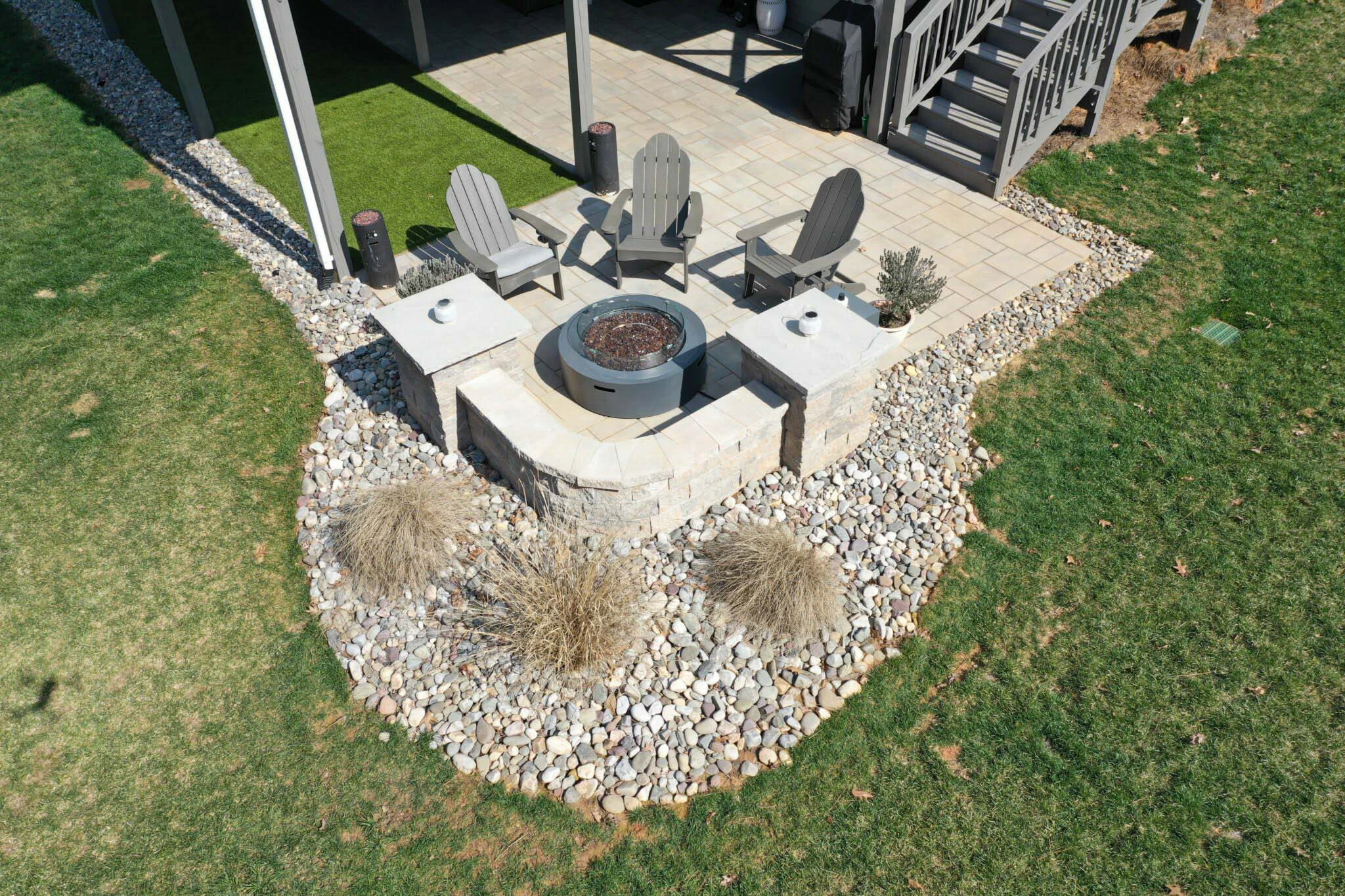
Check the soffit material before you measure. Aluminum soffit with aluminum fascia is non-combustible; skip the adder. Vinyl soffit is combustible — vinyl melts at 160°F and ignites near 450°F, and a glowing ember sits at 1000-1600°F. Cedar or painted wood soffit is the worst case; it’s what caught on that October job. If the home has any combustible surface within the vertical cone above the firepit site, the 3-foot adder applies.
The overhang adder: Add 3 ft to the baseline setback when combustible soffit, eave, fascia, or overhang sits within 25 ft of the firepit. A wood firepit under a vinyl-soffit two-story home goes from 10 ft minimum to 13 ft working minimum.
The Dacula Prevailing Wind — The Smoke Problem
The baseline setback handles radiant heat and ember safety. It does nothing for smoke. Dacula’s summer prevailing wind runs from the southwest — warm air moving up from the Alcovy basin, through the Mulberry River corridor, and across the ridgeline that runs through Hamilton Mill and Ivey Chase. If your firepit sits northeast of the house, the wind drives smoke directly into the home’s windows, the covered porch, and — if the home is open — through the interior. Guests cough, HVAC filters fill with soot in weeks instead of months, and nobody enjoys the fire.
The correct wind-sided placement is firepit southwest of the house, where the prevailing summer breeze pushes smoke away from the home. Winter wind shifts north/northwest, but winter fires happen less often in Gwinnett’s mild climate.
On tight lots this turns into a real constraint. If the backyard sits north of the house (common on Hamilton Mill’s south-facing subdivision layouts), you don’t have a southwest option without breaking the setback. You’re choosing between two compromises — accept the smoke drift, or reorient the outdoor living area to put the firepit on the west or southwest side of the lot and extend the patio to reach it. The second option costs more. The first option means you use the firepit half as often because the smoke is unlivable. We flag the wind problem before design starts. A simple north arrow with an SW arrow for summer prevailing wind overlaid on the site plan usually settles it inside five minutes.
Step 3 — Clear the Ground, the Canopy, and the Surface Beneath
Radiant heat setback handles the structure. Ember drift handles the overhead. The third layer — the one people forget — is a 12-foot radius of non-combustible material around the firepit at ground level. No dry grass, no pine straw, no hardwood mulch, no wood chips, no dry leaf accumulation within 12 feet of the flame center.
Pine straw is the specific Dacula problem. It’s ubiquitous across Gwinnett — cheap, locally sourced from long-leaf and loblolly stands, and clean-looking around foundation plantings. It’s also the single most flammable landscape ground cover in regular residential use. A dry pine straw bed ignites from a single ember and runs a surface fire across the yard in under a minute. We’ve seen it happen on a lot in Providence Club — firepit was far enough from the house, but pine straw ran from the firepit edge to the foundation plantings and the fire climbed the siding from ground level.
The 12-foot radius means the patio itself has to be large enough, or you need a transition zone of gravel, river rock, concrete, or bare packed soil between the firepit edge and any mulch bed. On a 16×20 paver patio with a centered firepit, you’ve got the radius built in. On a smaller patio where the firepit sits near the edge, add a gravel or flagstone apron.
Tree Canopy — The Vertical Version
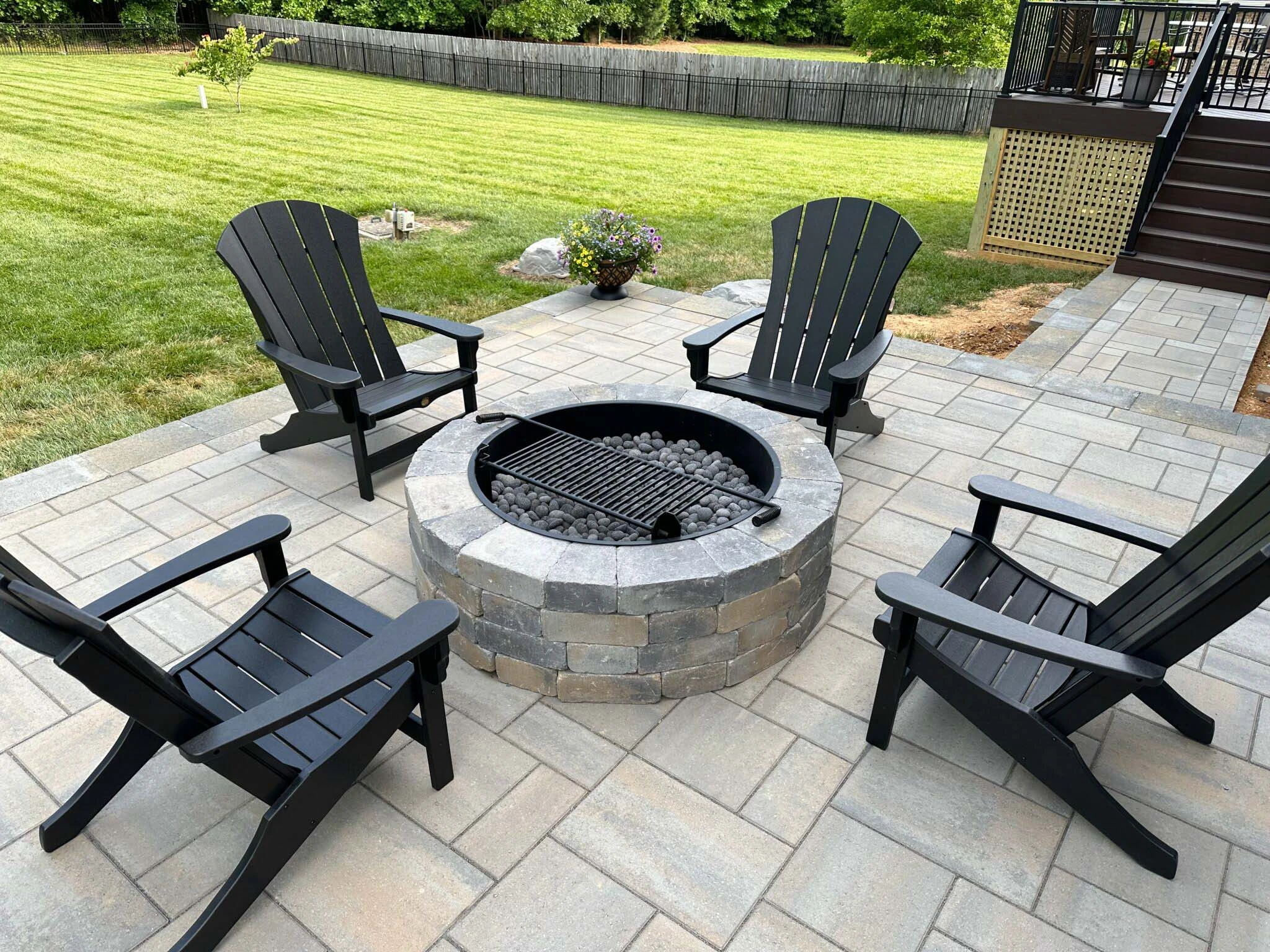
The ground-cover rule has a vertical twin. For a wood-burning firepit, the overhead clearance minimum is 20 feet of open sky directly above the flame. No overhanging tree limbs, no trellis, no pergola roof. For gas, 8 feet is the typical minimum because the flame height is controlled and ember production is zero.
Dacula’s mature hardwoods are the obstacle. Hamilton Mill and older sections of Dacula have canopy coverage from oaks, hickories, and sweet gums that often extends 40-60 feet outward from the trunk. A firepit that clears the 10-foot structure setback may still sit directly under a 35-foot-tall limb covered in summer foliage. Dry leaves in that canopy — especially during October’s seasonal drop — are fuel. A rising ember at 1500°F catches a dead leaf and you’ve got a crown-fire starter. Prune the canopy back, or relocate the firepit. On protected specimen trees in certain Dacula HOAs (Hamilton Mill’s covenants protect select hardwoods over a diameter threshold), the pruning may not even be allowed. Check before you cut.
Overhead clearance: 20 ft vertical open sky above a wood firepit; 8 ft above a gas firepit. No limbs, no pergola roof, no trellis overhangs within that cone.
Patio Surface — Where the Firepit Actually Sits
Concrete, flagstone, poured slab, travertine, and full-bedded pavers are non-combustible and handle radiant heat directly under a firepit without degradation. These are the default correct answers for Dacula installations.
Wood deck is the problem. Cedar, pressure-treated pine, and composite decking all count as combustible surfaces, and a firepit sitting directly on any of them will eventually char, warp, or ignite. If the design absolutely requires a firepit on a deck — rare but it happens on walk-out basement decks in Dacula’s sloped lots where grade doesn’t allow a ground-level patio — the installation needs a fire-rated heat shield with a minimum 1-inch air gap above the deck surface. The shield dissipates radiant heat; the air gap lets convective cooling happen; the combination protects the deck boards below. It’s a real engineered detail, not a sheet of metal laid flat — trapped heat cooks the deck boards instead of protecting them.
Practical Dacula recommendation: extend the patio to meet the firepit, or move the firepit to where the patio already is. Building a non-combustible surface that contains both the firepit and the 12-foot ground-cover radius is cheaper and safer than engineering a deck-mounted solution.
The Insurance Line Homeowners Don’t See Coming
Georgia homeowners-insurance policies underwrite single-family residential properties with a clause that covers exterior fire features, conditional on setback. The conditions vary by carrier, but the common thread across State Farm, Allstate, USAA, Nationwide, Farmers, and Georgia-specific underwriters like Georgia Farm Bureau is a documented 10-foot minimum setback from any combustible structure for wood-burning features, with some carriers requiring 15 feet for uncovered wood firepits.
That matters for two reasons. First, if a fire originating from the firepit damages the home and the setback wasn’t met, the claim can be reduced or denied under the “reasonable care” or “ordinance compliance” language in the policy. Second, on any post-loss inspection, the adjuster is measuring. We’ve seen homeowners discover post-loss that their firepit was 8 feet from the soffit instead of 10 — a distance nobody cared about before the fire and that suddenly defined the payout.
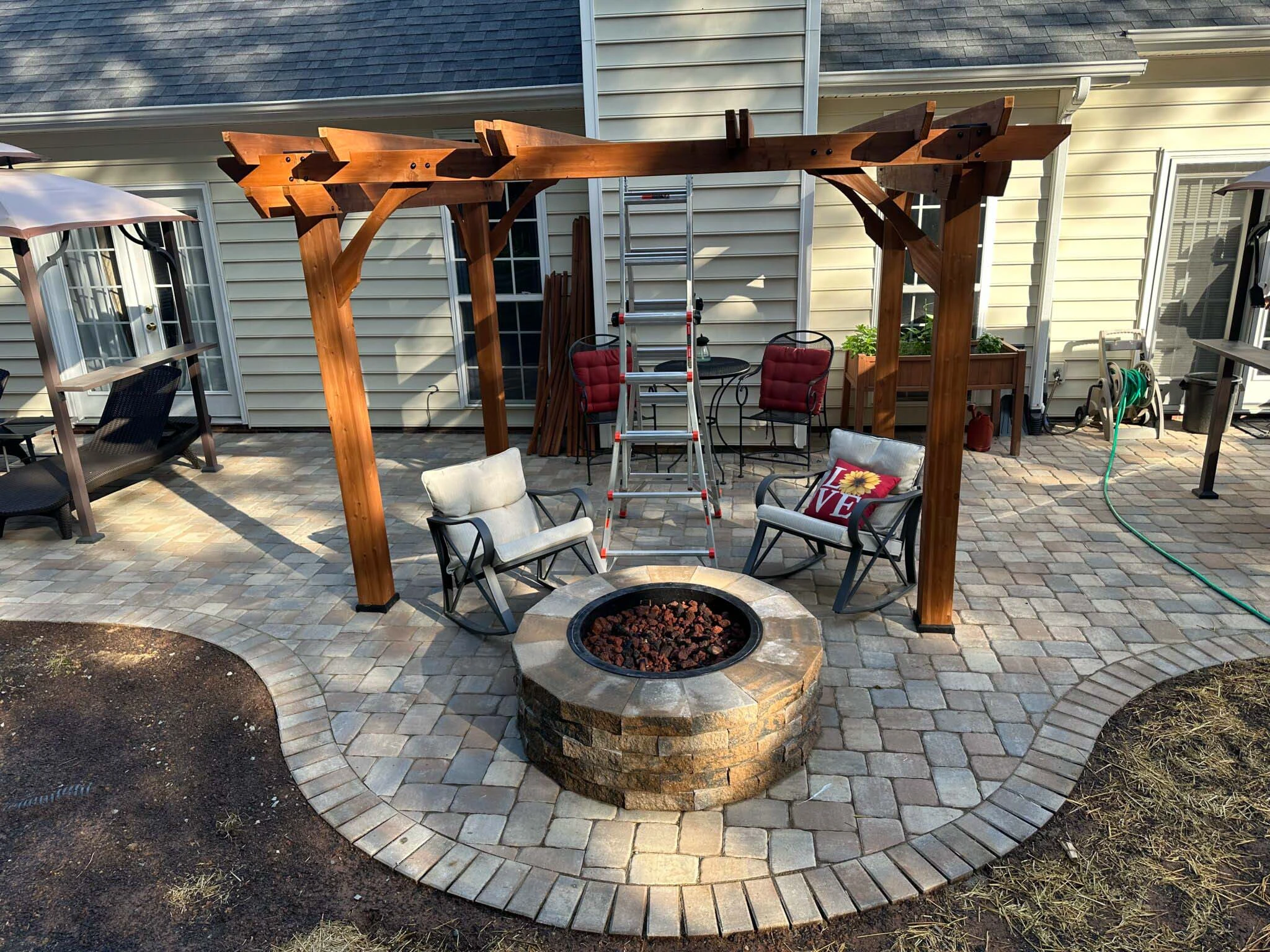
Keep documentation. When we finish a firepit install, the homeowner gets a photo with a measuring tape extended from the closest combustible surface to the firepit center, a site plan showing the same measurement, and manufacturer paperwork for any gas components. File it with the home’s insurance records. Fifteen minutes of documentation can save a five-figure claim dispute.
Step 4 — Put the Stack Together
Every firepit install we do in Dacula starts with a clearance calculation, not a design choice. The full stack looks like this:
- Baseline from combustible structure: 10 ft wood / 5 ft gas
- Overhang adder (combustible soffit within 25 ft): +3 ft
- Wind placement: Firepit southwest of house (summer SW prevailing wind)
- Ground cover clear radius: 12 ft non-combustible around flame center
- Overhead clearance: 20 ft vertical open sky for wood / 8 ft for gas
- Surface requirement: Concrete, flagstone, or full-bed pavers — not wood deck without engineered heat shield
- Insurance documentation: 10 ft minimum met and photographed at install
A Hamilton Mill two-story with vinyl soffits and a wood-burning stone firepit: 10 ft baseline + 3 ft overhang adder = 13 ft minimum working setback. Add patio size for the 12-ft radius and you’re designing around a 26-ft-wide hardscape footprint minimum, southwest of the home, clear of hardwood canopy.
An Auburn Park ranch-style with aluminum soffit and a gas firepit: 5 ft baseline + 0 overhang adder = 5 ft minimum working setback, with an 8-ft vertical clearance and a 12-ft ground-cover radius still in play. Tighter footprint, more design flexibility.
The math doesn’t change — it scales with the variables of the specific home and fuel choice. What doesn’t scale is the cost of getting it wrong. The homeowner who pushes for a 7-foot setback to save patio square footage is buying small savings against a catastrophic downside. We won’t build it at 7 feet. And the homeowners who push back hardest at the design stage are, consistently, the same ones who thank us two years later after their neighbor’s too-close firepit singes a porch post.
Every Dacula firepit we design runs through the full stack before the first stone gets set. Homeowners occasionally want to negotiate the numbers; the physics doesn’t negotiate. The firepit sits where the clearance stack says it sits — further from the house than intuition wanted, closer to the edge of the patio than feels centered, southwest of the home even when north was more convenient. Done right, it’s invisible that any of this was calculated. Done wrong, it’s the detail that shows up in the insurance claim.
Firepit design and installation across 20+ cities within 30 miles of Winder, GA
Every Primetime Pools firepit build runs through the full clearance stack — NFPA setback, overhang adder, wind placement, ground-cover radius, overhead canopy, surface requirement, and insurance documentation — before the first stone gets set.