
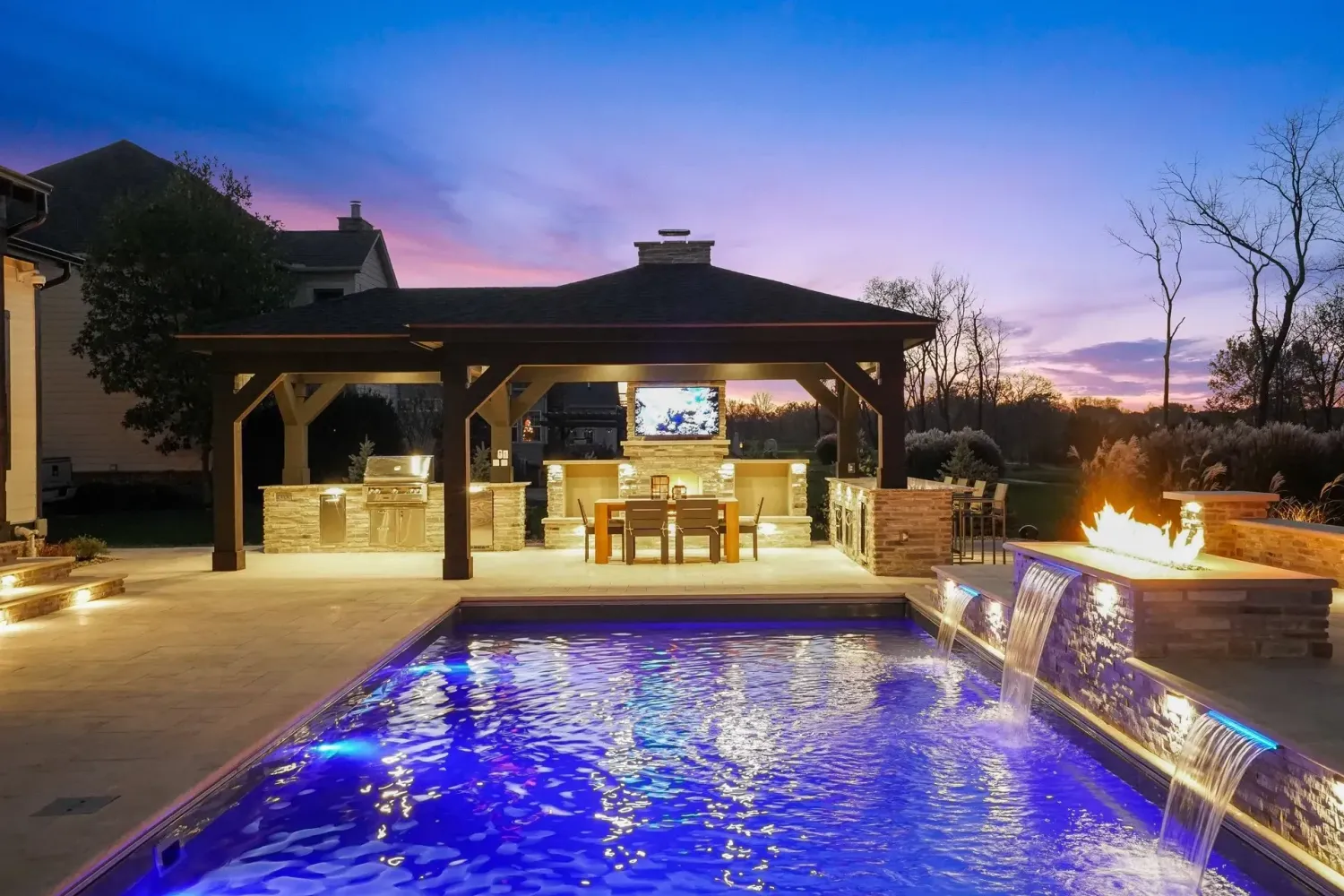
A Laurel Springs homeowner calls us in February with a single sentence: “I want the spa raised, water coming off it, and fire on both sides.” Nine weeks later, a 6-person spa sits 18 inches above the pool deck, three scuppers pour a sheet of glassy water into the main pool, and twin bronze fire bowls burn on stone pillars at either end of the spa wall. That single feature complex cost between $48,000 and $78,000 — and it will return $22,000 to $38,000 at resale on a Laurel Springs home versus a simple rectangle pool.
This post is the anatomy of that feature. Not a generic fire pit overview. Not a spa-vs-hot-tub comparison. The specific engineering, pricing, and sequencing behind the raised-spa-plus-scupper-plus-fire-bowl combination that has quietly become the signature look on the high end of Suwanee, Georgia’s luxury pool market.
If you own in Laurel Springs, The River Club, Bear’s Best Atlanta, The Manor, or any of the estate-scale neighborhoods off Peachtree Industrial Boulevard and McGinnis Ferry Road, this is the feature set you are looking at when you walk into a neighbor’s backyard and think “that is the one I want.”
Why the Raised Spa Is the Anchor of This Whole Feature
Everything in this signature complex is engineered around one decision: raising the spa. A flush-deck spa — the kind that sits at the same elevation as the pool deck and the pool waterline — is cheaper by about $8,000 to $14,000, simpler to plumb, and easier to tile. It is also visually invisible from anywhere except directly above it. In a Laurel Springs backyard, where the pool is often seen from a rear deck 12 to 20 feet up on a walkout basement floor plan, a flush spa disappears entirely.
Raising the spa 18 inches changes three things at once. First, it creates a vertical face. That face is the canvas for stone veneer, for the scuppers, and for the fire bowl pillars. Second, it forces water to fall — which means sound, movement, and the ability to cover pool-equipment noise that otherwise travels across a still pool surface. Third, it physically separates the heated zone from the main pool, so spa water at 102°F doesn’t dump into a 84°F pool and equilibrate before a guest ever sits in it.
The 18-inch height is not arbitrary. Fourteen inches looks short and awkward against a 6-foot-wide pillar. Twenty-four inches requires a step up into the spa that most adults stumble on in the dark. Eighteen is the Goldilocks number on Piedmont lots where the pool deck sits close to finished floor elevation — which is most of Suwanee’s 2000-to-2015 luxury builds.
Spa shell itself is typically a 6-person or 7-person shotcrete vessel with 5 to 7 therapy jets plus a blower. On our Laurel Springs builds the interior finish matches the pool — usually a blue-flecked pebble aggregate — so the eye reads the whole water envelope as one composition, not as a pool with a tacked-on hot tub.
Signature Spec: Spa raised 18″ above pool deck, 6-person shotcrete shell, shared heater with pool, dedicated spa pump, three scupper outlets pre-cast into the front wall, two fire-bowl gas stubs pre-run through the rear wall. All pre-plumbed at gunite stage, not retrofitted.
The Three-Scupper Spillover — Engineering, Not Decoration
A scupper is a water outlet that projects from a vertical wall and lets water fall freely — unlike a sheer descent or a rill, which is a continuous sheet. On a raised spa, a scupper serves double duty: it is a decorative water feature when the spa is idle, and it is the spillover path when the spa is in use. When a guest turns the spa jets on and the water level crests the weir, water pours through the scupper back into the pool. That is the self-leveling mechanism. It means no separate overflow drain. It means no pump trying to time a dump cycle. It means the hydraulic system takes care of itself.
Three scuppers is the right number for a 6-person spa. One scupper creates an obvious central jet and leaves dead zones at the spa corners. Two scuppers look intentional but unbalanced — the eye reads them as a pair, not as a composition. Four scuppers visually crowd a standard 8-foot spa wall and create a curtain effect that hides the stone veneer we paid to install. Three is the composition — one centered, two flanking, each roughly 18 to 22 inches from the next.
Sizing matters. A 2-inch scupper flows about 12 gallons per minute at our typical head pressure. Three scuppers = 36 GPM through the spillover path. Our spa pump is sized to deliver between 40 and 50 GPM when circulating, which means the spillover is always flowing when the spa system is on, and the spa water gets turned over faster than a closed-loop hot tub. The practical effect for the owner: water stays clearer, chemistry stabilizes faster, and the spa never develops the stagnant-hot-tub smell that plagues closed-system residential hot tubs.
Material choice on the scupper face affects both sound and longevity. Bronze scuppers develop a warm patina over 4 to 6 years in the Zone 8a climate, blend with bronze fire bowls, and don’t corrode in chlorinated or saltwater. Stainless polished scuppers stay mirror-bright but read as modern and clash with stacked-stone pillars. We default to bronze on traditional-architecture Suwanee homes and stainless only when the homeowner has selected contemporary architecture throughout.
The Twin Fire Bowls — Pillar Height, Gas Sizing, and the Bronze Question
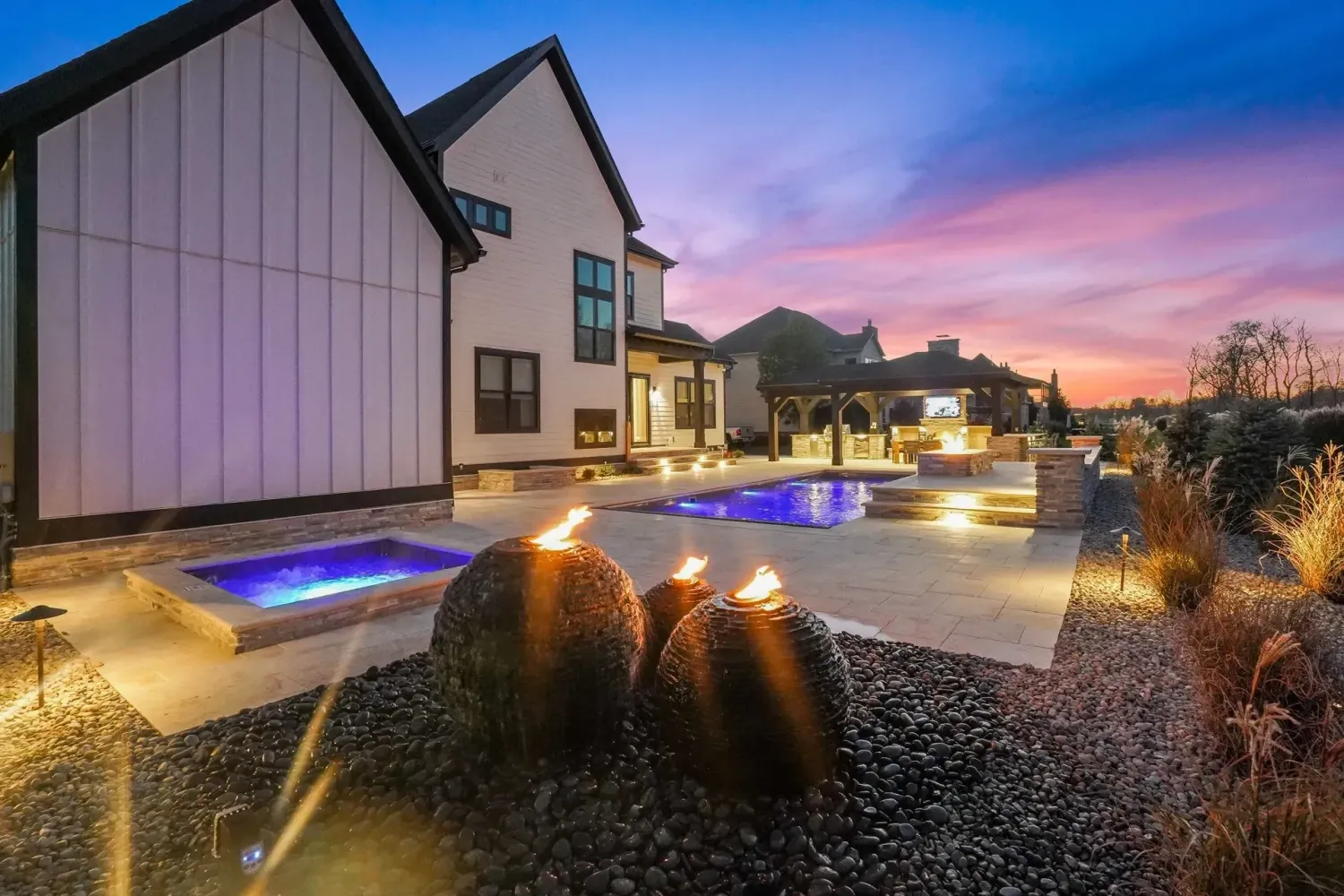
On either end of the spa’s back wall, we build two stone pillars roughly 28 to 32 inches tall, 24 inches square, and cap each with a bronze fire bowl. The bowls are typically 24″ or 30″ diameter — American Fyre Designs, Bobe, or Grand Effects depending on what the homeowner has spec’d. Each bowl runs on natural gas with an electronic ignition, a manual shutoff at the base of the pillar, and a control panel integrated into the pool automation system.
Pillar height is engineered from seat height. A guest sitting in the spa with shoulders just above the water is at roughly 34 to 36 inches of eye level. Fire bowls set at 28 to 32 inches put the flame just below eye level — close enough to feel the warmth on cool fall evenings, not so close that the flame blinds the guest sitting across the spa. Any taller and the fire feels detached from the spa experience; any shorter and the flame reflects off the spa water and creates glare.
Gas sizing is where most backyard fire-bowl installs fail. A single 24-inch fire bowl at full flame draws about 65,000 to 90,000 BTU/hour. Two bowls = up to 180,000 BTU/hour. Most Suwanee homes built 2000 to 2015 were spec’d with a 3/4-inch gas line from the meter to the back of the house, with a single 1-million BTU whole-house capacity. Add a pool heater (400,000 BTU), two fire bowls, an outdoor grill, and a gas-fired pool-deck kitchen — and you are at 900,000-plus BTU demand before you run the furnace.
On most of our Laurel Springs builds we upsize the gas run from the meter to a pool equipment pad with a dedicated 1-1/4″ line running from the meter to a subpanel manifold, then split from there to the pool heater, the fire bowls, and any outdoor kitchen elements. Atlanta Gas Light handles the meter upgrade if capacity needs to grow. Getting this wrong means fire bowls that flicker and die when the pool heater kicks on — the single most common complaint we inherit from other builders’ projects.
The Trench Play — Why Gas and LED Share One Dig
Here is the move that saves between $3,800 and $6,400 on every build of this feature complex: we trench the gas line, the low-voltage LED feeds for the spa underlighting, and the control wiring for the fire bowls all in one pass. One cut across the pool deck footprint, one backfill, one inspection.
Most pool companies trench gas separately (required by Gwinnett County inspectors to be at minimum 18 inches deep) and then come back later for LED conduit. That is two mobilizations of a mini-excavator, two separate landscape restoration events, two rounds of sod repair. On a typical Laurel Springs backyard where the lawn is Zoysia and the HOA requires sod replacement in kind, every extra trench event adds $1,400 to $2,200 in restoration alone.
The shared trench runs from the equipment pad, under the pool deck footprint (inside a sleeve, before the deck is poured), up the spa’s back wall inside the stone veneer void, and terminates at the fire-bowl manifold and the LED driver junction box. Gas is inside a rigid steel line; LED conduit is 3/4″ PVC with pull strings. Separation per code is maintained vertically inside the trench — gas at the bottom, LED 6 inches above, then aggregate fill.
The LED underlighting itself is typically 2700K warm white or a color-changing RGBW product from Pentair, Jandy, or Hayward. On a raised spa with bronze fire bowls, we default to 2700K — the fire bowls already provide warm color, and RGBW underlighting competes with the flame for attention. Save the color-change lights for the main pool body.
What It Costs — The Honest Breakdown at $48K to $78K
The range is wide because the decisions inside the feature are. Here is the rough component math on a typical Laurel Springs project in 2026 pricing:
- Raised spa shell upgrade over flush spa: $8,000 to $14,000 (additional gunite, additional forming, additional steel)
- Stone veneer on spa front and pillars: $6,500 to $14,000 depending on stone selection (dry-stack fieldstone vs cut ashlar vs thin-veneer engineered product)
- Three bronze scuppers plus plumbing: $3,800 to $6,200 installed
- Two bronze fire bowls, 24″ to 30″: $5,200 to $9,800 depending on manufacturer and size
- Fire bowl gas infrastructure (upsized line, manifold, shutoffs, ignitions, automation integration): $4,800 to $8,400
- Spa LED underlighting (integrated with main pool system): $1,600 to $3,200
- Engineering premium for the integrated complex (coordinated gunite, trench, veneer sequencing): $3,500 to $6,000
- Gwinnett County permit fees and plan revisions for the feature additions: $600 to $1,400
Low end of the range — ~$48K — is a 24″ fire bowl, thin-veneer engineered stone, standard bronze scuppers, 2700K underlighting. High end — ~$78K — is 30″ fire bowls, hand-selected dry-stack fieldstone veneer, custom bronze scuppers, RGBW programmable underlighting, and an automation panel that ties the whole complex into a homeowner’s phone.
Financing reality: Laurel Springs and River Club homeowners typically roll this feature complex into a total pool build of $180,000 to $340,000. It is rarely done as an add-on later — the cost of cutting back into a finished pool deck to add scupper plumbing and a gas run is $22,000 to $35,000, roughly 2× the cost of doing it right at construction.
The Resale Premium — What Laurel Springs Buyers Actually Pay Extra For
Here is where the signature detail matters most. On a comparable-square-footage, comparable-condition Laurel Springs home, a pool alone adds roughly 6-8% to the appraised value in the 2026 Gwinnett luxury market. A pool plus this specific fire-spa-scupper feature complex adds an additional $22,000 to $38,000 on top of the pool’s base contribution — often more, because buyers at the $1.4M-plus price point in Laurel Springs are looking for the exact visual signature this feature creates.
The River Club at Suwanee and Bear’s Best Atlanta both run higher — closer to $38K to $52K of incremental resale value on estate homes where the pool is visible from the primary great room. Listing agents who specialize in the 30024 zip code will tell you, without prompting, that the single biggest driver of a pool-to-pool value comparison at this price point is whether the pool reads as “full custom” or “tract pool.” The raised spa with spillover plus twin fire bowls is the fastest visual cue that the pool is full custom.
What it is not: a universal upgrade. On a mid-market Settles Bridge ranch house with a 3/4-acre lot and a $650K price point, the feature is actually a liability. Overbuilt pool complexes on modest homes can depress sale price because they signal maintenance cost without signaling status. This is a Laurel Springs / River Club / Manor / Bear’s Best feature. In those specific submarkets of Suwanee, it is the highest-ROI pool upgrade we build.
The Nine-Week Build — Why HOA Approval Sets the Clock
Laurel Springs’ Architectural Review Committee runs a 3 to 4-week submission review cycle — one of the strictest processes in Gwinnett County. That review clock is usually the long pole in the tent, not anything on the construction side. We submit to the ARC in parallel with the Gwinnett County permit process at 446 W. Crogan St. in Lawrenceville, so that when the ARC approves, the county permit is usually already in hand or close to it.
- Weeks -6 to -3 (pre-construction): Design finalization, material selection, ARC submission, Gwinnett County plan submission. Scupper sizing, fire-bowl selection, pillar geometry locked.
- Week 1: Excavation, rough plumbing layout, electrical rough-in to spa location.
- Week 2: Steel and rebar — this is where the raised spa takes shape. Extra reinforcement in the spa front wall for scupper penetrations.
- Week 3: Gunite (shotcrete) spa and pool shell together as a single pour to eliminate cold joints.
- Weeks 4-5: Tile, coping, pool interior prep. Shared trench dug for gas and LED.
- Week 6: Stone veneer on spa front and pillars. Scupper bodies mounted. Fire bowl mounts set.
- Week 7: Deck pour, gas pressure test, LED driver commissioning, final plumbing tie-ins.
- Week 8: Equipment pad finish, automation panel configuration, spa plaster / pebble interior.
- Week 9: Fill, balance, start-up, fire bowl commissioning, owner walkthrough. Final Gwinnett inspection.
The critical sequencing note: the gunite shell must include both spa and pool in a single pour. A separate spa pour bonded to an existing pool shell is a crack waiting to happen at the seam — especially given Zone 8a freeze-thaw cycles (roughly 20 freeze events per year in Suwanee), which work any cold joint to death over 3 to 5 years.
Where It Fits — Pergola, Kitchen, and Evening Use
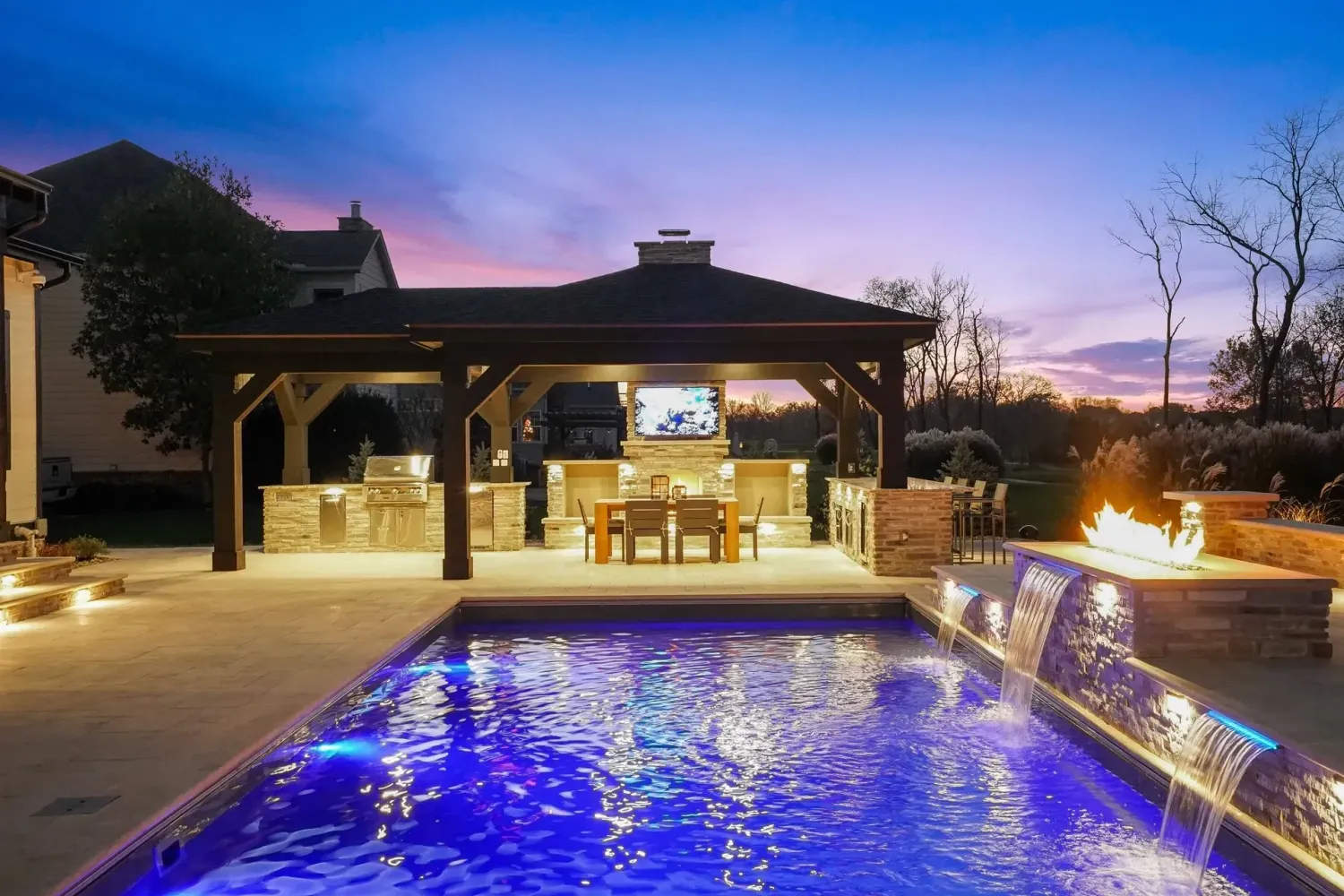
This feature is at its best in combination. A pergola 10 to 14 feet away with a built-in outdoor kitchen turns the signature spa complex into the evening centerpiece of an 1,800 to 2,600 square-foot outdoor living zone. The fire bowls throw enough light to double as site illumination. The scupper sound covers kitchen-hood noise. The raised spa gives seated diners at the pergola something to look at.
On Laurel Springs and River Club lots where the rear yard slopes toward the Chattahoochee River, we typically set the pergola at the highest point so the sightline drops down across the pool and spa toward the river below. The fire bowls become the anchor that carries the eye across the composition. Without them, the eye stops at the pool deck. With them, it travels.
One last engineering note: electrical service. Suwanee proper is served by Jackson EMC, not Georgia Power — different meter base, different service drop spec, different inspection contacts. On a raised-spa build with integrated fire automation, LED underlighting, and a pool heater, the typical load is 70 to 90 amps for the pool equipment pad alone. On older Settles Bridge homes with 200A service, adding this complex usually means a service upgrade to 300A or 400A. Laurel Springs and River Club homes built post-2005 typically have 320A or 400A service already — no upgrade required. Always verify before pricing.
The Chattahoochee River fog that rolls into Suwanee on fall mornings also affects fire bowl operation. High humidity and saturated air can cause flame instability on a windy fall morning. Electronic ignitions with flame-sensing safety shutoff (Grand Effects and American Fyre Designs both offer this) protect the gas supply — an unsensed flame-out just vents fuel into the fog. Don’t skip the sensor.
Fire Pits & Fireplaces across 20+ cities within 30 miles of Winder, GA
Integrated raised-spa, scupper, and fire-bowl complexes engineered for Laurel Springs, The River Club, Bear’s Best, and estate-scale homes across Suwanee and the Northeast Atlanta luxury corridor.