
Three numbers decide whether a Forsyth County fire feature passes inspection or sits cold behind a stop-work order: 10 feet from any combustible structure, 5 feet from the property line, and 15 feet from a septic drain field. Add a fourth if your backyard touches Lake Lanier — 25 feet from the water’s edge per Forsyth lake code. Miss one, and the permit reviewer at 110 East Main Street sends the drawings back.
Most Forsyth County homeowners find out about these setbacks after they’ve already picked a fire-bowl location. That’s backwards. The placement decision should come after you’ve mapped the three setback circles on your site plan — not before. This post walks through exactly how we do that on the three lot types we see across Forsyth’s 247 square miles: flat subdivision lots in south Forsyth, sloped foothill lots around Coal Mountain and Sawnee, and lakefront lots on the Lake Lanier south shore.
Here’s the teaser for what’s coming. We’re going to unpack four things in order. One: the exact setback math, including the two extra rules most installers miss. Two: the flat-lot walkthrough — a typical 3/4-acre lot off Bethelview Road, 30040 zip. Three: the sloped-lot walkthrough — a 2.5-acre estate off Kelly Mill with a 14-foot grade drop. Four: the lakefront-lot walkthrough on a Browns Bridge Road south-shore parcel. By the end you’ll know whether your fire feature idea is a $6,800 gas pit or a $19,000 stone fireplace with three permit revisions.
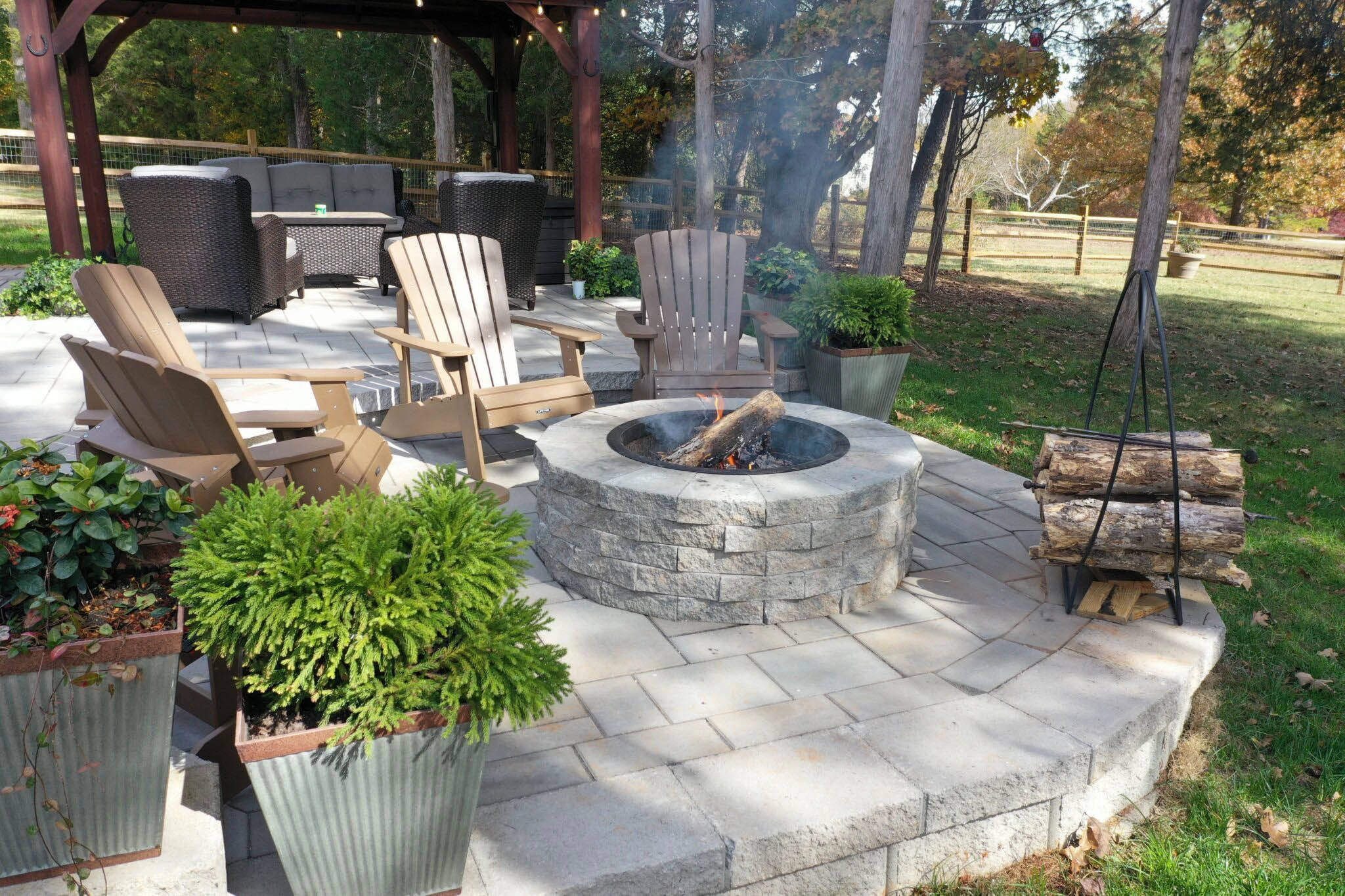
Step 1 — The Setback Rules Forsyth Actually Enforces
Forsyth County’s Community Development Department issues more than 200 pool permits per year and a comparable volume of standalone fire-feature permits. Most homeowners never see the Unified Development Code — they hear “get 10 feet from the house” and stop there. That’s half the rule. The full rule is four-part, and the permit reviewer checks every one before stamping the plan.
Rule 1 — Structure setback: 10 feet. Any open flame or solid-fuel fire feature must sit a minimum of 10 feet from any combustible structure. That includes the house, a detached garage, a pergola with a wood or vinyl roof, a pool house, and a wood privacy fence. A masonry fireplace with a code-compliant hearth and spark arrestor is measured from the firebox opening, not the chimney shoulder. Gas fire pits with UL-listed burner assemblies can reduce to 8 feet under the same rule, but almost no reviewer will accept less than 10 without a manufacturer’s written clearance letter.
Rule 2 — Property line setback: 5 feet. This is the one that catches south Forsyth subdivision lots. Many newer neighborhoods off Post Road and in the Shoal Creek corridor carry 20-foot rear-yard setbacks and 10-foot side-yard setbacks on the house itself — but the fire feature gets its own independent 5-foot line. On a typical 0.35-acre subdivision lot, that can mean the only legal fire-pit location is a 12-by-14 foot rectangle behind the patio.
Rule 3 — Septic drain field: 15 feet. Every unincorporated Forsyth lot north of Hwy 20 and most of Coal Mountain, Ducktown, and Shady Grove runs on septic, not sewer. Fire-feature footings cannot encroach within 15 feet of any drain-field lateral because heat and differential settlement both degrade the perforated pipe bed. If you don’t have the original septic as-built, Forsyth Environmental Health will pull the file from the state database for $47.
Rule 4 — Lake Lanier water edge: 25 feet. Parcels fronting Lake Lanier carry a Forsyth lake-protection overlay that requires fire features to sit 25 feet back from the 1,071-foot full-pool contour line. The U.S. Army Corps of Engineers also regulates the 1,085-foot contour for shoreline management, but that’s a separate federal rule. On almost every Browns Bridge Road and Little Mill Road parcel, the county 25-foot setback is the binding constraint.
The setback that kills the most plans: a covered pergola or louvered-roof outdoor room counts as a combustible structure if it has wood purlins. A stone fireplace you thought would anchor the pergola wall suddenly needs 10 feet of clear air between the firebox and the nearest rafter — which usually means detaching the fireplace or changing to an all-steel louvered structure with a non-combustible rating.
Step 2 — The Flat-Lot Walkthrough (Bethelview, Shoal Creek, South Forsyth)
Picture a typical south Forsyth build: 0.75 acres, rear yard 95 feet deep, 110 feet wide, house footprint 58 feet across, rear covered patio already existing, lot grade drops less than 18 inches from house to back fence. This is the most common Forsyth pattern — we see it across Bethelview, Shoal Creek, and the subdivisions off Post Road and Kelly Mill. Septic is almost always in the rear yard with laterals running parallel to the property line.
The process has five steps. Run them in order — skipping any of them costs revision time.
- Pull the septic as-built from Forsyth Environmental Health. $47, three-day turnaround. Mark the tank, the distribution box, and every lateral on a scaled site plan. The 15-foot septic buffer is usually the most restrictive zone on the lot.
- Draw the 5-foot property-line offset on all three rear and side boundaries. That gives you the legal build envelope for any fire element.
- Draw the 10-foot structure offset from the back of the house, the pergola footprint (if any), and any detached building. Watch for the privacy fence — if it’s wood, it gets the 10-foot treatment too.
- Overlay prevailing-wind direction. In Forsyth County the summer prevailing wind is from the southwest; in winter it rotates to the northwest. On a flat lot, position the fire feature so the occupied seating zone is upwind of the fire — that way smoke doesn’t blow across the conversation.
- Place the fire feature inside the remaining polygon. On a typical 0.75-acre flat lot after all three setbacks and the wind rotation, you usually have a 14-by-18 foot window — plenty for a 48-inch gas pit with a 60-inch stone surround or a linear gas trough built into a seat wall.
Budget for this lot type, $6,800 to $14,200 for a finished gas fire pit with HPC 18-inch or 24-inch burner ring, CSA-certified flex line from the house, stacked-stone or poured-concrete surround, and a code-compliant gravel base with drainage. The variable is the stone. A simple concrete-block form with stucco runs under $8k; a full dry-laid Techo-Bloc Rockland wall with inset lighting pushes $14k.
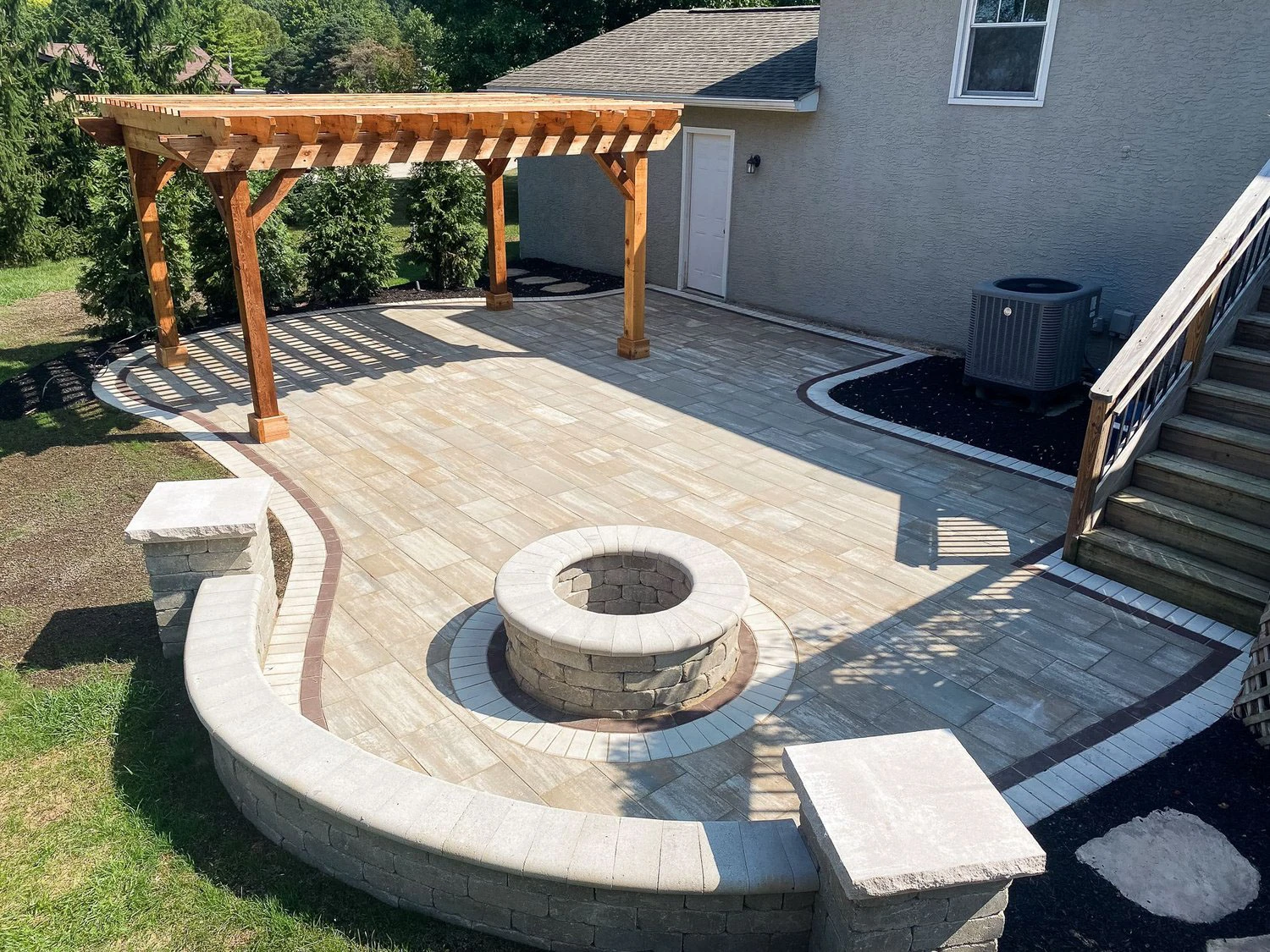
Step 3 — The Sloped-Lot Walkthrough (Coal Mountain, Sawnee, North Forsyth Foothills)
North Forsyth changes everything. The housing stock off Hwy 369, Coal Mountain, and the Sawnee foothills averages 2 to 5 acres per lot, and the grade is never flat. We routinely see 10-to-20-foot grade drops from house to rear fence, with Cecil-series clay on top and shallow bedrock underneath. The setback math is the same — but three new variables enter the frame: retaining walls, wind downwash, and terrace structural load.
The order of operations shifts. On a sloped lot, you don’t place the fire feature first — you place the terrace first, and the fire feature lives inside the terrace.
- Decide the terrace elevation. Most north Forsyth outdoor rooms sit 5 to 9 feet below the main-house floor on a stepped-down patio. That elevation choice controls everything else — retaining wall height, drainage, and fire-chimney height.
- Engineer the retaining wall. Any wall over 4 feet requires a stamped engineering drawing in Forsyth County. Over 6 feet, you’re into tiered design with geogrid — typically $42 to $58 per square face foot for an engineered block wall with proper drainage chimney.
- Apply all four standard setbacks to the new terrace plane. The 10-foot structure rule now runs to the uphill retaining wall if that wall carries an occupied structure above it.
- Run the wind model on a sloped site. Fire chimneys on hillsides suffer from downwash — when wind hits a ridge, it drops on the leeward side and can push smoke back into the seating area. We size masonry chimneys at 36 to 48 inches above the highest point within 10 feet, which is the NFPA 211 rule applied to an outdoor hearth. On a Coal Mountain terrace cut into a slope, that often means a chimney 3 to 4 feet taller than a flat-lot equivalent.
- Verify the terrace soil bearing. Piedmont clay holds 2,000 to 3,000 psf uncompacted, more on properly compacted fill. A 900-pound masonry fireplace is fine on native grade; the same fireplace on 6 feet of new fill needs a reinforced footing or a pier-and-grade-beam system.
Budget on a sloped north Forsyth lot, $18,000 to $34,000 for a full masonry fireplace with engineered footing, stone veneer, code-height chimney, and integrated stone seat wall. The variable here isn’t the fireplace — it’s the retaining wall and drainage system that make the terrace possible in the first place. On tighter slopes we’ve seen the wall cost exceed the fireplace cost two-to-one.
Why sloped lots need stamped drawings: The combined load of a masonry fireplace (800–1,400 lbs), a paver terrace (roughly 28 lbs/sf installed), and live loads from 8–12 occupants often exceeds what uncompacted fill can hold without settlement. A Georgia-licensed PE stamp costs $400 to $900 and is required on any wall over 4 feet. Skipping it fails inspection every time.
Step 4 — The Lakefront-Lot Walkthrough (Lake Lanier South Shore, Browns Bridge Corridor)
Lakefront changes the math again. Forsyth County’s Lake Lanier south-shore parcels — roughly the stretch from Browns Bridge Road east to Little Mill and the Shady Grove coves — carry three overlapping jurisdictions: the Forsyth County UDC, the Corps of Engineers shoreline management plan, and, in some sub-watersheds, the state stream-buffer rule. All three matter for fire placement.
The Forsyth lake overlay adds the 25-foot water-edge setback on top of the four standard rules. But that’s not the only constraint. The Corps regulates everything lakeward of the 1,085-foot contour — no permanent combustible structures allowed without a Corps permit, which nobody gets for a private fire pit. That leaves you a narrow legal band between 1,085 feet (Corps) and however far the county 25-foot buffer pushes you up from the 1,071-foot full-pool line.
On most south-shore parcels that legal band is 18 to 40 feet wide, running parallel to the shoreline. Here’s how we place a fire feature inside it:
- Survey both contour lines first. We have a land surveyor mark the 1,071-foot and 1,085-foot contours in the field with flagging tape. Without those markers, every other decision is a guess.
- Measure 25 feet uphill from the 1,071 line. That’s the inner edge of your legal fire-feature zone. Mark it with paint or staked string across the entire shoreline run.
- Overlay house and structure setbacks. Lakefront houses often sit close to the 1,085 Corps line. The 10-foot structure rule from the lake-side porch or screened room can push the legal fire location to within a 6-to-8-foot-wide sliver.
- Account for off-shore wind. Lake Lanier generates a reliable onshore breeze from about 10 AM to 6 PM in summer. A fire pit placed too close to the water edge pushes smoke into the house — the opposite of what you want. We typically position lakefront fire features on the uphill side of the patio, with the shoreline viewing area downhill and downwind.
- Specify non-combustible structure materials. If the fire feature is part of a lake-view pavilion, the pavilion has to be steel, stone, or composite non-combustible material throughout — because the 10-foot structure rule applies to the pavilion itself, and a wood pergola in that compressed band is effectively impossible to permit.
Budget for a lakefront fire feature with the additional survey, permit, and engineered-footing overhead, $14,500 to $28,000. A surveyed contour stake-out alone runs $700 to $1,400 and has to be done before the drawings go to the county. Nobody bypasses this step successfully — we’ve watched two different homeowners lose full deposits to contractors who tried to eyeball the water line.
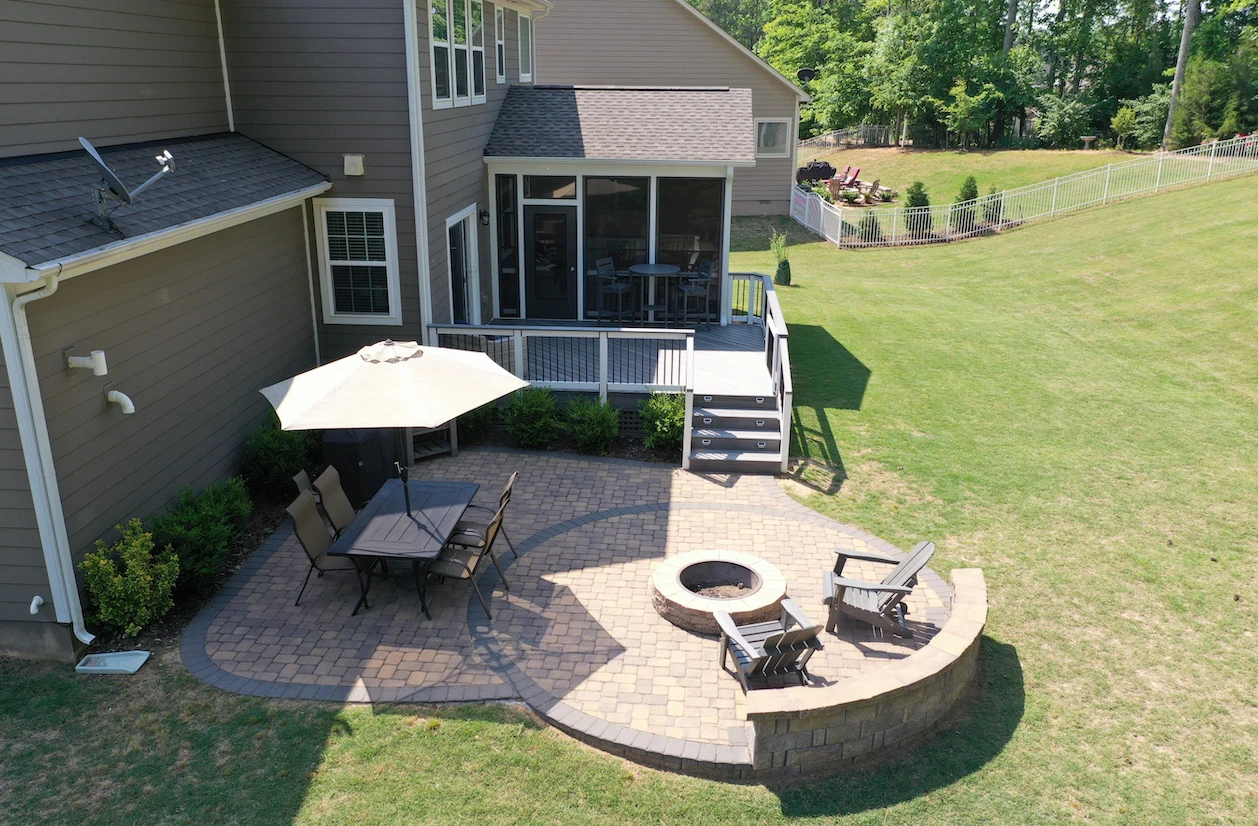
A Note on Zip Codes and Local Variation
Forsyth County splits into three primary zip codes — 30028 in the north, 30040 west-central including Cumming, and 30041 in the south. The setback rules don’t change across zips, but the site conditions do. 30028 (Coal Mountain, Ducktown) is where we see the most sloped lots, shallow bedrock, and septic. 30040 has the mix — some flat subdivisions near Sawnee Mountain Preserve, some hillside estates off Hwy 369. 30041 is mostly flat subdivision terrain along Post Road, Kelly Mill, and the south end toward Alpharetta — and almost all of it is now on municipal sewer, which removes the septic-buffer constraint entirely.
Neighborhood density also matters. The Shoal Creek, Big Creek, and Brookwood corridors carry HOA architectural-review committees that add design requirements on top of county code — things like matching house masonry, chimney-cap style, and approved gas-line routing. Factor 2 to 6 weeks of HOA review into the timeline before permit submittal. That’s on top of Forsyth County’s own 10-to-15-business-day plan review for standalone fire features, and 20-to-30 days if the fire feature is bundled with a pool permit.
Sawnee EMC handles most of the electrical service in the county, and if your fire feature has integrated landscape lighting, the line-voltage work ties back to their meter — no separate approval needed beyond the standard Forsyth electrical permit.
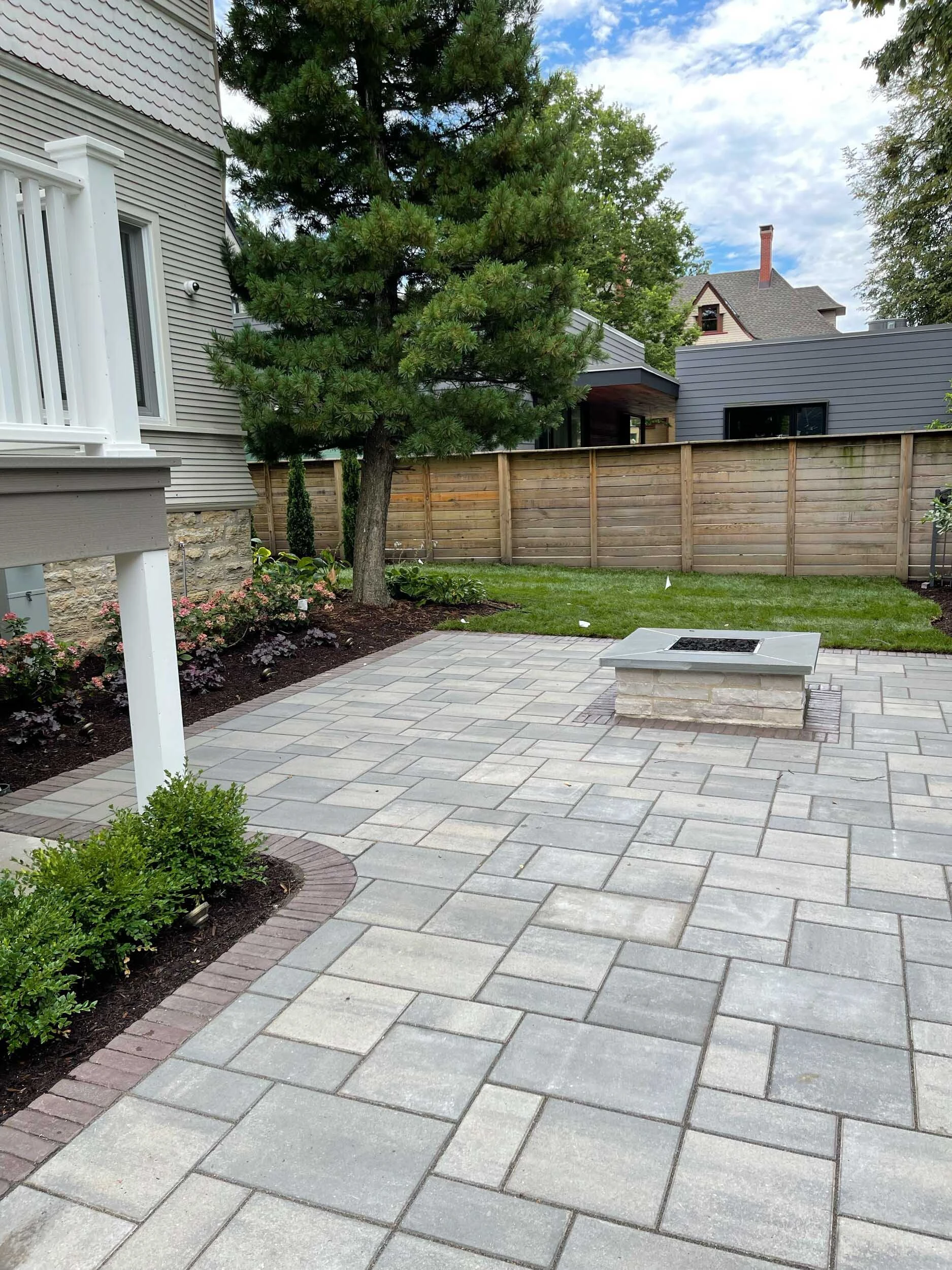
What to Bring to a Site Meeting
When we walk a Forsyth County lot before designing a fire feature, these five documents shortcut the whole process:
- The recorded plat (available through the Forsyth County GIS portal, free)
- The septic as-built if the lot is on septic — $47 from Environmental Health
- The HOA architectural guidelines if applicable (ask the management company directly)
- A rough sketch of where you want the fire feature, even if you know it might move
- Any prior permits for the pool, pool deck, or outdoor kitchen — they show existing gas and electrical routing
With those in hand a single site visit is usually enough to lock the fire feature’s location, orientation, and rough budget. Without them, we end up billing two site trips and still guessing at setback lines.
Fire pit and fireplace design across 20+ cities within 30 miles of Winder, GA
Three lot types, four setback rules, and one plan reviewer between you and a fire feature that actually gets built. We walk the site, mark the contours, and draw the envelope before anybody picks a stone.