
Why does a fire pit that looked perfect on the contractor’s site plan start leaning, smoking back into the seating area, or rocking on its footing by year three on a Haw Creek lot? The answer is not workmanship. It is that the feature was placed against the hill instead of with it — and the wind and water around a 3 to 8 foot grade drop do not forgive that mistake.
The short version: A sloped Cumming backyard is not a flat backyard with a tilt on it. It is a micro-landscape with its own prevailing wind channel, its own storm-water corridor, and its own freeze-thaw cycle running along the downhill edge. When you drop a 1,400-pound gas fireplace or a stacked-stone fire pit into that micro-landscape without accounting for all three forces, the feature becomes the lowest point on the lot — and everything the slope is moving, moves through it.
This post is specifically for the Forsyth County homeowner with a lot that drops 3 to 8 feet from the house to the rear property line. That is the dominant topography in South Forsyth — Haw Creek, Vickery, Polo Fields, and most of the 2000-to-2015 tract subdivisions sit on exactly this kind of rolling Piedmont slope. We’re going to walk through the placement math we use on every sloped Cumming install: the 15-foot setback above a grade change, the wind-shadow quadrant, and the 6-foot minimum from the natural drainage path. No generic fire pit overview. No “add ambiance with a cozy fire feature.” Just the physics and the numbers.
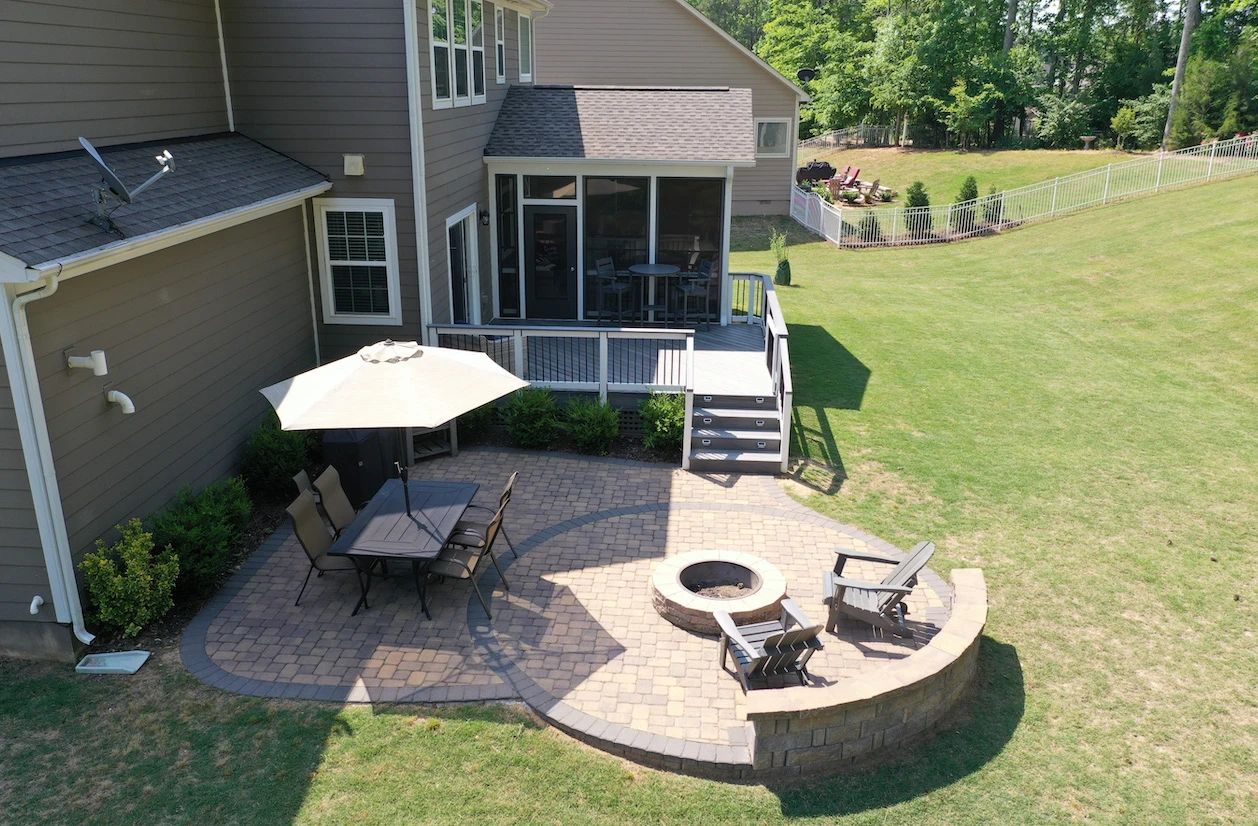
Why 3 to 8 Feet of Grade Drop Behaves Nothing Like a Flat Yard
Cumming sits at roughly 1,275 ft elevation on the southern shoulder of Sawnee Mountain (which itself rises to 1,963 ft). The entire county is gently rolling Piedmont foothills that drain south and east toward Big Creek and the tributaries that feed Lake Lanier. What that means practically: almost no Cumming backyard is actually flat. The subdivisions built between 2000 and 2015 — Hampton Park, Three Chimneys, Mashburn Plantation, Sadie Farms — were graded to meet a single-story or two-story walkout spec, which means the builder typically cut 4 to 6 feet out of the backyard to get a daylight basement elevation at the back of the house.
That cut creates three forces a fire feature has to survive:
Force one: wind eddying. When prevailing wind hits a grade break from above, it accelerates over the lip and forms a rotor — a rolling cylinder of air that curls back on itself behind the break. Sit a fire pit inside that rotor and the flame smokes toward the seating, not away from it. Put the pit 15 feet uphill of the break and the rotor sits downwind, harmless.
Force two: surface water. Piedmont red clay, specifically the Cecil series that dominates Forsyth County, has an infiltration rate of roughly 0.06 inches per hour when compacted. Compare that to the 52 inches of annual rainfall Cumming averages. Most of that water does not soak in — it runs. On a 3-to-8 foot slope, it runs in a predictable channel, and that channel is almost always within 4 to 8 feet of the steepest fall line. Build a fire pit in that channel and within 3 to 5 years the footing undermines.
Force three: freeze-thaw. Cumming averages about 22 freeze events per year. Each cycle pushes saturated clay upward roughly 3 to 5 millimeters, then drops it. A fire feature that sits in a wet channel experiences the full cycle; a feature that sits 15 feet up the slope on compacted structural fill experiences almost none of it. That difference is the single biggest predictor of whether a fireplace is plumb at year 10.
Cumming slope baseline: Assume 3 to 8 ft of grade drop from house pad to rear property line on any 2000–2015 subdivision lot. Assume Cecil clay. Assume the fall line runs within 4 to 8 ft of the steepest visible drop. Those three assumptions are correct about 85% of the time in South Forsyth.
How Lake Lanier Changes the Math
One thing Cumming gets that Dacula does not: Lake Lanier forms the entire northeast edge of the county, and the lake moves air. Evening down-lake breezes come in off the water and run southwest through Forsyth County from roughly 4 p.m. to 9 p.m. in the warm months. That is the exact window most homeowners want to sit by a fire. So the “prevailing wind” you have to design against is not the weather-station annual average — it is the evening lake breeze, which comes from a more northeasterly bearing in summer than the regional norm. We orient wind-shadow quadrants to that bearing specifically on lots within roughly 4 miles of the lake.
The Placement Math: 15 ft, Wind-Shadow Quadrant, 6 ft from the Drainage Path
Here is the rule we use on every sloped Cumming install, and it has three clauses:
1. 15 feet minimum above any grade break. If there is a visible transition where the yard drops — a retaining wall, a swale, a slope that suddenly steepens — the fire feature’s outside edge sits at least 15 feet horizontally above (uphill of) that transition. Why 15 feet? Because the wind rotor behind a 3-to-8 foot grade change extends roughly twice the height of the break downwind, and you want the feature outside that rotor. On a 6-foot break, the rotor reaches about 12 feet; 15 gives you working clearance.
2. Inside the wind-shadow quadrant. Take the prevailing wind bearing (southwest for most of Cumming, with a northeast evening component near Lake Lanier) and draw a 90-degree arc on the downwind side of the house or a mature tree line. That is the wind shadow — the quadrant where the structure blocks the prevailing gust. The fire feature sits inside that arc. Seating sits downwind of the fire, not crosswind. If the seating is crosswind, every 8 mph gust pushes smoke across the conversation, not away from it.
3. At least 6 feet offset from the natural drainage path. Walk the yard after the next hard rain. The path the water takes — usually a shallow dish or a visible line of pressed-down grass — is the drainage corridor. The fire feature’s footing sits a minimum of 6 feet laterally from that line. Better: the feature sits above a cross-slope diverter (a French drain or a surface swale) that intercepts the water before it reaches the footing.
If you apply all three clauses to a typical Haw Creek lot — say, a 0.35-acre lot with the house set 30 feet off the front, a daylight basement walkout in back, and 6 feet of drop from the rear door to the back fence — you end up with a specific placement window. It is usually on the uphill shoulder of the pool deck, offset 8 to 12 feet from the house corner, facing the downhill view. That is not a coincidence. That is the geometry telling you where the feature belongs.
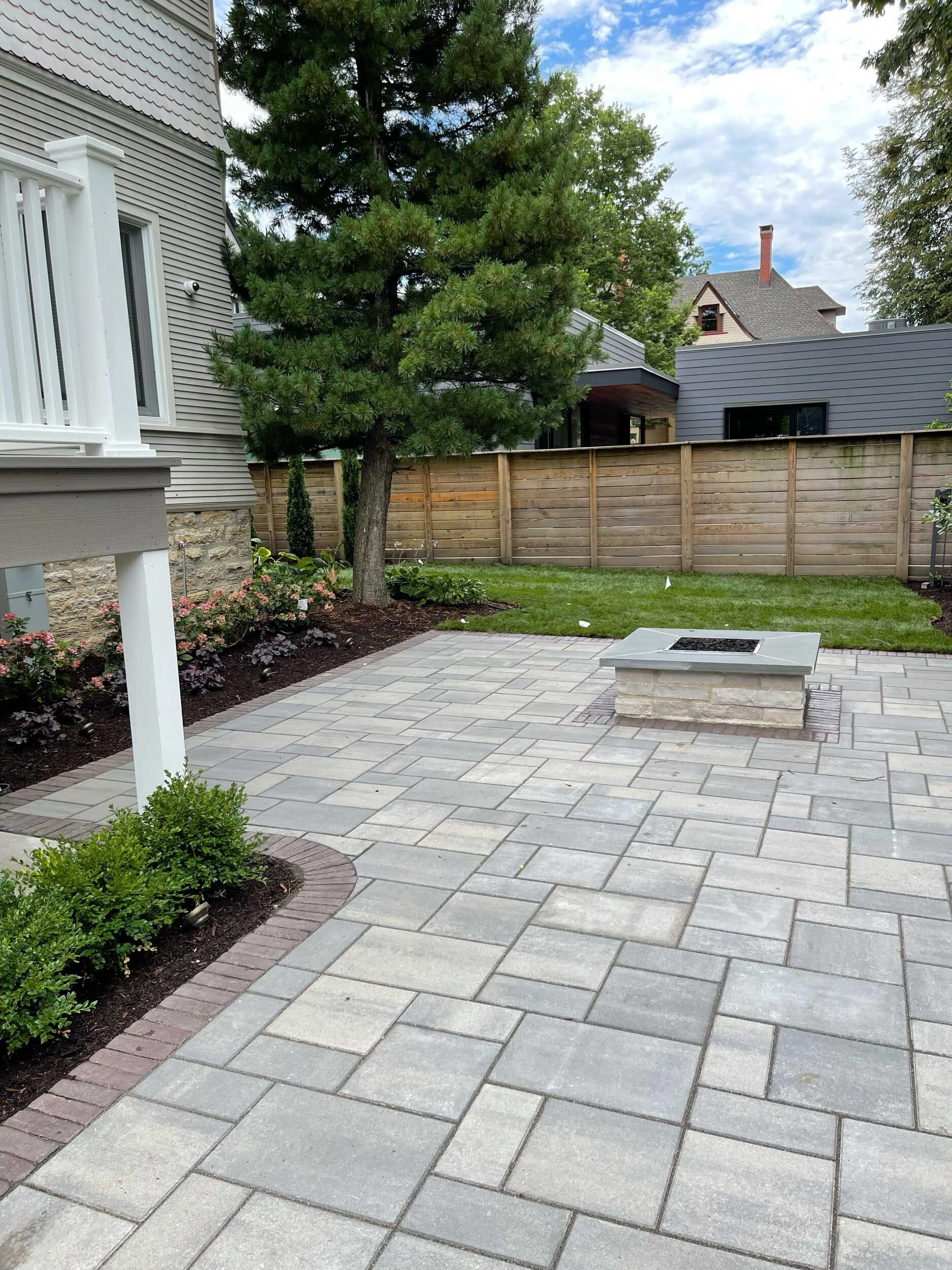
When the Code Enters the Picture
Before any of this matters, the feature has to be permittable. In Forsyth County, fire features are reviewed through the Forsyth County Dept. of Planning & Community Development at 110 E. Main St. in Cumming. Gas fire features — whether natural gas or an LP run — require a gas-piping permit and follow NFPA 54 for clearance and emergency-shutoff valve placement. The emergency shutoff has to be within sight and reach of the feature but outside the heat zone, which in practice means 6 to 10 feet away at finish grade.
Solid-fuel (wood-burning) features follow different setbacks under the 2018 International Residential Code as adopted locally: a minimum of 10 feet from any combustible structure wall, and — for anything with a chimney — clearance above the roofline of any structure within 10 feet. On a sloped lot, that chimney-clearance calculation can get odd, because the “structure within 10 feet” might include a deck rail that you did not count, and the chimney top has to be 2 ft above any point within that 10-ft cylinder. We have re-routed two Cumming projects in the last 18 months because the original plan put the chimney under a second-story eave on the downhill side.
HOA review is its own layer. St. Marlo and Polo Fields both run architectural review boards with typical 2 to 3 week turnaround on pool and fire-feature plans, and they ask for a specific answer on materials, chimney visibility from the street, and nighttime glow spill into neighboring lots. Build that 2-to-3-week window into your schedule from day one — it is the single most common reason a Cumming fire-feature project gets pushed from spring to fall.
Water Run-Off: Why the Footing Is the Whole Ballgame
Everything above the grade is cosmetic. The fire feature lives or dies at the footing. On a Cumming slope, we design the footing around one assumption: Cecil clay will get saturated, and when it does, it loses 40 to 60 percent of its bearing capacity.
The baseline footing for a 4-to-6-ton fireplace on sloped Cumming soil is a 24-inch-deep reinforced concrete pad, 12 inches wider than the feature on all sides, with #4 rebar on 12-inch centers in a two-way mat. That is the starting point, not the ceiling. If the feature sits within 6 feet of a drainage path, or if the soil report comes back showing low-density fill (common on subdivision lots where the grading contractor pushed topsoil over cut material), the pad drops to 30 inches deep and the rebar grid tightens to 8-inch centers.
Below the pad, we specify a capillary break — 6 inches of #57 stone over a 6-mil poly vapor barrier — because saturated clay wicks moisture upward, and moisture against the pad’s underside accelerates freeze-thaw damage. Above the pad, a perimeter drain (either a 4-inch PVC French drain or a linear trench drain) catches surface water before it hits the feature. On a 4-to-8-foot slope, that perimeter drain daylights downhill, not to an infiltration pit. Infiltration does not work in Cecil clay.
Footing spec, sloped Cumming lot, typical: 24 in deep × 12 in overhang on all sides, #4 rebar 12 in o.c. each way, 6 in #57 stone sub-base, 6-mil vapor barrier. Upsize to 30 in deep × 8 in o.c. rebar if within 6 ft of drainage path or on pushed fill.
The Cross-Slope Diverter
Even with a correct footing, surface water is the enemy. On every sloped Cumming fire-feature install we do, we put a cross-slope diverter uphill of the feature. That is usually a 30-to-50-foot surface swale or a shallow French drain that runs perpendicular to the fall line, intercepts water above the feature, and routes it around to the side. Cost is typically $1,800 to $3,400 depending on length and whether it daylights into an existing drainage point. Compare that to the $6,500 to $18,000 it costs to tear out and rebuild a settled fireplace at year 5, and the diverter is the cheapest insurance on the project.
Gas Line Routing on a Slope
Natural gas service in most Cumming subdivisions comes off the front of the house. Running 40 to 70 feet of gas line downhill through compacted clay to a rear fire feature is not trivial. We trench at minimum 18 inches below finish grade per code, but on a sloped lot we add a second consideration: the trench has to drop with the slope, not against it. If the line rises then falls, condensation and any water intrusion pools at the low point, and over 5 to 10 years that pool degrades fittings. Install a sediment trap (drip leg) at the feature and, on long runs, a second trap at the lowest elevation in the trench.
Also: Sawnee EMC handles electric for most of Forsyth County, and if the fire feature includes an electronic ignition or a pilot-on-demand module, you need a 240V or 120V circuit terminated in a weather-rated box within 6 feet of the feature. Sawnee EMC’s standard residential service panel can accommodate this, but the meter-base upgrade — if you’re adding it alongside a pool build — needs to be coordinated with the pool sub-panel so you are not pulling two separate permits two weeks apart.
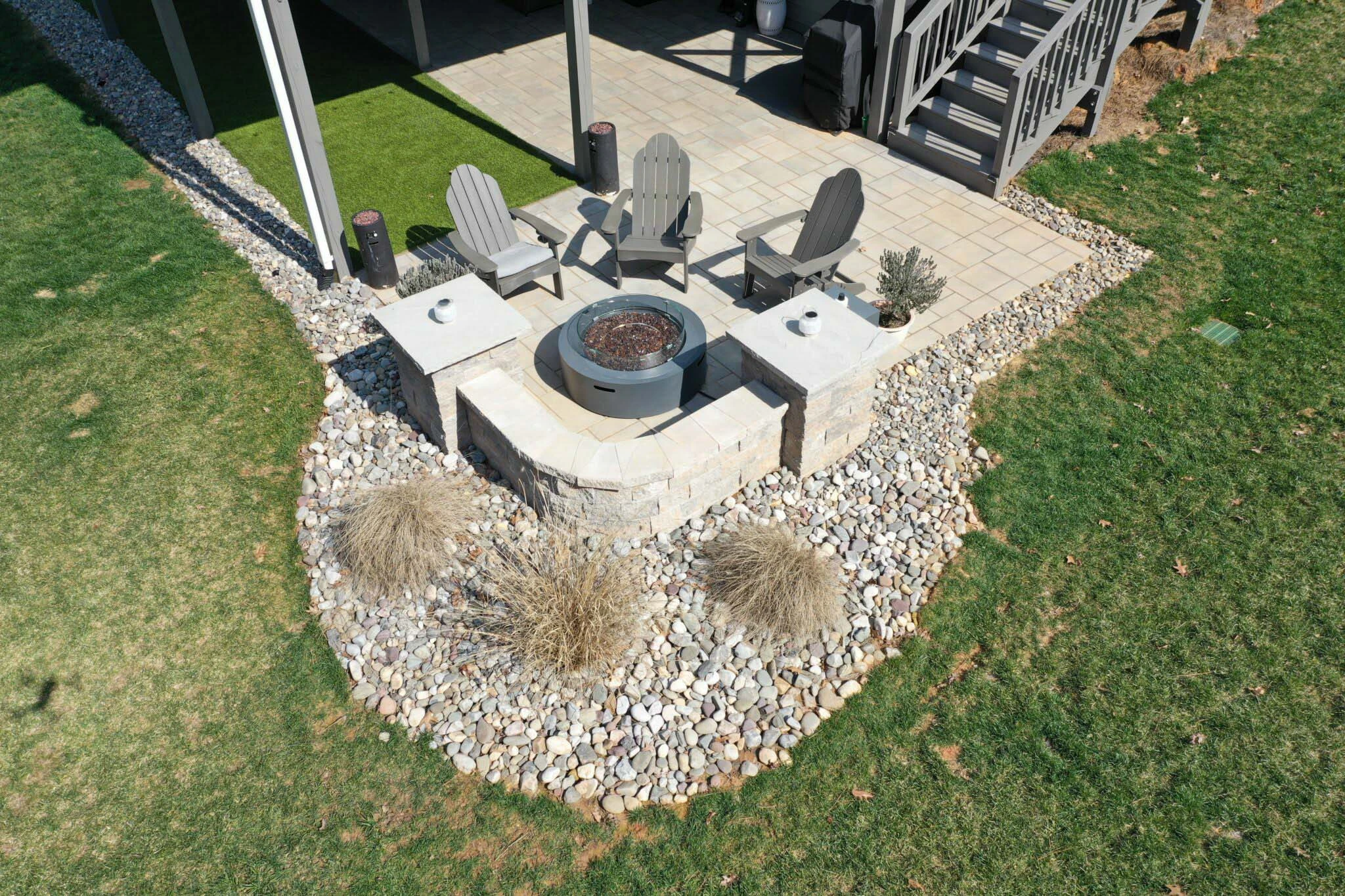
A Real Haw Creek Example: Lot, Numbers, Placement
To make this concrete, here is the logic we walked through on a recent Haw Creek project off Post Rd. The lot was 0.42 acres, house set 35 ft off the front, daylight basement walkout in back. Rear yard measured 68 ft from the walkout slab to the rear fence, with a total grade drop of 7.4 ft — about 11 percent average slope, but front-loaded, meaning most of the drop happened in the first 30 ft behind the house.
Step one: we walked the yard after a 1.2-inch rain event and mapped the water path. It ran 22 ft off the east corner of the walkout slab, curved southwest, and exited the property through the back fence at the southwest corner. That established the drainage path — a shallow curve with its steepest segment 38 ft behind the house.
Step two: we marked the grade break. The yard was relatively flat for the first 14 ft behind the walkout (a builder-graded transition zone), then dropped hard for 16 ft, then moderated again. That gave us a clean break at 14 ft out from the slab.
Step three: apply the 15-ft rule. The fire feature had to sit within the first 14 ft — because anywhere beyond was below the grade break and inside the wind rotor. That shrank the placement envelope to a narrow band 35 ft wide by 14 ft deep, adjacent to the walkout.
Step four: wind-shadow quadrant. Prevailing summer evening breeze came from the northeast (Lake Lanier, 3.8 miles away). The house structure cast its wind shadow to the southwest. The southwest corner of the walkout slab became the pivot point for a 90-degree downwind arc.
Step five: drainage offset. The mapped water path passed 11 ft off the east corner at its closest — well inside the 6-ft buffer we needed. But it was far enough from the west half of the placement envelope to give us 20+ ft of lateral offset on that side.
Result: the fire feature (a Techo-Bloc Border modular fireplace, 7 ft tall with a 10-ft flagstone hearth) ended up at the west shoulder of the walkout, 8 ft off the slab, 12 ft above the grade break, 22 ft from the drainage path, and inside the wind-shadow arc. Total project cost, fireplace plus 280 sq ft of flagstone hearth plus footing plus cross-slope diverter plus gas line: $34,800. The feature is now in year 2 with no settling, no smoke blowback, and no chimney staining on the downhill face.
Every one of those numbers came from walking the lot, not from a default template. That is the work.
What This Means If You Own a Sloped Cumming Lot
Three things you can do before you ever call a contractor:
Walk the yard in a rain. Literally. Put on boots and walk it during the next hard rain — not after, during. You are looking for where the water runs, where it pools, and where the grass lies flat. That is your drainage map. If you hand a contractor a drainage map you made yourself, the entire placement conversation changes.
Measure the grade drop. A cheap laser level or a string level and a tape measure gets you within 6 inches. Stand at the back corner of your house, shoot a level line to the rear fence, and measure the drop. If it is 3 ft or less, the placement rules soften. If it is 5 ft or more, every number in this post applies, and you should expect a footing upgrade and a cross-slope diverter as line items on the proposal. If either of those is missing from a Cumming fire-feature quote, ask why.
Find the wind. Stand in the yard at 6 p.m. on a summer evening with a wet finger or a smoking stick of incense. That tells you the evening breeze bearing. The seating goes downwind of the fire, not crosswind. Contractors who have not worked on sloped Lake Lanier-adjacent lots sometimes orient seating to the “view,” which in a lot of Cumming backyards means crosswind to the evening breeze. That is the smoke-in-the-face configuration. Do not accept it.
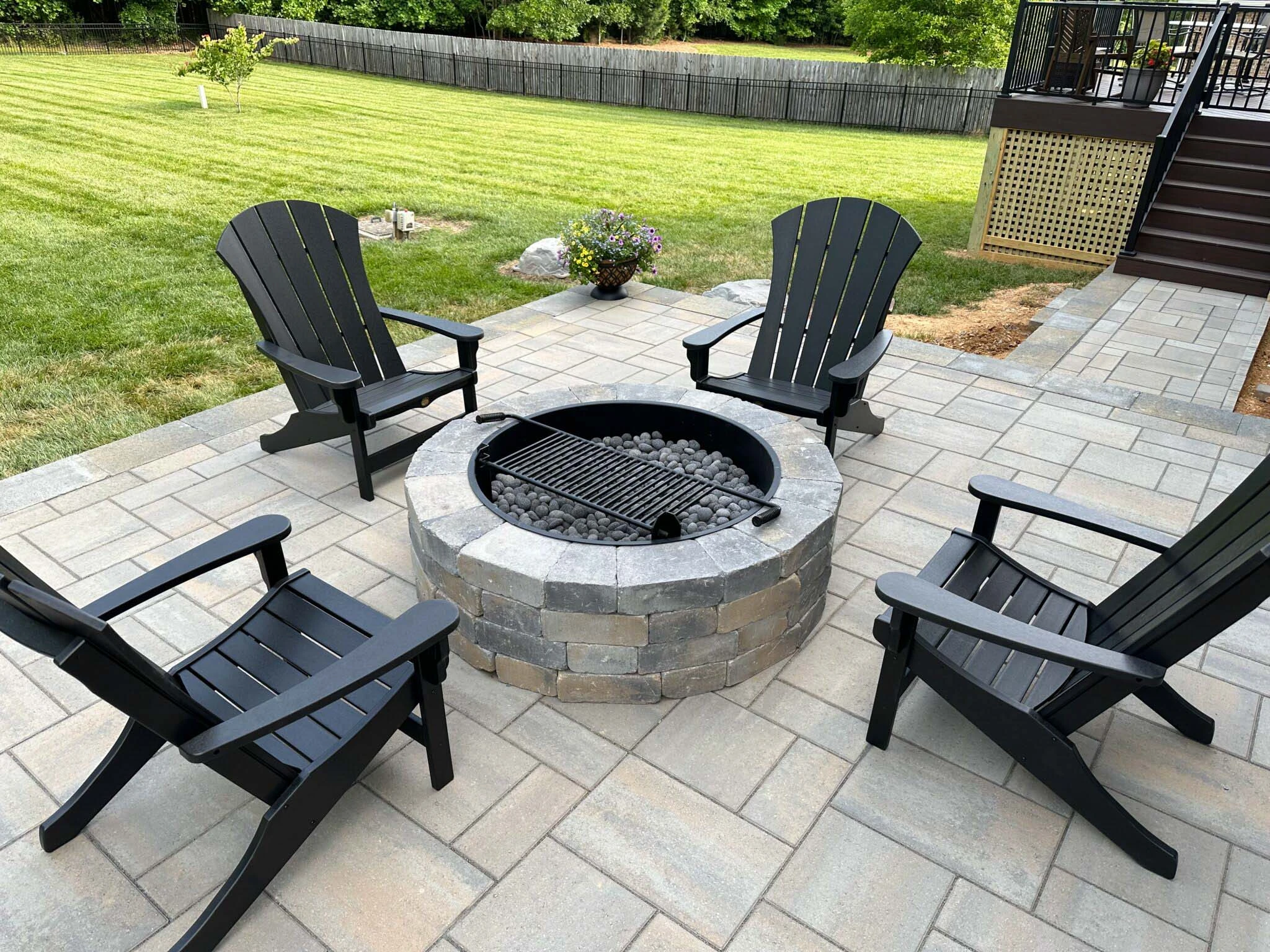
Why We Build This Way in Forsyth County Specifically
Cumming is the seat of the fastest-growing county in Georgia. Forsyth County’s population is approaching 260,000, and the influx of Atlanta-metro relocation buyers is driving a surge in new-build luxury homes on larger, more graded lots — especially along GA-400 corridor exits 13 through 17, and in the outer subdivisions off Bethelview Rd and McFarland Pkwy. Those lots are bigger, the grade drops are steeper, and the fire features going on them are bigger and heavier. The placement math has never mattered more.
At the same time, a lot of the pool-and-patio work being done on 2000-to-2015 resale homes in Vickery Village, The Collection at Forsyth corridor, and Lake Windward is remediation — pulling out fire features that were installed flat-yard-style ten years ago and are now leaning, staining, or smoking back into the seating. The remediation cost is almost always more than the original install cost. If you are buying one of those 2000-to-2015 homes with an existing fire feature, get the footing looked at before you ever light it.
A correctly placed fire feature on a Cumming slope has a couple of advantages over the same feature on a flat yard. The elevated position gives a better view — most sloped backyards here look southwest into tree lines or out toward the ridges that run down to Big Creek. The natural drainage below the feature means the hearth and seating stay drier. And the chimney, if there is one, draws better, because the prevailing wind has a longer run at it coming over the house roof. Fire physics actually prefers elevation. The only thing that ruins it is putting the feature on the wrong side of the grade break.
Fire pits and fireplaces engineered for sloped Cumming lots — across 20+ cities within 30 miles of Winder, GA
Every sloped backyard gets a drainage walk, a grade-break map, and a wind-shadow analysis before we quote a fire feature. That is how a fireplace stays plumb at year ten.