
October in Crooked Creek. The pool equipment has been winterized six weeks early because the homeowner lit the fire pit at 7:14 PM and realized she didn’t want to go back inside. That is the Milton evening — and it’s the reason a fire feature block is the single highest-ROI add you can bolt onto a remodel on 1+ acre lots out here.
We were four days into a coping-and-tile refresh on a 2011 gunite pool off Freemanville Road when the conversation shifted. The homeowner had booked us for 3/8″ glass tile, a bluestone coping swap, and an LED retrofit. Standard remodel scope. On day four she walked out with a wine glass, stood near the stepped-down side of the yard where the grade fell seven feet toward a Cooper Sandy Creek tributary, and said the thing every pool builder in Milton eventually hears: “We never come out here after October. How do I fix that?”
That question became the project. This post is the entire build — the three fire-feature tiers we priced on the drive home, why the 72-inch Warming Trends Crossfire burner earned the center block, how City of Milton Community Development handled the gas line permit, and what the after-dark yard looks like when 22 freeze events a year stop being an obstacle and start being the reason the fire feature exists.
Why Milton Specifically — Darkness, Elevation, and an 11-Month Fire Season
Three things separate Milton from Alpharetta five miles south, and all three favor fire features. The first is dark sky. Milton’s equestrian preservation ordinance caps density at 1-to-3-acre minimum lots in AG-1 zoning, which means no subdivision streetlight bleed and, on most estate parcels, no neighbor’s porch lamp thirty feet from your deck. When you light a gas fire bowl in Cogburn Estates, the flame is the light source, not an accessory to it.
The second is elevation. Milton sits at roughly 1,150 feet, a couple hundred feet above central Atlanta. That lift plus the rural land cover gives you 8 to 14 degrees of overnight cooling most of the fall and spring — enough that a 58°F Atlanta evening reads 46°F on a ridgeline in The Manor Golf Club. A gas fire at 30,000 to 145,000 BTU bridges that gap cleanly.
The third is grade. Milton’s rolling topography gives you 6 to 14 feet of elevation change across a typical estate lot. That means we’re rarely building a fire pit on a flat plane — we’re terracing it into a grade, seating it between retaining walls, or cantilevering a seat wall over a drop. The visual weight is built in.
The climate math: USDA Zone 8a, ~22 freeze events per year, summer highs 88-93°F, ~53″ annual rainfall. A covered or partially-covered fire feature in Milton earns roughly 10-11 months of usable season. In Buckhead or Sandy Springs, that number drops to 8-9 months because the urban heat island lifts the shoulder-season lows.
The Three Tiers We Price on Every Milton Remodel Walk-Through
When a Milton homeowner asks “can we add fire to this remodel,” the answer is always yes and the next question is which tier. We carry three standard configurations, and the decision tree comes down to lot character, HOA architectural review, and how the fire feature sits relative to the pool waterline.
Tier 1 — The 8×8 Natural-Stone Fire Pit + Seat Wall ($34K)
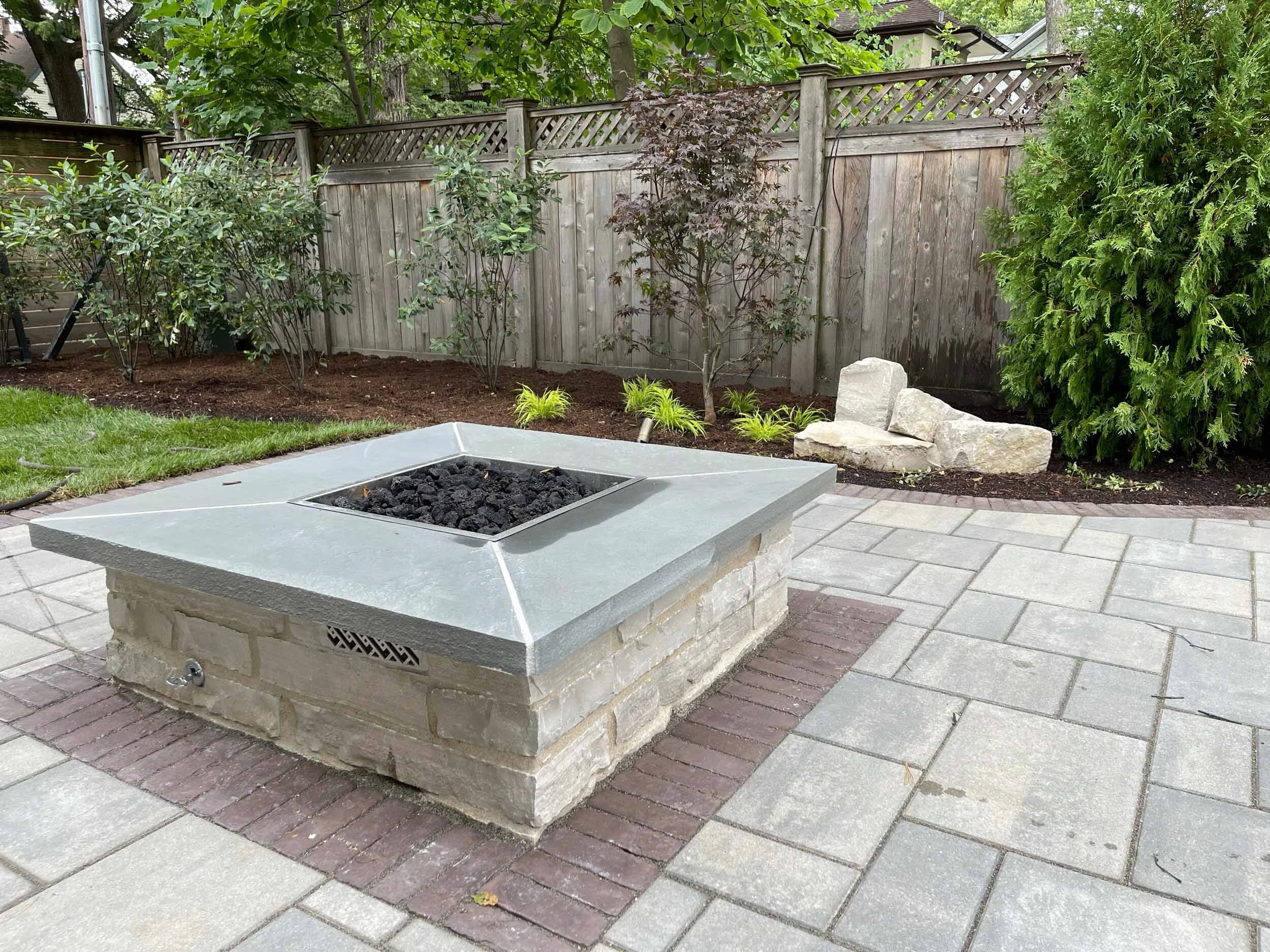
This is the most-built tier in Milton and the one we recommended on the Freemanville Road remodel. An 8-foot by 8-foot square platform in Tennessee fieldstone or a matched Pennsylvania bluestone, center-fired with a 72-inch Warming Trends Crossfire linear burner (the CFBL72), wrapped on two or three sides by a curved or L-shaped seat wall sized for 8 adults. The burner runs on natural gas at 216,000 BTU maximum and throws a flame pattern you can actually read a book by.
The seat wall is the under-discussed half of this package. We build it at 18 inches of seat height with a 14-inch tread depth, cap it in a coping stone that matches the pool deck, and integrate low-voltage LED under the overhang for a down-wash that reads as ambient rather than task lighting. Total invested time on site: 9 to 11 working days once the gas line is stubbed.
Tier 2 — The Raised Stacked-Stone Fireplace with Chimney ($48K)
A different animal. This is a built-in-place masonry fireplace with a firebox, a chimney that clears the roofline of any adjacent pavilion, and a hearth sized for actual seating. We build these in Crabapple-adjacent sections of Milton where the architectural review wants to see vertical structure to echo historic farmhouse silhouettes, and on lots in Atlanta National where the clubhouse sightlines reward a strong vertical feature.
The chimney is the cost driver. Minimum 14 feet of finished height for draw, proper firebox and damper, clay flue liner, and a spark arrestor. We spec it gas-assist with an Isokern or Superior Clean Face firebox so the homeowner can run a quick 20-minute burn without loading real wood — critical for Milton’s wet spring months when cordwood holds moisture even under cover.
Tier 3 — The Twin Bronze Fire Bowls Flanking a Raised Spa ($18K)
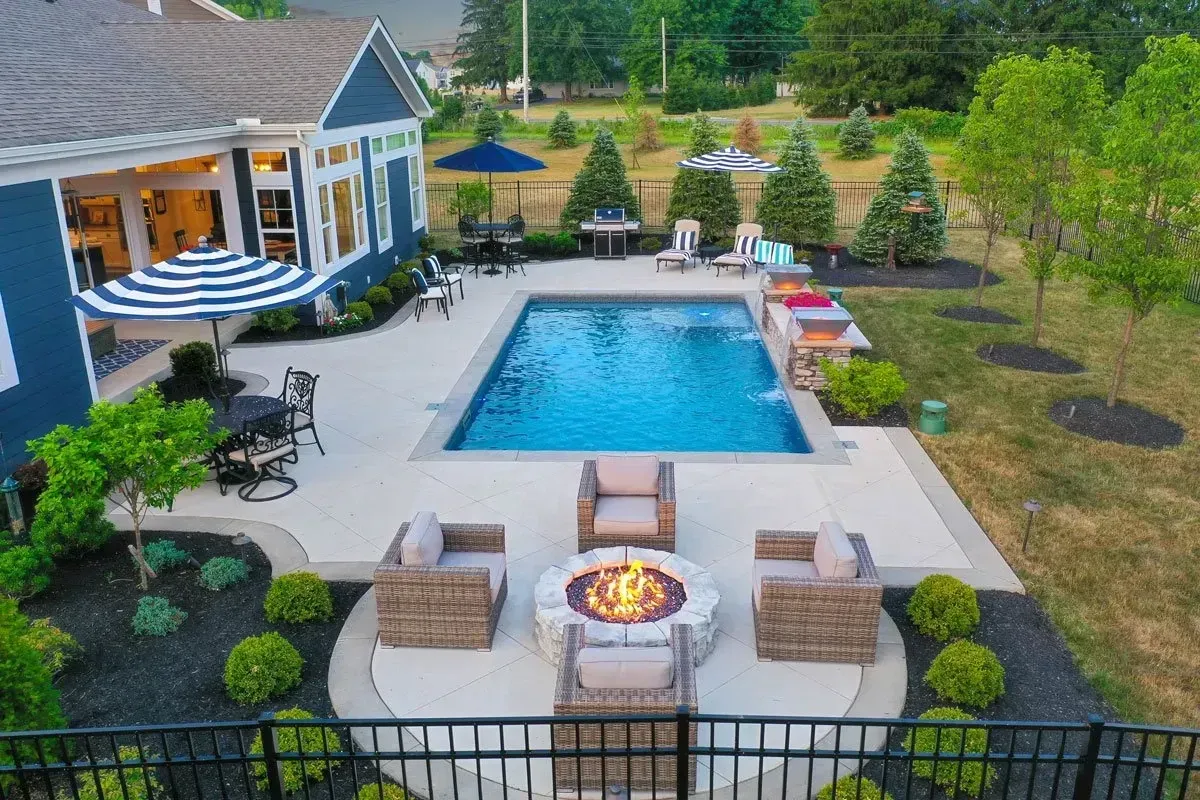
The lowest ticket and the quickest install. Two 30-inch cast-bronze bowls (HPC or Grand Effects are the two we trust), plumbed on an electronic ignition with manual override, positioned on raised spa-adjacent pedestals at 24 inches above waterline. The fire bowls function as architectural bookends during the day and primary light source at night. Two-day install once the spa is set.
This tier makes sense when the existing pool already has a raised spa and the homeowner wants atmosphere without rebuilding the yard. It’s the least structural, most jewelry-like option we offer.
The Freemanville Road Build — Scope, Sequencing, and the Permit That Almost Tripped Us
Back to the Crooked Creek homeowner. We signed the Tier 1 addendum on a Tuesday. Pool remodel already in motion meant the gunite was exposed, the waterline tile was off, and the coping had been demolished — perfect window to run a new 1-inch natural gas line under the deck perimeter without retrenching later.
Because Milton incorporated as a separate city in 2006, her permit went through City of Milton Community Development at 2006 Heritage Walk rather than Fulton County. That’s normally the faster path — typical turnaround runs 10 to 14 business days versus 18 to 25 at the county level. In this case it came back in 11 days with one flag: the proposed fire-pit pad sat 68 feet from a named tributary of Cooper Sandy Creek, inside the 75-foot state stream buffer.
We pulled the pad seven feet back, re-drew, re-submitted, and got the green light in three more days. The lesson for any Milton homeowner: if your yard backs Cooper Sandy, Chicken Creek, Lake Creek, or an Etowah tributary, the 25-75 foot creek-buffer setback is the first thing to check — before coping material, before burner size, before anything.
Permit tip for Milton estate builds: The Manor Golf Club and Atlanta National both run their own architectural review committees on top of city review. Typical ARC turnaround is 4-5 weeks and they care about stone color, chimney profile, and sightline to the golf course. Submit to the ARC the same day you submit to the city — don’t stack them.
The Warming Trends Decision — Why 72-Inch Crossfire Over a Stock 36-Inch Ring
Every fire-pit spec document eventually lands on a burner. The default in most Georgia backyards is a stock 24- or 36-inch stainless ring running at 60,000 to 90,000 BTU. It works. It lights. It’s cheap. And on a 1.3-acre Milton lot with a seat wall sized for 8 people, it looks like someone put a birthday candle in the middle of a dining table.
The Warming Trends Crossfire is the corrected version. The CFBL72 linear model runs a brass construction burner with a jet port design that delivers dancing flame patterns twice the height of a ring at equivalent gas input. On our Freemanville Road build we ran it at 216,000 BTU — flame height hits 18 to 22 inches, which is proportional to the 8×8 pad and the seat wall dimensions. Brass won’t rust, which matters in Milton’s 53-inch annual rainfall. And the burner is warrantied lifetime to the original owner.
The upcharge over a stock stainless ring is roughly $1,800 to $2,400 on materials. On a $34,000 package that’s 5 to 7 percent. The visual impact is 40 percent of the final “wow.” We don’t quote Tier 1 without it anymore.
Lighting, Materials, and the Downstream Design Decisions a Fire Feature Forces
The moment you add real fire, three other decisions get pulled forward on the remodel.
Pool lighting gets dimmable. You can’t run a 300-watt halogen pool light next to a warm flame source — the color temperature fight is ugly, and the halogen dominates. We swap every Milton fire-feature remodel to a Pentair IntelliBrite 5G color-LED on a dimmable circuit, set default to warm white at 45 percent. That way the fire is the primary light source at night and the pool is the secondary wash.
Coping and deck stone get warmer. Cool-toned travertine (silver, ivory) goes dead under firelight. We push Milton clients toward warm travertine (walnut, noce) or toward a Tennessee fieldstone coping that carries red and amber in the veining. The pool deck picks up the fire and extends it.
Landscape gets a dark bowl around the feature. We plant or transplant evergreen mass (deodar cedar, Nellie Stevens holly, or mature boxwood hedging) 15 to 20 feet out from the fire feature on any side facing neighbors or a road. The dark backdrop lets the flame read sharper and, on Milton’s AG-1 estate lots, gives you the outdoor-room feel the rural context is already trying to deliver.
What It Costs to Add Fire to an Existing Milton Pool Remodel — Line-Item Breakdown
Here’s what the $34,000 Freemanville Road Tier 1 package actually buys, line by line, so you can see where the money goes and where you can trim without losing the result.
- Gas line scope (1-inch NG, 140 feet from meter, trenched): $4,200. Includes permit, pressure test, and sleeve under decking.
- Structural pad (8×8 reinforced concrete, 6-inch pour with #4 rebar grid): $2,800.
- Fieldstone face + seat wall (14 face-feet of wall, full stone face, bluestone cap): $14,600.
- Warming Trends CFBL72 Crossfire burner + pan + electronic ignition module: $4,100.
- Lava media, burner kit, and igniter trim: $850.
- Low-voltage under-cap LED (seat-wall down-wash): $1,900.
- Permit, inspection coordination, and ARC submission fees: $1,550.
- Labor, demobilization, and final site grade restoration: $4,000.
The knobs you can turn: swap fieldstone face for a drystack panel system and save $3,200, drop the Crossfire to a 48-inch version and save $1,100, skip the under-cap LED and save $1,900. Floor on a real-quality Milton build lands around $27K; ceiling with custom-cut Pennsylvania bluestone and a dual-ignition backup runs to $41K.
The Eight-Month Window — Why the Freemanville Remodel Now Runs 11 Months a Year
The homeowner emailed eight months after we wrapped. Total use nights on the fire feature: 74. Rough math she ran herself: 19 nights in October, 14 in November, 11 in December, 3 in January (cold snap), 8 in February, 13 in March, 6 in April. Her pool equipment ran during five of those months. Her yard ran during eleven.
That’s the thesis in one number. A pool on a Milton estate lot is a 5-to-6-month asset against Georgia power bills and chemistry. A fire feature bolted to the same yard — especially on 1+ acre lots with dark skies and rural land cover — is an 11-month asset against almost no operating cost (gas consumption runs roughly $1.80 to $2.60 per hour at full burn on Atlanta Gas Light residential rates).
When the spreadsheet starts reading like that, the $34K line item stops looking like a remodel upcharge and starts looking like the actual reason the yard earns its keep.
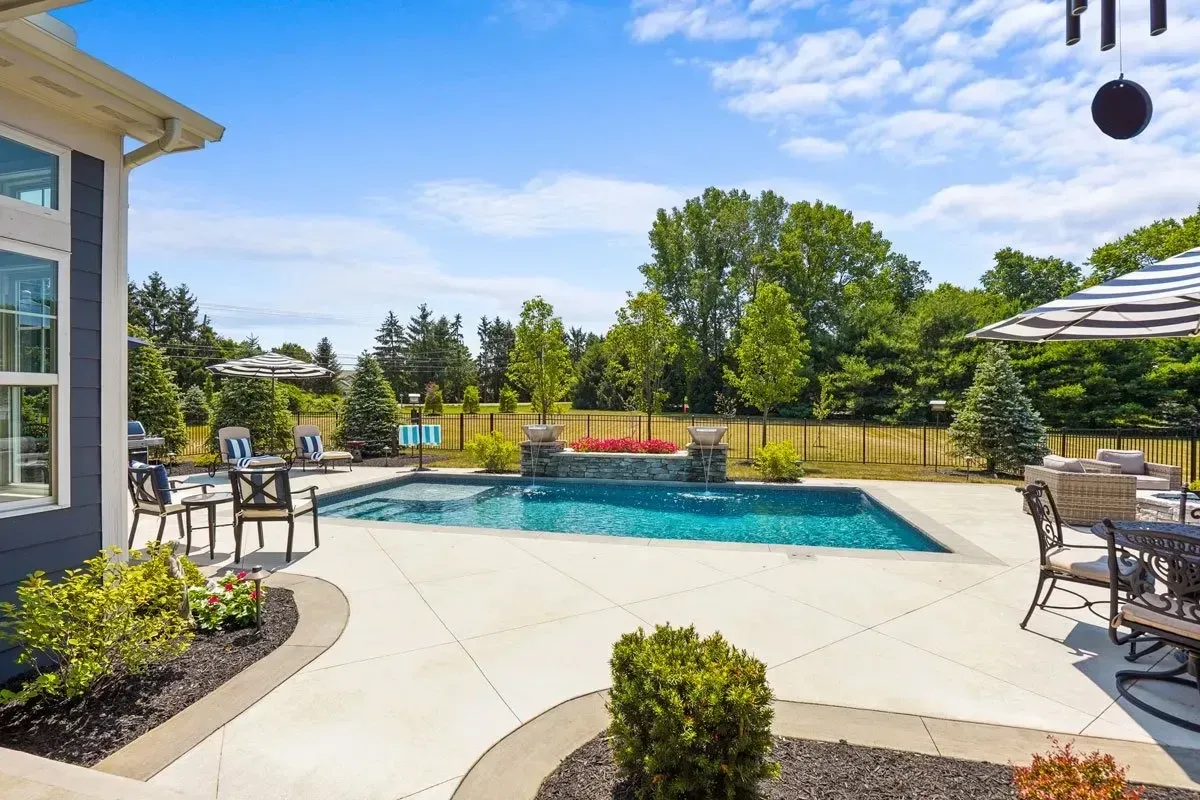
Pool Remodeling & Fire-Feature Additions across 20+ cities within 30 miles of Winder, GA
From Tier 1 seat-wall fire pits to full raised-stone fireplaces with chimney, we build fire features engineered for Milton’s dark-sky, rolling-hill, 11-month outdoor season.