
The wall was six years old when the top course bowed out and the geogrid mat — the mat that was supposed to be there — was nowhere to be found. It was a $38,000 rebuild the homeowner paid twice because the original crew skipped two middle lifts to save $1,200.
This is a case-study post. A real Dawson County wall, a real forensic tear-down, and a real invoice that we’re going to pull apart piece by piece. If you live in Foxcreek, Etowah River Club, Kensington Ridge, or anywhere along the GA-400 corridor where your backyard falls off faster than your driveway climbs, this is the post that explains why your contractor’s quote either has a PE stamp in it — or doesn’t — and why that single document is the difference between a wall that lasts forty years and a wall that kills your resale value in six.
Dawsonville sits at roughly 1,270 ft elevation, the highest city in our service area. The soil under your feet is not the Piedmont clay we deal with in Dacula or Snellville. It’s stony residuum — saprolite over weathered granite, thin topsoil, and the occasional refusal layer that eats a bucket tooth before you can say blast charge. Walls built on this ground fail differently than walls built in the metro. They fail slowly, then suddenly, and the failure mode is almost always drainage meeting under-engineered reinforcement.
Dawson County’s Department of Planning & Development — 25 Justice Way, Dawsonville — requires a PE-stamped drawing for any retaining wall with a retained height of 4 ft or more. That’s not a suggestion. It’s a permit gate. And most homeowners never see the stamp because most general hardscape contractors never pull the permit. The wall gets built. The wall gets backfilled. And six years later, the inspector you didn’t call is the reality check you can’t avoid.
The Autopsy: One Dawsonville Wall, Six Years, Three Mistakes
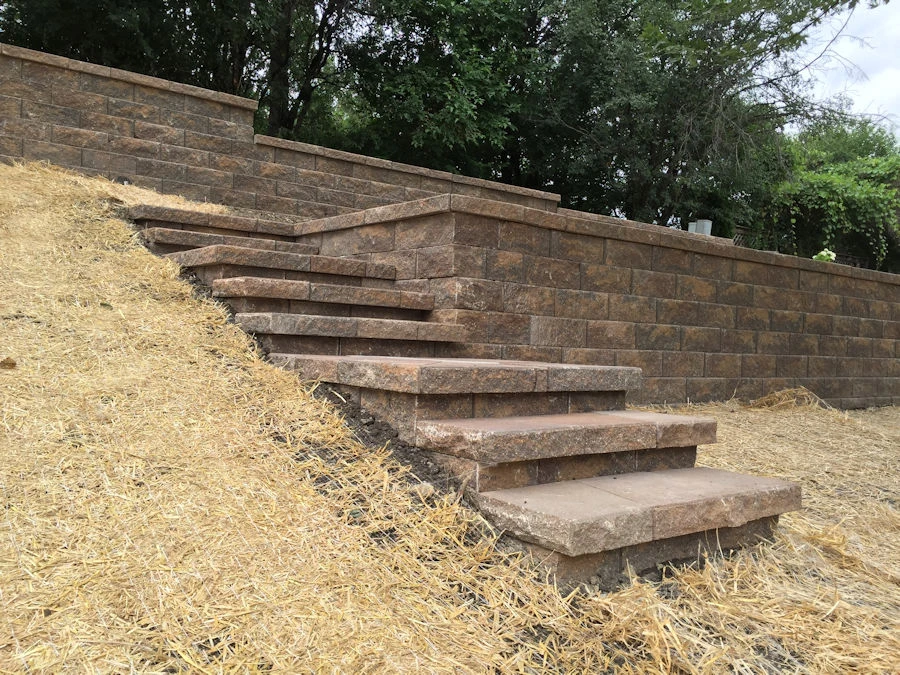
Let’s start with the wall itself. Foxcreek subdivision, 2018 install, 72 linear feet, retained height stepping from 3 ft at the garage side up to 6 ft 4 in at the rear property corner. The original invoice was $38,412. We were called in 2024 when the homeowner noticed the top two courses at the tall end had rotated outward roughly 1.5 inches — a reliable tell that the reinforced soil mass behind the wall had already begun sliding.
We pulled permits for the rebuild and brought in a third-party geotech for the forensic report. The findings came back in three clean categories. No geogrid in the middle third of the wall height. A pea-gravel drainage chimney only 4 inches wide where spec called for 12. And a base course set on native saprolite with no crushed-stone leveling pad whatsoever. Any one of those failures would have shortened the wall’s life. All three together meant the wall was engineered to fail — it was just a question of which spring thunderstorm would finally tip it.
The original contractor had charged as if the spec was correct. The wall looked correct from the surface. Cap courses were level. Block alignment was clean. The homeowner had no way of knowing, visually, that the guts of the wall had been value-engineered down to a glorified lawn edging with structural pretensions.
Dawson County Permit Threshold: Any retaining wall with more than 4 ft of retained height (measured from the top of the footing to the top of the wall) requires a PE-stamped structural drawing submitted to Dawson County Planning & Development before the permit issues. PE fee typically runs $800–$1,800 depending on wall length and geometry.
Why Dawsonville Soil Breaks the Rules You Learned in Dacula
If you’re used to building in Gwinnett or DeKalb, you’re used to clay. Cecil-series red clay is cohesive, predictable, and — despite its reputation — actually a decent backfill material when you manage moisture. Dawsonville changes that equation entirely. At a typical 2-to-6-ft excavation depth here, you’re no longer in topsoil. You’re in saprolite: weathered granite that behaves like soil on the way up and like rock on the way down. It can ravel out of your excavation cut in one rainstorm and then refuse to compact under a jumping jack the next day.
Three practical consequences. First, your excavation geometry changes — you cut narrower benches because the material won’t hold a steep face for long. Second, your drainage behavior inverts — saprolite drains fast until it hits the bedrock contact, at which point water travels laterally along that interface and arrives behind your wall with surprising volume. Third, your rock refusal is unpredictable. We’ve hit weathered granite at 30 inches on one end of a wall and 84 inches on the other. That matters when your PE drawing assumes a consistent footing depth.
The rock charge itself — when you hit refusal and need to break rock for a footing or a pool excavation — runs $8 to $14 per cubic yard premium over standard soil dig in the Dawsonville market, based on the hourly rates the two local blasting contractors quote us. On a wall project that’s usually a $600 to $2,400 line item. On a pool-with-retaining-wall combo, it can clear $10,000. Contractors who don’t disclose rock-contingency language in the contract are contractors who will be asking for a change order the day the bucket stops.
The 4-ft Threshold: What the PE Stamp Actually Buys You
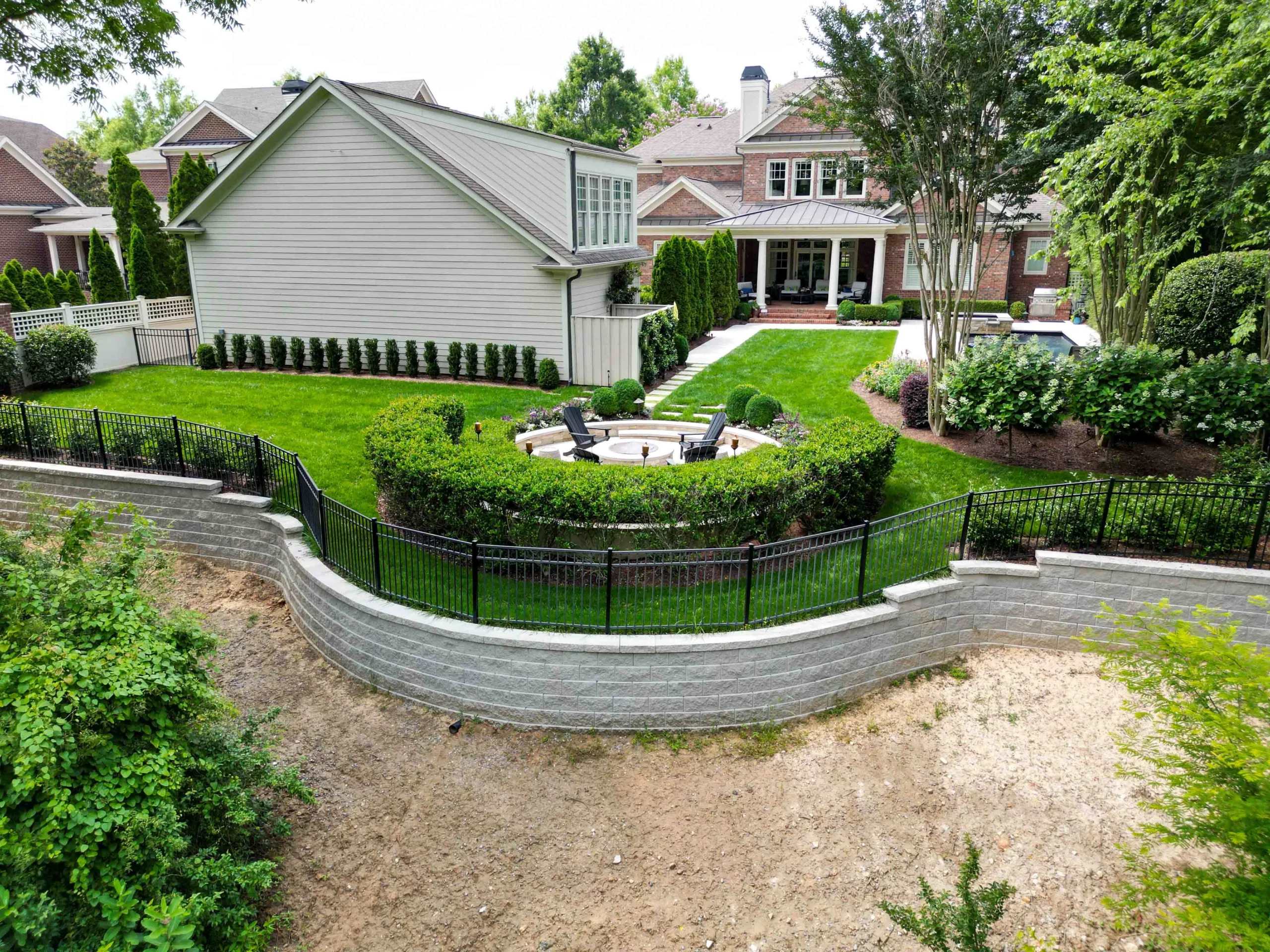
A Professional Engineer’s stamp on a retaining wall drawing is not a formality. It’s a liability transfer. When a PE stamps your drawing, she is putting her license on the line that the wall — as drawn — will hold the soil it’s designed to hold, under the soil and water conditions the geotechnical report specifies, for the design life of the product. That’s a legal and financial guarantee that extends well past the contractor’s one-year workmanship warranty.
On a Dawsonville wall above 4 ft retained height, the PE will specify four things your generic brochure spec will not. Geogrid length and spacing — typically every 24 inches of vertical lift in saprolite zones, with grid length equal to 60–70% of the retained height. Drainage chimney dimensions — a 12-inch-wide column of clean #57 stone from the base to within one course of the cap, wrapped in non-woven geotextile. Base preparation — a compacted crushed-stone leveling pad typically 6 inches deep, extending 12 inches in front of the wall face. And for walls over 6 ft, dead-man anchors or stepped foundations tied into the rear reinforced soil mass.
Here’s the part contractors don’t like to explain: the PE’s spec sheet for your wall becomes your contractor’s construction document. The crew is not allowed to value-engineer it in the field. If the drawing says geogrid at 24 inches, the crew installs geogrid at 24 inches. If the crew skips a lift to save $1,200 in material and labor, they are violating a stamped engineering document — and your permit is revoked. The paperwork gives you leverage you don’t otherwise have.
The Four Non-Negotiables on a 4+ ft Wall in Dawsonville:
1. PE-stamped drawing submitted to Dawson County before construction.
2. Geogrid at every 24 in of lift (saprolite zones) — grid length 60–70% of wall height.
3. 12-in drainage chimney of #57 stone, geotextile-wrapped, daylighted every 30 ft.
4. Dead-man anchors or stepped foundation for retained heights over 6 ft.
Drainage Is the Thing That Kills Your Wall — Not the Block
Every failed retaining wall forensic we’ve run — in Dawsonville, in Riverbend, in Mountain Laurel, anywhere along the Etowah corridor — has water at the center of the failure story. The block is almost never the problem. Manufactured segmental block from Techo-Bloc, Belgard, or Allan Block will outlive your mortgage. What kills walls is hydrostatic pressure, and hydrostatic pressure is a drainage problem masquerading as a structural problem.
The physics is simple. Rain falls on the slope above the wall. It percolates down through the saprolite until it hits the bedrock interface or the reinforced soil mass. It travels laterally and arrives at the back face of the wall. If you have a properly sized drainage chimney with a properly daylighted drain line, the water exits the system. If you have a 4-inch chimney with a drain line buried under sod with no outlet, the water stays. Water weight behind a 6-ft wall is roughly 62.4 pounds per cubic foot. On a 60-ft run of wall, you can build up literal tons of hydrostatic load in a single Dawsonville summer thunderstorm.
Saprolite makes this worse than standard Piedmont clay does. Clay is slow — water arrives gradually and the wall has time to shed it between storms. Saprolite is fast — water arrives in 20 minutes and stays for 48 hours because that bedrock interface acts like a bathtub liner. You need a drainage system engineered for pulse loads, not for average rainfall. That’s the argument for the 12-inch chimney over the 4-inch one. The extra material cost is maybe $900 on a typical wall. The extra service life is measured in decades.
Geogrid: The $1,200 Line Item That Rebuilds Your Wall for $40,000
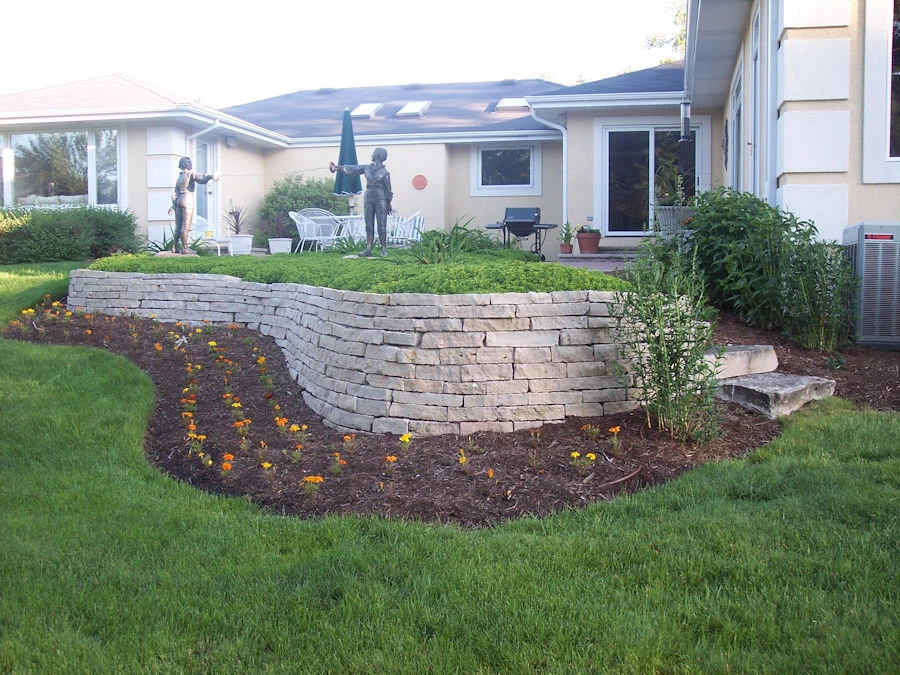
Geogrid is a woven polymer mat — usually high-density polyethylene or polyester — that gets laid horizontally into the backfill behind the wall at prescribed vertical intervals. Its job is to tie the reinforced soil mass behind the wall into a coherent block that resists the slump forces pulling the wall face forward. On a PE drawing, geogrid is specified by length, tensile strength, vertical spacing, and embedment depth into the block course.
On the Foxcreek wall we rebuilt, the original contractor installed geogrid at the base course and the top course — two layers out of what should have been six. The middle third of the wall had zero grid. In saprolite zones that’s a terminal mistake. The soil in the middle of the reinforced zone has nothing tying it back into the hillside, and once the drainage starts to fail and the water gets in, that middle band of backfill becomes the failure plane. The top of the wall rotates because the middle is moving.
We priced the material the contractor skipped. Four additional courses of geogrid — standard Strata 200, 8-ft embedment, 72 ft of run — would have cost roughly $720 in material and $480 in labor. $1,200 total. That $1,200 saved the contractor a line item on the invoice. It cost the homeowner a $38,000 rebuild plus the loss of six years of use and a garden bed that had to be torn out and rebuilt. No geotextile ever recovered that math.
Geogrid Spec for a 6-ft Wall in Saprolite: Strata 200 (or equivalent) at 24-inch vertical intervals, 8-ft grid length, embedded 4 in into the block course. Six courses of grid on a 6-ft wall. Material cost roughly $180 per course. Non-negotiable on a PE-stamped drawing.
What the Contract Should Actually Say — Language That Protects You
A wall contract under $10,000 can probably get away with a one-page scope. A wall contract over $25,000 in Dawsonville cannot. Here’s the language that either exists in your contract — or you have a $40,000 problem waiting to happen.
PE drawing reference. The contract should name the PE firm, the drawing revision number, and state that the work will be built in accordance with that specific stamped drawing. Without this language, the contractor is free to interpret “engineered wall” however they want.
Geogrid specification by product name and lift spacing. “Geogrid per engineer’s spec” is not enough. The contract should list the product (e.g., Strata 200, Mirafi 3XT, or equivalent), the vertical spacing (every 24 inches), the grid length (typically 60–70% of wall height), and the acceptable substitution language.
Drainage chimney and daylight drain dimensions. “#57 stone drainage” is not enough. The contract should list the chimney width (12 inches), the wrapping geotextile (non-woven, 4 oz minimum), the drain line type and size (4-inch rigid perforated PVC, not corrugated), and the daylight locations and grades.
Rock contingency clause. Given Dawsonville’s refusal patterns, the contract should state the rock-dig premium (typically $8–$14 per cubic yard) and an agreed-upon method for documenting and billing unexpected rock. We quote rock contingency as a capped line item — not an open-ended change order — so the homeowner knows their maximum exposure before the excavator shows up.
Dawson County permit and inspection schedule. The contract should name who pulls the permit (the contractor, not the homeowner), when the inspection is triggered (before backfill, typically after the third geogrid layer), and what happens if the work fails inspection (remedy at contractor’s cost, not homeowner’s).
Brand, Material, and Delivery — The Dawsonville Logistics Reality
Because Dawsonville sits on GA-400 and Hwy 53, material delivery logistics are easier than most mountain-adjacent markets. Belgard and Techo-Bloc distributors in Cumming and Gainesville can deliver to most Dawsonville lots within a 48-hour window. That’s the good news. The bad news is that Amicalola EMC service drops run low across a lot of wooded lots up here, which means your equipment staging has to respect Amicalola EMC overhead lines that the metro contractor isn’t used to thinking about. More than one crew has learned this the expensive way by parking a mini-excavator boom into a service drop.
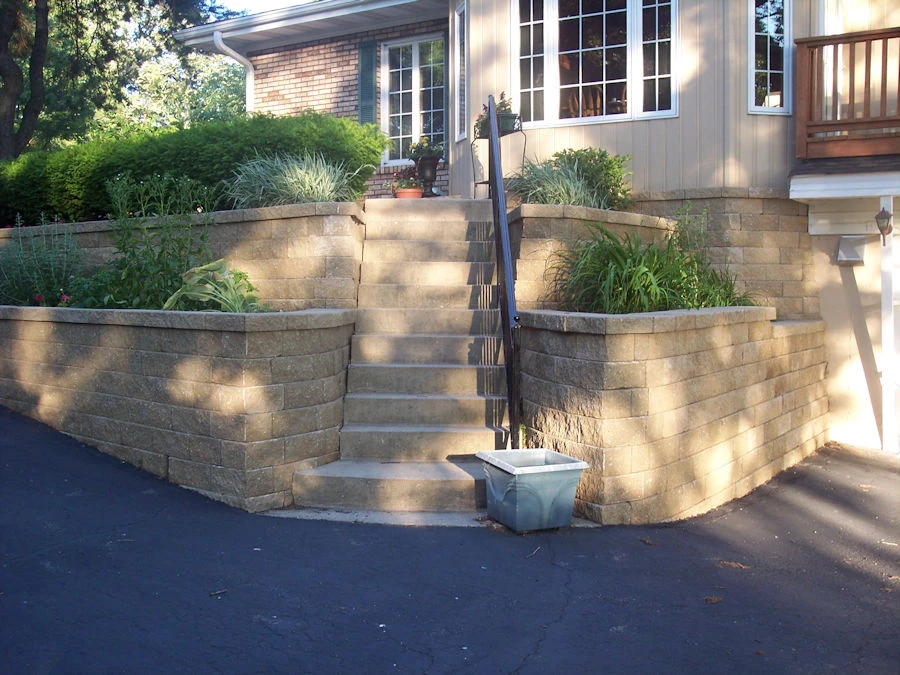
On the material side, for walls in this market we typically recommend one of three systems. Techo-Bloc Mini-Creta for sub-4-ft decorative walls — tight tolerance, clean cap options, good color selection in the tans and charcoals that blend with Cecil-series soil tones. Allan Block AB Classic for structural 4-to-8-ft runs — proven geogrid-tie-back system, PE-friendly engineering tables, and the distributor network handles it well. Versa-Lok Standard for 6-ft-plus structural installs where we want the deeper block for shear capacity. All three are stocked within a one-hour haul of Dawsonville.
Concrete walls — poured-in-place or shotcrete — are the other option for very tall or very long runs. They’re more expensive up front, typically $180–$260 per face-square-foot vs. $55–$110 for segmental. They’re also faster to build on tight sites and have no geogrid to skip. For walls over 10 ft retained height in Dawsonville, we almost always recommend a concrete or hybrid solution over segmental, both for structural performance and for the absence of the value-engineering failure mode this post exists to warn about.
What to Ask the Next Contractor Who Quotes Your Wall
If you’re reading this before you sign, this is the section to screenshot. Five questions, asked in this order, will eliminate about 70% of the Dawsonville contractors who shouldn’t be building your wall.
- “Will this wall exceed 4 ft retained height at any point, and if so, who is the PE of record?” Correct answer: a named firm with a Georgia PE license. Wrong answer: “We don’t need one.” If retained height is over 4 ft and they say no PE, the conversation is over.
- “What is the geogrid product, vertical spacing, and grid length, and can I see that on the PE drawing?” Correct answer: a product name, 24-inch spacing (for saprolite), and a drawing reference. Wrong answer: “We use geogrid where it’s needed.”
- “How wide is the drainage chimney, what’s the geotextile wrap, and where does the drain daylight?” Correct answer: 12-inch chimney, non-woven geotextile, daylighted at grade every 30 ft to a visible outlet. Wrong answer: “We install a drainpipe behind the wall.”
- “What’s your rock contingency — specifically in Dawson County — and how is it billed?” Correct answer: a dollar-per-cubic-yard premium, a capped contingency line, and photo documentation of refusal. Wrong answer: silence, or an open-ended change-order clause.
- “Are you pulling the Dawson County permit, and when is the pre-backfill inspection scheduled?” Correct answer: yes, and the inspection is scheduled after the third geogrid layer. Wrong answer: “Do you want a permit?”
If the contractor answers those five cleanly, you’re dealing with someone who builds to the Dawson County Planning & Development standard and respects the 4-ft threshold for what it is — an engineered, stamped, inspected work product. If they hedge or pivot, the $38,000 rebuild is already in the quote. You just can’t see it yet.
Dawsonville is the hardest residential wall market in our service area, and we say that as a compliment to anyone building here. The elevation, the saprolite, the rock refusal, the 30 freeze events a year, the mountain-pattern storms — all of it rewards walls built to the PE drawing and punishes walls built to the brochure. The $1,200 in geogrid is the cheapest insurance policy any homeowner in Dawson County will ever buy. And the $800 PE stamp is the document that makes the $1,200 actually show up on your lot.
If you’ve already got a quote in hand and you want a second set of eyes on the scope, the PE drawing, and the geogrid spec — that’s what we do. Bring the paperwork. We’ll tell you what’s in it and what isn’t.
Engineered retaining wall installation across 20+ cities within 30 miles of Winder, GA
We build PE-stamped retaining walls for Dawsonville mountain lots, Dawson County foothill grade-change projects, and every wall spec in between — from 18-inch driveway edges to 8-ft structural tie-backs with dead-man anchors.