
It’s a July Tuesday in Windward. You leave a 4:30pm Microsoft Teams call, walk to the kitchen, and the sky goes from blue to slate-green in the time it takes to pour a glass of water. Twelve minutes later a pop-up cell has dropped half an inch of rain, ripped a water oak limb over the fence, and left your pool looking like a forest floor — pine cones, oak twigs, and a week’s worth of leaves spread corner to corner, skimmer baskets already packed tight.
This is the Alpharetta summer pattern. North Fulton backyards along the GA-400 corridor get blindsided by fast-forming convective cells almost weekly from late June through early September, and the damage those storms do to a pool is not random — it follows a predictable sequence that fails predictable equipment in a predictable order. If you handle the first two hours correctly, you’re looking at a $180 service call. If you don’t, you’re looking at a burned-out pump motor, a clogged filter, a chemistry crash, and a bill that climbs past $1,800 before the end of the week.
This piece is the triage sequence we run on storm-debris emergency calls across Alpharetta — Windward, Country Club of the South, Hutchinson Farm, the Avalon-adjacent infill, the older Haynes Manor and Martins Landing neighborhoods. Every step has a reason. Every number is from an actual post-storm invoice. Follow the sequence in order and you’ll save the pool. Skip a step and you’ll pay for it at the equipment pad.
Step 01 — Kill Power to the Equipment Pad Before You Pick Up a Single Leaf
This is the one step homeowners skip, and it’s the one step that turns a $200 problem into a $1,400 problem. The second debris hits the water, the skimmer baskets start loading. When they fill past the overflow ring, the pump stops pulling water and starts pulling air. A suction-side air lock on a variable-speed pump is not a soft failure — it’s a thermal event. The motor windings begin to run hot within 90 seconds of losing prime, and a Pentair IntelliFlo3 VSF that burns a winding costs $1,650 to $1,950 to replace depending on model year.
Walk to the equipment pad first. Flip the pump breaker at the subpanel — on most Alpharetta installs it’s the 20-amp or 30-amp breaker on the outdoor disconnect near the pad, not the main breaker inside the garage. If you have automation (Pentair IntelliCenter, Jandy iAquaLink, or Hayward OmniLogic), kill it at the physical disconnect, not just the app — the app may show “off” while the motor is still energized on a delayed schedule. You want zero current at the motor.
Why the app isn’t enough: Pool automation runs on a scheduled-pump-program model. Hitting “Off” in the app queues the command to the controller, which then waits for the next polling window. On Pentair IntelliCenter firmware pre-1.064, that window is up to 8 minutes. The physical disconnect is immediate. Always use the disconnect in a storm event.
If you have a salt chlorine generator — most 2015+ Alpharetta builds do — the cell will also be taking current. Kill that breaker too. The cell plates don’t burn out from air loss, but running a salt cell against a dead-head plumbing system (no flow, pump off) shortens cell life measurably. Just power it off until the flow is restored.
Step 02 — Manual Debris Removal Before You Ever Turn Equipment Back On
With power off, the order is: top layer first, skimmer baskets second, drain grates third. You need three tools and you should keep all three in a labeled bin in the pump shed: a 16-inch commercial leaf rake (not the $22 consumer version — get the $58 Purity Pool ProLeaf or equivalent with the reinforced aluminum frame), a 16-foot telescopic pole, and a spare skimmer basket that matches your skimmer model.
Skim the top layer in parallel passes, not circles. Leaves and pine needles float for the first 30 to 90 minutes before they waterlog and sink, so the window to grab 80% of the debris from the surface is narrow. After that window closes, the same debris drops to the floor and you’re looking at a vacuum job instead of a rake job — two to three additional hours of labor.
Once the surface is clear, pull both skimmer baskets. In a heavy debris event, the baskets will be packed solid — not just full, but compressed to the point where water can’t move through them. Dump them, rinse them in the grass (not the pool), and seat them back in. If any basket is cracked from the debris load — oak limbs punch through OEM baskets regularly — replace it before restarting the pump. A $14 basket is cheaper than the hair-and-lint impeller rebuild you’ll need after a single pine cone gets past a broken basket and into the pump volute.
Step 03 — Inspect the Filter Pressure Gauge Before You Restart
With baskets clear and surface raked, walk back to the equipment pad and read the filter pressure gauge — but read it before you turn the pump back on, so you have a baseline. On a clean system during normal operation, you should see somewhere between 8 and 14 psi, with the exact “clean” number being whatever was normal for your filter when it was last serviced (this is why you write that number on a piece of blue tape and stick it to the filter housing — if you haven’t, start now).
Restart the pump. Watch the pressure gauge for 60 seconds. Three patterns tell you three different things:
- Pressure reads normal (within 2 psi of baseline): The filter is intact, the baskets were doing their job, and you can proceed to chemistry triage.
- Pressure reads 8 to 12 psi above baseline: Fine debris made it past the baskets and is loading the filter media. You’ll need to backwash (sand/DE) or pull the cartridges (cartridge filter) before the pump starts working against itself.
- Pressure reads below baseline or needle bounces: You have an air leak on the suction side — probably a cracked skimmer throat from debris impact, or air being drawn past a compromised pump-basket lid O-ring. Stop and call for service before you cavitate the impeller.
For DE filters, also check the sight glass on the multiport valve if your system has one. If the glass shows milky white after restart, DE is bypassing the grids or laterals — that’s a valve-rebuild or grid-replacement job, typically $340 to $620 depending on the unit. Don’t keep running the filter with DE bypassing; it’s pushing diatomaceous earth into the pool and will re-cloud the water as fast as you clear it.
Pressure-gauge baseline: Write the clean-filter psi reading directly on the filter housing with a paint pen the day it’s serviced. Every Alpharetta homeowner we work with who follows this habit diagnoses storm-event filter problems in under 30 seconds. Those who don’t spend 20 minutes on the phone trying to remember what “normal” looked like.
Step 04 — Shell and Coping Inspection (The Part Everyone Forgets)
Visible structural damage from falling limbs is rare on gunite shells — the engineered concrete shell handles a direct hit from a 200-pound oak limb without cracking in almost every case we’ve documented. But “almost every case” is not “every case,” and the inspection takes 90 seconds, so do it.
Walk the perimeter. You’re looking for three things:
- Coping chips or displacement. Falling limbs crack coping stones more often than they crack shells. A single displaced travertine or bullnose piece is a $180 to $340 repair if caught early; it becomes a deck-mortar-failure job costing $1,100+ if water works behind the coping for a season.
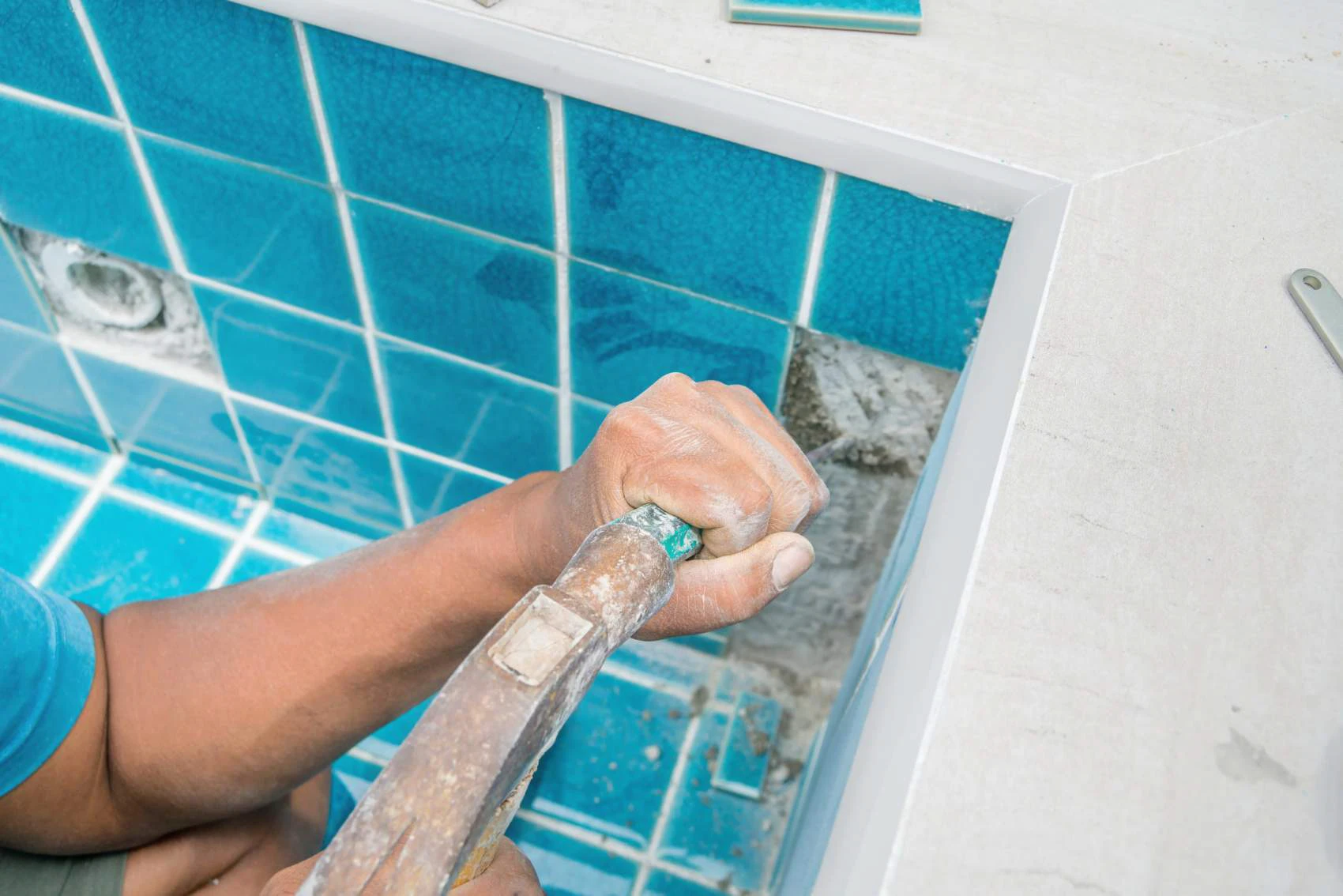
- Waterline tile damage. Turquoise 4×4 ceramic waterline tile chips cleanly under impact. If you see a missing or cracked tile at the surface level, photograph it immediately for insurance and plan a targeted tile-replacement repair (usually $220 to $480 for a patch).
- Shell hairline cracks below the tile band. Use a phone flashlight and scan the plaster from inside the pool (wear goggles if the water is still cloudy). Hairline cracks from storm impact are extraordinarily uncommon, but when they happen they leak — and every day of leaking is more chemistry loss and more substrate erosion.
If you spot any of the three, photograph it, note the date and weather event, and send both to your pool service before the next scheduled visit. Alpharetta falls inside Fulton County, and homeowner’s insurance in the 30004, 30005, 30009, and 30022 ZIP codes will generally cover storm-related pool damage under “other structures” coverage — but only if you document within 72 hours of the event.
Step 05 — Chemistry Triage in the 24 to 36 Hours After the Event
This is where most homeowners lose the pool. The debris is out, the equipment is running, the water looks 90% recovered — and then three days later it’s green. What happened in between: every leaf and pine needle that hit the water for even 15 minutes dumped organic load into the pool. That load eats your free chlorine, drops your chlorine demand through the floor, and creates the exact conditions algae needs to bloom.
The chemistry triage sequence is not optional:
Hour 0 to 2 (immediately post-debris-removal): Test free chlorine, combined chlorine, pH, and total alkalinity. If your test kit reads zero or near-zero free chlorine with elevated combined chlorine, the pool has already burned through its sanitizer fighting the organics. Dose cal-hypo shock at 2 pounds per 10,000 gallons — that’s roughly double the routine-shock dose, which is intentional. Alternatively, dichlor shock works but adds cyanuric acid to the water, and Alpharetta pools that are already running 50+ ppm CYA will stabilize slower if you stack more dichlor on top.
Hour 6 to 12: Re-test. Free chlorine should be reading 5 to 10 ppm. If it’s below 3 ppm, the organic demand is still eating sanitizer faster than you can supply it. Dose again at half the original rate and circulate overnight with the pump running continuous — no schedule, no nighttime reduction.
Hour 24 to 36: Add a polymer-based algaecide (not copper-based — copper stains plaster and stays in the water for months) at the label’s “post-storm” rate. This is the belt-and-suspenders step. You’ve already killed the organic load with shock, the algaecide prevents the small percentage of algae spores that survived from establishing over the next 72 hours.
Cyanuric acid matters more than you think: Alpharetta pools that run cyanuric acid above 70 ppm lose 40–60% of their chlorine’s effective sanitizing power. If your water sits at 80+ ppm CYA heading into storm season, a partial drain-and-refill in June is cheaper insurance than a green-pool recovery in August.
Step 06 — What a Professional Post-Storm Service Call Actually Costs in Alpharetta
If you’d rather not run the triage yourself — a lot of Alpharetta homeowners, especially in the tech-corridor relocation pocket near Avalon and the Windward Pkwy corridor, are time-poor rather than cash-poor — a post-storm service call in north Fulton runs in three tiers:
- Standard debris triage (clear, restart, chemistry adjustment): $180 to $260 during business hours. This is the 90% case — heavy debris, no equipment damage, chemistry reset needed. Typical turnaround is 60 to 90 minutes on-site.
- Debris triage plus filter service: $280 to $420. Same as above plus a DE recharge or cartridge cleaning, or a multi-valve service if the sight glass showed a problem.
- Equipment failure response (burned pump motor, cracked skimmer throat, valve rebuild): $650 to $2,400 depending on the part. Most commonly it’s a pump motor — the Century Centurion C-face 2.0 HP replacement, which is the most common pump motor on Alpharetta pools built 2005–2015, runs $420 for the motor plus labor. Variable-speed replacements run higher, as noted above.
After-hours and weekend-emergency pricing adds roughly 30–45% to the standard rate. If a storm hits at 5pm on a Friday, expect the Saturday morning call to reflect that. We schedule a dedicated rotating emergency slot through July and August specifically because the volume of post-cell calls is predictable — in a typical Alpharetta summer, there are 12 to 18 storm events significant enough to trigger service calls, clustered heavily in the late afternoon 4pm–7pm window.

The Permanent-Fix Upgrades Worth Considering After a Second Storm Event
A lot of Country Club of the South and Hutchinson Farm homeowners call us for the first time after a storm event, not during a scheduled service. If the triage sequence above has happened twice in the same summer, there are three permanent-fix upgrades worth pricing before September:
Oversized skimmer basket inserts. OEM baskets on most Alpharetta pools top out at 8 to 10 ounces of debris capacity before they choke the pump. Aftermarket inserts (the SkimDoctor 2.0 or Pool Skim upgrade insert) roughly double that capacity for $22–$38 per skimmer. For pools with heavy oak canopy overhead, this is the single highest-ROI upgrade on the equipment side.
Automated cover. A retractable safety cover — Coverstar or Latham automatic cover — closes in 30 seconds and blocks 95% of airborne debris. Full installs run $12,000 to $22,000 for an Alpharetta rectangular pool in the 14×32 to 18×40 size range. This is the expensive option, but for tech-corridor homeowners traveling three weeks a month, it’s the only triage system that operates while you’re not there.
Variable-speed pump with flow-sensor automation. If you’re still running a single-speed pump (common on builds before the 2011 APSP energy code shift), upgrading to a Pentair IntelliFlo3 VSF or Jandy ePump 2.7 with integrated flow sensor gets you a pump that self-diagnoses debris-restriction conditions and throttles down to protect itself before the motor overheats. Installed cost runs $2,400 to $3,600, with typical payback on the energy savings alone inside 3 to 4 summers in Alpharetta’s climate.
None of these upgrades eliminates post-storm cleanup entirely. What they do is convert an emergency service call into a routine morning skim — and that’s the difference between losing a July weekend to a green pool recovery and being in the water by sunset.
The Kit Every Alpharetta Pool Owner Should Keep in the Pump Shed
If you take nothing else from this piece, take the kit list. This is the exact contents of the storm-response bin we recommend every north-Fulton homeowner keep stashed in the pump shed or equipment closet. Total out-of-pocket for the full kit runs $140 to $185 — less than a single emergency service call.
- Commercial-grade 16-inch leaf rake (Purity Pool ProLeaf or equivalent) — $58
- 16-foot telescopic pole (anodized aluminum, not plastic-segmented) — $42
- One spare skimmer basket matched to your skimmer model — $12–$28
- One sealed container of calcium hypochlorite shock, 6 lb — $18
- One quart of polymer-based algaecide (non-copper) — $22
- A roll of blue painter’s tape and a paint pen (for baseline notations) — $8
- A laminated card with your equipment model numbers and the service phone number — free
The last item matters more than the hardware. At 5:45pm on a Friday in July, when the sky opens up and you need to know whether you have a Pentair Warrior SD or a Hayward Super Pump so the service tech can quote the right part over the phone, having the model and serial number written on a laminated card taped to the inside of the pump shed door will save you 20 minutes and a frustrated call. Every post-storm call we take where the homeowner can read us the model number off a card gets resolved faster and cheaper than the ones where they can’t.
Pool repair and storm-response service across 20+ cities within 30 miles of Winder, GA
Alpharetta summer storms are predictable — your response to them should be too. We keep a dedicated rotating emergency slot through July and August for Fulton County post-storm calls.