
The homeowner called us out to a 2.4-acre lot off Freemanville Road after sunset on a September Tuesday. He wanted to show us something specific — how dark it actually got. No streetlights. No neighbor glow. Just a $180,000 pool disappearing into a black hole at 8:14 p.m.
That is the Milton lighting problem in one sentence. You build an estate pool in Alpharetta and the ambient suburban glow carries it after dark. You build the same pool four miles north in Milton and it vanishes. The rural preservation ordinance that makes this town beautiful — 1-acre minimums in AG-1 zoning, no strip retail, tree canopy to the horizon — also means zero light pollution to lean on. Your deck lighting is not cosmetic here. It is the entire evening.
This post walks through the exact deck lighting package we build into Milton pool projects, what it costs, what the fixtures are, how the scenes program, and why the conversation is completely different than the one we have in Alpharetta or Johns Creek. If you are reading this before breaking ground, you will save yourself an expensive retrofit. If you already have a pool and a dark deck, the same package drops into an existing build in about nine working days.
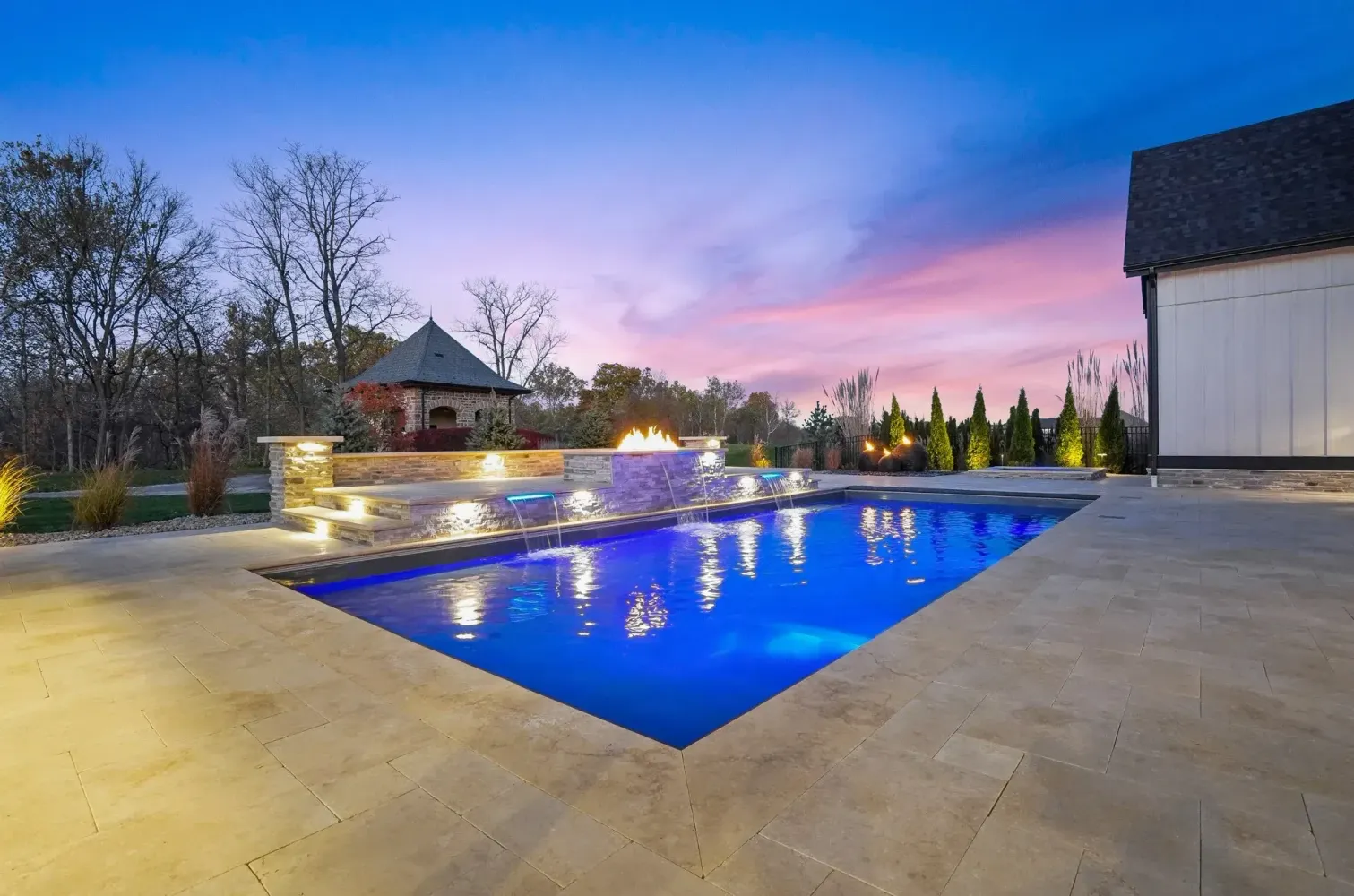
Why Milton Darkness Changes the Whole Lighting Conversation
Drive south on GA-372 (Birmingham Highway) at 9 p.m. and watch the horizon. There is no cityscape. The Manor Golf Club to your west is a dark canopy. Chukkar Farm polo grounds to your north is unlit pasture. The only lights you see are porches and the occasional headlight on Hopewell Road. That is what your pool deck is competing against — which is to say, nothing. Every watt you install reads.
Compare this to an Alpharetta subdivision pool, where a Publix parking lot, a Chick-fil-A, six streetlights, and forty-two neighbor porches are already washing the scene in about 0.3 lux of ambient glow. In Alpharetta, a homeowner can install four path lights and call it done. The deck still reads at night because the sky is gray, not black.
In Milton, the sky at 10 p.m. in Crooked Creek or Cogburn Estates measures under 0.03 lux — roughly ten times darker. We have photometered this on three separate jobs. That order-of-magnitude difference is why a Milton pool deck either becomes an evening destination or becomes invisible. There is no middle ground.
The Milton lighting budget reality: Estate deck lighting packages on 1–3 acre Milton lots run $18,000 to $32,000 installed — roughly 3x what we quote for a comparable Alpharetta build. The extra cost buys you fixture count (22 vs 8), landscape uplighting on specimen trees, and a Lutron control system.
The Fixture Package: What Actually Goes in the Ground
A full Milton estate deck lighting package has four distinct fixture zones, and they get specified separately because they do different jobs. Mixing them up — or skipping one — is the most common mistake we see on retrofits brought to us by homeowners who hired a pool builder without a lighting designer.
Zone 1: Perimeter In-Grade Fixtures (14–22 units)
These are the anchor of the whole package. We spec FX Luminaire Zonda or Nox brass in-grade fixtures set flush with the travertine or bluestone deck surface at 16- to 20-foot spacing. On a typical Milton deck — say 1,800 square feet wrapping a 20×40 pool — that works out to 18 fixtures. At 3-watt LED per fixture with a 2700K warm-white spec, the deck reads as a continuous glow-line, not a string of dots.
Brass matters here. The aluminum knockoffs fail inside four winters because Cecil clay over weathered granite holds moisture against the housing, and our 22 average annual freeze events cycle that moisture into the LED driver. We have pulled corroded aluminum fixtures off eight-year-old decks that looked twenty years old. The FX brass units run $340–$480 each installed, and they outlast the deck.
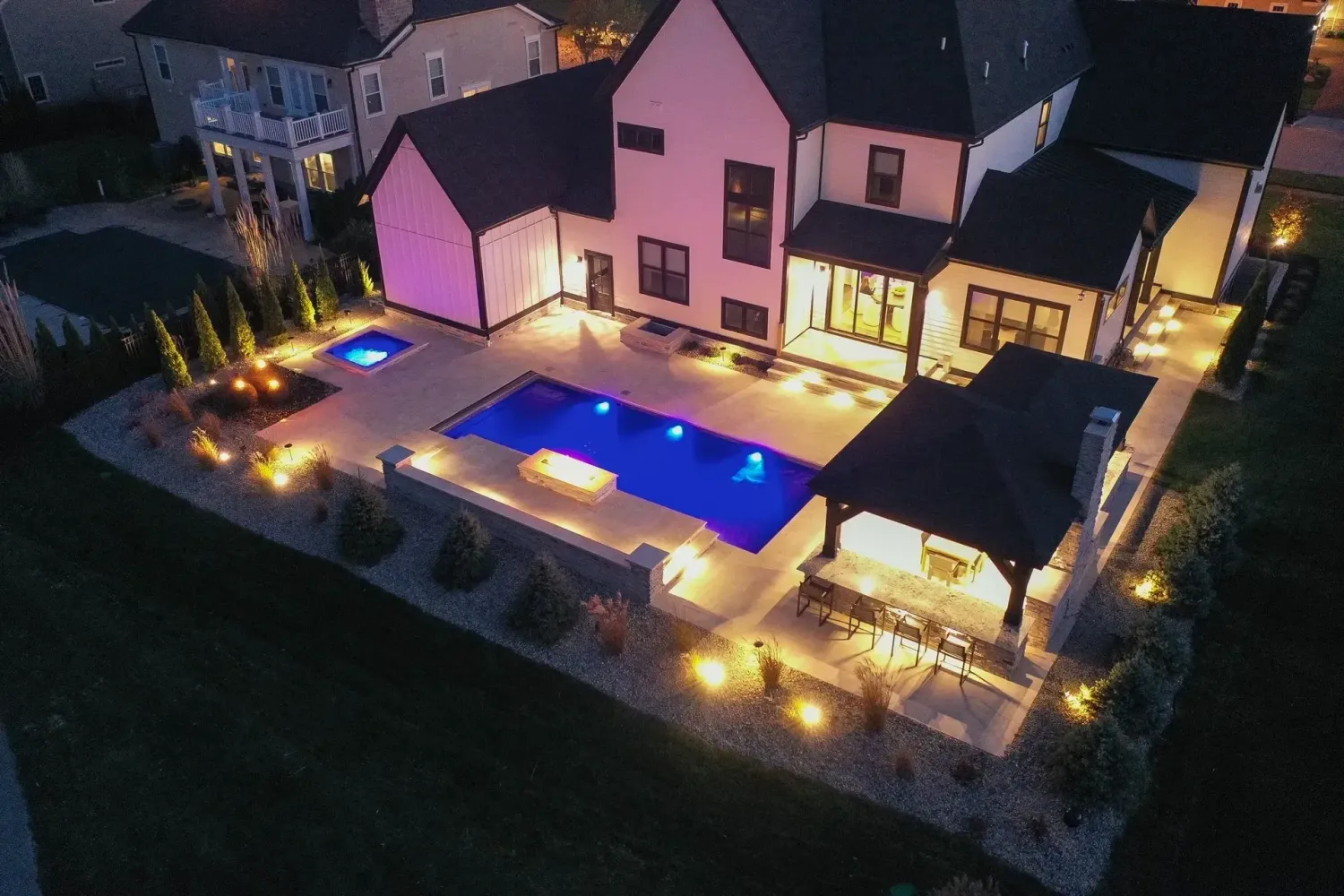
Zone 2: Step-Riser and Grade-Change Lighting (8–12 units)
Milton lots average 6 to 14 feet of grade drop across the pool zone. That is a huge number compared to flat Forsyth subdivisions, and it means your deck has steps, seat walls, and retaining transitions that need to be lit for safety before anything else. We run low-voltage LED strip under the nose of every tread (IP67, 2700K, 180 lumens/foot) plus brass down-lights recessed into seat-wall caps at 4-foot intervals.
On the Hopewell Plantation project last spring we installed 11 step-riser runs across three grade transitions. The homeowner had originally been quoted a flat deck by another builder — the lighting conversation is what convinced him to let the grade drop naturally and build a tiered entertaining zone instead. Better pool, better lighting, same money.
Zone 3: Water-Feature Accents (4–6 units)
Every deck we do in Milton gets water somewhere — a sheer descent, a scupper wall, a spillover spa. The water is doing the work in daylight. At night it needs backlighting to keep performing. We use Pentair GloBrite color-changing LEDs behind sheer descents and FX Luminaire MP2 wall-wash fixtures on scupper walls at 4-foot spacing. Budget $600–$900 per feature installed.
Zone 4: Specimen Tree and Landscape Uplighting (12–20 units)
This is the zone that separates estate lighting from subdivision lighting, and it only makes sense in Milton because Milton has the trees. Every AG-1 lot we work on has at least four to eight mature hardwoods — white oak, hickory, tulip poplar — within 30 to 40 feet of the deck. We uplight them with 20-watt equivalent LED flood fixtures at 20-degree or 38-degree beam spread, aimed up through the canopy.
The effect is not subtle. A 60-foot white oak uplit at 2700K becomes a cathedral ceiling for your pool deck. On a 2-acre lot we typically place 14 to 18 uplights creating a 30-to-40-foot-diameter lit perimeter around the pool zone. Without this zone, everything beyond the deck edge reads as a black wall. With it, the estate extends.
Lutron RadioRA 2 and the 8-Scene Program
Twenty-two perimeter fixtures, twelve step lights, six water accents, and sixteen uplights equals 56 fixture points. You cannot run that on a wall switch. Every Milton deck lighting package we install ships with a Lutron RadioRA 2 or Homeworks QS controller and eight pre-programmed scenes. The control system runs $2,800–$4,200 of the total budget and pays for itself the first weekend.
The eight scenes we program by default:
- Arrival (dusk to 8 p.m.): perimeter at 60%, uplights at 40%, water features off. Welcoming but not theatrical.
- Dining: perimeter at 80%, step risers at 100%, uplights at 25%, water features at 70%.
- Cocktail: perimeter at 40%, uplights at 80%, water features at 100%. The estate-resort look.
- Swim: pool lights on, water features on, perimeter at 30% for safety.
- Late Night: step risers only at 60%. Enough to navigate, nothing else.
- Security: perimeter at 100%, uplights at 100%, all water off. Triggered by motion after midnight.
- Off: everything down, dry-contact relay cuts transformer power.
- Holiday: a custom scene with color-changing accent channels for December.
The scenes run from wall keypads at the back door and kitchen island, from the homeowner’s phone via the Lutron app, and from an Alexa or Google Home voice command. Most homeowners use the phone and voice control after the first two weeks. Nobody remembers keypad scenes under pressure when six couples are arriving for dinner.
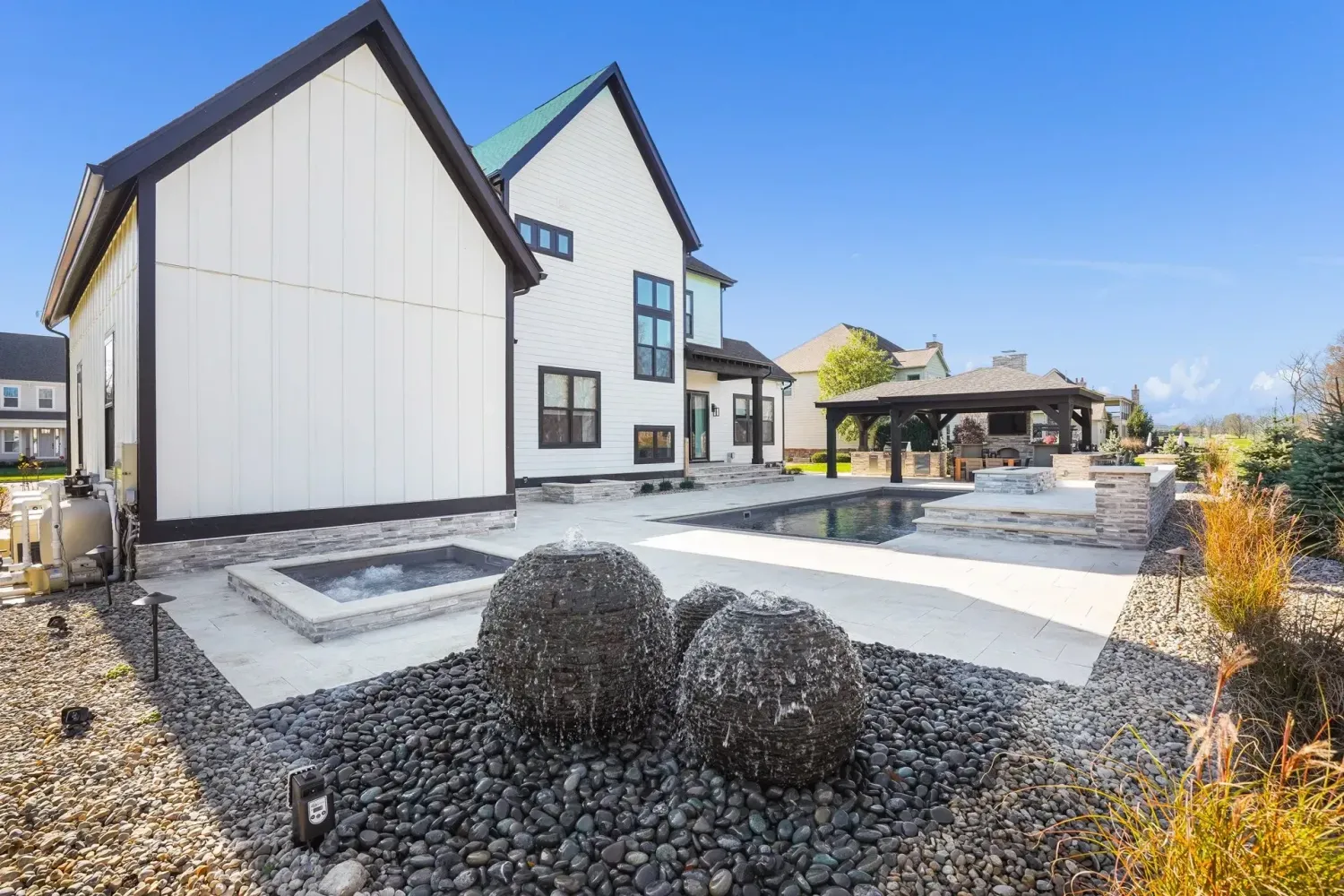
The Milton Permit and Review Timeline
Here is where Milton gets specific and you need to plan for it. Because the city incorporated in 2006 and pulled out of Fulton County for most development review, your permits go through Milton Community Development at 2006 Heritage Walk, not the Fulton government in downtown Atlanta. That is a win and a constraint.
The win: turnaround is faster. We see low-voltage lighting permits cleared in 10 to 14 business days, roughly half the Fulton County timeline. The constraint: Milton’s preservation review is stricter. On lots zoned AG-1 or inside the Crabapple overlay, any fixture mounted above 48 inches has to be reviewed for sky-glow and neighbor spill. That is why every landscape uplight we spec uses a full-cutoff or fully-shielded housing and why we cap color temperature at 2700K. A warm fixture with a tight cutoff clears review every time. A 4000K fixture without shielding gets flagged.
If the property is inside The Manor Golf Club or another controlled neighborhood with an architectural review committee, add four to five weeks to the timeline for ARC approval — the committee meets monthly and wants fixture cut-sheets, photometric plan, and a site plan showing pole height and beam spread. We handle that submission; the homeowner signs one form.
Creek-buffer note: If your property touches Cooper Sandy Creek, Chicken Creek, Lake Creek, or an Etowah tributary, you have a 25-to-75-foot impervious setback and we cannot place in-grade fixtures inside that buffer. Plan the deck edge accordingly — retrofitting around a creek setback is the hardest fix in the book.
A Real Project Breakdown: 2.1-Acre Build on Potters Road
This is the job the opening story came from. Homeowner in a $2.8M Potters Road estate, built 2019, original pool builder had installed eight cheap aluminum path lights and called it lighting. By 2024 five were dead, the remaining three flickered, and the deck was unusable after sunset. He called us in October.
The scope we built:
- 20 FX Luminaire Zonda brass in-grade perimeter fixtures at 18-ft spacing around the 42×22 freeform pool
- 11 step-riser runs covering 38 linear feet of travertine steps across a 7-foot grade drop
- 6 Pentair GloBrite color-LED units behind two sheer descents on the spa wall
- 16 landscape uplights across six white oaks and two tulip poplars forming a 36-ft-diameter lit perimeter
- Lutron RadioRA 2 system with two 8-button wall keypads, phone app, and Alexa integration
- 300-watt Kichler multi-tap transformer plus secondary 150-watt unit for uplight zone
Installed total: $26,400. Timeline from signed contract to first-scene demo: 31 days, including 12 business days for permit. The Manor-adjacent ARC added another 18 days because the uplights crossed a view-corridor easement, which we resolved by lowering two fixtures to 24-inch mounting height and re-submitting.
The homeowner’s wife runs cocktail scene from her phone when guests arrive. Her words — not ours — on the final walkthrough: “The house used to end at the back door.” That sentence closed the sale on two referrals in Cogburn Estates within six weeks.

What to Ask a Builder Before You Sign
Most pool contractors subcontract lighting to a landscape lighting company after the deck is poured. That almost always produces a worse result than integrating it during design, because the conduit sleeves, transformer location, and fixture rough-ins have to be set before the concrete and stone go in. Three questions to ask any pool builder in Milton before you sign:
- Are conduit sleeves for low-voltage lighting cast into the deck pour? The correct answer is yes, a minimum of six 1-inch sleeves per deck quadrant at strategic transition points. Retrofitting sleeves means saw-cutting your new deck — a $4,000-to-$7,000 cosmetic tax on bad planning.
- Where is the transformer location and how is it fed? A 300-watt transformer on a 20-amp dedicated circuit is the correct spec for 22+ fixtures. Homes that share lighting power with pool equipment or a landscape irrigation controller trip breakers all summer.
- What is the control system spec, and is the programming included? If the contractor says “Bluetooth app that comes with the fixtures” — walk. That is a $180 Amazon controller. You want Lutron RadioRA 2 or Homeworks QS with scenes programmed by a certified integrator and a printed scene card for the homeowner.
Maintenance, Warranty, and the Long View
A properly installed Milton lighting package is nearly maintenance-free for years one through four. After that, the LED drivers in the perimeter fixtures start to drift in output — a fixture rated 400 lumens at install reads 340 by year five. You will not notice visually, but the scenes start to feel uneven.
We return on a five-year re-balance cycle. It costs about $800 for a 22-fixture deck, we drop the Lutron scene levels 8% across the board to re-match output, and we swap any failed drivers under the 10-year FX Luminaire warranty. Most homeowners book this through us on a reminder call; it takes four hours and falls on a Tuesday morning in spring.
Beyond that, you replace a transformer every 15 years or so, an occasional fixture lens after an unfortunate encounter with a zero-turn mower, and that is the full lifetime cost. The deck lighting package outlasts the pool plaster by at least two refinish cycles.

Pavilion, Kitchen, and Pergola Integration
Almost every Milton estate pool we build includes a detached pavilion or pergola — and this is where lighting planning either pays off or falls apart. A pavilion roof gives you a place to hang pendant fixtures over the dining table and under-cabinet LEDs inside the outdoor kitchen, both of which have to be on their own Lutron zones so they can run independently of the deck scenes. A homeowner wants to dim the dining pendants during conversation while the perimeter deck lighting stays at full cocktail output. That requires the control system to see the pavilion and the deck as separate rooms, not one lighting group.
The outdoor kitchen zone typically adds four to seven fixture points — two pendants over the island, LED strip under the counter overhang, a dedicated task light over the grill head, and sometimes a brass sconce flanking the refrigerator column. Budget another $1,800 to $2,400 on top of the base deck package. Every fixture here has to be rated for wet location with a stainless or brass body, because the spray from the pool reaches farther than most homeowners think, and a 12-foot pavilion overhang does not stop wind-driven mist.
Pergolas get a different treatment. Without a solid roof, you cannot hang pendants — they sway, look wrong, and collect every spider in the county. Instead we run warm-white LED rope along the inside top edge of the pergola beams, indirect, aimed up at the wood. The pergola itself becomes the fixture. Add four to six uplights at the base of the support posts aimed up through the structure for a layered effect, and the pergola at night reads like architecture instead of lumber.
Seasonal Programming and the Georgia Calendar
The lighting scenes are not set-it-and-forget-it. The Georgia calendar pushes sunset from 8:50 p.m. in late June to 5:25 p.m. in mid-December, and the scene timing has to follow. Every Lutron install we do includes astronomical-clock programming — the controller knows sunset and sunrise for Milton’s coordinates and shifts the Arrival scene trigger day by day, automatically. The homeowner never touches it after install. In July, arrival fires at 8:45. In December, it fires at 5:20. The porch lights come on at dusk whether anyone is home or not.
The other seasonal factor is holiday programming. Milton takes Christmas lighting seriously — drive Freemanville or Hopewell in mid-December and half the estates are lit from road frontage to rear pool deck. We build a dedicated Holiday scene that runs alongside a separate contactor-controlled circuit for the homeowner’s string lights, so one keypad button lights the deck in warm amber, fires up the spa jets, and kicks the front-yard Christmas lights on at 5:20 p.m. The homeowner controls it from the phone on the drive home from work. Families with kids have told us the scene-call moment — pulling in the driveway to the whole estate firing up at once — is the part of December their ten-year-old remembers.
Common Mistakes We Fix on Retrofit Calls
About 30% of our Milton lighting work is retrofit — homeowners who built pools with another contractor, lived with the lighting for three to five seasons, and called us because it never worked. The failure patterns are consistent and worth naming so you can avoid them on a new build.
The first is over-reliance on pool-interior lighting. Inexperienced contractors install two or three bright pool lights and assume the water glow lights the deck. It does not. Pool interior lighting is for swimmers, not for the deck surface. The deck needs its own fixtures pointing at the deck surface, and they need to be separate from the pool circuit so the homeowner can run deck lighting without running the pool pump.
The second is wall-pack flood lighting. A 150-watt LED floodlight mounted on the house pointed at the pool is not deck lighting — it is a prison yard. It washes out all the subtle scene work, creates hard shadows on faces, and attracts every moth in Fulton County. We disconnect wall packs on almost every retrofit and replace their function with a combination of step-riser lighting and low-mount eave down-lights at 3000K or lower.
The third is color temperature mismatch. A deck lit at 2700K (warm candlelight) is a completely different mood than a deck lit at 4000K (cool daylight). Mix them and the scene fights itself. We spec every outdoor fixture on a Milton job at 2700K unless the homeowner specifically requests otherwise, and we do not mix on a single deck. Uniformity is worth more than novelty here.
The fourth is cheap transformers. Landscape lighting transformers take weather abuse, and the $180 big-box unit fails in three to four seasons. We only install Kichler, FX Luminaire, or Unique Lighting multi-tap brass or stainless transformers with proper grounding and a weatherproof enclosure. The upgrade from consumer-grade to professional-grade transformer is about $400 per unit and adds ten years to the system.
Wiring, Voltage Drop, and Why Wire Gauge Matters on Long Runs
The estate lots in Milton create a wiring problem that does not exist in subdivision builds. When the transformer is mounted near the equipment pad on one side of the pool and a specimen-tree uplight is 180 linear feet away across the deck and into the landscape, you get voltage drop — the LED at the far end of the run receives less than the rated voltage and outputs less light, sometimes noticeably. Two fixtures on the same scene can end up reading visually different, and the homeowner cannot figure out why one oak looks dimmer than the other.
The fix is to size wire gauge to run length and fixture load. For any run over 100 feet we move from 12-gauge to 10-gauge low-voltage cable, and for runs over 180 feet we use 8-gauge with a multi-tap transformer that lets us pick the voltage at the transformer terminal to compensate. It costs another $300 to $600 in wire per job and it is the difference between a deck that reads even and a deck that reads patchy. On the Potters Road project we had four fixture runs over 150 feet and all four needed 10-gauge and the 13-volt tap on the transformer.
The related issue is trenching. Milton’s estate lots have irrigation already installed, drainage already installed, and often a dog fence wire already buried. We hand-trench or use a vibratory plow at 6-inch depth to avoid hitting existing lines, and we map every run with photos before backfill. This protects the next contractor who ever digs on the property and has saved us from being blamed for irrigation cuts that happened years later.
The single most useful thing a Milton homeowner can do before building is visit a completed project after dark. We schedule evening walkthroughs of reference projects in Crooked Creek, The Manor, and Cogburn Estates — typically 8:30 to 9:15 p.m., which is when the scenes read at their best. Seeing a 56-fixture package running through Arrival, Dining, and Cocktail scenes in person answers every question a cut-sheet cannot.
The rural character that makes Milton worth living in is exactly what makes the lighting design harder and the payoff larger. You are not fighting streetlight glow. You are building the only light for a quarter-mile. Budget for it during design, spec the right fixtures, and the estate becomes something the original architect never drew — a place that works at 9 p.m. as hard as it works at noon.
Pool decks and estate lighting across 20+ cities within 30 miles of Winder, GA
We design the four-zone lighting package during pool architecture, not after — so the conduit, transformer, and Lutron control system are baked into the build from day one.