
It is a Saturday in late June in Hamilton Mill. You have eight guests coming at 6:30. Radar has been showing a pop-up thunderstorm sliding east from the Alcovy watershed for three hours, and at 5:45 the first drops hit the pavers. If your outdoor kitchen is open, everyone retreats into the house and the ribs finish under the ceiling fan in the dining room. If it is covered, the party does not move. That one Saturday is the whole argument.
Except it is not. There are roughly twenty Saturdays a year in Dacula where cover changes everything, and another forty where an open kitchen under the July sun is more pleasant than sitting under a cedar hip roof in still air. The question is not which version is objectively better. The question is which fits the way you will actually use the space year-round, and what the cost difference buys you over a decade.
We build both. In the Providence Club neighborhood off Hog Mountain Rd., we have one client with a fully open L-shaped kitchen on 600 square feet of travertine and another three doors down with a 14×16 cedar pavilion covering the grill, prep counter, and a full dining table. Both are happy. They use their backyards differently — different times, different weather, different guest counts.
This is a decision framework, not a verdict. Six scorecards — real criteria, real numbers, real verdicts.
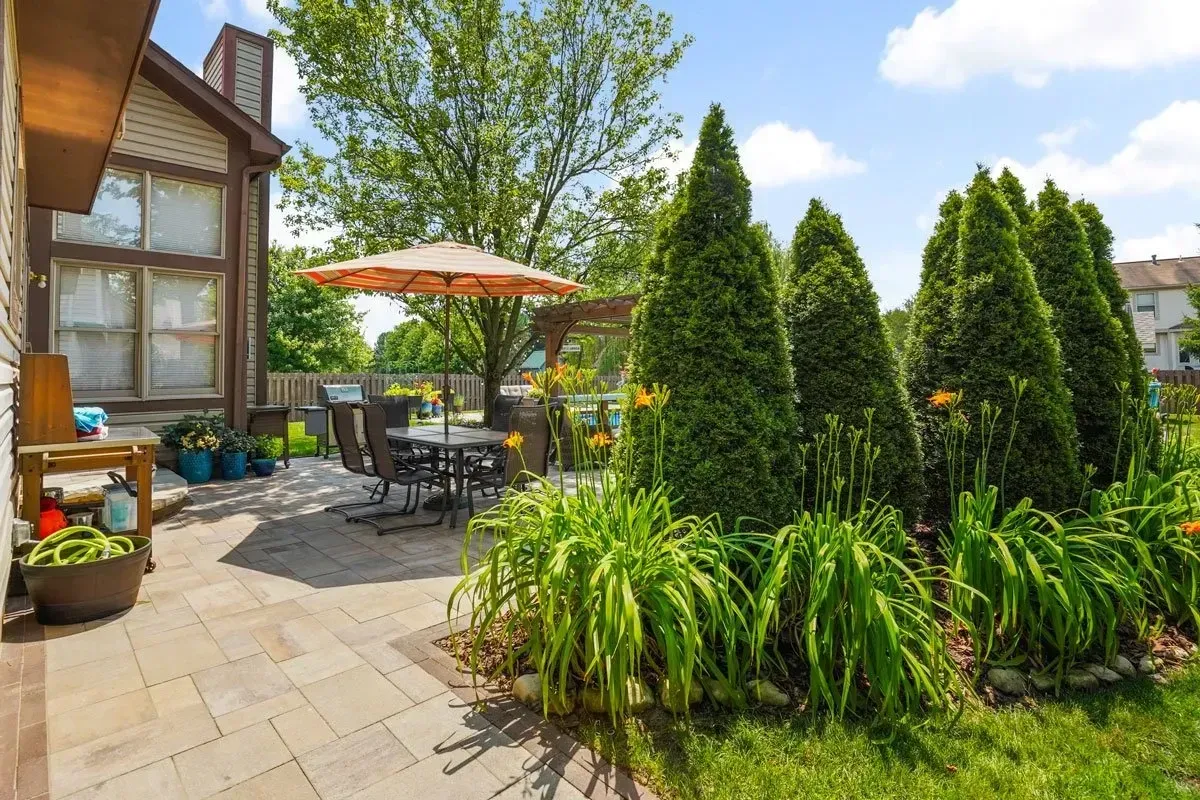
How Dacula’s Weather Actually Shapes the Decision
Grounding fact: Dacula averages 52 inches of annual rainfall over roughly 116 rain days. Spread across the calendar, that is nearly one rain event every three days, with summer afternoons being the window when pop-up storms most often interrupt an evening gathering. Dacula is wetter in June and July than most people remember.
We track a rainfall loss factor on our outdoor-kitchen projects. Of those 116 rain days, roughly 40 percent land during prime entertaining hours — late afternoon into evening plus weekend mid-days. An open kitchen loses those hours. A covered kitchen gets most of them back, because light and moderate rain becomes a non-event and only wind-driven rain actually ends the evening. A covered kitchen in Dacula gains roughly 80 usable hours per year over an identical open setup — two full weekends of entertaining.
Layer on summer heat. Dacula runs mid-90s with high humidity from mid-June through early September. Direct sun on a stainless grill hood at 3 p.m. in August puts the cooking surface 20 to 30 degrees above ambient. Cover changes that, but only if the structure is tall and ventilated enough to pull hot air out instead of trapping it — covered under the venting scorecard.
Dacula rainfall baseline: 52 inches per year across roughly 116 rain days. A covered outdoor kitchen recovers about 80 usable entertaining hours annually compared to an identical open setup.
Climate is only the first axis. Five more matter at least as much — and materials longevity is where people get the cost math wrong by the largest margin.
Scorecard 1 — Weather Protection and Year-Round Usability
Cover wins this row almost outright. The question is how much, and whether the gain justifies the cost delta on the last scorecard.
Two caveats. First, “covered wins” assumes the cover is built right — correct height, venting, finishes. A cheap low pavilion with a trapped grill vent is worse than no cover. Second, 80 extra hours matters more for some households than others. Cook outside six times a year and the gain is theoretical; live outside May through October and it is enormous.
Scorecard 2 — Grill Venting, Ceiling Height, and Code Compliance
This is where most under-specified covered kitchens fail on day one. A grill under cover is not the same installation as a grill in open air — the difference is measured in inches of clearance and feet of ceiling height.
Under NFPA 54 (National Fuel Gas Code), a grill under a combustible cover requires 36 inches minimum between the top of the grill hood and the ceiling. We build to 48 inches preferred — a tight 36 traps heat against the decking, discolors the finish, and reduces the draft that pulls smoke out. Pellet smokers, which run longer cycles and produce heavier smoke plumes, need even more vertical room.
Ceiling height controls all of it. Our baseline for any covered kitchen serving a tall grill is 9 feet minimum, 10 feet preferred for a pellet smoker or built-in overhead hood. Below 9 feet, the smoke plume hits the ceiling before cooling, and you get a stained ring directly above the grill within 18 months.
Open kitchens sweep this scorecard. If simplicity is the priority and you never want to think about clearance, draft, or smoke staining, open is the lower-friction path. The trade is everything on scorecard one.
NFPA 54 under-cover clearance: 36 inches minimum above grill hood. We build to 48 inches. Ceiling height: 9 ft minimum for standard grills, 10 ft preferred for pellet smokers.
Scorecard 3 — Materials Longevity (The Scorecard Most People Miss)
Most homeowners assume a covered kitchen means any material will last longer. Half true. Cover protects against rain, snow, and ice — but UV is still the primary destroyer of finishes on southern outdoor equipment, and cover does not eliminate it. It redirects it.
Under cover, finishes receive reflected UV from surrounding pavers, pool water, and lighter ceilings. Temperature swings are gentler, but humidity is often higher because still air traps evaporation. The result: non-stainless metals and lower-grade coatings sometimes rust faster under cover because the moisture cycle never fully dries out. We have seen powder-coated cabinet pulls show pinpoint rust at 36 months under cover, while the same pulls on an open kitchen two blocks away are fine at year seven.
The takeaway that matters: cover is not a license to cheap out on materials. Plenty of homeowners budget a covered kitchen thinking they can use interior-grade appliance panels because “it is protected now.” Three years later they are dealing with rusted panels on a $28,000 installation. Spec to marine grade in both scenarios.
Scorecard 4 — Ceiling Fans, Lighting, and Comfort Features
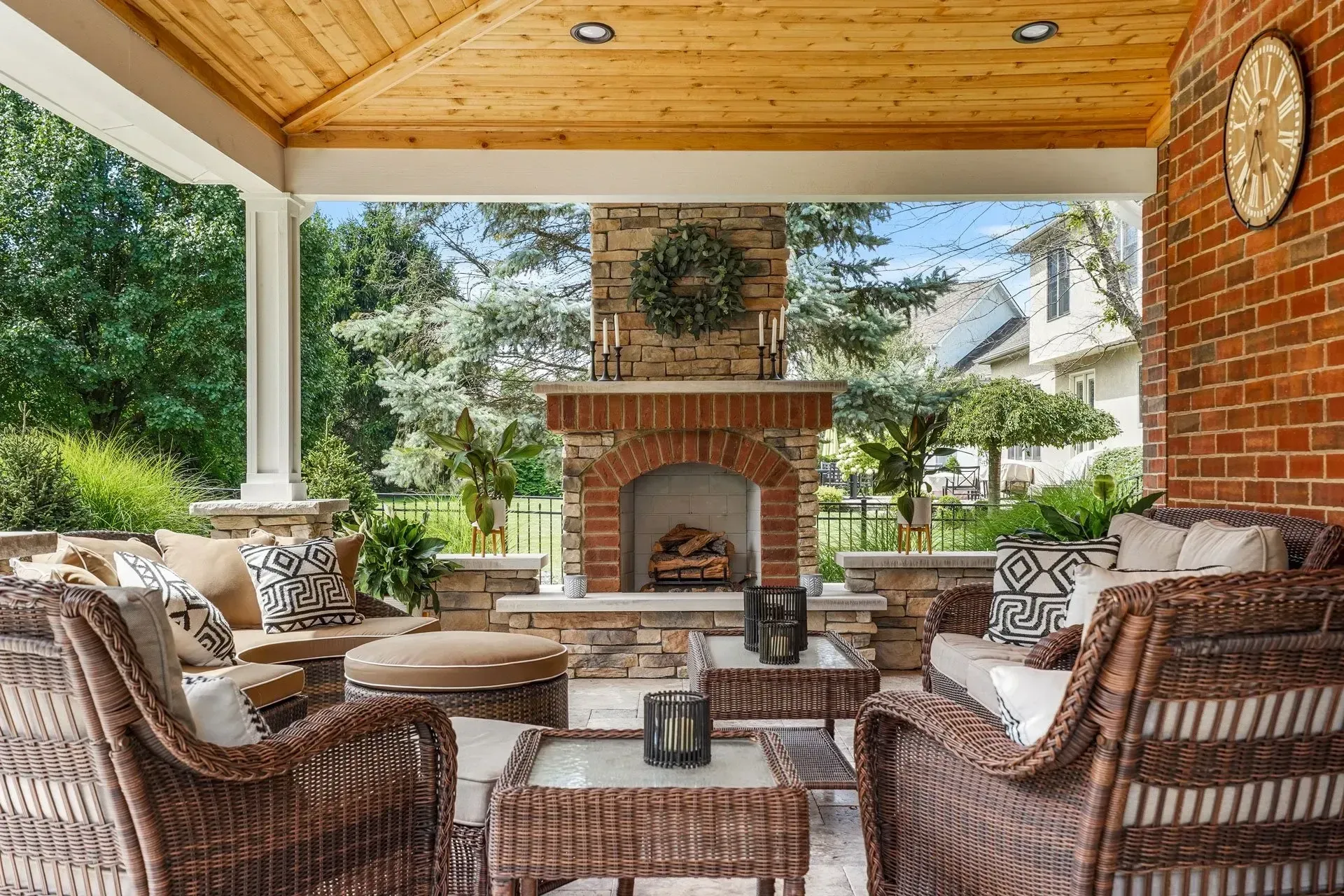
Under cover, you inherit infrastructure decisions that do not exist for an open kitchen. A ceiling fan is close to mandatory under any Dacula pavilion — without air movement, still humid air turns a summer evening into a sauna, and the whole promise of covered entertaining collapses. Outdoor fans are not interchangeable with interior fans; the spec matters.
Our rule: minimum 56-inch blade span for a 12×14 pavilion, larger for bigger footprints, and damp-rated (IP65 minimum) — wet-rated if the pavilion is open on all four sides. Interior fans labeled “outdoor” without real ingress protection corrode within three Dacula summers. Hunter, Kichler, and Emerson all make wet-rated models in the $300–$900 range that last a decade.
Lighting is the other piece. A covered ceiling lets you mount proper down-lighting — real task lighting over prep, even ambient light over dining, full dimmer control. Open kitchens rely on path lighting and house-mounted spots — functional but never as controlled.
One spec we enforce without compromise: every outdoor ceiling fan we install is IP65 damp- or wet-rated. If a homeowner insists on a cheaper fan because “it will be fine under the roof,” we write it in as their choice — we will not warranty a rusted motor in year three.
Scorecard 5 — Cost, Permits, and What You Actually Pay
Current Dacula-area installed ranges for the structure portion only — kitchen equipment, counters, and finishes run roughly the same whether covered or open.
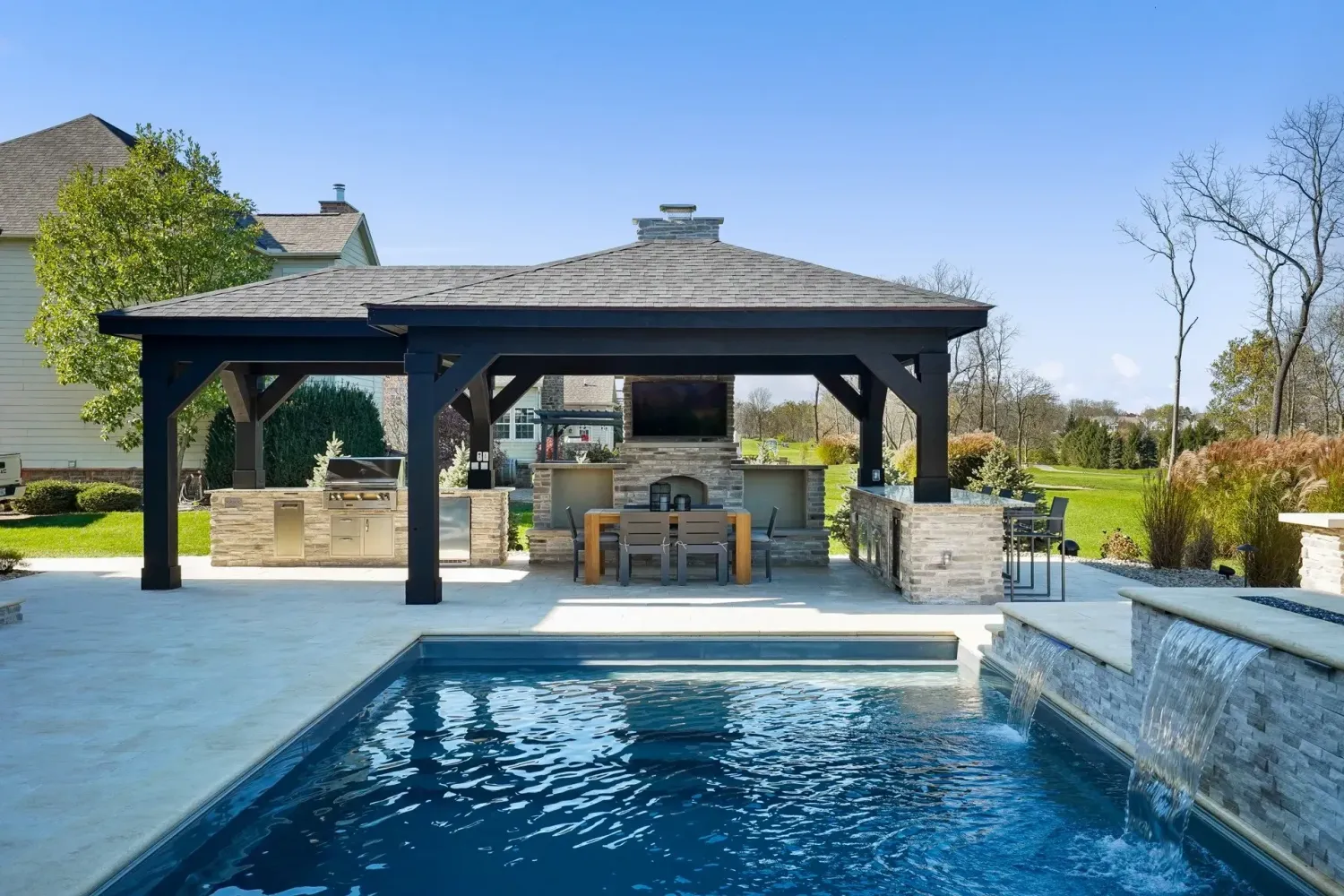
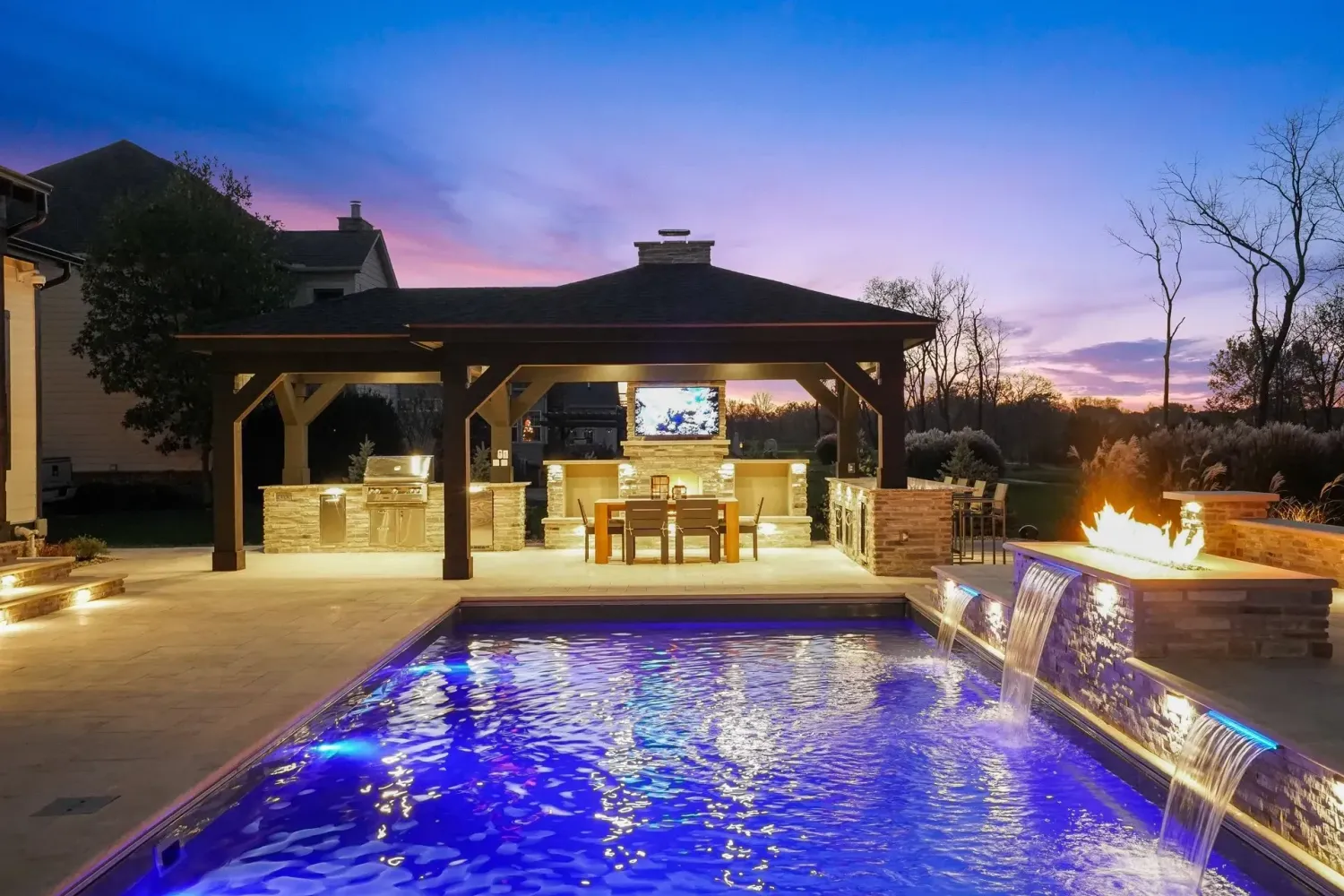
Cedar 12×14 hip-roof pavilion, installed: $14,800–$22,400. The most common structure we build over Dacula outdoor kitchens. Real cedar posts and rafters, asphalt or metal roofing, T&G cedar ceiling, stained and sealed. Pier-and-beam footings on Piedmont clay. Permit through Gwinnett County Planning & Development at 446 W. Crogan St. in Lawrenceville once the structure hits thresholds — allow 3–6 weeks for review plus inspections.
Aluminum louvered roof (StruXure-style), installed: $28,000–$44,000. Premium tier — rotating aluminum louvers that open for full sun and close for full rain shedding, with integrated lighting and fan mounts. Modern, mechanically complex, maintenance-light. Roughly 1.8x–2.0x cedar.
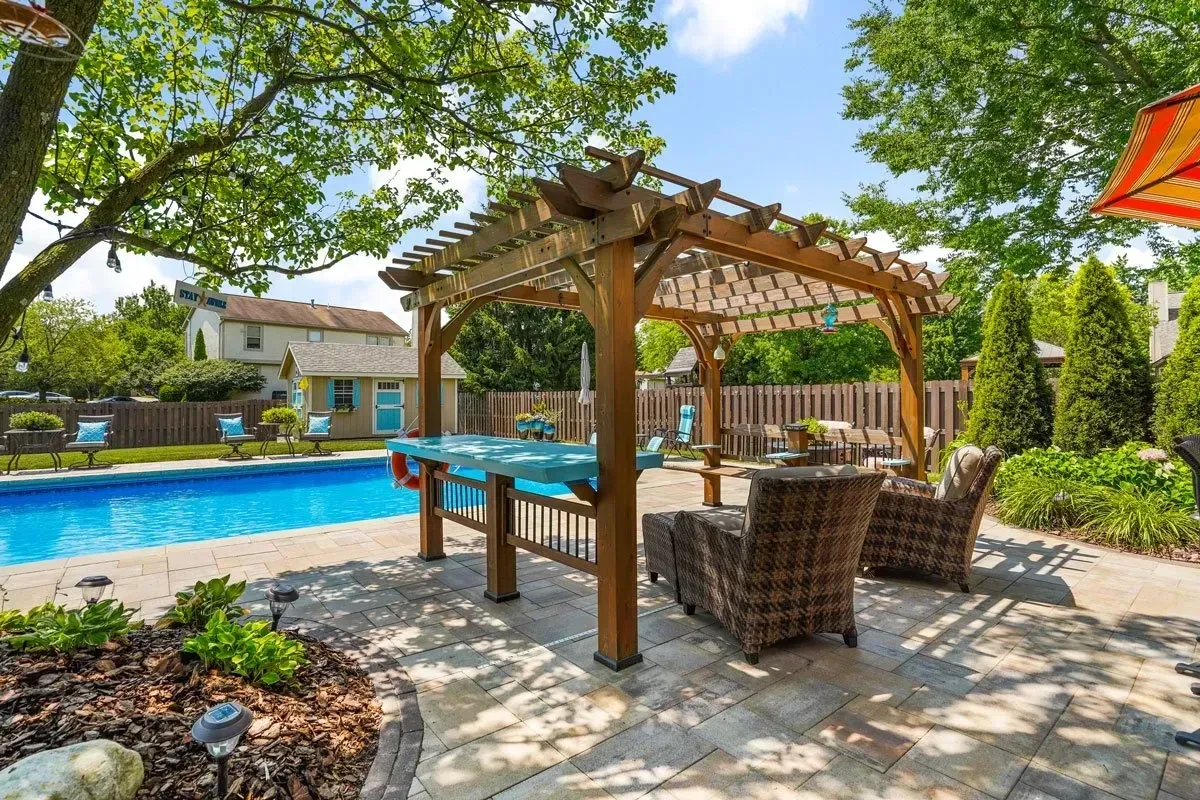
Pergola 10×12 cedar (partial cover), installed: $8,200–$12,600. Splits the difference — dappled shade and a defined overhead zone, but does not shed rain. You still get wet.
Honest cost-per-hour math: if cover adds $18,000 and recovers 80 annual hours, over a 15-year horizon that is about $15 per extra hour. Coffee money for frequent entertainers, preposterous for people who cook outside twice a year. Your household, not the structure, makes it worth it.
Structure cost reference (installed, Dacula): Pergola 10×12 cedar $8,200–$12,600 · Cedar 12×14 hip-roof pavilion $14,800–$22,400 · Aluminum louvered roof (StruXure-style) $28,000–$44,000.
Scorecard 6 — Site Fit: Lot, Sightlines, and House Architecture
This is the scorecard nobody thinks about before committing. A covered kitchen is a building — real vertical volume, real shadows, real sightline impact, and it has to relate architecturally to the house. A beautiful pavilion in the wrong position can black out a second-story window, block the pool view from the kitchen, or sit awkwardly against the house.
Dacula lots run 1/3 to 1/2 acre, with many homes in Sycamore Ridge and Chandler Ridge backing to wooded common space or adjacent subdivisions. Rear-yard depth is typically 60–90 feet before the tree line. A 12×14 pavilion at the 40-foot mark is fine; the same pavilion at the 20-foot mark shoves itself into the foreground of every rear window and kills depth in the yard.
Open kitchens sit at counter height, disappear from sightlines past about 20 feet, and adapt to any lot shape.
Final tally across six scorecards: covered wins roughly 10, open wins roughly 12, with ties. Not a contradiction of scorecard one — the actual answer. Covered delivers the biggest single benefit (weather protection) but carries costs across permits, lot fit, venting, and infrastructure. Open is flexible, cheaper, and simpler but surrenders the Saturdays thunderstorms will steal.
How to Actually Decide
Our decision framework, in order:
- How many times per month will you cook outside in season? Below four, go open. Above eight, go covered. In between, the other variables decide.
- Do you entertain on a schedule, or spontaneously? If you host 15 planned gatherings a year, covered protects the schedule. If you cook for family whenever the mood hits, open is fine — you can always reschedule.
- Is your backyard depth at least 60 feet? If yes, a pavilion sits correctly. If less, start with pergola or stay open.
- Is your total kitchen budget $45K+? If yes, adding $18K for a cedar pavilion is proportionate. If the kitchen itself is a $22K build, spending another $22K on a structure doubles the total and may not be the right sequencing — build open now and add cover later.
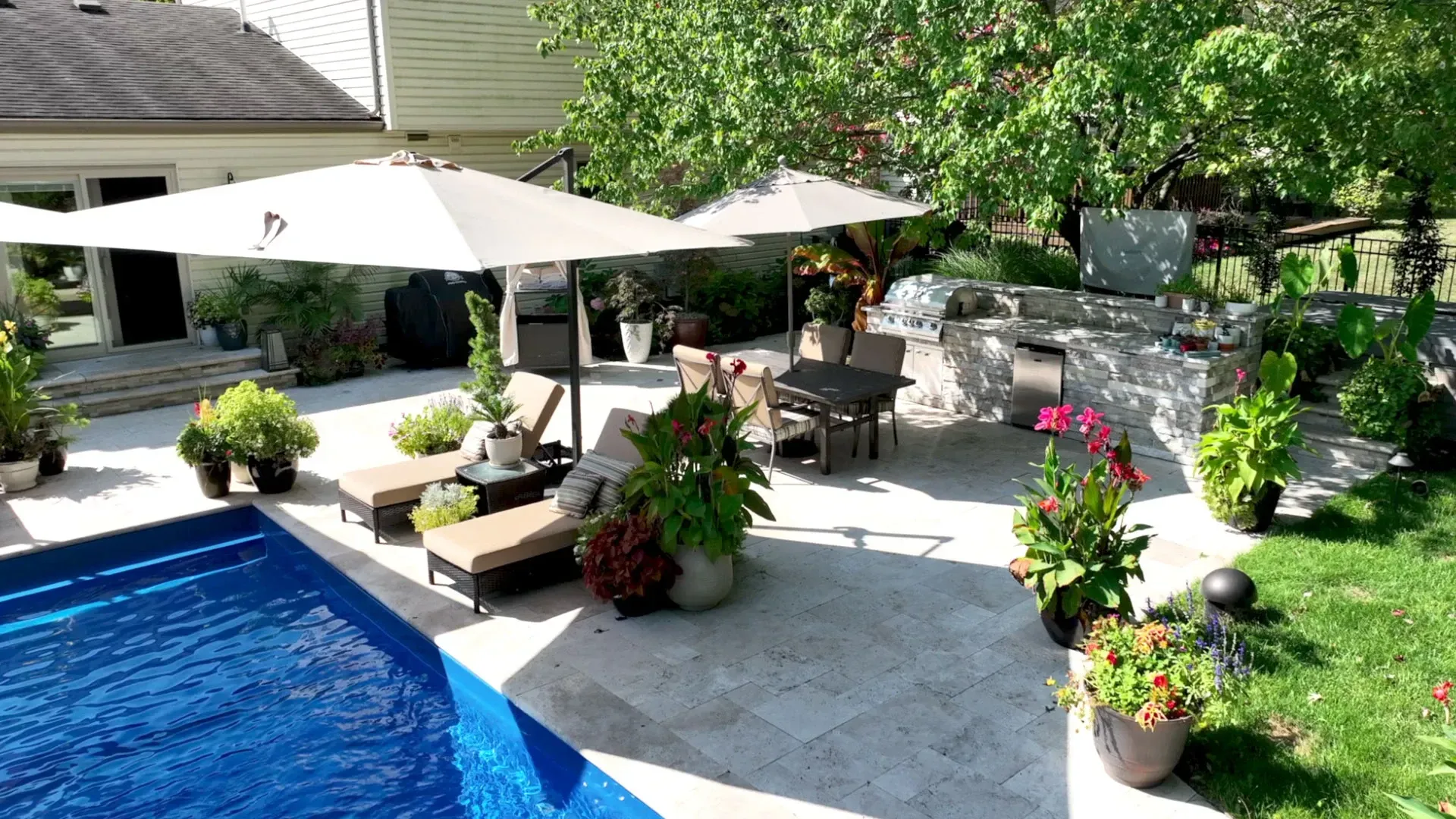
- Is there a pool in the plan? Covered kitchens near pools are enormously valuable — the cover becomes an eating/lounging zone during swim events. Open kitchens near pools work but lose the winter season completely.
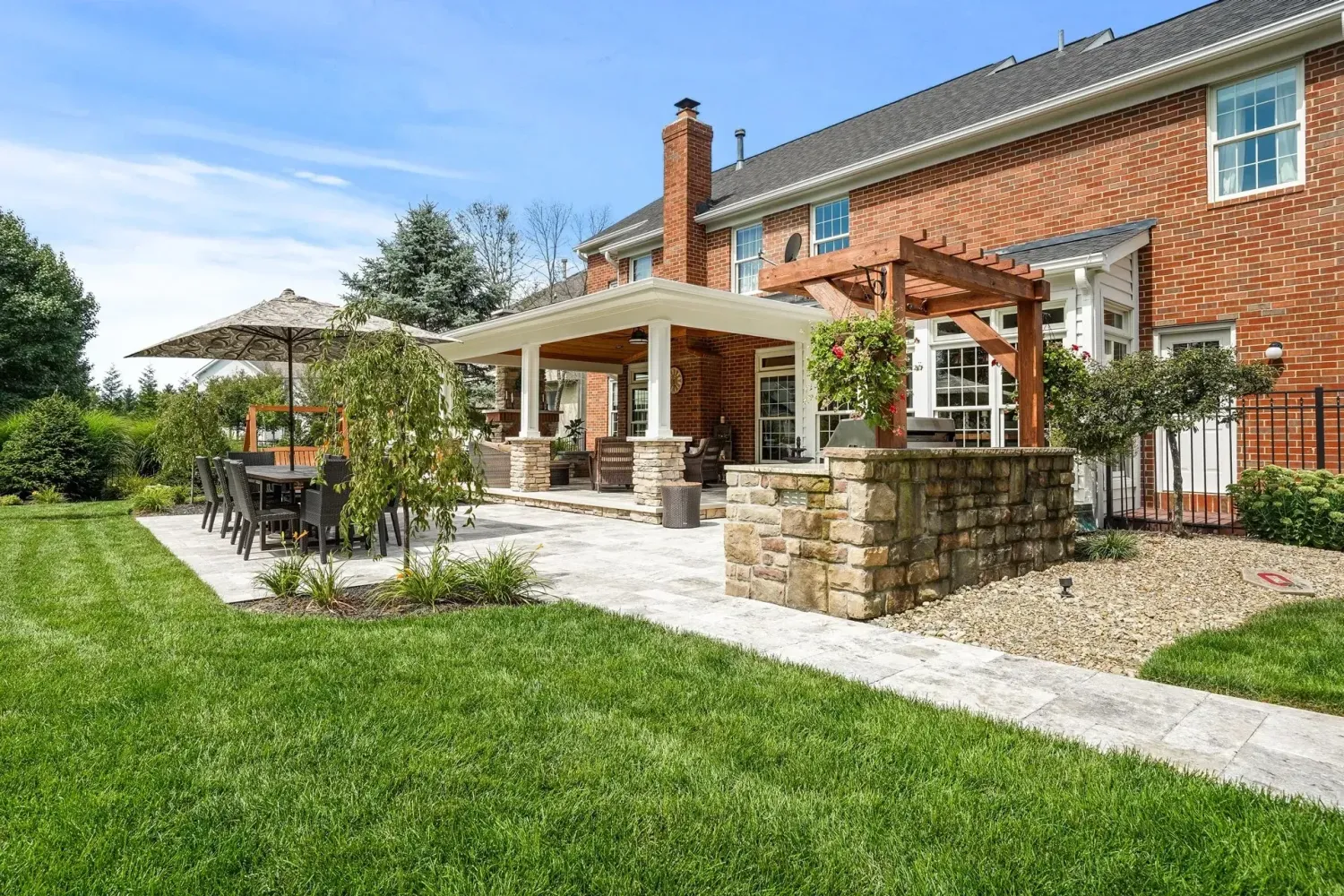
If you are still torn, the compromise we recommend most often is a 10×12 cedar pergola over the grill and primary prep zone only, with the dining counter and bar open. $8K–$13K instead of $15K–$22K, shade over the working zone, dining area open to the sky. Rain still ends the evening, but summer afternoons become usable. Wrong answer for year-round entertainers; right answer for maybe half the households asking the question.
Either choice is defensible when it matches how you actually use the backyard. The wrong choice is the one that photographs beautifully and then sits empty because nobody thought through whether eight people would come over on a rainy Saturday.
Covered & open outdoor kitchens across 20+ cities within 30 miles of Winder, GA
If you are weighing covered against open for a Dacula backyard, the answer depends on how you will actually use the space. We walk every scorecard with you on-site — weather, venting, materials, lighting, cost, and lot fit — before anyone draws a line.