
Three things most Marietta homeowners don’t know before they pick a coping profile: one, shade matters more than style; two, the wrong edge under a 90-foot oak canopy starts growing moss by year three; three, the price gap between bullnose and square runs $6 to $10 per linear foot — small on paper, big across a 90-LF perimeter.
This post is built around a single question we hear almost every week from homeowners off Lower Roswell Road and Johnson Ferry: “Which coping profile should I pick?” The honest answer is that nobody can tell you until they look at your backyard canopy. Marietta has two completely different pool-site environments stacked inside one ZIP-code map, and the coping choice that looks gorgeous on a sun-drenched lot in Brookstone is the same coping choice that turns into a slick green hazard under the East Cobb oak canopy.
Below, we break down bullnose, square, and drop-face (sometimes called dropped-edge) coping, priced in 2026 Cobb County dollars, sorted by shade rating, and cross-referenced against the specific canopy conditions you’ll run into in Indian Hills, Atlanta Country Club, Walton Woods, Sope Creek, and the older Burnt Hickory ranches that sit on half-acre wooded lots. We’ll also tell you what we do differently when we’re within a mile of Kennesaw Mountain versus a sun-exposed infill lot off Powder Springs Street.
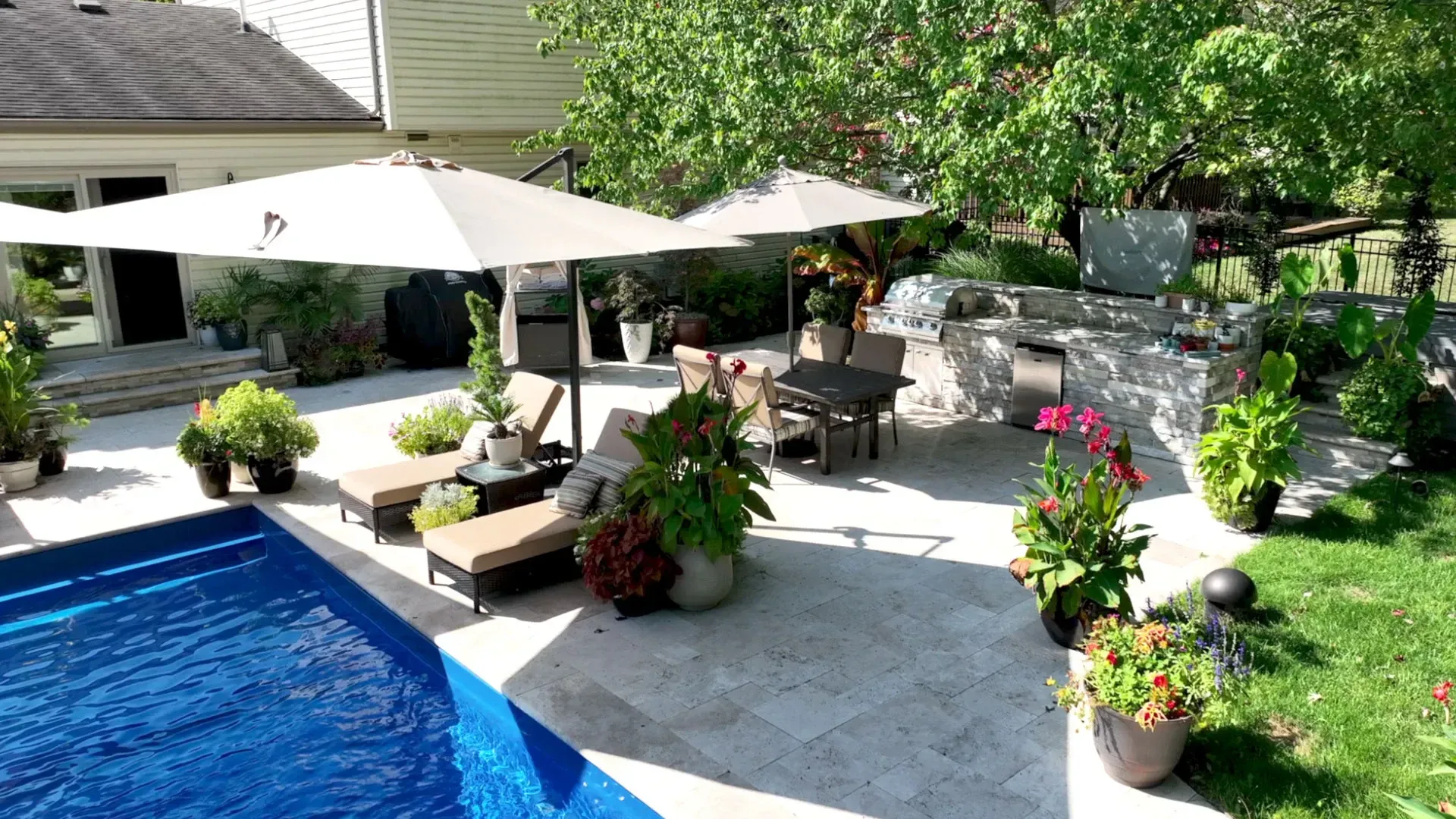
Why Coping Profile Is a Shade Decision, Not a Style Decision
In a magazine shoot, coping profile is about aesthetics. On a real Cobb County jobsite, it’s about how water leaves the stone. A bullnose edge wraps down and back toward the pool wall in a continuous radius — beautiful to touch, comfortable behind the knees for a swimmer resting at the edge, and visually soft. But that curved underside also traps a thin capillary film of water that wicks up along the stone. On a sunny lot in Chestnut Hill, that film flashes off in 40 minutes. On a shaded lot in Indian Hills under 70-foot tulip poplars, that film stays damp for six to eight hours — long enough for airborne moss spores and biofilm to colonize the underside.
A square coping profile (sometimes called “flat edge” or “eased edge”) terminates at a crisp 90-degree corner with a defined drip line. Water sheets off the edge and falls; it doesn’t track underneath. This is why every commercial-pool spec book from the APSP-5 to modern CMHC guidelines defaults to square or drop-face in high-moisture, low-airflow environments. Swimmers don’t love it as much — the edge is sharper behind the thigh — but the stone stays dry.
Drop-face coping (a square face with the front edge dropped 1/2″ to 3/4″ below the waterline edge) is the compromise. It gives you the visual weight of a thick square edge with even better drip-line behavior than flat square, and it’s our default on pools that sit under more than 40% canopy shade.
Our shade-rating shorthand for Marietta lots: 0–25% afternoon canopy = any profile works. 25–55% canopy = square or drop-face preferred. 55%+ canopy or within 30 feet of a mature oak drip line = drop-face only. We measure canopy shade with a 3 PM sun-path photo in August, not in winter.
East Cobb’s Oak and Poplar Canopy Changes the Math
If you live inside the box bounded by Johnson Ferry, Lower Roswell, Roswell Road, and Sope Creek — the heart of what locals call East Cobb — your backyard is almost certainly sitting under a mix of white oak, willow oak, and tulip poplar that was planted or preserved when the subdivisions went in between 1965 and 1985. That canopy is now 45 to 70 feet tall, drops leaves from early October through December, and — this is the part nobody mentions — continuously sheds micro-debris (pollen in April, oak-flower bloom in May, tulip-poplar sap in June, acorns and caterpillar frass in late summer).
All of that debris lands on your coping. Under a bullnose profile, it rolls down the curve and settles against the waterline tile. Under a square profile, it either blows off the flat surface or gets rinsed clear when you hose the deck. The debris itself is the feedstock for biofilm — a thin, slippery microbial film that builds up in the microscopic pores of natural stone coping and turns the pool edge into a hazard exactly when a swimmer is reaching for the lip to pull themselves out.
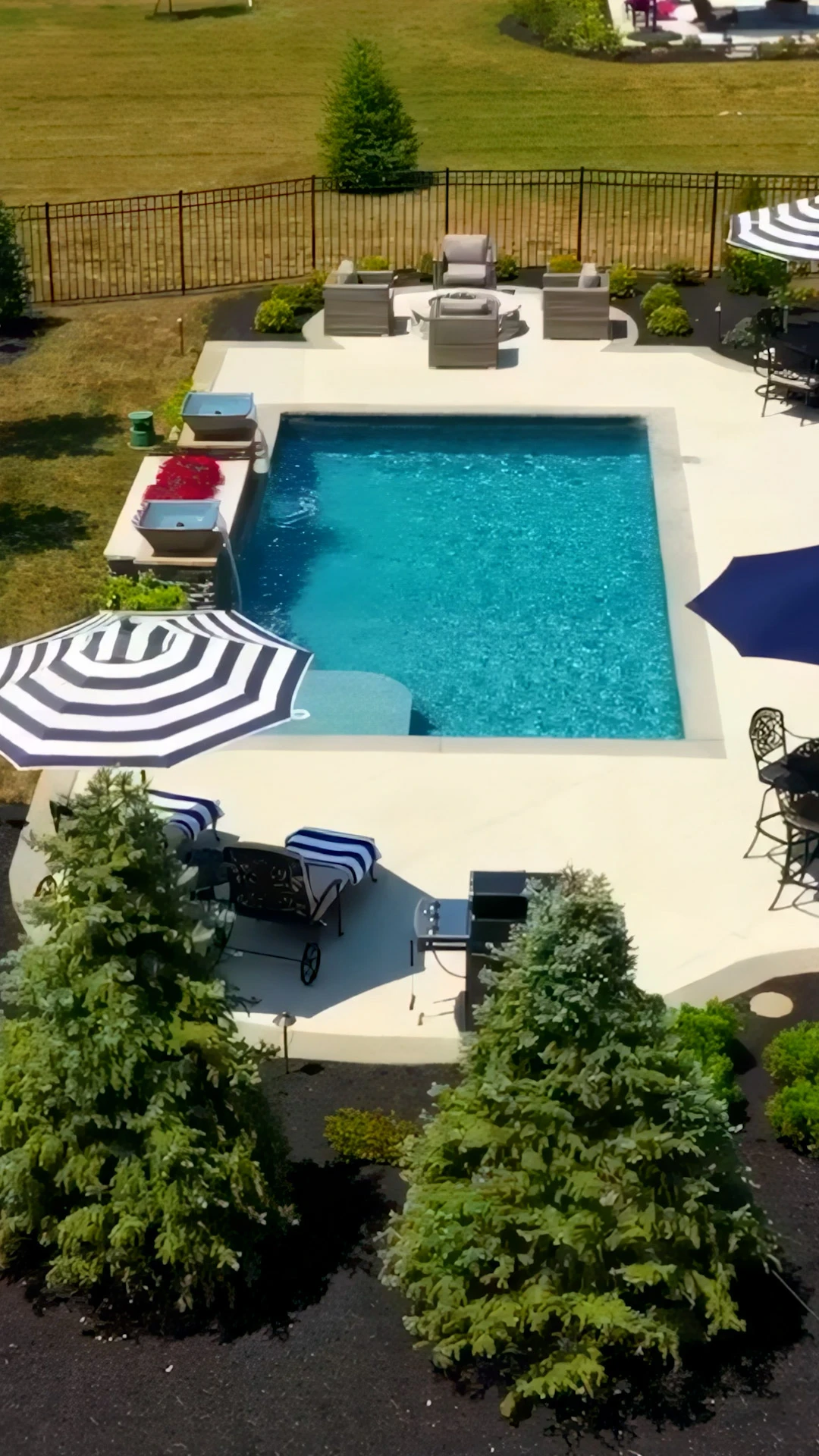
We saw this play out on a remodel we did in Walton Woods where the previous builder had installed bullnose travertine coping on a pool that sits under a 62-foot white oak about 22 feet off the pool edge. By year four, the underside of the bullnose had a continuous dark green band of algae-stained moss. The owners were cleaning it with a wire brush twice a year. We rebuilt the perimeter with a drop-face profile in the same travertine color, added a 1/2″ drip notch, and three years later there’s nothing to clean — the edge stays visibly dry within two hours of a rainstorm.
The Sun-Exposed Marietta Pool: Why Bullnose Wins
Flip the environment. A new-build in the ongoing luxury infill along Atlanta Country Club, or a cleared lot in one of the Burnt Hickory redevelopment pockets, typically sits in full sun from 10 AM to 6 PM in summer. On those pools, bullnose is the right answer — and “right” means it genuinely outperforms square for comfort without any maintenance penalty.
Here’s why. In full sun on a 92°F Marietta afternoon (we hit 90–94°F as summer highs in Cobb County, and peak surface temperatures on natural stone coping run 20 to 30°F above air temp), a square coping edge reaches surface temperatures around 118–122°F. A bullnose profile disperses heat along a curve, reducing peak contact-surface temperature by roughly 8–12°F because there’s no concentrated flat face receiving direct sun at a single angle. For a swimmer resting their forearms on the edge — the single most common pool posture — that’s the difference between comfortable and “I can’t lean here.”
The capillary-wetting problem that destroys bullnose on a shaded lot simply doesn’t exist on a sunny lot. The edge dries in 30 to 45 minutes after a swim session. Biofilm never establishes. The moss problem is moot. In full sun, bullnose is the more luxurious, more swimmer-friendly call, and we recommend it without hesitation on every fully exposed Marietta build.
The Cost Delta Across a Typical 90-Foot Marietta Perimeter
Let’s put real Cobb County numbers on the choice. A typical Marietta residential pool has an 80 to 110 LF perimeter. We’ll use 90 LF as the baseline.
- Square coping (travertine, unfilled): $34 to $40 per linear foot installed. At 90 LF: $3,060 to $3,600.
- Bullnose coping (travertine, double-bullnose machined edge): $40 to $50 per LF installed. At 90 LF: $3,600 to $4,500.
- Drop-face coping (travertine, custom-cut with 1/2″ drip notch): $44 to $54 per LF installed. At 90 LF: $3,960 to $4,860.
The cost delta between the cheapest and most expensive option is roughly $1,800 on a full perimeter. On a typical Marietta new-build that’s running $125,000 to $180,000 for the full pool-and-deck scope, that’s a rounding error — less than 1.5% of the project cost. The point isn’t to save the $1,800. The point is to spend it on the right profile for your specific canopy conditions, because the wrong profile costs far more in maintenance, resurfacing, and eventual tear-out.
Cobb County permit note: Coping profile does not trigger any additional permit-plan revision if it’s being installed as part of a pool that’s already permitted. All pool permits go through Cobb County Community Development at 1150 Powder Springs Street. Residential pool permit fees run $285 to $465 depending on pool size and electrical scope. Changing coping profile mid-project does not require a re-submittal.
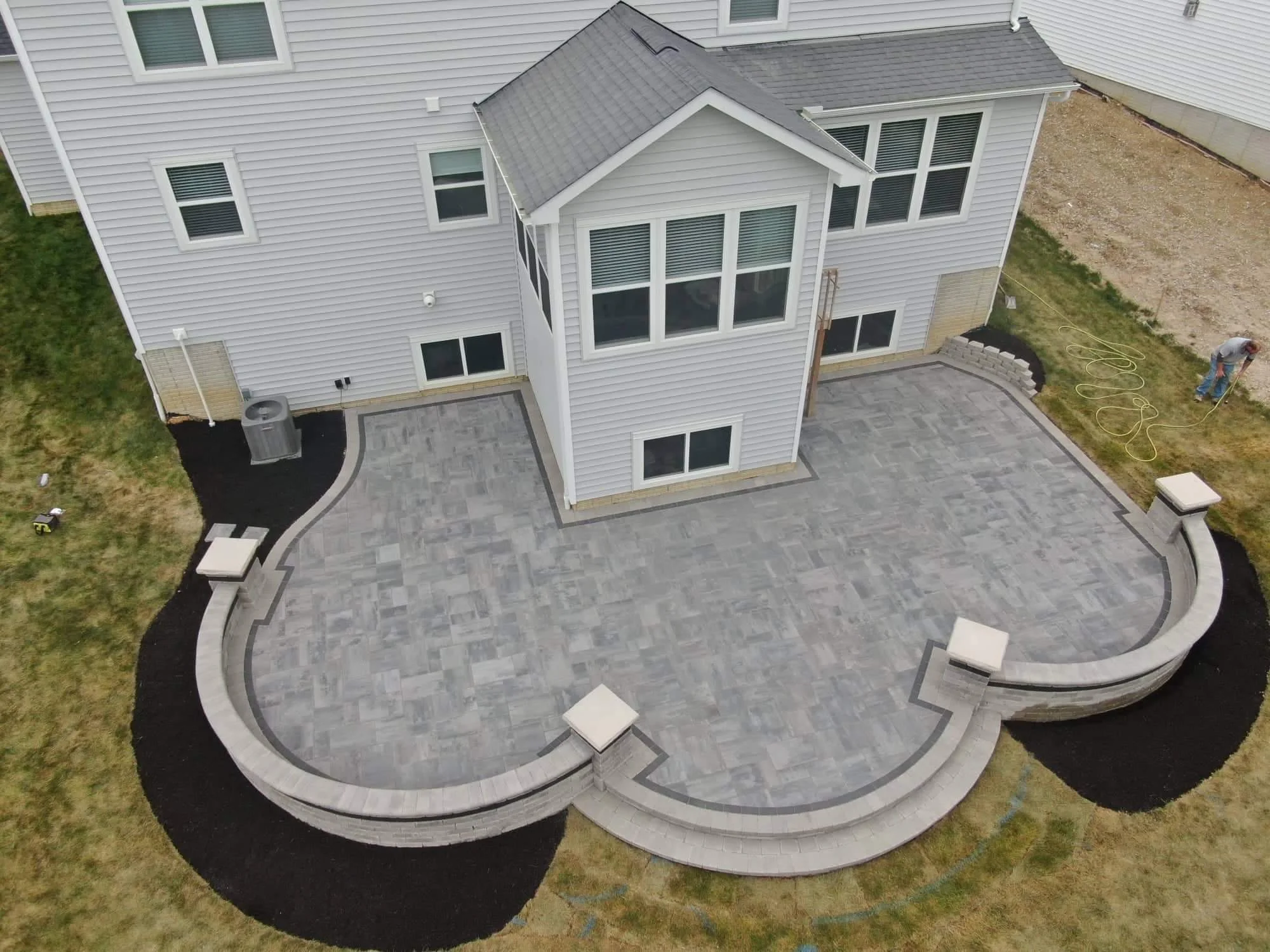
The Canopy-Zone Map: Matching Profile to Marietta Neighborhood
We’re not going to pretend every lot in a given subdivision looks the same — they don’t. But there are patterns, and twenty-two years of building pools across Cobb County tells us the following holds more often than not:
Full-Sun Zones (bullnose recommended)
- Brookstone and the newer sections of Seven Oaks — 1990s-2000s subdivisions with smaller lots and less preserved canopy. Most backyards get 6+ hours of direct sun.
- Ongoing luxury infill near Atlanta Country Club and along the Indian Hills edge — cleared lots, new landscaping, canopy not yet mature.
- Open lots in the Marietta Country Club neighborhood where the original 1980s fairway homes were rebuilt.
- Anywhere in zip 30060 inside the original city grid — most of these lots are sub-quarter-acre with minimal canopy.
Mixed-Shade Zones (square or drop-face recommended)
- Most of Indian Hills — large lots, mature oaks preserved, but also many open pool decks with good afternoon sun.
- Chestnut Hill and the eastern edge of Sope Creek — varies house-to-house.
- Older sections of Seven Oaks built in the 1980s with larger lots and preserved trees.
Heavy-Shade Zones (drop-face only)
- Walton Woods and Willeo Creek — deep canopy, creek-adjacent, high moisture.
- The original East Cobb ranch belt from the 1965–1978 era off Johnson Ferry — 50+ year-old oaks and poplars over most pool sites.
- Burnt Hickory older sections where the original canopy was preserved — many lots here are 70%+ canopied.
- Any lot within one mile of Kennesaw Mountain — the topography traps morning fog against the mountainside, and the canopy is dense.
Installation Details That Matter More Than Profile
Choosing the right profile is half the battle. The other half is how your builder sets the coping. Three installation details decide whether your perimeter lasts 30 years or starts failing in year 6:
1. Bond-beam expansion joint. Coping must be set on a compressible 1/4″ sealant joint above the pool bond beam, not rigidly mortared to the shell. This allows the pool structure and the deck to move independently through ~22 freeze-thaw cycles per year that we see in Marietta. A rigid coping-to-deck bond will crack within five winters. We use backer rod plus a urethane sealant in every coping installation; no exceptions.
2. Back-bevel at the mortar bed. The mortar bed under the coping should slope away from the pool at a 1/4″ per foot minimum pitch. Water that gets under the stone (and some always does — efflorescence is the proof) must have a path to drain out the back side of the coping, not pool against the back of the bond beam. This single detail is the difference between a coping that stays tight for decades and one that lifts, cracks, and leaks by year 8.
3. Waterline tile drip edge. Below the coping underside, we install a 3/4″ overhang of waterline tile on the pool-wall face. This gives rainwater hitting the top of the coping a clean break point — it drips from the tile edge into the pool, not down the pool-shell face where it would stain the plaster. Bullnose installations often skip this because the curve is supposed to act as the drip. In Marietta’s mixed shade conditions, that’s not enough. We install it under every profile.
Code reference: All residential pool electrical bonding in Cobb County must meet NEC §680.26 for equipotential bonding of the pool perimeter — including a #8 AWG solid copper bonding ring 18 to 24 inches back from the pool’s inside wall, between 4 and 6 inches below subgrade. This is a pool-deck-system requirement that every coping installation has to respect. Cobb EMC (not Georgia Power) supplies 240V service to most East Cobb lots and the bond must be verified during rough electrical inspection.
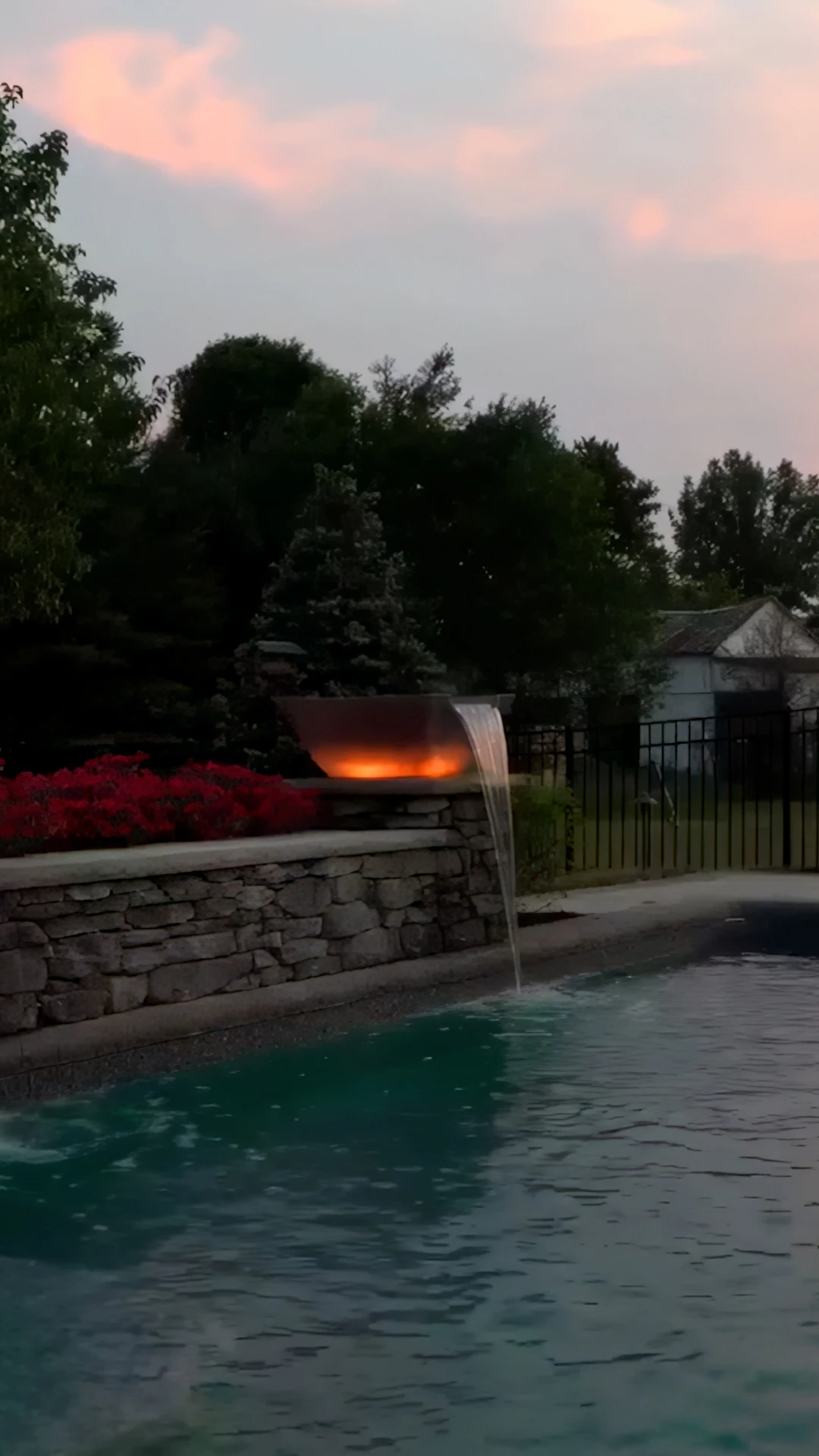
Material Choices: Travertine, Bluestone, Porcelain, Precast
Coping profile and coping material are separate decisions. The profile guidance above applies regardless of which stone you pick, but material changes how each profile performs over time in Marietta conditions.
Travertine is our default for 70% of Marietta pool builds. It’s a sedimentary limestone that stays cool in direct sun (surface temps 15–20°F below granite at the same exposure), grips well when wet, and comes in warm neutrals that match the red-clay Piedmont palette. The trade-off is porosity — travertine must be sealed every 3 to 5 years, and in heavy-shade zones the pore structure accelerates biofilm formation under a bullnose profile.
Bluestone (Pennsylvania bluestone, thermal-finished) is our go-to for modern, dark-palette builds in the Atlanta Country Club and Marietta Country Club areas. It’s dense, less porous than travertine, and holds up well under canopy. Gets hot in full sun — easily 120°F+ surface temp — so we steer clients away from bullnose in bluestone on sun-exposed lots. Square profile is almost always the right pair for bluestone in Marietta.
Porcelain pavers (20mm thickness, rectified edges) are a newer option we’ve been specifying more since 2023. Zero porosity, no sealing, frost-proof, and they work well in square or drop-face profile but can’t be machined into a proper bullnose radius — the ceramic body is too brittle. If you want porcelain, you’re committing to square or drop-face. For heavy-shade East Cobb lots, this is actually a feature, not a limitation.
Precast concrete coping (the cantilever-style edge used on commercial pools and older residential builds) is the budget option at roughly $22 to $28 per LF. We rarely install it on custom residential work in Marietta — it weathers inconsistently, stains with the red-clay subsoil within three years, and doesn’t carry the visual weight clients in this price tier are paying for. We’ll use it on renovations where budget is the hard constraint, but never as a first-choice spec.
What We’d Build on Five Specific Marietta Lots
To make this concrete, here’s how we’d approach five different hypothetical (but realistic) Marietta pool builds:
Lot A — Brookstone, fully open 0.4-acre backyard, west-facing: Bullnose travertine. Full sun all afternoon, deck dries in 30 minutes after a swim, bullnose comfort wins.
Lot B — Indian Hills, 1-acre lot, 40% afternoon canopy from two mature white oaks: Square travertine with a 1/2″ drip notch. Split environment; flat edge sheds debris cleanly.
Lot C — Walton Woods, creek-adjacent 0.9-acre lot, 65% canopy: Drop-face porcelain in 20mm. Zero porosity, no sealing, engineered specifically for this condition. Add two deck drains behind the coping line to move rainwater away from the pool.
Lot D — Atlanta Country Club, luxury infill, 0.6-acre graded flat lot with new landscaping: Bullnose thermal bluestone on the shaded north side of the pool, square thermal bluestone on the sun-exposed south side — same material, two profiles, seamed across the east and west ends. Custom, but we’ve done this on half a dozen builds and it solves the split-exposure problem cleanly.
Lot E — Older Burnt Hickory ranch on half-acre wooded lot, moderate grade: Drop-face travertine with a reinforced back-bevel to handle hillside runoff. The grade change on these lots means water sheets toward the pool; the drip line on a drop-face profile sheds it more cleanly than bullnose would.
Every one of those recommendations is driven by canopy and exposure, not by aesthetic preference. If you walk into a pool builder’s office and they recommend a coping profile without first asking “what does your backyard look like at 3 PM in August?” — walk out. That’s the single most important data point for this decision, and it takes ninety seconds to answer.
A Word on HOA and Atlanta Country Club Approval
Several Marietta subdivisions — Atlanta Country Club most notably, but also parts of Indian Hills and the newer sections of Marietta Country Club — have active HOAs with architectural review requirements that cover pool projects. We’ve worked with all of them. Coping profile and material are usually not subject to approval (it’s below the sightline of the ARC review), but we always submit a full material-and-profile spec sheet with the pool permit application as a courtesy. This prevents a neighbor complaint from becoming a re-submission three weeks into the build.
Design-guideline-wise, Atlanta Country Club strongly prefers natural stone over precast concrete for pool coping; several ARCs have explicitly rejected stamped-concrete cantilever coping on remodels. If you’re building inside one of these HOAs, stick to travertine, bluestone, or a defensible porcelain spec — not poured concrete — and your approval runs smoothly.
Custom pool decks and coping across 20+ cities within 30 miles of Winder, GA
Coping profile is a shade decision before it’s a style decision. We’ll walk your backyard, measure your August canopy, and spec a perimeter that stays dry under Marietta’s oaks — or comfortable under full sun.