
Roughly 68% of Marietta outdoor kitchen projects we scope east of I-75 fall under Cobb EMC territory, while the remaining homes inside the city limits of 30060 and 30064 sit on Marietta Power’s grid — and that single utility-boundary distinction quietly swings permit timing, wire routing, and inspection depth on every single new-service request we file.
Here’s the pattern nobody explains at the design consultation. You pick your Lion grill, your Kamado Joe, your 5.2-cu-ft refrigerator drawer, your ice maker, your outlet counts. The designer sketches a beautiful U-shape pavilion. Then the electrical sub pulls the address, sees “Marietta, GA 30068,” and assumes Cobb EMC — because “Marietta” is the mailing city — only to discover three weeks later that the home actually sits inside the incorporated city boundary and is served by Marietta Power. The scope doesn’t change. The timeline does. The inspection does. And on a tight build schedule, that’s the difference between firing the grill on Memorial Day weekend or waiting until mid-June.
This post is about that invisible line. Not the design. Not the appliances. The utility seam that runs through Marietta, why it matters more for outdoor-kitchen service than it does for almost any other backyard project, and the specific numbers — dollars, days, and code citations — behind what your electrician actually has to do on each side of it.
Step 1: Figure Out Which Utility Actually Serves Your Address
Before a single trench is cut, before the stone veneer gets ordered, before the grill is even specified, the electrical sub needs an answer to one question: who owns the pole (or the underground transformer) feeding this house?
For Marietta addresses inside the incorporated city limits — typically parts of 30060, 30064, and scattered pockets of 30066 and 30067 — the answer is Marietta Power and Water, a municipal utility headquartered at 675 North Marietta Parkway. For everything outside the city line, including almost all of East Cobb, Indian Hills, Atlanta Country Club, Walton Woods, Chestnut Hill, Sope Creek, and Willeo Creek, you’re on Cobb EMC, an electric membership cooperative based in Marietta but serving unincorporated Cobb County.
You can check in about ninety seconds. Pull up your most recent electric bill. If the logo says Marietta Power, you’re municipal. If it says Cobb EMC, you’re co-op. That single bill tells us which application form we file, which inspector we’re working with, and how we design the sub-panel location and the conduit path from the meter.
Homeowners in Atlanta Country Club and Indian Hills sometimes assume they’re on Marietta Power because of the Marietta mailing address. They’re usually not. Both of those subdivisions sit in unincorporated Cobb County and fall under Cobb EMC. Conversely, homeowners in the historic core near Marietta Square — west of Powder Springs Street, around Kennesaw Avenue — are almost always Marietta Power even if they’ve lived there thirty years and never thought about it.
Quick check: Look at the top of your power bill. Marietta Power = municipal utility (city residents). Cobb EMC = cooperative (unincorporated Cobb, including most of East Cobb). This determines your entire outdoor-kitchen electrical timeline.
Step 2: File the Right New-Service Request (and Know the Timeline)
Outdoor kitchens with the appliance load most Marietta clients specify — a built-in grill with rotisserie motor, two refrigerator drawers, an ice maker, an exhaust vent hood, 8-12 undercounter LED circuits, and four GFCI receptacles — usually require either a dedicated 50-amp sub-panel or a significant load calculation on the existing main panel. Either way, it’s a new-service request with the utility.
Here’s where the timelines diverge sharply.
Marietta Power runs a 5 to 8 business-day turnaround on new-service requests submitted with complete documentation (site plan, load calculation, appliance cut sheets, permit receipt from Cobb County Community Development at 1150 Powder Springs Street). Their service territory is small and dense, their crews are local, and their underground service is already the default in most city neighborhoods — which means if your existing feed is underground, the new branch is likely underground too. Clean, fast, predictable.
Cobb EMC runs a 10 to 14 business-day turnaround on the same paperwork. The territory is larger, the crew rotation covers multiple counties, and much of unincorporated East Cobb is still served by pole-mount overhead feeds from the 1970s and 1980s housing boom. If your kitchen build happens to require a service upgrade — say, moving from a 150-amp main to a 200-amp main to accommodate the new load — Cobb EMC’s coordination with the meter base swap adds another 3 to 5 business days on top.
The practical translation: if you’re breaking ground in April and hoping to grill on Memorial Day weekend, Marietta Power makes that math work. Cobb EMC makes it tight. If you’re hoping to grill by Fourth of July, either utility is comfortably in range — but only if the application is filed the same week construction starts, not after.
Step 3: Understand What the Inspector Actually Checks (This Is Where They Differ Most)
Both utilities eventually hand off to the Cobb County electrical inspector for the final pass. Cobb County permits are pulled at Community Development, 1150 Powder Springs Street in Marietta, and both service territories route through the same county inspection process for the branch circuits and receptacles at the kitchen.
But there’s a second inspection — the utility’s own inspection of the service connection itself — and this is where Cobb EMC and Marietta Power diverge sharply.
Cobb EMC’s inspection is a service-connection inspection. The inspector verifies the meter base is grounded, the service entrance conductors are sized correctly, the weatherhead is at the right height for their overhead feed (or the underground conduit meets their spec), and the main disconnect is accessible. They do not independently verify your load calculation. They trust the county inspector to catch branch-circuit sizing on the kitchen side.
Marietta Power’s inspection does the same service-connection verification, but it also includes a load-calculation review. Marietta Power’s inspector looks at the total connected load on the house, adds the new kitchen load per NEC 220.83 calculations, and independently verifies that the existing service can carry it. If the load calc shows you’re over the existing service capacity even by 10%, Marietta Power will flag the service upgrade before they energize the new circuit — whether the county inspector caught it or not.
This is neither good nor bad. It’s a different posture. Marietta Power acts as a second set of eyes; Cobb EMC trusts the chain of inspection. If you’re doing a moderate kitchen build on an existing 200-amp service, neither approach changes anything. If you’re pushing the edges of your main panel capacity — common in 1960s-era Indian Hills ranches on 150-amp service — the Marietta Power review can actually save you from a failed inspection two months after the pavilion is framed.
Code reference: NEC 220.83 (optional method for load calculations on existing dwellings). Both utilities accept this method; Marietta Power independently verifies the result at service inspection.
Step 4: Price the Job — Real Numbers by Utility
New-service electrical work for a standard Marietta outdoor kitchen install — dedicated 50-amp sub-panel at the pavilion, two 20-amp small-appliance circuits, two GFCI receptacle circuits, LED lighting circuit, exhaust hood circuit, bonded ground rod, trenching from house to kitchen — runs different numbers on each side of the line.
On Marietta Power territory, typical all-in cost for that scope: $1,200 to $2,400. Underground service is standard, trenching distances are shorter (city lots are typically 60-80 feet wide), and the utility’s 5-to-8 day turnaround means the electrician isn’t standing around on paid hours waiting for the energize call.
On Cobb EMC territory, typical all-in cost for the same scope: $1,400 to $2,800. The overhead-to-underground transition at the meter adds $150-$300 in conduit and riser work. Trenching runs longer on larger East Cobb lots (often 120-200 feet from meter to kitchen location). And the 10-to-14 day wait sometimes means a second mobilization if the electrician has to come back for the final tie-in after other trades have moved on.
These are the costs just for the utility-side work — what the electrical subcontractor spends on service, trenching, conduit, panel, and connection. They don’t include the branch-circuit work at the kitchen itself (another $900-$1,600 depending on circuit count), the receptacle finishes ($40-$120 each for the code-required weather-resistant GFCI covers), or the appliance-specific dedicated circuits (a Kamado Joe electric-start accessory alone needs its own outlet).
Step 5: Plan Around the Terrain — Because Marietta Isn’t Flat
There’s a second variable that interacts with the utility question: the topography. Marietta sits on rolling Piedmont terrain at roughly 1,118 feet elevation, and many East Cobb and Kennesaw-adjacent lots have 3 to 6 feet of grade change between the house and the back corner where the outdoor kitchen usually wants to go.
That grade change matters for electrical because trenching depth is measured from finished grade down. A 24-inch-deep trench across a flat lot is a half-day of labor with a Ditch Witch. The same trench across a 5-foot slope — with soil that’s Cecil red clay and possibly hitting granite bedrock at 3 to 15 feet down — can turn into a two-day job with hand-digging around the high points and a water-break cutoff where the trench hits the slope.
The signature Piedmont soil issue is granite. North-Marietta lots closer to Kennesaw Mountain (which rises to 1,808 feet on the north boundary) hit bedrock shallower than average. We’ve had Burnt Hickory and Brookstone jobs where the trench line had to get rerouted around a granite shelf because jackhammer work on electrical trenching wasn’t in the budget. On East Cobb lots with better-draining sandy-loam pockets, trenching runs easier — but you still plan the conduit route around mature oak roots, which in Indian Hills and Atlanta Country Club can be 80+ years old and 12+ inches across at the trunk line.
All of this happens before the utility ever energizes the new service. Which is why the smart move on any Marietta outdoor-kitchen build is to have the electrical sub and the hardscape crew walk the lot together — with a probe, not just a tape measure — before the design is finalized.
Step 6: Coordinate Permits, Inspections, and Weather Around the Kennesaw Mountain Micro-Climate
Marietta’s climate sits on the USDA Zone 7b/8a border with roughly 22 freeze events a year, summer highs in the 90-94°F range, and about 52 inches of rainfall annually. The freeze count matters for your gas line bonding on the kitchen (every freeze cycle stresses the above-grade gas stub), but it matters more for the rough-in timing.
Cobb County won’t approve a final electrical inspection if the trench is still open because of rain. Rain pooling in the trench saturates the conduit, introduces moisture into the raceway, and gives the inspector a reason to fail the job. In practice, this means the rough-in electrical inspection wants a dry week. Spring storms through April and pop-up summer thunderstorms from June through August are the main delays.
Lots on the Kennesaw Mountain side of Marietta have their own wrinkle: the mountain creates a wind pattern that channels storms east-southeast across North Marietta, and those storms drop heavier rainfall on the western slope than the numbers suggest. A Burnt Hickory lot can see an inch of rain from a storm that drops a quarter-inch downtown. We’ve seen that shift the ready-for-inspection date by four or five days relative to a Sope Creek or Walton Woods lot on the same week.
Combine this with the utility timeline — Marietta Power’s 5-to-8 days, Cobb EMC’s 10-to-14 days — and the best-case scenario for an outdoor kitchen targeting Memorial Day grilling looks like this: break ground the last week of March, rough-in by mid-April, utility application filed the same week, final inspection late April, punch list and tile/stone finish work the first two weeks of May, gas hookup and appliance install the third week, first burn by May 23.
Push that schedule two weeks later — break ground mid-April instead of late March — and Cobb EMC territory probably won’t hit Memorial Day. Marietta Power territory still can. That’s the compression the utility boundary creates.
HOA Review Windows — The Third Clock You Didn’t Know Was Running
There’s a third clock that Marietta homeowners frequently miss: the HOA review window. Atlanta Country Club, Indian Hills, Marietta Country Club, and most of the 1990s-2000s luxury subdivisions require architectural review board approval for any exterior structure over a certain footprint — often including outdoor kitchens with a pavilion or pergola element. ACB review windows run 14 to 30 days, and some boards only meet monthly.
File the HOA packet the same day the design is signed. Not the day the permit is pulled. Not the day the crew mobilizes. The day the design is signed. This is the most common 3-week delay we see on Marietta builds, and it has nothing to do with utilities or the county — but it compounds with both, and it’s the single item that turns a 6-week build into a 10-week build.
Typical ACB asks for outdoor-kitchen submissions: site plan with setbacks, elevation drawings of the pavilion, material samples (stone veneer chip, countertop sample, pergola stain), appliance spec sheets, nighttime lighting plan. The lighting plan is becoming the sticking point in Indian Hills and Atlanta Country Club — undercounter LED strips are fine, but overhead pavilion fixtures now frequently require downcast shielded fixtures to meet dark-sky preferences. Worth confirming before ordering fixtures.
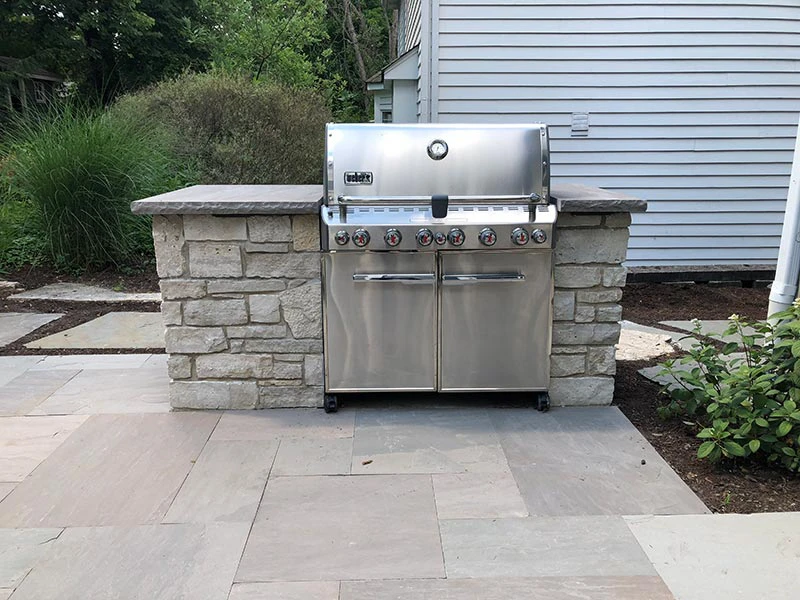
Tree Canopy and the Skimmer-Leaf Lesson That Applies Here Too
Mature East Cobb oaks and poplars are one of the great charms of Indian Hills, Sope Creek, and the older Marietta neighborhoods. They’re also the single biggest maintenance load on every outdoor kitchen we’ve built in those zones. Leaves drop into the grill, into the sink, onto the counter, into the vent hood. The cleanout schedule on an East Cobb outdoor kitchen runs about 3x the cleanout schedule on a Loganville or Dacula kitchen with younger trees.
This doesn’t change the electrical. But it changes the specification. Undercounter LED strip lighting under heavy leaf load wants sealed IP65-or-better fixtures, not the basic IP54 strips that work fine on a covered pavilion in a newer subdivision. The bond between the grill hood and the conduit run needs to tolerate more moisture from decomposing leaves clogging the drip path. And the GFCI receptacles — all of them must be weather-resistant GFCI per NEC 406.9 — get extra inspection scrutiny because the receptacle covers in East Cobb territory see more debris and moisture than nearly anywhere else in the Primetime service area.
What to Ask Your Electrician Before You Sign
Before the electrical contract is signed on a Marietta outdoor kitchen, the homeowner should get specific answers to five questions. The answers tell you whether your electrician actually understands the Marietta-specific variables or is running a generic scope:
- Which utility serves this address — Cobb EMC or Marietta Power? (They should know before they quote.)
- What’s the expected service-application turnaround, and when will it be filed?
- Is the existing main panel capacity sufficient per NEC 220.83, or does the service need an upgrade?
- Is the trench path clear of granite bedrock risk (for North Marietta / Kennesaw-adjacent lots) or mature tree roots (for East Cobb)?
- Are the receptacles, light fixtures, and conduit all rated for this lot’s specific exposure — covered pavilion vs open bar vs attached-to-house?
An electrician who answers all five cleanly has done Marietta work before. An electrician who shrugs on question one is quoting generically, and your schedule will pay for it.
Primetime note: We coordinate the electrical scoping conversation with our subs during the design phase — before the stone is ordered, before the pavilion is framed. The utility territory gets flagged on the site plan in the first site visit, which is why our Marietta builds rarely see the two-week surprise other builders eat after the fact.
Outdoor kitchens built for Marietta across 20+ cities within 30 miles of Winder, GA
Every Marietta outdoor kitchen we build starts with the utility territory check, the load calculation, and the HOA packet — before the first stone is cut. That’s how the build hits the grilling weekend the homeowner actually cares about.