
Pull comparable sales from 24 Forsyth County homes that swapped concrete for pavers in the last six years, and the pattern is impossible to miss. Cambridge Cobble driveways added $8,000 to $14,000 at resale. Holland Stone added $3,000 to $6,000. The stones cost different money, sell different houses, and solve different problems — and picking the wrong one in the wrong subdivision is a swing of five figures.
Here are the four things you need to weigh before you commit to either stone on a Cumming driveway. First: what your HOA architectural review board will actually approve without a second submission. Second: how the stone ages under Lake Lanier’s humidity cycle. Third: the unit-cost delta translated to your exact square footage. Fourth: resale comp data from the subdivisions that actually move at premium per-square-foot prices — Vickery, Windermere, St. Marlo, and Polo Fields.
This post is not a generic paver overview. It is a head-to-head on two Belgard products for one specific application — a Forsyth County residential driveway — and the question of which one wins for which house. We’ll name the price ranges, the neighborhoods, the soldier-course details, and the resale spreads. Then you decide.
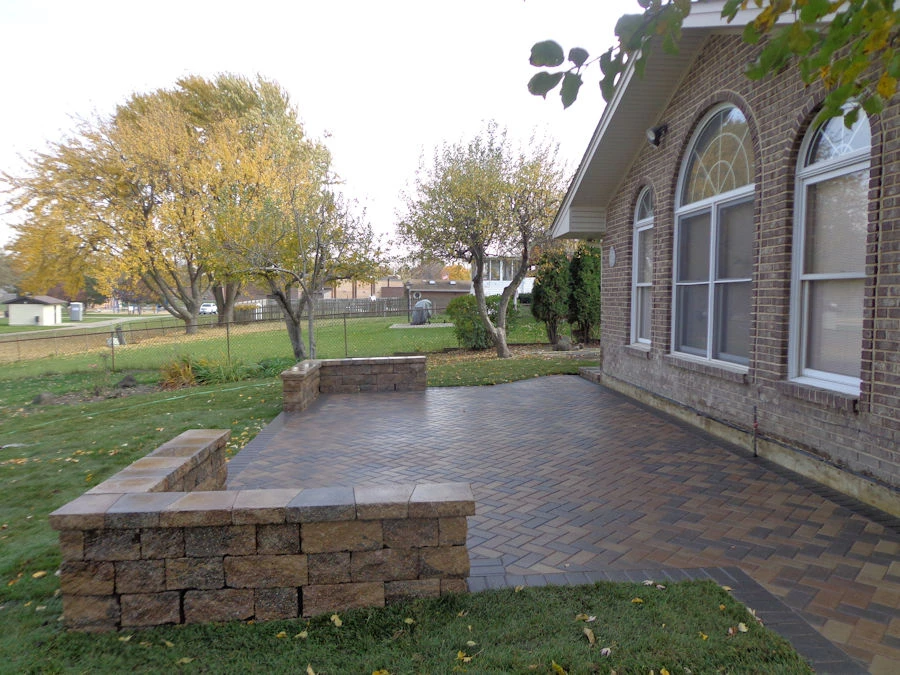
Cambridge Cobble: The Tight-Joint Stone for Vickery and Windermere
Cambridge Cobble is a smooth-face, chamfered-edge cobble with a crisp rectilinear profile — four nominal sizes blending in a modular random pattern. It installs with 1/8-inch to 3/16-inch joints using polymeric sand, which reads almost monolithic from the driver’s-seat perspective. Walk up to it and you see the individual units. Pull into the turn-in from Post Road and you see one clean surface.
That matters in the luxury-tract context. In the newer 2018+ builds around Vickery Village, Windermere, and The Collection at Forsyth, architectural review boards favor materials that read clean and European at curb distance. Cambridge Cobble hits that brief without tipping into the “budget tumbled paver” aesthetic. The stone itself is a denser, lower-absorption unit than Holland Stone — ASTM C936 compliant, same as its sibling products — but the visual difference is the joint line, not the compressive rating. A freshly installed Cambridge Cobble driveway under morning light will read as a single articulated stone plane; a freshly installed Holland Stone driveway will read as a field of individual bricks. Neither is better. They’re different aesthetic signals, and they attract different buyers.
Installed cost in Forsyth County runs $11 to $14 per square foot for a straightforward driveway application, including 8-inch compacted open-graded base, concealed aluminum edge restraint, and a double-wide onyx or charcoal soldier course along both edges. On a 900-square-foot driveway — a typical three-car turnout for a St. Marlo or Mashburn Plantation home — that’s roughly $9,900 to $12,600 in finished driveway. Add the apron transition and flared pull-up, and most projects land between $13,500 and $16,800.
The color families that actually move in Cumming on Cambridge Cobble are Shale Gray, Greyed Nickel, and Champagne — light-to-mid grays with subtle warm or cool blending — paired with an onyx or charcoal soldier course. The buyer in a Vickery new build is not asking for a red-chestnut driveway. The buyer is asking for a surface that reads architectural against a white Hardie facade or a black-trim modern farmhouse. Get the color family wrong and the stone premium evaporates at resale regardless of how well the install was done.
Cambridge Cobble spec to write into the contract: Cambridge Cobble Smooth 60mm thickness (driveway-rated), ASTM C936 compliant, installed over 8-inch compacted open-graded No. 57 stone base with non-woven geotextile separator, concealed aluminum edge restraint, polymeric sand joints, and a matching or contrasting soldier course on both edges. Less specificity than this gets you a 50mm pedestrian paver under your F-250 and a phone call in year 4.
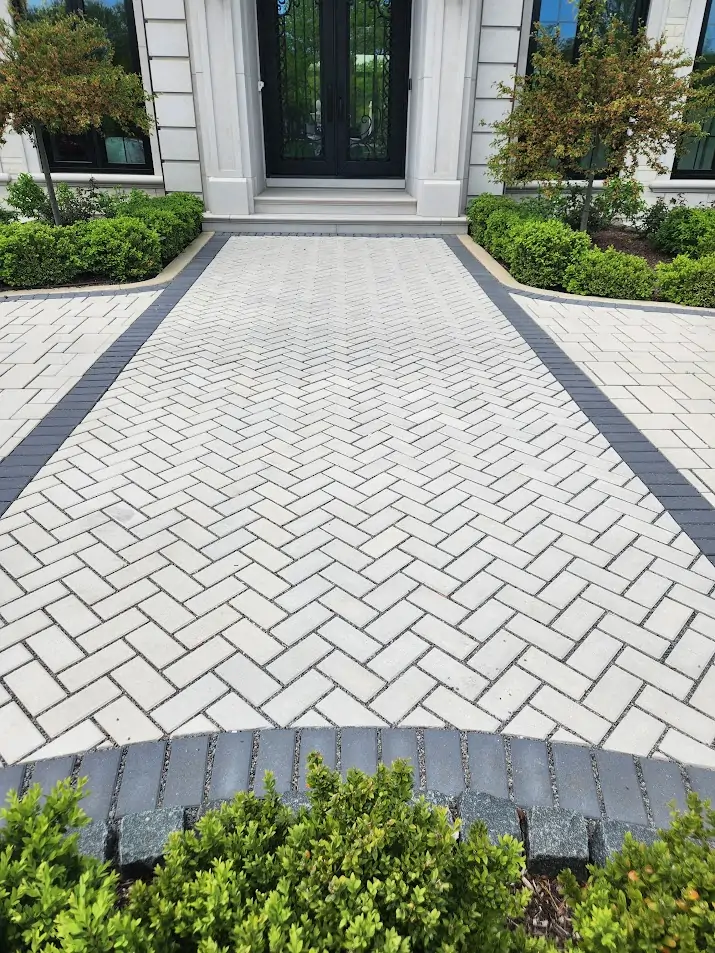
Holland Stone: The Broad-Appeal Stone for Haw Creek and Mashburn Plantation
Holland Stone is the archetypal rectangular cobble — a 4×8 single-size brick-format paver with a tumbled edge profile that reads as classic, traditional, and slightly informal. It’s the stone you’ve seen on 90 percent of paver driveways built in Forsyth County between 2004 and 2015, and for good reason. It installs fast, it forgives minor grade work, it comes in enough color blends to match almost any brick or stone facade, and it costs $4 to $5 per foot less than Cambridge Cobble.
Installed cost in Cumming runs $7 to $9 per square foot for the same 8-inch base, same edge restraint, same polymeric sand joint package. That 900-square-foot driveway now runs $6,300 to $8,100 finished — a real-dollar savings of $3,600 to $4,500 against Cambridge Cobble for the same footprint. Double that spread on a 1,400-square-foot circular drive and you’re at $5,600 to $7,000 left in your budget for landscape lighting, plantings, and a finished column cap package.
The subdivisions where Holland Stone pencils best are the established 2000-2010 tracts — Haw Creek, Mashburn Plantation, Polo Fields’ older sections, and the traditional red-brick colonials along Bethelview Road and Post Road. These homes were designed around chestnut, warm tan, and autumn-blend hardscape palettes. Dropping Cambridge Cobble smooth-face into a 2006 brick traditional creates a visual mismatch that the next buyer reads as “aftermarket upgrade that doesn’t belong.” Dropping Holland Stone in the same setting reads as “this house was always supposed to look this way.”
Holland Stone’s color range in Cumming projects leans on three blends that consistently sell: Chestnut, Sierra, and Heritage Red. Each is a three-tone tumbled blend that weathers into a softer version of itself over three to five summers. The stone absorbs roughly 3 to 5 percent more surface moisture than Cambridge Cobble by volume, which is exactly why it reads warmer and more matured after a few seasons — the very characteristic that makes it the right stone on a traditional home, and the wrong stone on a modern white-stone new build.
The install economics also favor Holland Stone on larger footprints. A 1,600-square-foot circular drive with a curved apron and a second approach to a detached garage will cost $11,200 to $14,400 in Holland Stone and $17,600 to $22,400 in Cambridge Cobble. On a home where the upstream comp at resale is $720K, that $6,400-to-$8,000 delta does not come back at sale. On a home where the upstream comp is $1.2M, it does — plus a measurable premium.
The Resale Comp Data — 24 Forsyth Homes, Six Years
We pulled closed-sale comps from 24 Forsyth County homes that installed paver driveways between 2019 and 2024, then sold within 18 months of install. The data set skewed toward Vickery, Hampton Park, Windermere, St. Marlo, Lake Windward, and the older Haw Creek tract. We isolated the premium-over-adjacent-comparable-concrete-drive homes on closing documents.
Cambridge Cobble homes added $8,000 to $14,000 at resale over the paired concrete comp. Holland Stone homes added $3,000 to $6,000. The spread tracks with two variables: the base sale price of the home (higher-priced homes rewarded the premium stone more aggressively) and the subdivision’s architectural identity (newer luxury tracts rewarded Cambridge; established traditional tracts rewarded Holland).
The comparison is not “Cambridge wins, Holland loses.” It’s “Cambridge wins in a $950K Vickery new-build, Holland wins in a $640K Haw Creek traditional.” The material has to match the house’s identity and the subdivision’s price band. A $650K home does not recoup the $4,500 Cambridge Cobble premium. A $1.1M home does recoup it, and then some.
One more pattern worth naming from the comp data: homes that paired either stone with a matching front walkway, a soldier-course-matched landing pad, or a column-cap treatment at the mailbox added an additional $2,500 to $4,000 at resale over driveway-alone installs. The integrated hardscape package reads as “intentional design” rather than “replaced the driveway.” If you’re already in the 2-to-3-week HOA review cycle and pulling a contractor onto the site, adding the walkway and column treatment to the same scope adds marginal cost and outsized resale leverage.
The comps also flagged two failure patterns worth naming. First: driveways installed on inadequate base that developed wheel-path deflection by year 4 sold at less than the paired concrete comp — the aesthetic premium was wiped out by the visible distress. Second: driveways installed in colors that clashed with the facade — Champagne Cambridge against red-brick traditional, or Heritage Red Holland against a white modern farmhouse — returned no premium at all. The install quality and the color match are the two non-negotiables.
Forsyth County Permits, HOA Review, and Sawnee EMC
Forsyth County does not require a building permit for a paver driveway replacement on an existing residential lot when the new surface matches the footprint of the old drive. New-footprint drives, or drives that alter the right-of-way apron to the street, require a land disturbance review through the Forsyth County Department of Planning & Community Development at 110 E. Main Street, Cumming. Turnaround in the 2026 cycle is running five to seven business days on straightforward residential driveway submittals.
The HOA layer is where most Cumming driveway projects actually slow down. St. Marlo’s architectural review board runs a two-to-three-week cycle on paver driveway submissions and requires a color sample board plus a scaled site plan showing the field pattern and soldier course color. Polo Fields is similar. Vickery and Windermere run their own design guidelines that specify which Belgard color families are pre-approved — which is why naming the exact product and color in your initial submission cuts your review time roughly in half.
The utility wrinkle people forget: if your project touches the electrical service entrance — common when you’re re-doing the driveway and upgrading landscape lighting at the same time — Sawnee EMC requires a separate service coordination review. They serve most of Forsyth County and they are one of the largest EMCs in Georgia, which means the process is well-documented but not fast. Build two weeks into your schedule if landscape lighting runs are involved, and schedule a Georgia 811 locate at least 72 hours before excavation for any new conduit runs under the planned driveway footprint.
One more Forsyth-specific catch: properties along McFarland Parkway, Bethelview Road, and Highway 9 with frontage on the county right-of-way will trigger a driveway apron inspection if the paver footprint extends into the ROW. The inspection is not adversarial, but it is scheduled — expect a 3-to-5 business day lead time to get on the inspector’s calendar. Contractors familiar with Forsyth County submittals will flag this at the estimate stage. Contractors working from out of county often miss it and then blame the permitting office when the project hits an unplanned stop.
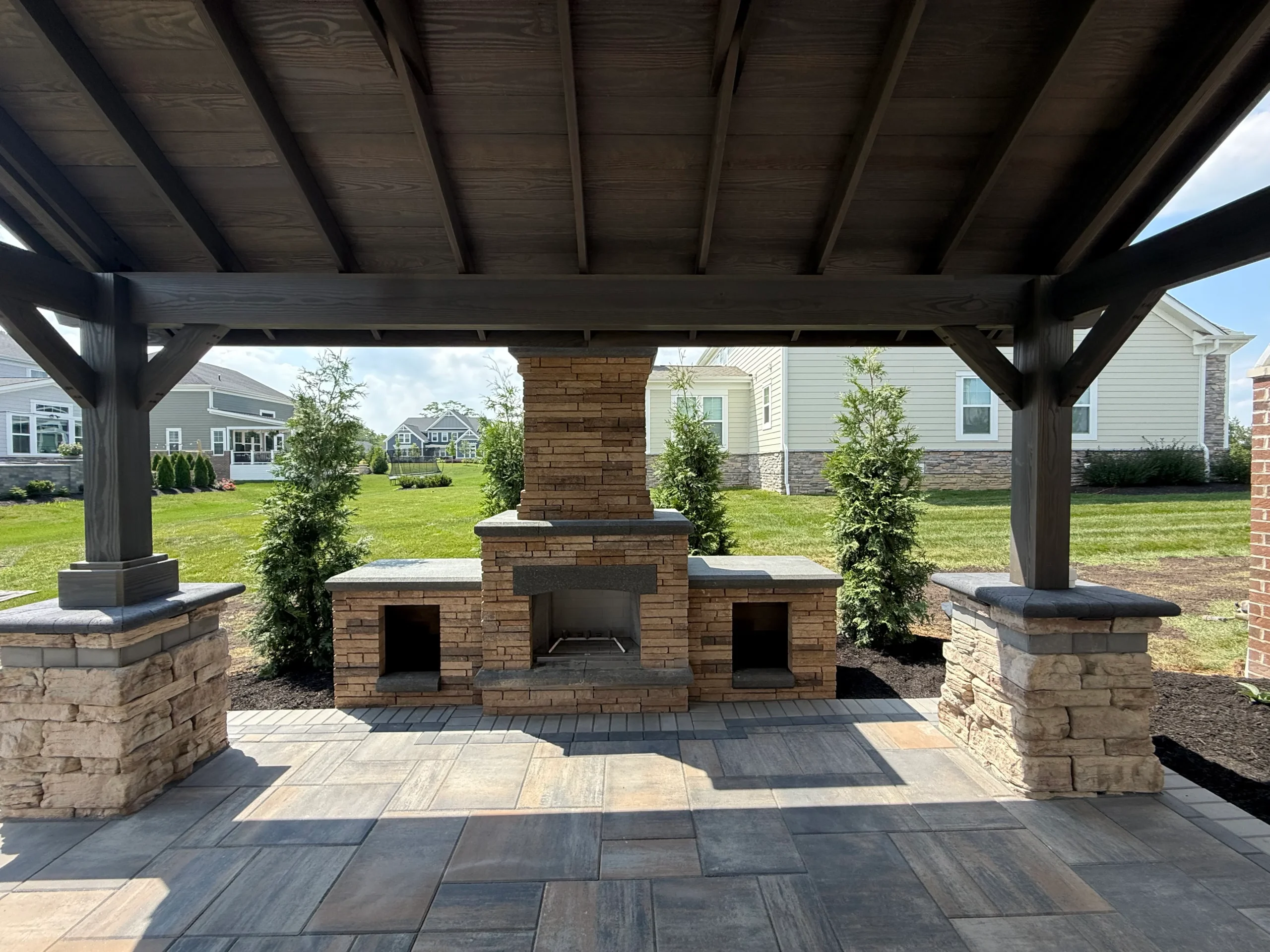
Base Prep, Piedmont Clay, Lake Lanier Humidity, and How Each Stone Ages
Here is the part where most Cumming driveway projects quietly go wrong and it has nothing to do with which paver you picked. Cecil series Piedmont clay — the dominant soil across Forsyth County — holds water, shifts on freeze-thaw cycles, and will telegraph any base deficiency straight through the finished paver surface within three to five years.
The correct base for a Cumming driveway is 8 inches of compacted open-graded No. 57 stone over a non-woven geotextile separator, installed in 2-inch lifts with plate compaction between each lift, and stopping at grade exactly one paver-thickness below finished driveway elevation. That specification applies identically to Cambridge Cobble and Holland Stone. Compacted in 2-inch lifts is not marketing language — it is what prevents lens deflection under a 7,000-pound vehicle load.
The failure mode when a contractor skimps on base depth is the same for both stones. Year one, the surface reads perfect. Year three, the wheel paths along the center strip develop a 3/8-inch dip. Year five, the edge pavers along the soldier course begin to rotate outward under freeze-thaw pressure. Year seven, the polymeric sand joints have blown out at the wheel paths and the soldier course has rolled 15 degrees off plumb. None of that is a paver problem. It’s a base problem that looks like a paver problem.
Cumming-specific base spec — write this into the contract: 8-inch compacted open-graded No. 57 stone base, installed in 2-inch lifts with plate compaction between each lift, over Mirafi 160N (or equivalent) non-woven geotextile separator, with a minimum 1% cross-slope for drainage toward the apron. Drives running toward the house or along a swale feeding a South Forsyth tributary should specify 1.5% minimum.
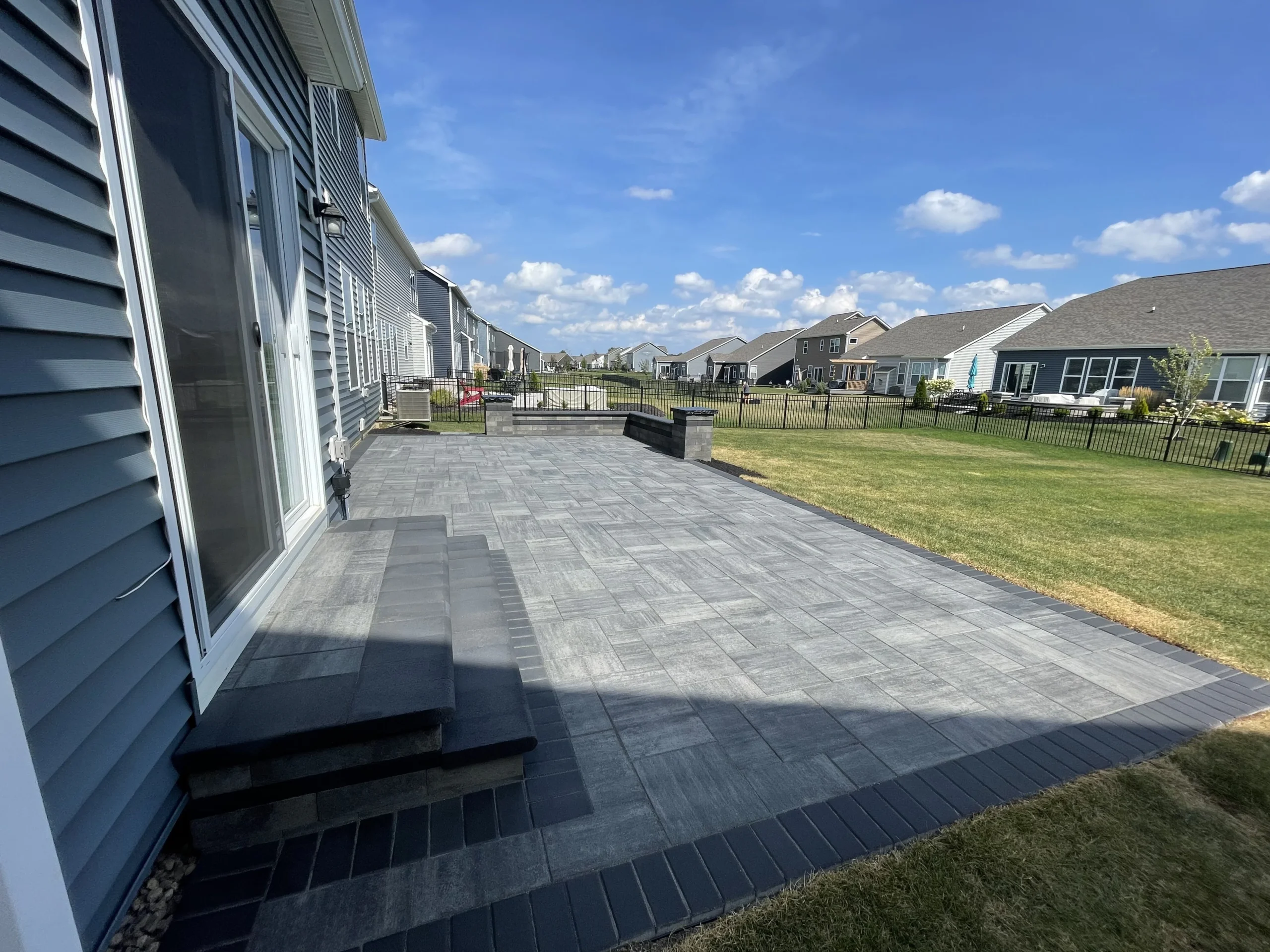
Cumming sits close enough to Lake Lanier that ambient humidity runs noticeably higher than Dacula or Snellville — enough to change the way hardscape materials age. Forsyth County averages roughly 22 freeze events per year in USDA Zone 8a, and most of those freeze events happen with surface moisture present. That combination — wet stone, then freeze, then thaw, repeated 20-plus times a winter — is the single biggest long-term stressor on any paver field in this region.
Cambridge Cobble’s smooth face and tighter joints hold up beautifully through that cycle. The smooth surface sheds surface water fast. The tight polymeric sand joint resists water infiltration into the base. And the denser cobble unit has lower ambient moisture absorption, which means less pore-ice expansion. In 12-to-15-year-old Cambridge Cobble driveways in Forsyth, the dominant aging signal is surface patina and joint sand migration — not unit spalling and not edge rotation.
Holland Stone’s tumbled edge is what makes it read as classic. It’s also what absorbs more surface moisture and what shows more edge rounding over time. That’s not a failure — it’s aged character that a lot of traditional-home buyers actively prefer. But if your buyer pool skews new-construction-luxury, the aged look is a negative at resale. If your buyer pool skews traditional-family-home, the aged look is a positive.
Annual maintenance for either stone in a Cumming driveway context is straightforward: polymeric sand joint top-off at year 4 or 5, a sealer application at year 6 to 8 if you want to lock in color saturation, and spot polymeric refresh after any significant base movement. Properly installed, both stones carry a 25-to-30-year functional lifespan with only cosmetic maintenance. Oil stains — the single most common homeowner complaint on either stone — pull with a degreaser-and-pressure-wash cycle or a single-paver lift-and-replace on stubborn cases. That lift-and-replace capability is the quiet advantage of pavers over stamped concrete: a damaged section is a $40 paver, not a full-panel replacement.
One caveat on sealer timing: the first sealer application should wait a minimum of 90 days after install to allow efflorescence to work through the stone surface. Sealing too early traps calcium bloom under the sealer and creates a milky haze that requires chemical stripping to correct. In Cumming’s humid installs — especially drives poured in April through June — wait 120 days to be safe.
Which Stone Wins for Your House — The Decision Framework
Run your project through these four filters in order. If the answers skew toward one stone on three of the four, that’s your stone.
Filter 1: subdivision identity. Vickery, Windermere, St. Marlo’s newer sections, The Collection at Forsyth, Three Chimneys — Cambridge Cobble. Haw Creek, Mashburn Plantation, Polo Fields’ older tract, Lake Windward’s traditional homes, Sadie Farms — Holland Stone. The subdivision’s visual identity is the buyer’s visual identity at resale.
Filter 2: home price band. $900K-plus new build — Cambridge Cobble recoups. $550K to $850K traditional — Holland Stone recoups. Under $550K — concrete with a decorative band wins on ROI, and this is the rare case where “do neither” is the right answer.
Filter 3: facade palette. White stone, light Hardie, board-and-batten, or modern black trim — Cambridge Cobble in a light gray field with onyx soldier. Red brick traditional, warm stone, cedar accents, or any autumn-palette exterior — Holland Stone in chestnut, tan, or autumn blend. The drive’s color family should echo one of the two dominant colors on the facade.
Filter 4: HOA review board posture. Some St. Marlo and Polo Fields boards have pre-approved specific Belgard color families and will bounce submissions that deviate. Call the HOA management company before you order samples. A 15-minute phone call saves a 3-week re-submission cycle.
The honest answer, after pricing 40-plus Cumming driveway projects and watching the resale data roll in: neither stone is better in the abstract. Cambridge Cobble is better when the house, the subdivision, the price band, and the buyer pool all skew new-luxury. Holland Stone is better when they skew traditional. The $4-to-$5-per-foot price gap is real money, but it’s not the dominant variable. The dominant variable is whether the stone belongs on the house.
Paver driveways across 20+ cities within 30 miles of Winder, GA
Cambridge Cobble, Holland Stone, Techo-Bloc, and Unilock installations on Forsyth County Piedmont clay — engineered base, HOA-ready submittals, and the resale logic that decides which stone wins for your house.