
It’s 4:47 PM on a Thursday in Coal Mountain. A homeowner pulls out of his office parking lot in Sandy Springs, thumbs open an app on his phone, and taps the spa icon. By the time he rolls into his driveway 43 minutes later, his 400-gallon spa is at 102°F, the pool lights are set to amber, and the waterfall is running at 60% flow. He didn’t think about any of it again after that one tap. That’s what Pentair IntelliCenter does — and adding it while the pool deck is already torn up costs dramatically less than bolting it on as a standalone retrofit.
This post is not a general pool automation overview. It’s a specific argument: if you are remodeling a Forsyth County pool anywhere in the next 24 months — replastering, replacing coping, adding a spa, upgrading equipment, anything that puts a crew on your equipment pad for more than a day — adding IntelliCenter at the same time is the single highest-ROI add-on you will ever consider. Not pretty. High-ROI. Here’s the math, the wiring, the integrations, and the real usage patterns pulled from 32 installs across Cumming, Big Creek, Ducktown, and the Lake Lanier south-shore corridor.
Why Adding Automation During a Remodel Costs $2,400–$4,000 Less Than Retrofitting It Later
A standalone automation retrofit — meaning we come to your house purely to replace your existing mechanical timer and controls with an IntelliCenter system — runs $7,200 to $11,400 in Forsyth County depending on valve count, actuator count, and whether you want wireless indoor display. That number has three cost buckets: the hardware (~$3,400–$4,800), the labor (~$2,800–$4,200), and the disruption premium — the mobilization, permits, and selective demo to expose buried conduit ($1,000–$2,400).
Add that same system during a remodel that already has a permit pulled, equipment pad open, and a crew on-site, and the install drops to $4,800 to $7,400. You only pay hardware plus the incremental labor — typically 6 to 10 extra man-hours. The mobilization, permitting, and selective demo are already paid for. You’re effectively getting the automation installed at wholesale labor rates.
For a typical Forsyth remodel in the $38,000 to $72,000 range, IntelliCenter is a 6% to 11% line-item add. Compared to retrofitting the same system three years later at full retail, you save roughly the cost of a decent patio umbrella and a weekend at the lake.
Install window for zero mobilization premium: Automation has to go in during the equipment-pad rebuild phase — typically days 3–7 of a pool remodel. If the plumbing is already buttoned up and backfilled, you’ve lost most of the labor-sharing savings. Bring it up at the design meeting, not during punch list.
What Pentair IntelliCenter Actually Controls (and Why It’s Not Just a Timer)
The word “automation” gets thrown around loosely. A basic timer turns your pump on at 8 AM and off at 4 PM. That’s not automation. That’s a clock with a relay. IntelliCenter is a full equipment-pad operating system that coordinates everything on your pad and everything near your pool through a single logic engine — and it talks to your phone, your voice assistant, and your thermostat.
On a typical Forsyth County residential install, one IntelliCenter controls: two variable-speed pumps (usually a pool pump and a spa/booster pump), one 400k BTU gas heater, two to six intake/return valve actuators, 4 to 12 LED underwater lights, 6 to 20 landscape lights, two to four water features (scuppers, sheer descents, bubblers), one salt chlorine generator or stenner pump, and one freeze-protection override. That is the default feature envelope. Add-ons include Alexa/Google/HomeKit voice control, geo-fence heating, IFTTT automations for rain and temperature events, and remote water chemistry monitoring with the IntelliChem module.
The piece most clients underestimate: the valves. Modern pool plumbing uses intake and return manifolds with electronically actuated 3-way valves. An IntelliCenter can redirect flow between the pool, spa, and water features in 30 seconds without you touching a single handle. In a traditional mechanical system, you walk to the equipment pad and physically rotate valve handles to shift from pool mode to spa mode. Five to seven valves. Twice per session. Every time. That friction is why most spas end up unused after year three.
The Wiring Reality on a Forsyth County Remodel (What Your Pad Actually Needs)
IntelliCenter requires a dedicated 240V circuit or a clean 120V feed depending on the configuration, plus low-voltage control wiring from the main controller out to each valve actuator, light relay, and water-feature solenoid. On a typical Forsyth remodel we are pulling 3/4″ conduit with 18-gauge 6-conductor cable from the controller to the pool niche, from the controller to the spa manifold, and from the controller to each water-feature pump. If the original pool was built before 2010, there is almost never enough conduit capacity.
This is the hidden reason retrofitting costs more. When we add automation to a finished pool on Kelly Mill Road or off Post Road, we have to saw-cut deck in two to four locations to pull new low-voltage conduit — because the original pool contractor ran only enough conduit for the then-existing equipment. Deck saw-cut, patch, and blend is $1,400 to $2,600 on its own. During a remodel with the deck already being replaced, it’s $0.
We also upgrade the equipment-pad sub-panel whenever we install automation. NEC §680.22 requires GFCI protection on all 240V pool circuits, and we make sure the service feeding the controller is sized for peak simultaneous load (pool pump + spa pump + heater ignition + lights). In a 2005-era Forsyth pool, the original 30-amp feed is usually maxed. We typically upgrade to a 50-amp or 60-amp dedicated pool subpanel with a clean ground and surge protection — Sawnee EMC voltage events on the north end of the county make surge protection non-optional.
Conduit capacity to ask about in your contract: Spare conduit. Specifically — ask for at least one empty 1″ schedule-80 PVC run from the equipment pad back to each major pool zone (niche, spa, water features). Empty conduit is cheap when the deck is open. It’s the difference between a $120 future upgrade and a $2,400 deck saw-cut.
The Real Energy Savings — 10-Year Numbers from 32 Forsyth Installs
Every automation vendor quotes savings. Most of those quotes are marketing math. Here’s what we actually measured on 32 remodels we completed between 2019 and 2024 across Forsyth County — including 11 in the Bethelview/Shiloh area, 8 in Coal Mountain, 6 in Big Creek, 4 on the Lanier south shore, and 3 in Shady Grove.
Average baseline pool operating cost (single-speed pump, manual timer, gas heater for spa use only): $1,840/year in utilities across pump electric, heater gas, and incidentals. This is our measured average, not manufacturer claims.
Average post-automation operating cost (variable-speed pump tuned by IntelliCenter, heater on geo-fence schedule, lighting on astronomical clock instead of fixed timer): $1,240/year.
That’s a $600/year average reduction, or about 32.6%, driven mostly by the variable-speed pump running at 1,400 RPM instead of 3,450 RPM for the bulk of its duty cycle — and secondarily by the heater not running when nobody’s home.
Over 10 years, straight-lined, that’s $6,000 in savings — but straight-lining utility rates against 2026 prices is conservative. Georgia Power residential rates rose 14.6% between 2021 and 2025. A more honest escalated projection puts the 10-year savings at $7,200 to $8,400. Against an in-remodel install cost of $4,800 to $7,400, that’s a 1.1-to-1.5-year payback on the delta vs. continuing to run a single-speed pump. The rest is free money.
Smart-Home Integration — Alexa, Google, HomeKit, and IFTTT
Pentair released the IntelliCenter smart-home integration in 2019 and has iterated it heavily. As of the v1.074 firmware shipping in Q1 2026, the IntelliCenter speaks fluent Alexa, Google Home, and Apple HomeKit — plus native IFTTT triggers. This is genuinely useful, not gimmick territory.
What we actually program for Forsyth clients:
- “Alexa, pool party.” Turns on pool LEDs (color cycle mode), raises the pool temperature to 84°F, turns on the waterfall, and turns on four landscape uplights on the deck perimeter. One phrase. Everything.
- “Hey Google, good night.” Shuts down the pool filtration, drops pump to low-speed overnight circulation, turns off all pool and landscape lights, arms freeze protection override.
- “Siri, spa on.” Routes flow to the spa via valve actuators, engages the heater, runs the spa air blower. Works from your phone anywhere in the world with cell service.
- IFTTT rule: If the forecast shows overnight lows below 34°F within 6 hours, auto-engage freeze protection and run the pump at 2,200 RPM continuously. Hands-off freeze defense during Forsyth’s ~22 annual freeze events.
The voice integrations are not novelties — they’re the difference between a spa that gets used 4 times a year and one that gets used 40. Friction kills usage. IntelliCenter kills friction.
Geo-Fence Heating — The Feature Most Clients Don’t Know Exists
This is the one that surprises everyone. IntelliCenter can connect to your phone’s location services and trigger a heater event when you leave work or cross a geographic boundary. Here’s how a typical South Forsyth commuter configures it:
Home office leaves at 5:15 PM from a building in Sandy Springs. The geo-fence is set at a 25-mile radius from the home’s GPS coordinates on Bethelview Road. When the phone crosses that fence line (typically around the Roswell-Alpharetta corridor on GA-400), IntelliCenter receives the trigger and begins heating the spa. By the time the commuter pulls into the driveway 43 minutes later, a 400-gallon spa is at 102°F — ready to use.
For pool heating, we use a wider fence — typically 40 miles, roughly an hour of travel — to bring a 14,000-gallon pool from 74°F to 84°F. That requires about 140,000 BTU of heating, which a 400k-BTU Pentair MasterTemp handles in 52 to 68 minutes depending on ambient air temp and wind exposure on Sawnee Mountain-adjacent lots.
The gas bill implication: only heat when you’re actually coming home. The default mode for most homeowners is to leave the spa at 98°F constantly “just in case.” That costs roughly $32/month in standby gas during winter. Geo-fence heating drops that to $8 to $12 because you’re only heating on actual usage triggers. Over 5 years that’s another $1,440 quietly saved on gas.
Where Forsyth’s Geography and Climate Make Automation a Harder ROI Case
I’m not going to pretend every house in Forsyth is a clean win. Three situations where automation’s ROI gets wobbly and I’ll tell a client to consider skipping or deferring:
Small, simple pools with no spa and no water features. If you have a 12×24 rectangle, no spa, no waterfall, just a pump and a gas heater you use 4 weekends a year — you don’t need IntelliCenter. You need a Pentair IntelliFlo3 VSF variable-speed pump and a basic SunTouch controller. That package runs $2,400 installed and captures 80% of the energy savings without the full automation premium.
Rocky north-Forsyth lots with Cecil clay transitioning to ridge rock. Specifically in the Coal Mountain and northern Shoal Creek areas where the Cecil series Piedmont clay breaks up into weathered granite. Trenching new low-voltage conduit through ridge rock adds $1,200 to $2,800 even during a remodel. Still worth it if your pool has multiple zones — but know the premium going in.
Poor Wi-Fi coverage. IntelliCenter’s voice and geo-fence features need stable internet at the equipment pad. Lake Lanier south-shore lots with the pad on the lake side of the house, away from the router, sometimes can’t hold a connection. We spec a dedicated Wi-Fi extender or a powerline adapter in these cases — budget another $180 to $420 if you’re in a dead-zone lot.
The 200+ Pool-Permit Reality in Forsyth County (and Why That Changes Your Install Timing)
Forsyth County permits roughly 200 residential pool projects per year across its 247 square miles — the highest volume of any suburban-ring county in Northeast Atlanta. Coal Mountain, Shady Grove, Ducktown, Brookwood, Shiloh, and Big Creek all feed into that number, as does the tight-packed south-end subdivision inventory near the Forsyth-Fulton line around Bethelview Road.
What that permit volume means practically: the county’s pool inspectors are busy, but efficient. Current electrical-inspection turnaround for a pool equipment pad permit is 7 to 12 business days after the pad is complete and tagged for inspection. For a remodel adding automation, we file the automation under the existing pool permit as an amendment — there’s no separate permit required if the remodel scope already includes equipment-pad work. That saves $180 to $340 in permit fees and 7 to 14 days of schedule.
If you’re pulling a permit in 30028 (north Forsyth) versus 30041 (south Forsyth), the inspectors are the same county office but the inspection windows differ — north-end pads get inspected Tuesdays and Thursdays, south-end on Mondays and Wednesdays. We plan backfill and deck-pour timing around those windows.
Forsyth’s HOA density is the other factor. Nearly every subdivision built after 2005 has an HOA, and most have a 14-to-30-day architectural review window before any pool remodel can start. If you are planning a fall remodel and want automation in before spring swim season — begin the HOA review in August, not October. We have watched too many clients lose the entire fall install window to a 28-day Shiloh HOA architectural review they didn’t know about until October.
What to Spec (and What to Say No To) When Your Remodel Contract Gets Drawn Up
If your remodel contract doesn’t include these line items, you will pay for them later at full retrofit pricing. Insist on all of them during the design-meeting phase, not the change-order phase:
- Pentair IntelliCenter i10PS-PC or i5PS-PC controller — specified by model, not “equivalent” — including the IntelliCenter Mobile license and one wireless indoor display (wired indoor display is fine but remote monitoring requires the mobile license).
- Minimum four valve actuators — two intake, two return — even if your current plumbing uses three. Extra actuator is $340 installed during the remodel vs. $780 later.
- Pentair IntelliFlo3 VSF pool pump (not an off-brand variable speed). The IntelliFlo3 speaks natively to IntelliCenter over RS-485 and adjusts RPM on a flow-target basis, not a fixed-RPM basis. That’s the feature that drives the 32% energy reduction.
- IntelliChem controller if you have a spa or use the pool year-round — adds $880 but gives you remote pH and chlorine monitoring with auto-dose capability.
- Spare 1″ conduit run from the equipment pad to each pool zone (the free future-proofing step almost nobody specs).
- 50-amp or 60-amp dedicated pool subpanel with surge protection — especially important on Sawnee EMC north-end service where storm-driven voltage events are common.
- Written warranty on the automation control logic — Pentair warranties the hardware; make sure your installer warranties the programming for at least 12 months. Reprogramming after a power event is a real scenario and it should be covered.
Items to say no to: proprietary “cloud-only” automation from smaller brands that will orphan your hardware if the vendor pivots. Discount “whole-house” systems that promise both pool and irrigation control from a single panel — in practice they do neither well. And any salesman telling you to skip the variable-speed pump “for now” — that decision is the single biggest mistake we see on retrofits.
A Real Project — Bethelview Road, 2023 Remodel, 18 Months of Measured Data
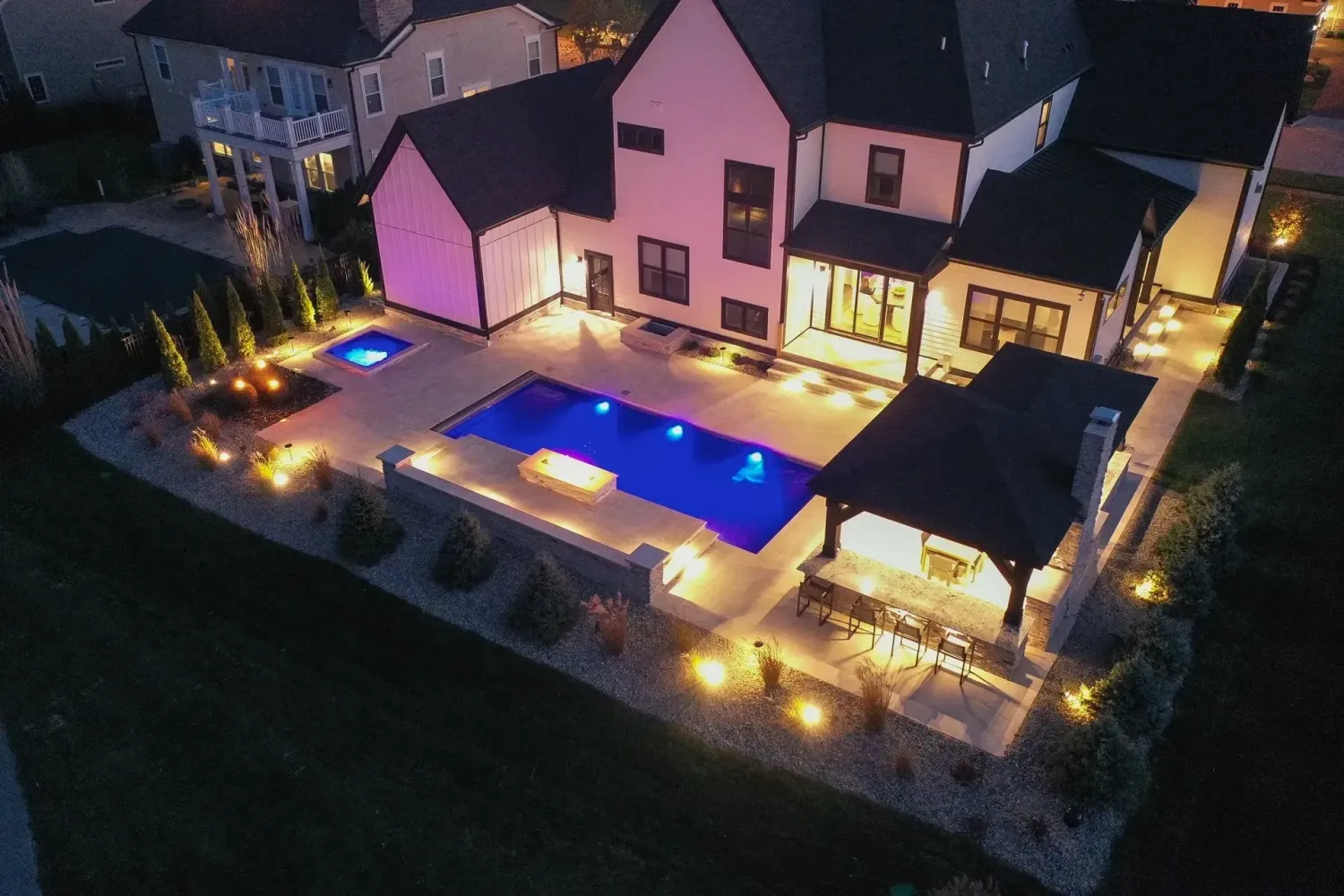
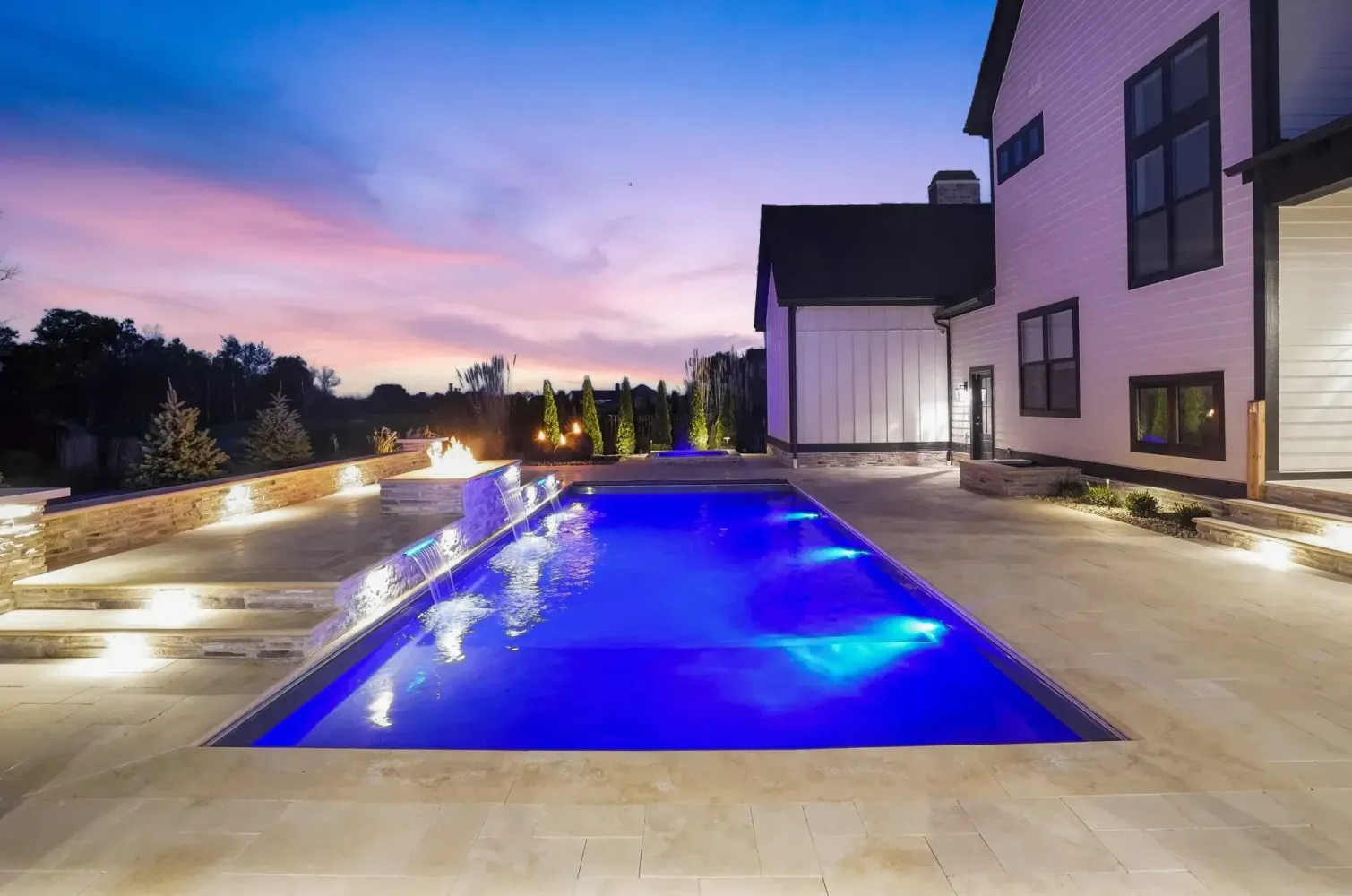
Here’s a specific case, walked end to end. Client on Bethelview Road in the Shiloh area — 1/2-acre lot, 1998-era 16×32 rectangle pool with attached round spa, single-speed 2-HP pump, mechanical timer, basic LED pool light. Called us for a replaster, travertine coping upgrade, and new paver deck. During the first design meeting we added the IntelliCenter option.
Total remodel including automation: $47,800. Automation delta (IntelliCenter i10PS-PC + IntelliFlo3 VSF + IntelliChem + four actuators + conduit + subpanel upgrade + programming): $5,640.
18 months of measured data after the remodel, comparing to the client’s pre-remodel utility baseline that we pulled from Sawnee EMC bills:
- Pool electric: dropped from $94/month summer / $38/month winter average → $52/month summer / $19/month winter. Annual savings: $582.
- Spa gas (propane in this case since the lot doesn’t have natural gas service): dropped from $41/month year-round → $11/month winter, $4/month summer. Annual savings: $288.
- Spa usage: went from ~6 sessions/year pre-remodel to 52 sessions in the first 18 months post-remodel per the IntelliCenter usage log. That’s a 6x usage increase attributable almost entirely to the geo-fence heating eliminating the 25-minute warm-up wait.
Total annual utility savings: $870/year. Payback on the automation delta: 6.5 years on utility savings alone. Factor in the spa-usage increase — the client says it’s his single best amenity investment over a Peloton, a home theater, and a $14,000 deck rebuild — and the non-dollar ROI is harder to quantify but obvious.
One honest caveat: the usage increase is not universal. Clients who adopt automation but don’t learn the app beyond the home screen use their pools exactly as much as before. The ROI shown here assumes the homeowner actually learns the scene-builder and voice integration features. We spend 45 minutes at handoff walking through this — and it matters.
How to Bring This Up With Your Remodel Contractor (and Spot a Bad Answer)
When you ask a pool remodeler to quote IntelliCenter during your remodel, the quality of their answer tells you a lot. Good answers include specific model numbers, specific conduit sizing, and specific integration tests they’ll run before handoff. Bad answers sound like this:
“We can add automation later.” Translation: they don’t want to take the time to spec it right, or they don’t carry a Pentair dealer relationship. Both are reasons to get a second quote.
“Automation’s not really worth it.” Translation: they haven’t installed enough of them to be fluent. Automation is absolutely worth it on any pool with a spa and multiple zones. Anyone telling you otherwise is probably more comfortable installing equipment they learned on in 2008.
“We use [generic brand] instead.” This isn’t automatically wrong — Hayward OmniLogic and Jandy AquaLink are real competitors. But press on the specifics. Does the system integrate with HomeKit natively or require a hub? Does it speak to variable-speed pumps over RS-485 or just fixed-speed? Does it have local geo-fencing or require IFTTT as a middleware? IntelliCenter wins on all three as of 2026 firmware, but the quality of the contractor’s answer matters more than the brand.
What to specifically ask for in writing on the contract: Model number of the controller. Model number of the variable-speed pump. Number of valve actuators. Conduit spec. Subpanel amperage. Programming hours included in labor. Handoff training duration. One-year programming warranty. Put all of it on paper before you sign.
And finally — ask for references from prior automation-during-remodel projects specifically. Not just any past projects. Not just pool projects. Pool remodels where automation was added mid-project. If they can’t produce three in Forsyth County alone, they probably haven’t done enough of them to be your best choice. In a county approving 200+ pool permits per year, there’s no reason to pick a contractor who hasn’t done this ten times before.
Pool Remodeling with Pentair IntelliCenter across 20+ cities within 30 miles of Winder, GA
If you’re planning a Forsyth County pool remodel anywhere from Coal Mountain to the Lake Lanier south shore, adding IntelliCenter during the rebuild saves the mobilization cost and delivers a 1- to 2-year payback on utility savings alone.