
Seven things are wrong with your pool. Resurfacing will fix one of them. The other six will chew through the new plaster in thirty months and you will write another check for a problem you already paid to solve. This is the uncomfortable version of the quote you should have gotten the first time.
Dacula has a lot of pools in that awkward middle age. Gwinnett County’s Hamilton Mill boom ran through the late 1990s and early 2000s, which means a chunk of the 30019 housing stock is carrying gunite shells that are now 20 to 30 years old — and a smaller but growing number of pools in the older pockets near downtown Dacula Rd and Hog Mountain Rd are pushing 35 to 50. Those pools have three things going against them at once: plaster well past its service life, Gwinnett County Watershed Management water that runs 3 to 5 grains per gallon of hardness, and bonded copper pipe installed before the industry learned what galvanic corrosion does to it.
When a homeowner calls us after a “resurfacing estimate” came in at $9,000 and asks why our number for the same pool is $32,000, this article is the answer. The bidder who quoted $9,000 isn’t lying. He’s just ignoring the six other failure modes happening underneath the plaster he’s trying to sell you.
Below are the seven signs we look for on a walk-through. If your pool has three or more, resurfacing alone is throwing money into a hole. If it has five or more, you are one freeze-thaw cycle away from a shell you cannot save. Here is how we read them.
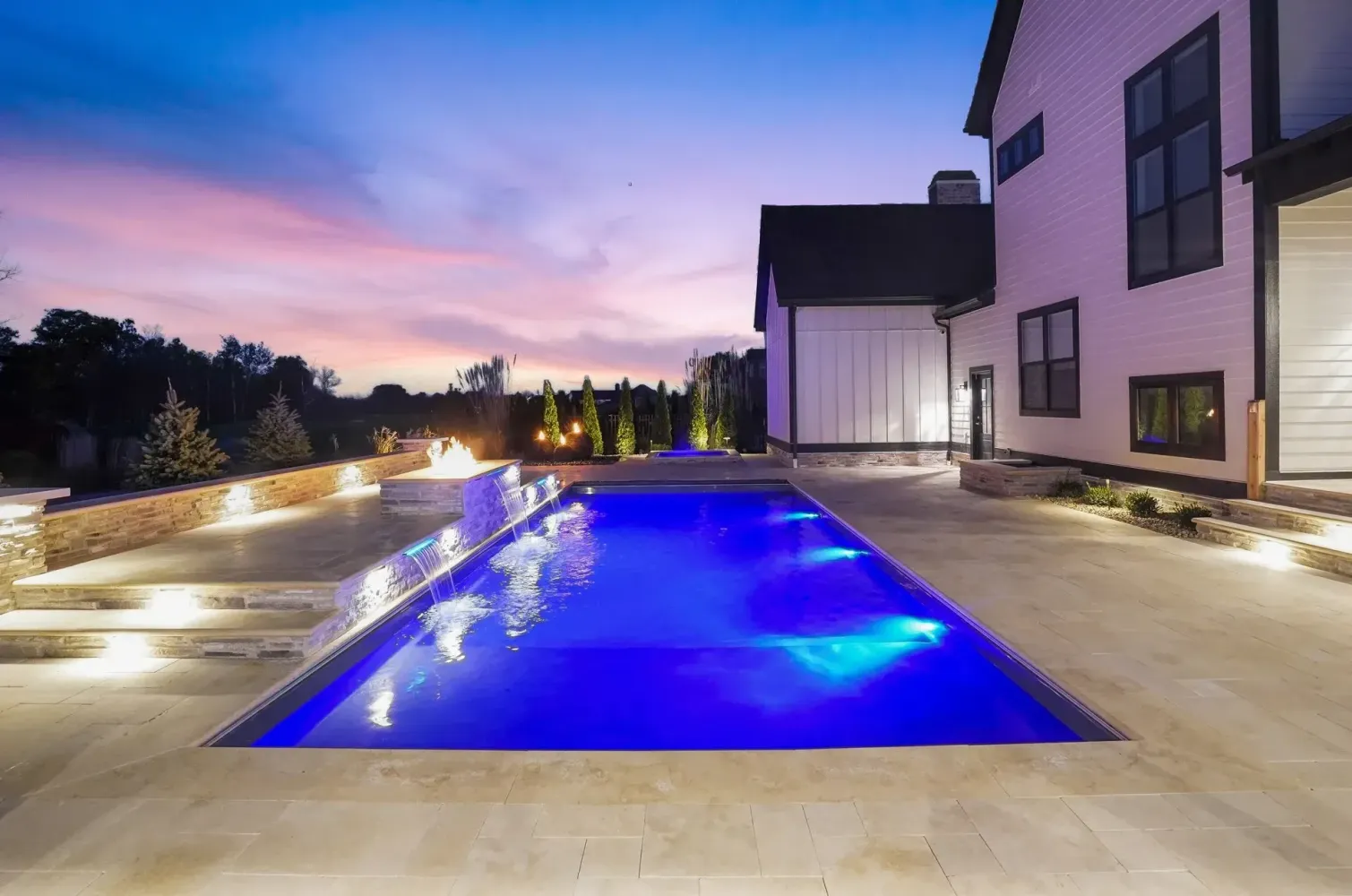
Sign 1: Structural Cracks Wider Than 1/16″ That Open and Close With the Seasons
The symptom: A crack in the shell or floor that is visibly wider in winter than in late summer. You can sometimes push a fingernail, a dime, or a pencil tip into it. It may weep water into the pool or lose water out of it. In Dacula we see these most often in pools built on the red-clay backfill of a downhill lot where the original builder didn’t stabilize the base correctly.
What it indicates: This is a structural shell crack, not a cosmetic plaster crack. We classify gunite cracks into three buckets: hairline (less than 1/16″), moderate (1/16″ to 1/8″), and structural (greater than 1/8″). We then sort them again into static (stopped moving years ago) versus active (still opening and closing). An active crack wider than 1/16″ means the shell itself is moving — freeze-thaw expansion against saturated Piedmont clay, a footing problem, or original rebar that rusted out in the 1990s and stopped holding tension.
Why resurfacing won’t fix it: Plaster is a cosmetic finish. It has roughly zero tensile strength. When a structural crack opens 1/32″ in February, new plaster telegraphs the crack to the surface in the first winter and cracks through itself by year two. The crack needs to be chased, cleaned, and repaired through the gunite — staple repairs, epoxy injection, or in severe cases a full hydraulic-cement patch bonded to fresh rebar — before anyone talks about new plaster.
Renovation cost for structural crack repair: $2,800–$6,400 depending on crack length and whether the shell needs staple reinforcement. Full hydraulic patching of a multi-crack floor can run $8,000–$12,000. This is additive to any resurfacing.
Sign 2: Plaster Past the 8–12 Year Mark in Gwinnett County Water
The symptom: White plaster that has gone gray, blotchy, or chalky. Calcium nodules the size of dimes popping out of the floor. Rough surface that snags a swimsuit or scratches skin when you run a hand along the steps. Sometimes the plaster visibly delaminates — a fingernail-sized chip lifts and you can feel a hollow behind it.
What it indicates: Plaster in Gwinnett County water — where hardness runs 3 to 5 grains per gallon and pH tends to climb in heat — has a realistic service life of 8 to 12 years. Quartz and pebble finishes push the upper end of that range; straight white plaster sits closer to 8. When we walk a pool and the owner says “it was replastered around the time my oldest started middle school,” we already know we’re past the envelope.
Why resurfacing “fixes” this one on its own: It does. If plaster age is the only problem on your pool, resurface it. A typical Dacula full replaster with quartz runs $6,500–$9,500, and you’ll be fine. The trap is that nobody who has lived with their pool for a decade has only this problem. The failed plaster is the visible symptom that makes you call for a quote. The other six signs are what the bidder is supposed to find while he’s there.
Sign 3: A Pool-Equipment Pad Where Everything Is the Original Age of the Pool
The symptom: Walk to the pad. If the pump is a single-speed, the filter housing is sun-bleached and chalky, and the heater has a corroded heat exchanger fin stack visible through the side vents — you’re looking at 20-plus-year-old equipment. Bonus symptom: the pump runs hot to the touch after twenty minutes, which means the motor bearings are starting to drag.
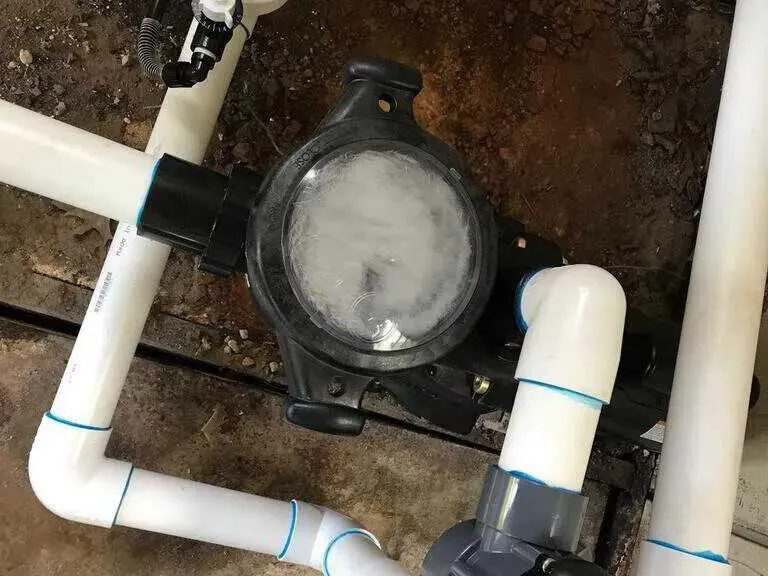
What it indicates: Equipment that was installed when the pool was built is past its design life. A single-speed pump from 2002 isn’t just inefficient — it’s also out of compliance with current Gwinnett County and Georgia state variable-speed requirements for replacement. Sand filters past 15 years shed media into the pool. Heaters past 12 years in hard water have heat exchangers that are 40 to 60 percent blocked with calcium scale, which is why your gas bill is brutal and your water takes three days to warm.
Why resurfacing won’t fix it: New plaster on a pool running old equipment is a countdown. The pump doesn’t circulate water fast enough to keep the new surface clean during the initial 30-day start-up, which is the most sensitive window in a plaster’s life. We’ve seen brand-new quartz plaster mottled and streaked at day 60 because the old pump was pushing half the rated gallons-per-minute.
Equipment replacement cost in a renovation: Variable-speed pump $1,800–$2,600 installed. Filter (cartridge or DE) $800–$1,400. Gas heater $3,200–$5,400. Full pad rebuild with smart controller and new plumbing headers typically runs $9,500–$14,000.
Sign 4: Suction-Side or Return-Side Plumbing Failures You Can Hear
The symptom: The pump loses prime overnight. You hear gurgling at the skimmer. Air bubbles push out of the returns for the first few minutes every time the system kicks on. The pool level drops 1/4″ to 1/2″ per day and you can’t find a shell leak.
What it indicates: This is plumbing failure, and it matters enormously whether the failure is on the suction side (the pipes pulling water from the skimmer and main drain to the pump) or the return side (the pipes pushing water back from the filter into the pool). Suction-side leaks pull air in when the pump runs and lose water out when the pump is off — those are the ones that gurgle and drop the level overnight. Return-side leaks push water into the ground whenever the system runs. Both are bad. They fail differently.
Older Dacula pools built before the mid-1990s commonly have copper return lines. Copper in soft-to-moderate Gwinnett water, with a bonding system that has developed a galvanic mismatch, corrodes from the inside. We’ve cut out copper returns in Hamilton Mill pools and found the wall of the pipe reduced to 40 percent of its original thickness. Newer pools use PVC, which doesn’t corrode but fails at joints when ground movement over Piedmont clay shears the glued connections.
Why resurfacing won’t fix it: Plumbing lives behind the shell, under the deck, or buried in the yard. Plaster cannot reach it. If the plumbing is leaking at the penetration points where returns and skimmers pass through the gunite, new plaster gets chased by the same leak within months because the leak is at the shell, not in the finish.
Plumbing replacement in a renovation: Partial suction-line re-plumb runs $2,400–$4,800. Full plumbing rebuild with new skimmer and return penetrations, upgraded PVC schedule 40, and a freshly isolated equipment pad: $7,500–$13,000.
Sign 5: Drain Covers That Don’t Meet VGB / NEC §680 Current Requirements
The symptom: A main drain cover that is flat, domed the wrong direction, cracked, or missing a visible embossed certification stamp. Dates older than 2008 on the cover itself. A single main drain with no secondary drain or split-flow system.
What it indicates: The Virginia Graeme Baker Pool and Spa Safety Act (VGB) and the retrofit provisions homeowners in Georgia inherit through NEC §680 set mandatory anti-entrapment standards for drain covers. Any pool drain cover manufactured before 2008 is almost certainly non-compliant. Single-drain configurations without an anti-vortex cover or a secondary suction port are a known entrapment hazard. On the electrical side, NEC §680 also governs pool bonding — and we’ll hit that in Sign 6.
Why resurfacing won’t fix it: You can’t plaster over a non-compliant drain. You also shouldn’t. A resurfacing crew that leaves an illegal drain in place is handing you a liability you can’t insure around. Any proper renovation in Dacula, GA includes replacing the main drain cover with a VGB-compliant unit and — when the pool is drained anyway — upgrading the drain sump, adding a split-flow secondary where feasible, and bringing plumbing velocity under the code-required limit.
Sign 6: Electrical Bonding Failure — Corroded Lug, Voltage Outside 0.3V
The symptom: A tingle when you touch the handrail and the water at the same time. Rust bleeding out of the lug where the bonding wire attaches to the pool steel or ladder. A handrail that has eaten through its stainless sleeve and pitted into the gunite. Light niches that have gone dull or are throwing a warm white that wasn’t there last year.
What it indicates: Pool bonding is the equipotential grid — the #8 copper wire that ties every metallic part of the pool (steel rebar, handrails, ladders, light niches, equipment pad) into a single electrical reference so stray current cannot create a voltage differential between any two points a swimmer might touch. NEC §680 governs it. When the bonding lug corrodes, the grid breaks. When the grid breaks, galvanic current flows between dissimilar metals. We verify bonding health by reading galvanic voltage between the water and the deck — the reading should sit under 0.3V. Anything above that is a live bonding failure.
Dacula pools built in the 1990s and early 2000s frequently have bonding lugs that were never sealed against the red-clay soil, and 25 years of acidic groundwater has oxidized them into uselessness. You cannot see this from the water. You see it when we dig up the equipment pad.
Why resurfacing won’t fix it: New plaster on a pool with a broken bonding grid is a cosmetic improvement wrapped around a code violation. Any full renovation in Dacula should include a bonding-grid audit, lug replacement, and — if readings run above 0.3V — a new equipotential loop installed in the surrounding deck when the concrete is cut for coping replacement.
Sign 7: Coping, Tile, and Deck Separation From the Pool Shell
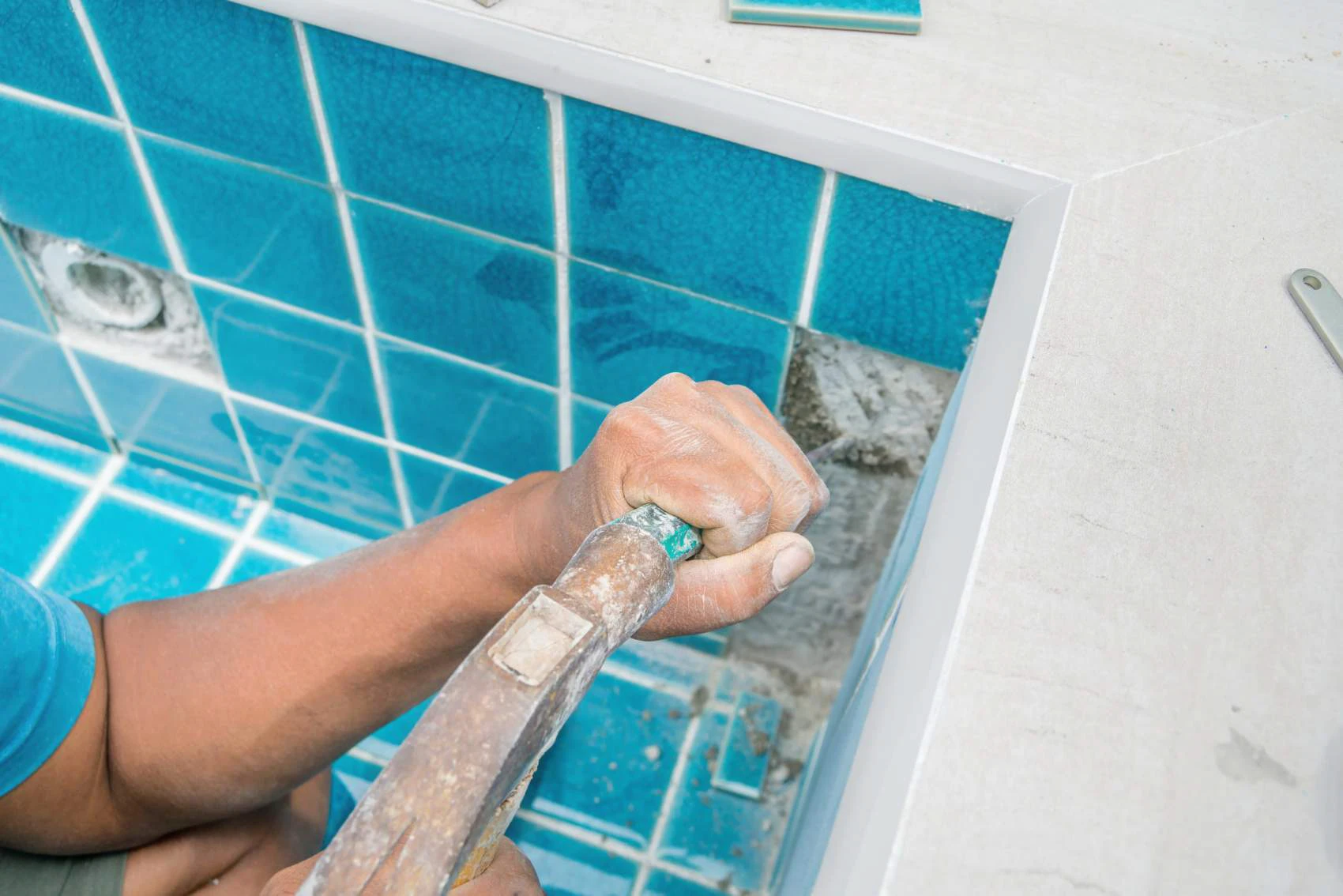
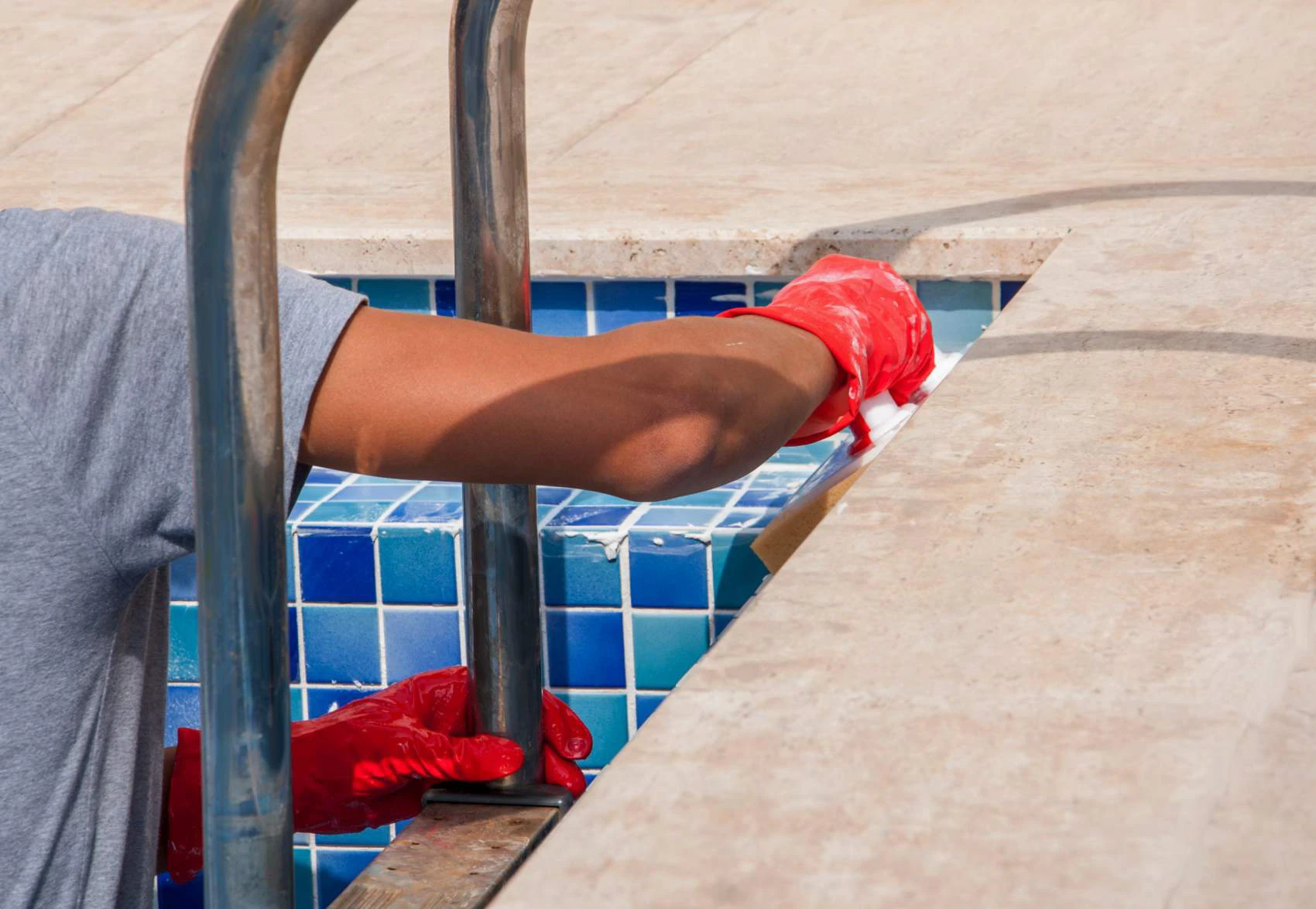
The symptom: A gap between the coping stone and the deck you can push a business card into. Tile at the waterline that is cracked, missing, or sounds hollow when you tap it. A deck that has clearly settled or heaved on one side and is now dragging the coping line with it.
What it indicates: The expansion joint between the pool shell and the surrounding deck has failed. In Piedmont clay, this is not a maintenance problem — it’s a soil problem. Dacula’s Cecil-series topsoil over saprolite shrinks in drought and swells in wet years, and the deck rides that movement while the shell (anchored through 30 feet of soil to a more stable strata) doesn’t. The result is a shear stress right at the bond beam where tile, coping, and the top inch of plaster meet.
Why resurfacing won’t fix it: New plaster doesn’t touch the coping joint. New tile doesn’t fix the deck movement that cracked the old tile. If the bond beam is compromised, the shell is now exposed at the top edge to water intrusion, which in freeze-thaw cycles — Dacula averages around 20 freeze events per year — starts splitting the gunite from the top down. Full renovation replaces coping, rebuilds the expansion joint with a proper sealant and backer rod, re-tiles the waterline, and addresses the adjacent deck movement before any plaster touches the shell.
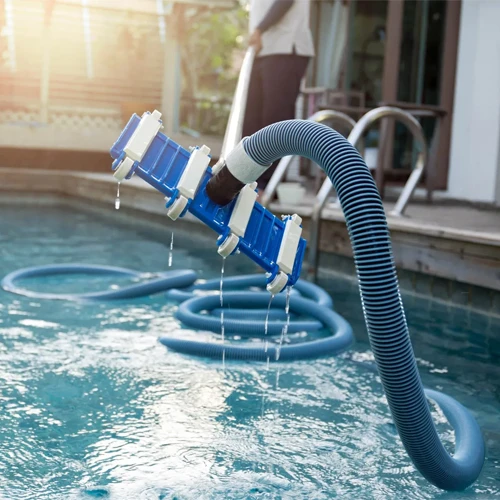
What Full Renovation Actually Costs in Dacula, GA — Honest Ranges
Here is the range. A light renovation — resurface with quartz, tile and coping replacement, new VGB drain cover, a variable-speed pump swap, and a bonding inspection with minor repair — runs around $14,000 for a standard 15,000-gallon rectangular pool. That is the floor.
A full renovation on an older Hamilton Mill or Sycamore Ridge pool with structural crack repair, a complete re-plumb, new pad equipment across the board (pump, filter, heater, automation), a new bonding grid tied to the deck’s equipotential loop, drain upgrade, new tile and coping, and pebble or premium quartz plaster runs $38,000–$48,000. Projects that add deck replacement, water features, or shape modification push above that.
The reason the resurfacing-only estimate comes in at $9,000 and the honest renovation estimate comes in at $32,000 is not that one bidder is greedy and the other is cheap. It’s that the first bidder is solving one problem and the second bidder is solving all seven.
The math we walk homeowners through: Resurfacing a pool with five of these seven signs is roughly a three-year purchase. You spend $8,500 now, and within 36 months the plaster is failing again because the underlying problems never got fixed. A $35,000 full renovation, done once, gives you 12–15 years before the next major service. The per-year cost is lower, and you don’t live through the same failure twice.
Look for three or more signs on your pool. If you find them, don’t sign the first quote for $9,000. Get a second opinion from a builder who will walk the pad, read the bonding voltage, check the coping joint, and classify the cracks against the hairline-moderate-structural framework above. That conversation costs nothing. The wrong decision costs four figures a year for the rest of the time you own the house in Dacula.
Every pool tells you what it needs — you just have to know which seven things to look at. If your plaster is past its Gwinnett-water service envelope, your pad equipment is original, your plumbing gurgles at start-up, your drain cover predates the VGB retrofit, your bonding lug is weeping rust, your coping joint is splitting, and your shell has a crack that opens every February — you have a renovation, not a resurfacing. The bidder who understands that is the one worth hiring.
Pool renovation across 20+ cities within 30 miles of Winder, GA
If your pool is showing three or more of the seven signs in this post, we’ll walk it honestly and tell you whether resurfacing is enough — or whether you need the full package. No pressure, just the uncomfortable version of the truth.