
It’s a Tuesday afternoon in March. You’re standing in your back yard in Vickery, looking at the sloped patch of fescue where the new paver terrace is supposed to live. Your neighbor’s contractor told them eight weeks from contract signing to pour. You’ve been quoted four. That gap — the difference between 28 and 56 days — is almost entirely about how a contractor handles Forsyth County permitting, HOA review, and Sawnee EMC coordination in parallel rather than in sequence.
That is the whole story of this post. Four weeks is not a sales number. It is an operational sequence, and it depends on three institutions in Cumming moving on their own clocks: Forsyth County Department of Planning & Community Development at 110 E. Main St., your HOA’s architectural review board, and Sawnee EMC. Miss a step with any of them and the timeline bleeds into week six, week seven, week eight — which is what you see on most driveways in this county.
Below is a day-by-day walkthrough of how a hardscape project in Cumming actually moves from signed contract to first pour in 28 business days. We’ll name the paperwork, the lead times, the specs, and the coordination errors that eat calendar. If you’re building this summer in St. Marlo, Hampton Park, or any of the newer tracts off Bethelview Road, this is the map.
Week 1, Days 1–3: Site Measure, Topo Capture, and Design Kickoff
The clock starts the day the contract is signed. Not the day the deposit clears. Not the day the designer “has time.” Day one. On a four-week schedule, a Primetime crew is on site inside 48 hours with a laser level, a rod, and a drone for topo capture. Cumming back yards are deceptive — they look flat from the kitchen window and drop 3 to 8 feet toward the rear property line on half the lots we’ve worked in South Forsyth. You cannot design a patio without numbers on that grade.
By day three, we’ve got a topographic base plan, a soil-type note (Cecil clay versus Appling sandy loam, which matters for compaction lifts), and a shot list of what the homeowner actually wants. Not a mood board — a spec list. Paver manufacturer, cap color, wall height, lighting voltage, grill run length, gas line length. The more decisions you make in week one, the fewer revisions you stack in week two.
Forsyth County address to know: Department of Planning & Community Development, 110 E. Main St., Cumming, GA 30040. Permit intake counter, 8:00 a.m. to 5:00 p.m. weekdays. Online submittals accepted via the county e-permit portal, but walked-in plans still move faster in our experience during spring peak.
Days two and three also include a utility locate request through Georgia 811. Legally it’s 48 working hours. Practically, on a Cumming lot where Sawnee EMC, AT&T fiber, and the county water main all converge at the front easement, it is the single most common reason a project stalls before it starts. We file it day one, so by day three the yellow gas paint and orange telecom paint are already dry.
One more week-one task that contractors skip: pulling the HOA’s covenants and architectural standards document before the design pencil hits paper. Subdivisions off Hwy 20, Post Road, and the newer Fowler Park corridor all publish their materials palettes — approved paver colors, allowable wall heights, setback rules, lighting color temperatures. Design to the palette first, and you don’t waste three days in week five watching the ARB vote down a limestone cap because the subdivision only permits a charcoal-tone concrete cap. The covenant PDF is usually 40 to 120 pages. Someone on the design team reads it day one. That is how four-week schedules stay honest.
The homeowner’s part of week one is short but critical. Sign off on the design direction — rough patio shape, wall height, kitchen-or-no-kitchen, fire-or-no-fire — by day five. Every day that decision lags, the drawings stall. Four-week projects live and die on how responsive the homeowner is during weeks one and two; after the permit is filed, their job is mostly done.
Week 1, Days 4–7: Design Drawings and HOA Architectural Review Prep
Now the design team is drawing. For a typical back-yard hardscape — paver terrace, seat wall, outdoor kitchen pad, fire feature, 240V low-voltage lighting — we produce three drawings: site plan with dimensions and drainage arrows, elevation view of any wall over 24 inches, and a materials schedule with manufacturer SKUs. That last document is what gets a subdivision’s architectural review board (ARB) to sign off without a second meeting.
Here is the gap most contractors miss. In St. Marlo, Polo Fields, and Lake Windward, the ARB meets twice a month. If you submit the day after a meeting, you are already two weeks behind before the county has even touched your file. We submit HOA plans in parallel with the county application, not after. That single sequencing decision is worth 10 to 14 calendar days on the back end of the schedule.
If a lot is not in an HOA — which is common in older sections of Cumming city proper and in the Haw Creek corridor — skip this entirely. But verify. We’ve had two projects in the past 18 months where a homeowner swore there was no HOA, and a post-closing covenant search at the county recorder’s office turned up a dormant association with an active ARB requirement. Verify on day one.
A quick note on drainage on the drawings. Cumming’s piedmont clay does not absorb water the way sandy soils do. A patio designed without a proper pitch and without a perimeter drain sends stormwater straight back toward the house. The site plan we submit to Forsyth County always shows the drainage arrows, the pitch percentage, and the outfall location. Drainage is the second-most-cited review comment after wall-height specs — getting it right on the first drawing is a three-hour task that saves ten days of back-and-forth with the county later.
Lighting voltage matters on the drawing too. A majority of back-yard hardscape lighting in Forsyth County runs on low-voltage 12V LED transformers, but anything beyond perimeter accent lights — built-in pool deck fixtures, outdoor kitchen task lighting, structural uplights on a pergola — bumps into line-voltage territory. Label every fixture by manufacturer and wattage on the drawing. It reads as contractor fussiness to the homeowner; it reads as competence to the county reviewer.
Week 2, Days 8–10: County Plan Submittal
Day eight is when the drawings walk into 110 E. Main St. Forsyth County runs residential hardscape permits through the same Planning & Community Development counter that handles pool permits and accessory structure reviews. The intake clerk checks for a completed application, the survey, the site plan, and if a retaining wall exceeds 4 feet in height, a sealed engineering letter from a Georgia-licensed PE.
A four-week project usually doesn’t trigger the PE requirement — we design walls at 36 inches or lower when the grade allows, which keeps the review administrative rather than engineered. When a lot has a real grade change — St. Marlo has several where the rear drop exceeds 6 feet — we commission the engineering letter on day four, so it’s ready to hand over at submittal rather than chased after a review comment.
Standard review time quoted by the county: 10 to 14 business days. Peak spring — typically late March through mid-May as relocation buyers ramp outdoor projects — that stretches to 4 to 6 weeks. The trick is to submit before spring peak if you can, which is why projects contracted in late winter run the fastest four-week schedules.
There’s a hidden lever in how the intake clerk routes the file. Forsyth County splits residential hardscape permits between two review paths: a fast-track administrative review for designs under a specific valuation threshold and wall-height cap, and a full technical review for anything above it. We size the project’s scope to stay inside fast-track whenever the client’s wish list allows. That isn’t about cutting corners — it’s about recognizing that a 320-square-foot terrace with a 30-inch seat wall reviews in six business days, while a 900-square-foot terrace with a 48-inch retaining wall reviews in fourteen. Same contractor, same quality, different lane.
The survey drawing that accompanies the application has to be recent — Forsyth generally accepts surveys within five years, but anything older gets a review comment requesting a reconfirmation. If a homeowner doesn’t have a current survey, commission one on day two for about $450 to $650. A four-day lead time from a local surveyor out of Cumming or Gainesville is typical. Sending the plan in without a survey is a guaranteed two-week delay.
Plan review fee, residential hardscape permit, Forsyth County: Calculated on total project valuation. Typical back-yard terrace plus seat wall plus outdoor kitchen pad in the $45,000 to $85,000 range runs a permit fee of roughly $180 to $340 plus a $65 plan review base. Pay at submittal or your file sits.
Week 2, Days 11–14: Sawnee EMC Service Coordination
Parallel track. While the county is reviewing, we’re filing a service request with Sawnee EMC — one of the largest electric member cooperatives in Georgia and the utility for virtually every residential address in Forsyth County. Any hardscape that includes an outdoor kitchen, pool equipment pad, landscape transformer over 600W, or a dedicated 240V circuit for a spa or heat pump needs a service coordination call.
Sawnee’s residential service modification turnaround is advertised at 5 to 10 business days for a straightforward meter upgrade or sub-panel add. Submit it on day eight alongside the county application and it closes out around day 16 — well before the county permit issues. Submit it the day the permit prints and you’ve just added two weeks to the back end of your schedule, because Sawnee will not energize a new sub-panel on a trench that wasn’t pre-inspected.
Here’s a detail most contractors outside Forsyth don’t know: Sawnee EMC maintains tighter voltage-drop standards on branch circuits feeding pool and spa equipment than the NEC §680 minimums. On long runs from the meter to a back-yard pad — and on deeper lots in Windermere and Mashburn Plantation that run well over 100 feet — that shows up as upsized conductor. Plan for #6 AWG copper or larger on the feeder where the tables alone would permit #8. Cheaper on the front end than a re-pull on day 40.
Bonding is the other Sawnee-era detail worth naming. Any metal within five feet of the waterline on a spa or pool, any structural steel inside an outdoor kitchen frame, any aluminum railing around a raised patio — all of it gets tied to an equipotential bonding grid before the concrete pours. The inspector out of 110 E. Main St. checks this with a clamp meter at rough-in. Fail the bonding inspection and you’re re-digging a trench to drop a #8 solid copper conductor. Cost: two days and roughly $800 in crew time. Do it right on the plan and the inspector walks through in fifteen minutes.
A word on the meter. Many Cumming homes on 200-amp service have just enough panel capacity to add a pool equipment circuit or an outdoor kitchen circuit, but not both. A quick load calc on day eight tells you whether the project needs a 400-amp service upgrade. Sawnee EMC’s service upgrade timeline from request to energization runs three to six weeks, which blows a four-week schedule entirely. If the load calc shows you’re going to pin the panel, that’s a conversation to have with the homeowner on day two, not day twenty.
Week 3, Days 15–19: HOA Approval Closes, County Review in Flight
By mid-week three, the architectural review board in St. Marlo or Polo Fields has met and voted. For a well-documented submittal — SKU-specific materials schedule, elevation drawings, neighbor notification letters when required — these pass on first review more than 90% of the time. When they don’t, the reason is almost always a material choice outside the HOA’s approved palette. The second-most-common rejection is a paver color that reads too light in the afternoon sun, which the ARB frames as “not consistent with existing streetscape.”
In Cumming’s newer luxury subdivisions — The Collection at Forsyth adjacent communities, the 2018-and-newer tracts along McFarland Parkway — ARBs are tighter than anywhere in metro Atlanta we’ve worked. Written turnaround averages 2 to 3 weeks, which is exactly why we don’t wait until county approval to file.
Meanwhile the county reviewer has the plan open. If there’s a review comment, we answer it inside 48 hours. The single biggest time-eater is letting review comments sit on a project manager’s desk for a week because someone is on vacation. That one lapse will push a four-week project to five or six. Staff an answering contact, not a voicemail.
Typical comments we see from the Forsyth County reviewer: clarify the drainage pitch on the site plan, confirm wall height does not exceed 48 inches at any point, provide setback distances to the property line, specify the cap stone SKU, confirm the location of the primary sewer cleanout relative to the proposed patio edge. None of these are project-killers. All of them cost a day if the contractor is staffed, a week if the contractor is not. This is where a four-week contractor and a seven-week contractor show very different operational cultures.
Week 3, Days 20–21: Permit Issues, Material Stage-Up Begins
If everything moves on schedule, the county permit issues at or near day 20. We print three copies — one for the site, one for the office file, one for the sub — and the permit card goes on the Tyvek house wrap at the nearest corner of the house, visible from the street. That’s the Forsyth County inspector’s rule, not a suggestion.
Material timing is the other lever. Techo-Bloc and Belgard lead times out of the Jacksonville and Kennesaw yards run 3 to 7 business days for stocked SKUs, 2 to 4 weeks for specialty textures and caps. We order on day 17 — not day 20. That way when the permit card prints, the pallets are arriving the same week, not two weeks behind.
Gas line sleeves, conduit runs, and the steel edge restraints for curved sections go on the same purchase order. The goal is that by day 22, everything needed through week four is either on the truck or stacked behind the garage on the jobsite.
The jobsite prep on day 20 and 21 is the other quiet piece. A portable restroom drop, a dumpster spotted at the driveway, silt fence installed along the downhill property line per Forsyth County’s erosion control ordinance, and tree protection fencing around any specimen trees within ten feet of the work zone. The ordinance is enforced; an inspector noticing a missing silt fence on day 23 can stop work until it’s installed. That’s another half-day lost that a disciplined four-week contractor never gives up.
Week 4, Days 22–25: Excavation, Base, and Compaction
Now the ground moves. A mini excavator and a skid steer show up day 22. For a typical 600 square foot terrace on Cumming’s Cecil clay, we strip 12 inches of topsoil and subgrade, over-dig 4 inches beyond the finished paver edge, and lay non-woven geotextile before any stone drops.
The base is the project. It is always the project. An 8-inch compacted open-graded base of #57 stone or #4 choker stone, compacted in 2-inch lifts with a plate compactor on each lift. That is not a Primetime preference; it is what makes a paver installation last through Forsyth’s ~22 annual freeze events without heaving at the joints. On the gently sloped lots common in Vickery and Hampton Park, we also build in a 1% drainage pitch away from the house foundation — invisible in the finished photos, impossible to retrofit later.
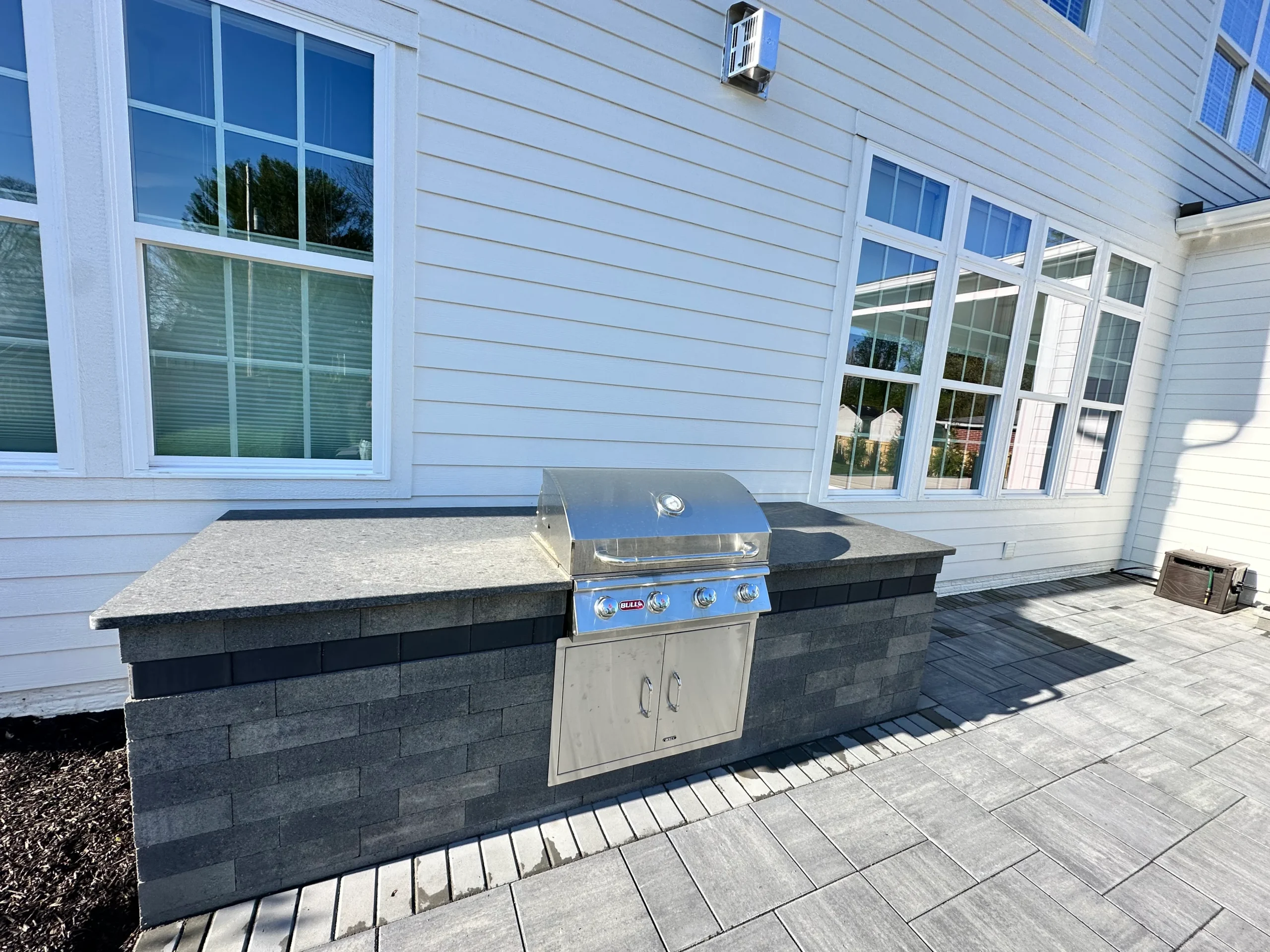
Day 24 is the county base inspection if the permit required one — more common on outdoor kitchen pads with structural loads than on simple terraces. Inspectors out of 110 E. Main St. typically schedule inside 24 hours of a request, sometimes same-day mid-week. Book it on day 22, not day 24.
The soil matters here in a way it doesn’t in most metro counties. Forsyth’s Cecil clay sits at roughly 105 to 110 pounds per cubic foot when fully compacted — meaningfully denser than the sandy loams you see closer to the Chattahoochee. On paper that sounds like a benefit. In practice, it means any void left under the base stone becomes a long-term failure point because the surrounding clay won’t flow to fill it. We mechanically compact in two-inch lifts — not four, not six — and we measure with a plate density gauge at random points across the bed. That’s the difference between a paver field that reads perfectly flat at year five and one that has a one-inch dip behind the grill island.
The geotextile separator layer is non-negotiable. A non-woven 4-ounce geotextile goes between the subgrade and the base stone on every Cumming project. On lots with the higher moisture profiles near Big Creek or along the Lake Lanier tributary drainages, we step up to a 6-ounce fabric. The fabric prevents the clay fines from migrating up into the base void structure, which is what turns a patio soft in year seven. Skip the fabric to save sixty dollars and the base fails on a compressed timeline.
Week 4, Days 26–28: Pour Day and First Paver Course
Day 26 is pour day for any concrete elements — footings under a seat wall, a slab under an outdoor kitchen island, a curb along a pool coping transition. Depending on the pour volume, a 4,000 psi mix with a 4-inch slump runs out of the Metro-Mix or Argos plant in Cumming or Gainesville. Delivery windows in April and May run tight — schedule the truck on day 22, not day 26 morning.
The first course of pavers is laid on day 27 or 28 on a 1-inch screed bed of washed concrete sand, chalk line pulled, and bond pattern checked before the second course goes down. This is where the obvious mistakes show up — a crooked starter course is a crooked patio forever, and no amount of polymeric sand fixes it.
Bond pattern matters to durability, not just aesthetics. Running bond at a 45-degree offset to the primary traffic direction is the default for Techo-Bloc and Belgard pavers across most Cumming installations because it distributes point loads better than a simple stack bond. Herringbone at 45 degrees is stronger still, and that’s the pattern we default to under outdoor kitchens where grill carts and cookware stations concentrate weight. A contractor who lays a stack bond under an outdoor kitchen is saving two hours of cutting — and setting you up for a wobble at year six.
Edge restraint is the other finish-day detail. We spike the perimeter with a heavy-duty polymer edging staked every eight inches into the compacted base. Every eight inches, not every twelve, not every sixteen. The difference sounds trivial; over a ten-foot run, it’s the difference between an edge that holds firm through freeze-thaw cycles and one that rotates outward by year three.
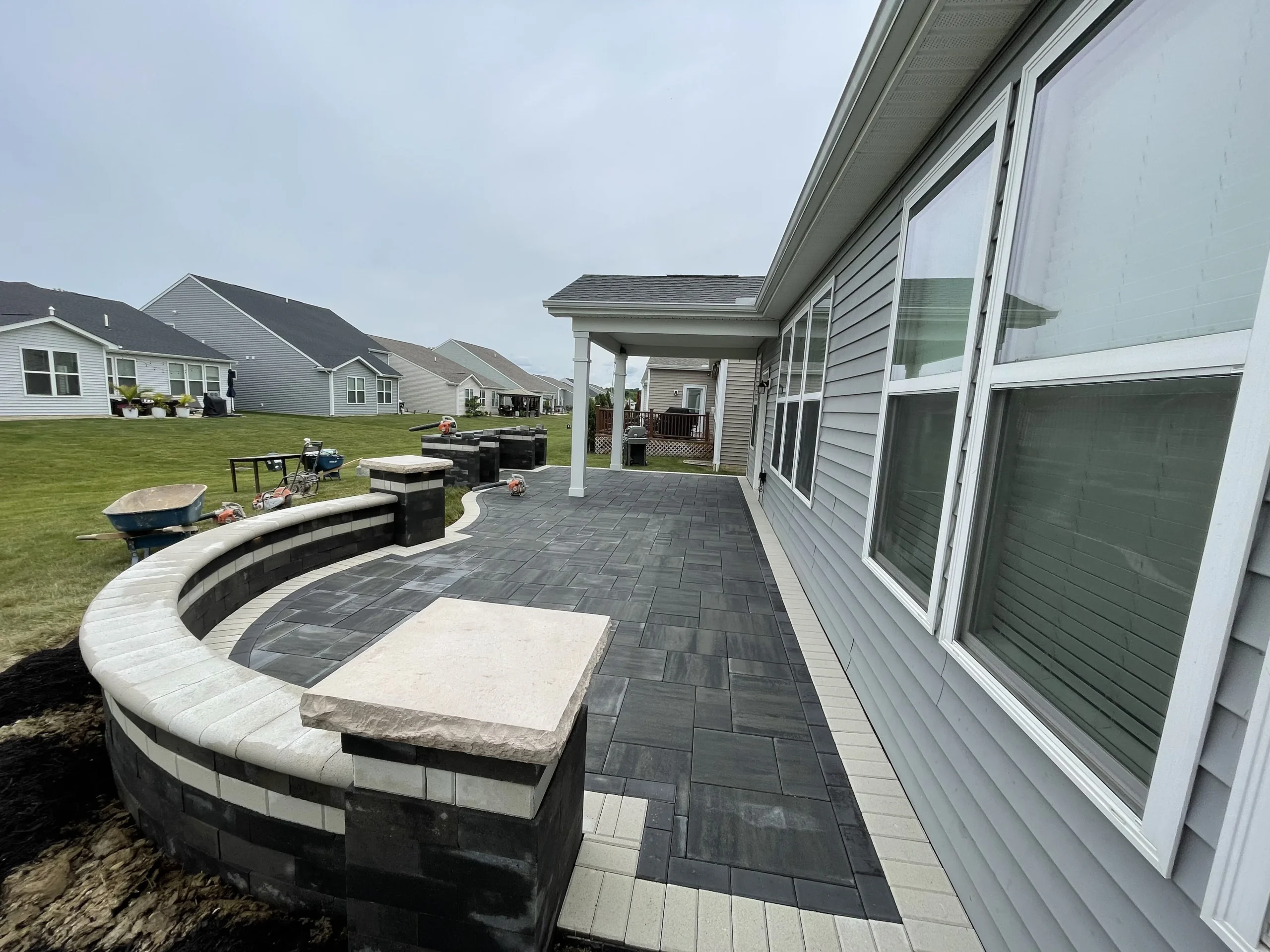
Finishing work — polymeric sand sweep, compaction into joints with a rubber-mat plate, pressure wash, sealer on a separate visit 14 to 30 days later after the joint sand has fully cured — continues into week five. But by day 28, the homeowner can walk on a finished surface. That is the 28-day target. Everything after is aesthetics, lighting commissioning, and the Sawnee EMC energization call, which we scheduled on day 15 and lands by day 29 or 30.
Where the 7-to-8-week projects actually lose their time. Every delay we’ve unpacked on other contractors’ schedules in Forsyth traces to one of four errors. Not design complexity. Not bad weather. Scheduling errors.
- Serial submittal. Filing HOA after county approval, or Sawnee after permit print. Each sequential filing adds 10 to 14 days that could have been parallel.
- Unstaffed review comments. A county reviewer’s question sits in a project manager’s inbox for a week because no one is assigned to answer it inside 48 hours.
- Late material order. Ordering pavers the day the permit prints instead of three days before. Techo-Bloc specialty SKUs can hit 3 to 4 weeks on a bad week.
- No topo. Designing on a tape measure instead of a real topographic survey means drainage reworks show up on day 23 instead of day 3, and the schedule collapses.
None of these are budget issues. They are process issues. A contractor who runs parallel tracks and staffs an answer-the-phone culture around review comments will deliver a Cumming hardscape in four weeks on the same permit system that takes a less-disciplined outfit eight.
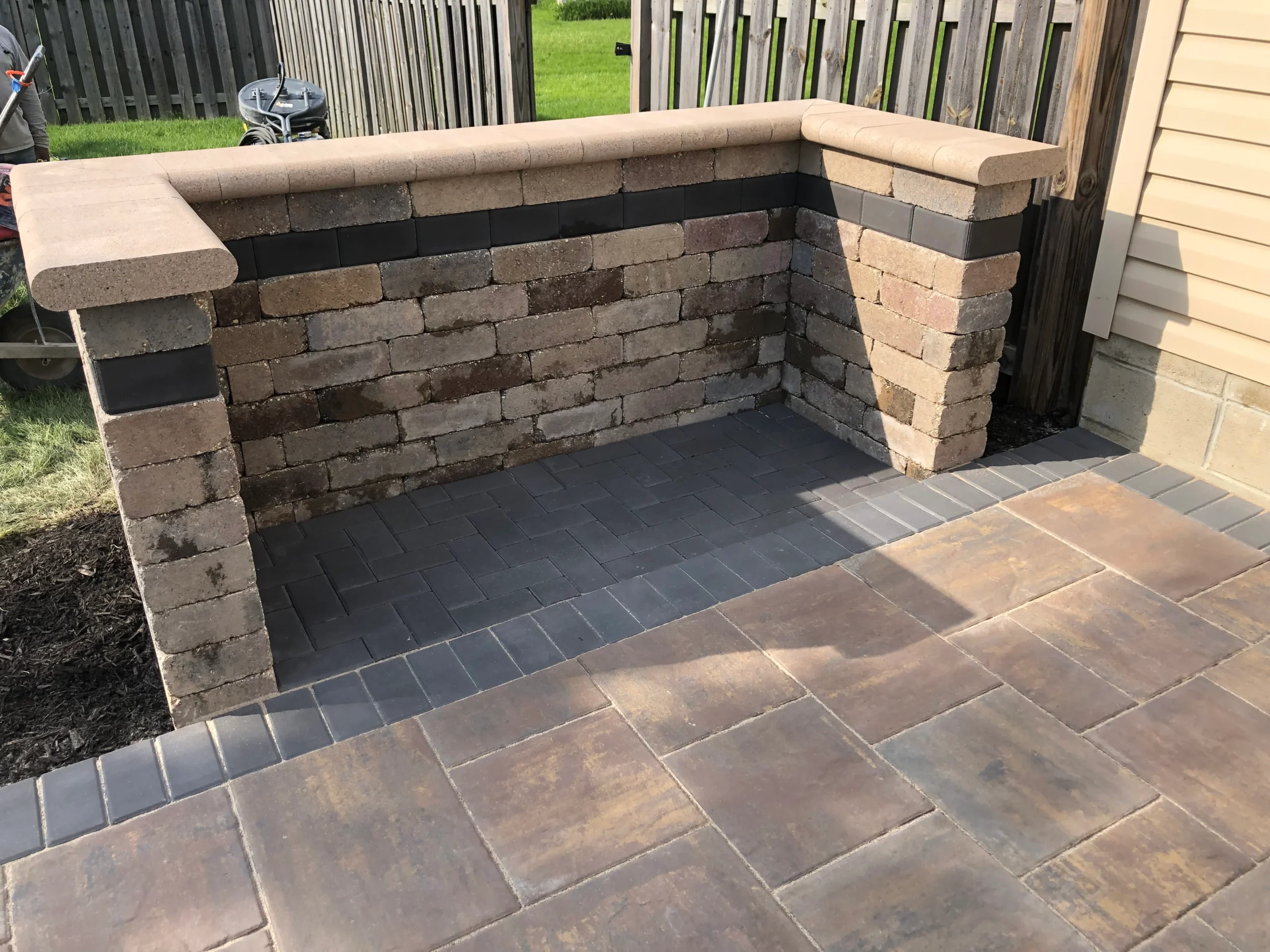
If you’re planning a 2026 spring or summer project in Vickery, St. Marlo, Hampton Park, Polo Fields, or anywhere inside the 30040 or 30041 zip boundaries, the smartest date to sign a contract is late January through early March. County review times are at their shortest, Sawnee EMC service queues are short, ARBs haven’t hit their spring rush, and the Techo-Bloc inventory in the Kennesaw yard is fully restocked from winter. Contract in March, pour before Memorial Day weekend. That is how the four-week timeline actually holds up.
Hardscape Design and Construction across 20+ cities within 30 miles of Winder, GA
Four-week permit-to-pour schedules depend on parallel filings with Forsyth County Planning, your HOA’s ARB, and Sawnee EMC. Primetime Pools runs all three tracks at once.