
On a 3-acre Cogburn Estates lot, a halogen lighting system burns through its entire service life in roughly 2,000 hours — about 28 months of nightly use. The same estate lit with a properly zoned LED package delivers 60,000+ hours, closer to 27 years. That single spec gap is where a $32K Milton lighting integration earns back $48K–$72K over its operational life.
Milton is different. Unlike the compact half-acre subdivisions south of McGinnis Ferry, the city’s AG-1 equestrian preservation zoning sets a 1-to-3-acre minimum on most estate parcels, and The Manor Golf Club and Cogburn Estates push that floor higher. Pool lighting budgets that make sense on a Johns Creek quarter-acre fall apart on a Milton estate — the lot is too large, the sight lines too long, and the approach drive too dark. A $7K “pool package” lights the pool and leaves the other 95% of the property in black.
This post walks through a real-budget, real-spec $32K estate lighting integration for a Milton build in the tier of The Manor or Cogburn Estates — the fixture schedule, the control layer, the code review through Milton Community Development at 2006 Heritage Walk, and the lifetime economics that justify every line item. The angle is narrow on purpose: this is not a general pool-lighting primer. It’s what $32K actually buys when the lot is 3 acres, the sky is dark, and the architectural review committee expects the approach to feel like the driveway into a private club.
The $32K Fixture Schedule — Line by Line
Before we get to scene logic and control layers, here’s what the money actually buys. This is the real schedule we price against on Milton estate builds in the $1.2M–$6M home tier. Every fixture is either Pentair IntelliBrite 5G, FX Luminaire (Hunter Industries), or Kichler Design Pro LED — all three brands carry 15-year fixture warranties and are DMX or 0-10V compatible with the control layer we wire in.
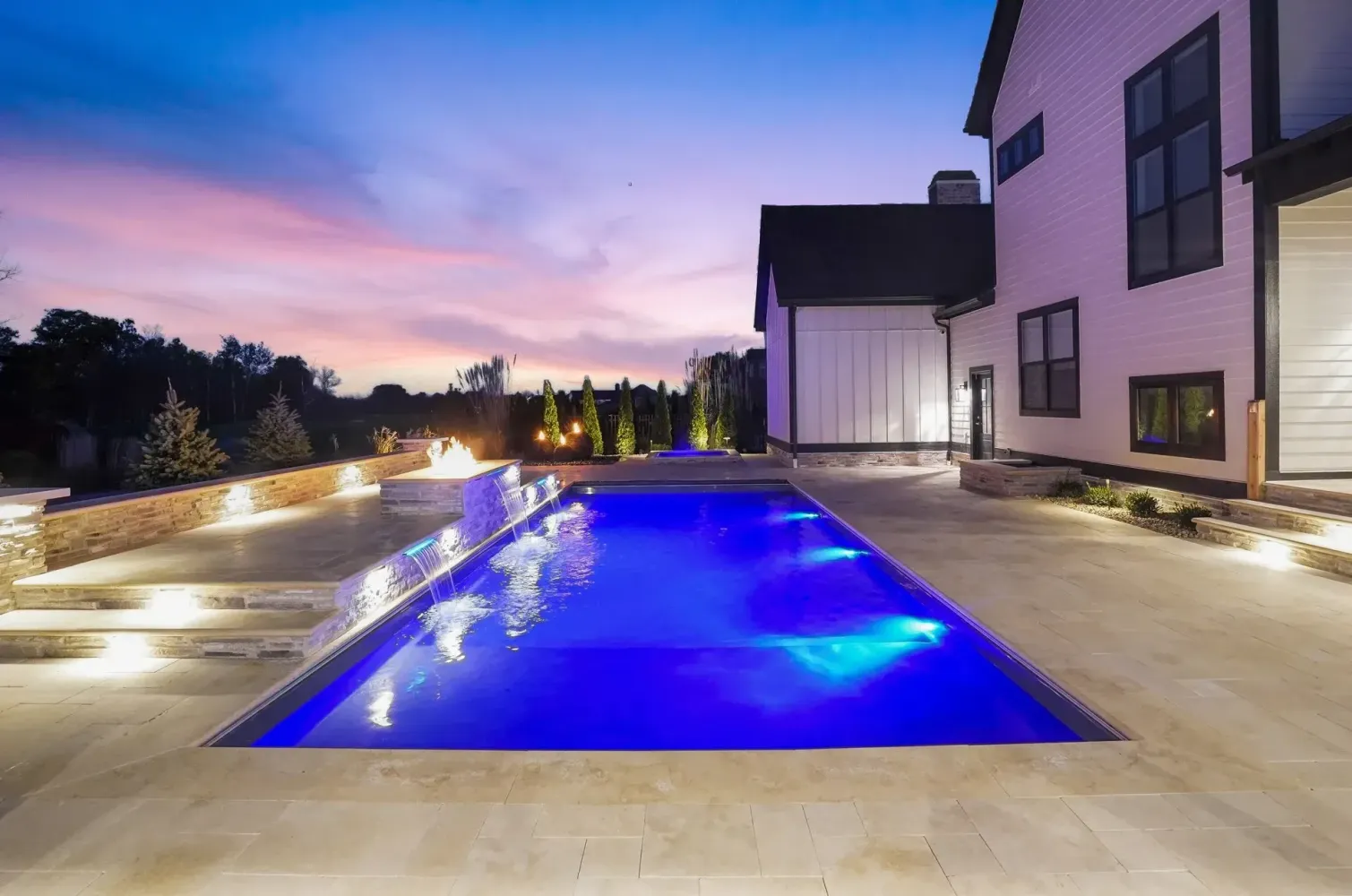
- 4 pool LEDs — Pentair IntelliBrite 5G Color, flush-mount, one per pool quadrant. 12-color spectrum plus five scene modes. Drawn through a single 300W transformer with GFI protection.
- 6 bubbler / water-feature LEDs — FX Luminaire PB mini-LEDs under sheer-descent bubblers and the auto-fill sheetfall. 2,700K warm white, no RGB — the water carries the color.
- 28 in-grade deck uplights — flush bronze-housing well lights, spaced every 4 feet around the pool coping and through the travertine deck surround. 3W each, 2,700K.
- 42 landscape uplights on 18 specimen trees — 2 to 3 fixtures per tree on the mature red oaks, willow oaks, and tulip poplars typical of Milton lots. Beam spreads from 10° narrow spot for crowns to 35° flood for trunks.
- 18 path lights on the approach drive — typical Milton approach from Freemanville Road or Hopewell Road is 400–900 feet long. 18 fixtures spaced at 50-foot intervals cover roughly 900 feet of lit approach.
- 4 security-grade pergola fixtures — downlights integrated into the ceiling structure of the pavilion, wired on a separate zone with motion activation.
- 6 perimeter accent fixtures on stone garden walls, fire features, and the outdoor kitchen countertop undersides.
Fixture subtotal: ~$19,400. Transformers, zoned wiring, trenching across a 3-acre lot, Lutron RadioRA 2 controller hardware with 10 programmed scene presets, and commissioning labor bring the full integration to $32,000 installed. That price assumes simultaneous install during pool construction — retrofit after the pool is poured typically adds $6K–$9K for trenching through finished deck and hardscape.
LED vs halogen life: A Pentair IntelliBrite 5G is rated at 60,000+ hours. At 6 hours of nightly use, that’s roughly 27.4 years before first bulb failure. A halogen equivalent lasts 2,000 hours — about 11 months on the same schedule. You will replace every halogen fixture 25+ times over the life of one LED.
Why Milton Estate Lots Need a Different Lighting Math
On a quarter-acre Suwanee build, pool lighting is a self-contained problem. You light the pool, the deck, a small lawn strip, and you’re done. On a Milton estate the pool is often 150–300 feet from the house, 600–900 feet from the street, and embedded in a landscape where grade drops 6–14 feet across the build envelope. That grade change matters — Milton’s rolling topography and its creek corridors (Cooper Sandy Creek, Chicken Creek, Lake Creek) cut terraces into most estate lots, which means a lighting plan has to work across elevation, not just plan view.
The implication is that lighting isn’t a “pool feature” on Milton builds — it’s a site-wide layer. The pool is one node in a network that includes the approach drive, specimen-tree uplighting through the front and side yards, perimeter accent lighting on stone walls, and the pavilion-to-pool sight line. Budget $7K on lights and the pool looks like it’s floating in an unlit void. Budget $32K and the entire 3-acre envelope reads as a single composed scene from the moment a guest turns off Freemanville Road.
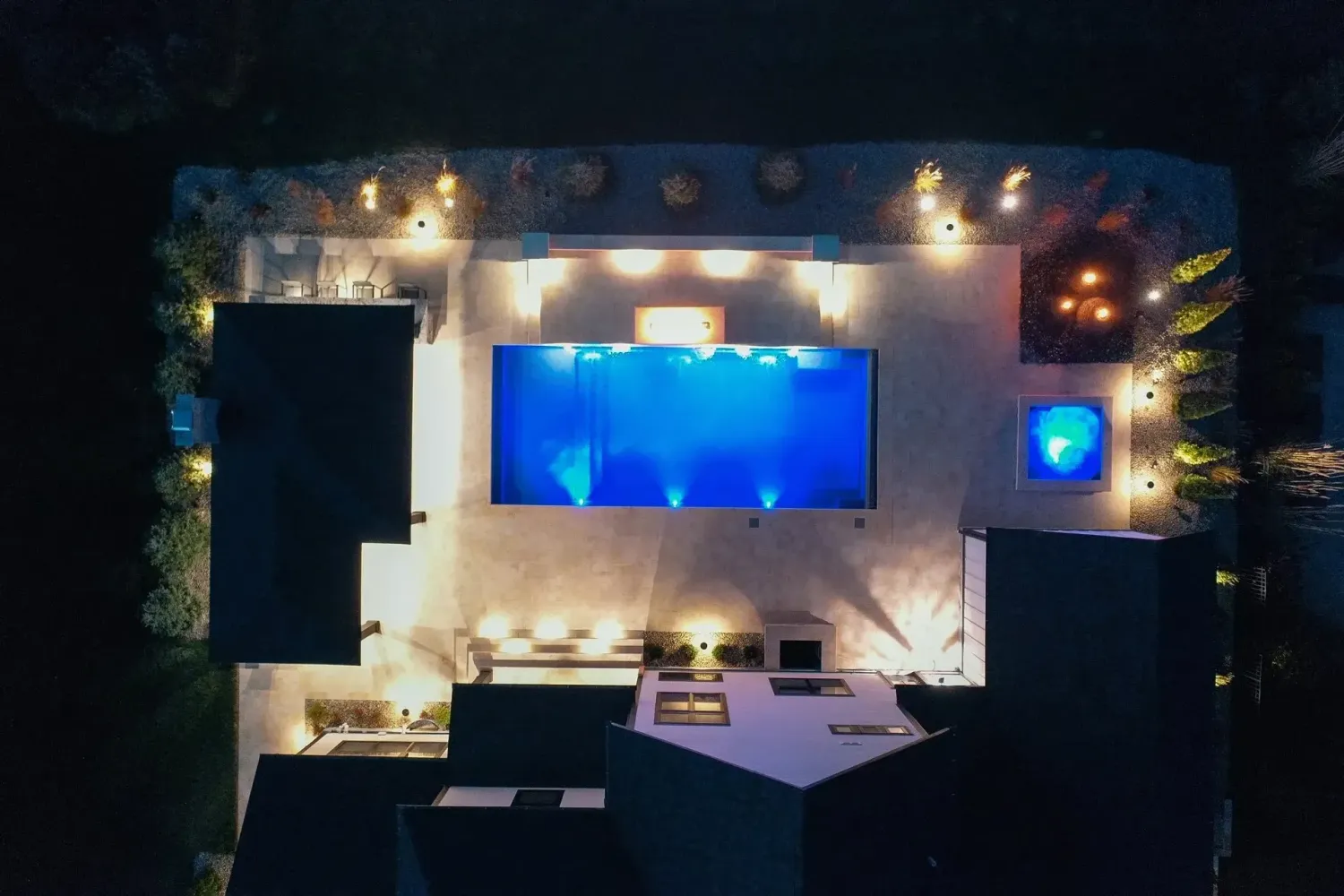
Milton’s 28-foot darker sky setup — shorthand for the fact that the city’s preservation ordinance restricts commercial light pollution from the nearest arterial (GA-372 / Birmingham Highway) and the rural parcel density keeps ambient sky glow low — means that every fixture you install is doing visible work. There’s no overwhelming street-glow baseline to compete against. A 3-watt path light reads at 80 feet. A 20-watt wash on a willow oak crown reads from the street. You cannot over-light a Milton estate from the property perspective, but you absolutely can over-light it from the architectural review perspective. The Manor Golf Club’s review committee and Milton Community Development both scrutinize perimeter spill and night-sky impact on creek-corridor parcels.
The Lutron RadioRA 2 Control Layer — 10 Scene Presets That Do the Real Work
Fixtures are the obvious line item. The control layer is where the budget actually earns its keep. The $32K package includes a Lutron RadioRA 2 main repeater wired to the pool equipment pad, with ten scene presets programmed during commissioning. Scene logic is what separates a resort-grade integration from a house-with-a-lot-of-lights.
- Welcome — path lights at 40%, specimen tree uplights at 25%, pool perimeter at 30%. Activated by a geofence on the homeowner’s phone as the gate opens.
- Arrival — approach drive at 100%, pergola fixtures at 60%, pool off. For dusk guests.
- Dinner — pavilion and outdoor kitchen at 70%, pool LEDs at 15% on a cool white, tree uplights at 40%.
- Swim — pool LEDs at 100% on homeowner color preset, deck uplights at 80%, perimeter off (kids safety — no dark edges).
- Party — pool LEDs color-cycling, bubblers active with LED sync, all perimeter and tree uplights at 60%, pergola downlights at 30%.
- Movie Night — pavilion downlights at 10%, pool LEDs at 5% on warm, everything else off.
- Quiet — tree uplights at 15%, pool perimeter at 5%, path lights at 20%. A subtle scene for 11 PM reading-on-the-deck nights.
- Security — all perimeter, pergola, and approach fixtures at 100%, motion-triggered. Pool off.
- Away — approach drive path lights at 30% on a sunset timer, randomized pergola and perimeter pulses to suggest occupancy.
- Off — hard cut. Everything dark except a single pool safety LED at 2% over the steps.
The ten presets are triggered from three places: wall-mount keypads at the back door and pavilion bar, a homeowner mobile app, and a Crestron or Control4 integration if the home has a broader smart system. The cost to add scene presets later is not trivial — retroactive Lutron programming on an already-commissioned system runs $800–$1,400 per scene, and rewiring zones adds thousands. Specify the ten scenes during construction and the cost is absorbed into the $32K.
The Milton Permit Path — Why City of Milton ≠ Fulton County
Milton incorporated as a separate city in 2006, splitting its land-use authority from unincorporated north Fulton. For pool and outdoor lighting permits, this means applications go through Milton Community Development at 2006 Heritage Walk, not the Fulton County permit office in Atlanta. The practical difference for homeowners is two-fold.
First, turnaround is faster. Milton Community Development reviews pool and outdoor electrical permits on a 10–14 business day cycle, compared to 18–30 business days at Fulton County for comparable work. For a build scheduled around a summer opening, two weeks of saved permit time is often the difference between a July completion and an August one.
Second, review is stricter on preservation and spill-light criteria. The Crabapple historic district, the creek-buffer setbacks (25–75 feet from named tributaries including Cooper Sandy Creek and Chicken Creek), and the AG-1 equestrian overlay all have lighting provisions. Perimeter wash fixtures within 25 feet of a creek buffer need shielded housings. Approach drive fixtures near the road right-of-way on Freemanville, Hopewell, or Bethany Bend cannot throw light above horizontal. The Manor Golf Club’s architectural review committee adds a 4–5 week structural review on top of city permits, and their lighting guidelines are more restrictive than Milton’s — no uplighting within 30 feet of a neighboring property line, and no color-changing fixtures visible from adjacent homes without written consent.
Permit timeline, Milton estate build (lighting-inclusive): 10–14 business days at Milton Community Development. Add 4–5 weeks for The Manor or Cogburn Estates architectural review. Plan pool construction schedule backward from opening date with a 9-week permit buffer on The Manor builds.
The 25-Year Economics — How $32K Becomes a $48K–$72K Savings
The fixture-life argument is the one most homeowners latch onto first, and it’s legitimate. A halogen-equivalent $32K package would run 15–18% cheaper in fixtures — call it roughly $27K installed — but the operating economics collapse within three years.
Run the math on a Milton estate at typical usage: 6 hours of daily operation on an average fixture, year-round. A halogen system at 60W per fixture across 108 fixtures (pool, deck, landscape, path) draws roughly 6.48 kW at peak. An LED equivalent at 4W per fixture draws 0.43 kW. Over 25 years at Georgia Power’s residential rate (call it $0.12/kWh to smooth for future rate increases), that delta is $71,600 in raw electricity cost.
Then layer in lamp replacements. Halogen at 2,000 hours means every fixture is replaced every 11 months on 6-hour daily use. 108 fixtures × 25 lamp replacements each × $18 average lamp cost × labor = roughly $48,000 in lifetime re-lamping. LEDs installed in 2026 will still be in service in 2051 with zero lamp replacements on most fixtures.
Net: the $5K premium on LED fixtures pays back inside 14 months on electricity alone. Over 25 years, the Milton estate owner running LED saves somewhere between $48K and $72K depending on usage patterns, rate escalation, and whether fixtures are on timers or always-on security loops. That’s the single clearest ROI argument in outdoor construction — and it doesn’t count the color-scene capabilities LED delivers that halogen physically can’t.
The Soil and Topography Problem — Trenching a 3-Acre Lot Through Cecil Clay
Lighting a Milton estate isn’t only a design problem. It’s a trenching problem. The subsoil under most Milton parcels is Cecil clay over weathered granite, with thinner residuum on ridgelines and thicker topsoil in creek bottoms. Saprolite shelves — partially weathered granite that behaves like rotten rock — are occasionally encountered 3–5 feet below grade during excavation. On ridgeline lots in Cogburn Estates and King Estates, trenching for lighting runs can hit saprolite within a single shovel pass.
The practical implications for a $32K integration:
- Trench depth and routing matter. Low-voltage landscape runs at 6–12 inches are easy. 120V runs out to pergolas and security fixtures need 18–24 inches. If saprolite is hit, the route has to shift or the trench has to be rock-sawed, which adds $40–$80 per linear foot.
- Grade drops require junction boxes. On a lot with 8-foot grade change, voltage drop across a 400-foot run becomes non-trivial. Install a secondary transformer mid-run instead of fighting voltage drop with larger cable gauges.
- Creek-corridor buffers limit routing. The 25-to-75-foot creek buffer from Cooper Sandy Creek, Chicken Creek, or Lake Creek tributaries is a hard no-trench zone. Run perimeter lighting along the inside edge of the buffer and feed it from house-side transformers — never breach the buffer with wire.
- Equestrian zones need conduit protection. AG-1 lots with active horse use require 24-inch buried conduit in any paddock, pasture, or riding-trail crossing. Hoof loads compact soil differently than foot traffic and will crush unprotected direct-burial cable within 2–3 seasons.
The $32K budget assumes typical Milton conditions: 6–8 foot grade variation, one saprolite encounter requiring a routing shift, and one creek-corridor buffer that forces an alternative wire path. A site with significantly worse topography — 14-foot drops across the build envelope, extensive saprolite, or multiple creek corridors — can push trenching alone to $5K–$7K over baseline. Always budget a 10% contingency line on Milton sites.
The Specimen-Tree Uplighting Layer — 42 Fixtures on 18 Trees
The single most visible element of the $32K package is the tree uplighting. Milton estate lots arrive with mature canopy — 60-to-90-foot red oaks, tulip poplars, willow oaks, and the occasional remaining longleaf pine. An unlit tree at night is invisible. A properly lit tree becomes a 90-foot architectural feature visible from the house, the pool, the approach, and often the neighbor’s front porch.
The standard Milton estate ratio is 2 to 3 fixtures per specimen tree — one at the base for trunk wash (35° flood, 4-watt), one mid-height on a branch union (20° spot, 3-watt), and on the tallest trees a third placed 20 feet out to catch the crown (10° narrow spot, 6-watt). The 42-fixture landscape allocation in the $32K package covers 18 trees at an average of 2.3 fixtures per tree — calibrated for a typical Cogburn Estates or Greystone lot with 14–20 specimen trees and 4–6 smaller understory trees that get single-fixture treatment.
Three technical details matter on specimen-tree uplighting in Milton specifically:
- Aim away from horizontal. Milton’s preservation ordinance and most HOA bylaws restrict light spill onto adjacent lots. Fixtures aimed straight up are fine. Fixtures tilted 15° toward a property line will draw an architectural review comment.
- 2,700K, never 3,000K or cooler. Warm-white reads as “estate lighting.” Cooler color temperatures read as “commercial parking lot.” The Manor’s architectural guidelines explicitly restrict landscape fixtures above 3,000K.
- Fixtures on tree branches must be mounted with stainless bands, not screws. Trees grow. A screw-mounted fixture gets eaten by the tree within 6–8 years and destroys the fixture. Stainless banding lets the tree expand without damage.
What a Retrofit Looks Like vs a Simultaneous Install
The last practical point: the $32K price assumes the lighting is installed during pool construction — while the deck is still open, while the hardscape trenches are already dug, while the equipment pad is being wired. Retrofit onto a completed Milton estate pool runs 20–30% higher.
On a retrofit, the additional costs break down as:
- Saw-cutting finished travertine deck for in-grade uplights — typically $40–$60 per fixture.
- Re-trenching through established landscape beds with mature plant material — $15–$25 per linear foot, plus plant replacement.
- Core-drilling the equipment pad wall for additional low-voltage feeds — $400–$600 per penetration.
- Re-permitting electrical work through Milton Community Development — a full second permit cycle adding 10–14 business days.
- Disrupting landscape irrigation and running secondary testing to confirm no trenching damage to drip lines or lateral pipe.
On a new build, all of that work happens once, on an open site, during the construction schedule. That’s why the same package that installs for $32,000 on a new Milton build typically prices at $38K–$42K as a retrofit — and why lighting is the single line item most often under-specified on estate builds, only to get triple-the-cost retrofitted two years later when the homeowner realizes the pool looks beautiful but the 3-acre lot around it disappears at dusk.
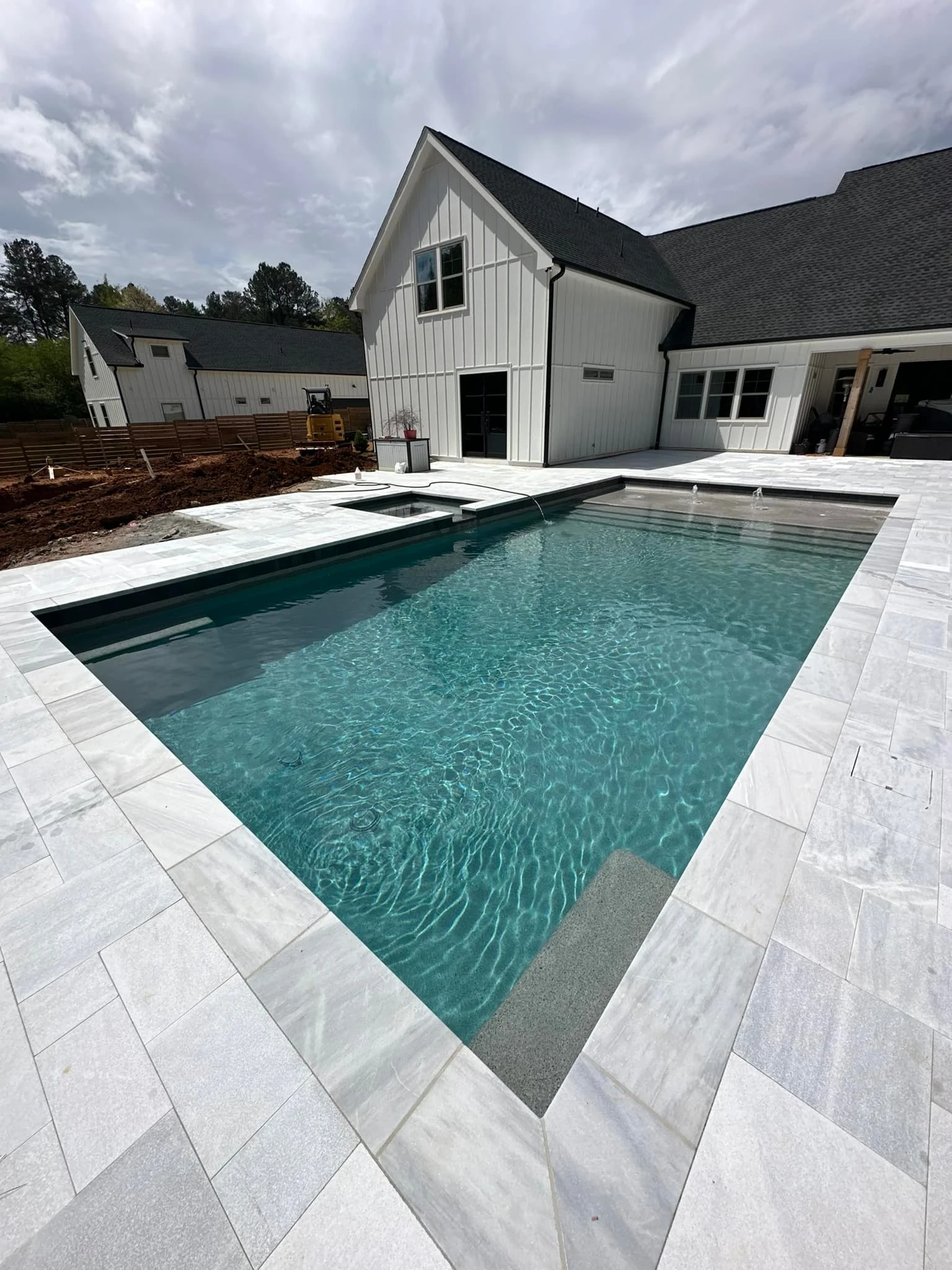
The retrofit math: $32K new-build vs $38K–$42K retrofit. A Milton homeowner who defers lighting to save $32K on the pool budget typically spends $40K+ two years later for a less integrated result — because core-drilled penetrations and saw-cut decks never disappear completely.
If there’s a single takeaway from this post, it’s that lighting is a pool-construction line item, not a pool-construction afterthought on Milton estate builds. The topography is too complex, the lots are too large, the preservation review is too strict, and the economics are too clearly in favor of getting it specified once, correctly, on an open site.
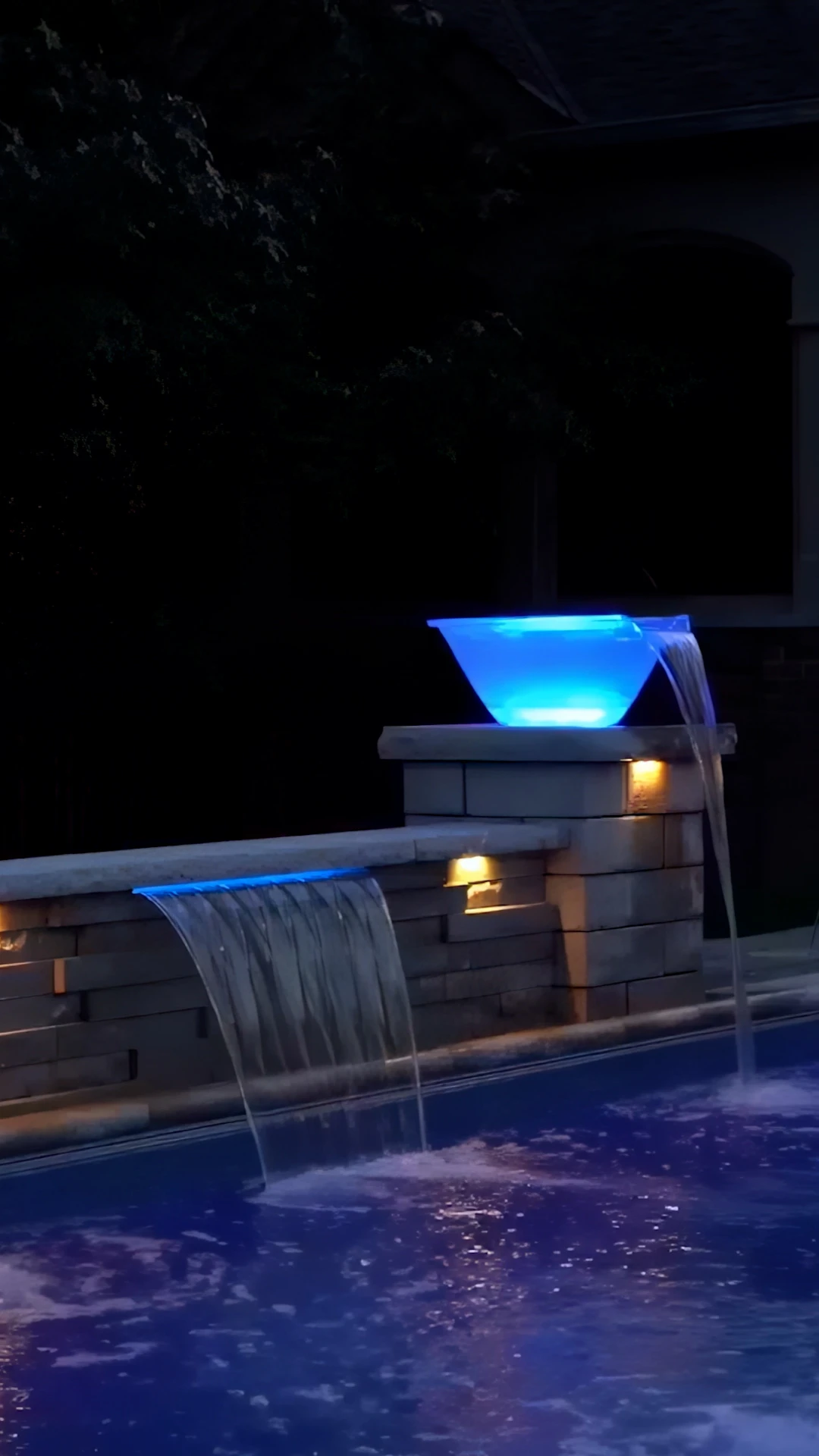
Resort-grade pool lighting across 20+ cities within 30 miles of Winder, GA
From The Manor and Cogburn Estates in Milton down through Dacula and Grayson, our lighting integrations are specified during pool construction — once, correctly, on an open site — with a control layer that still runs smoothly 25 years in.