
You walk the back of a 3-acre parcel off Freemanville Road at first light, and the grade rolls away from the house for 90 feet before it flattens. There is no privacy fence eight feet from the water’s edge. There is no neighbor’s patio crowding the property line. There is only open pasture, a line of mature hardwoods, and a slight dogleg where Cooper Sandy Creek bends behind the tree line — and everything about the space tells you the pool wants to be bigger, wider, and shaped to the land rather than squeezed against it.
This is the central design opportunity that Milton gives a custom pool builder, and it is the reason estate pools here look almost nothing like the pools we build twelve miles south in tighter Fulton subdivisions. When a homeowner has a full three acres to work with — and Milton’s AG-1 equestrian-preservation zoning means most back yards along Hopewell, Birmingham Highway, and the Cogburn corridor sit on exactly that kind of footprint — the pool is no longer a rectangle tucked against the rear setback. It becomes the center of a small resort. The brief stretches from a single body of water into a full outdoor campus: a freeform pool with an integrated spa, a 20×30 pavilion with an outdoor kitchen underneath, a separate fire pit, and a pergola-covered dining zone all tied together by hardscape that reads as one design rather than five add-ons.
This post walks through how we design and build a project like that in Milton specifically. Not a generic “custom pool” overview — a project case study built around the 22×46 freeform on open land that we see most often on estate lots here, with the engineering decisions, the permit sequence, the creek-buffer conversations, and the all-in pricing that comes with it. If you are planning a build in Crooked Creek, The Manor Golf Club, White Columns, Atlanta National, Cogburn Estates, or any of the estate subdivisions along the GA-372 corridor, this is the construction reality you are stepping into.
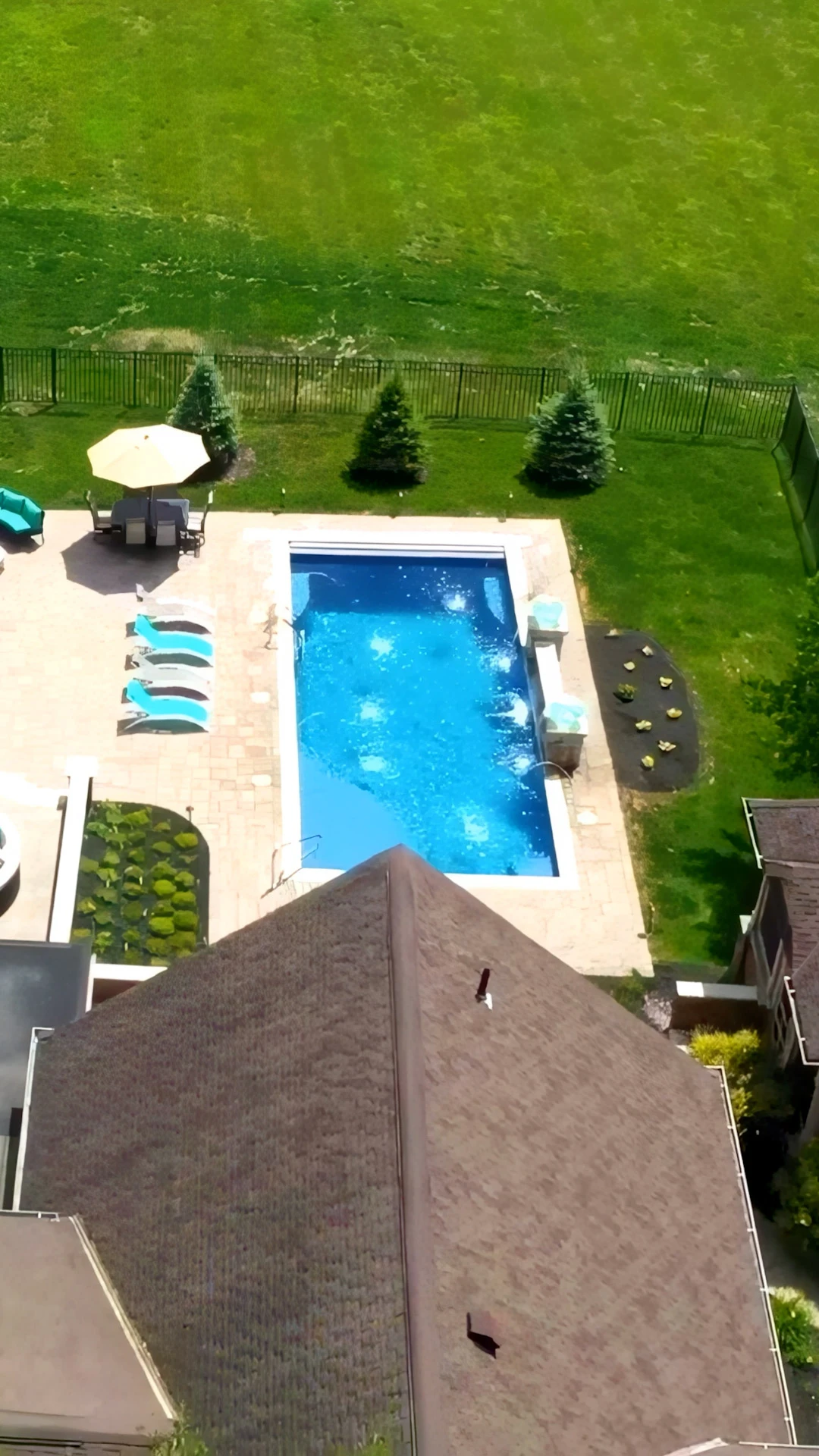
Why a 3-Acre Milton Lot Changes Every Design Assumption
On a standard three-quarter-acre subdivision lot in south Forsyth or west Alpharetta, pool design is a negotiation between setbacks. The builder fights for every linear foot, the rear yard dictates the pool’s long axis, and the hardscape program gets pared down until something has to go — usually the pavilion, sometimes the spa, occasionally the shallow entry. The conversation is about subtraction.
On a three-acre Milton lot, the conversation flips. With 130 to 200 feet of usable rear yard before you hit a creek buffer, tree line, or equestrian pasture, the design question becomes additive: what does the homeowner actually want, and how do we compose it into a single site plan that feels like one place rather than a collection of things? This is why a typical Milton project brief reads almost identically across zip codes 30004, 30075, and 30076:
- A 22×46 freeform pool — wide enough for multiple swim lanes, shaped to soften against the landscape rather than echo the architecture
- An 18 ft beach entry (zero-edge sloped entry, plaster-to-grass-level transition) with a built-in 8 ft sun shelf for two loungers and two umbrellas
- A raised spa integrated into the pool deck — typically a 7×7 square or octagon raised 18 inches with a spillover weir into the pool
- A 20×30 covered pavilion with tongue-and-groove cedar ceiling, paddle fans, and a full outdoor kitchen underneath
- A separate fire-pit zone set 35 to 50 feet off the pool deck — often paver-bounded, gas-fed, with a circular seat wall
- A pergola-covered dining terrace between the pavilion and the house — the connective tissue
None of those elements are individually extraordinary. What is extraordinary is that they all fit on the same back yard without crowding, and that when they are designed together from day one rather than added year by year, the hardscape resolves into a single plane with a single material palette. That is the Milton opportunity, and it is the reason estate pool budgets here run from $385K to $625K all-in rather than the $180K-$240K range you see on subdivision lots south of McGinnis Ferry.
Milton estate budget reality: A full pool + pavilion + outdoor kitchen + fire pit integration on a 3-acre lot typically lands between $385,000 and $625,000 all-in. Of that, the pool itself usually represents $165K-$225K; the pavilion and outdoor kitchen run $95K-$165K; hardscape connecting terraces, coping, and decking add $75K-$145K; fire pit and pergola add $25K-$60K.
Reading the Site: Grade, Creek Buffers, and Saprolite Shelves
Before any design concept is drawn, we walk the site twice. The first walk is with the homeowner to understand how they want to use the space — where the kids will come in from the house, which direction the afternoon sun angles across the yard, where the prevailing breeze moves, which view from inside the house should frame the spa. The second walk is with a grade rod and a handheld GPS. On a Milton estate lot, we are measuring three things:
1. Actual grade change across the pool footprint
Milton has more dramatic rolling grade than Alpharetta or Johns Creek. Six to fourteen feet of fall across a proposed pool envelope is common, particularly on lots along Hopewell Road, Bethany Bend, and the ridgelines running down toward Etowah River tributaries. A 6 ft drop across a 46 ft pool length is manageable with a stepped patio and a raised back wall; a 14 ft drop requires a full retaining-wall program that can double the hardscape budget. We measure this before design, not after — because a concept that ignores grade is a concept that dies at the first excavation meeting.
2. Named-tributary setbacks
Milton has an unusual density of small named creeks crossing residential parcels — Cooper Sandy Creek, Chicken Creek, Lake Creek, and several unnamed Etowah River tributaries that still trigger state buffer rules. City of Milton Community Development enforces 25 to 75 ft creek-buffer setbacks depending on the tributary’s classification. On about one in four estate lots we bid, this is the first real design constraint: the pool envelope shifts ten or fifteen feet toward the house, and the pavilion has to pivot accordingly. It is always easier to know this on day one than to redesign at permit review.
3. Saprolite shelves in the excavation path
Milton sits on Cecil clay over weathered granite — topsoil ranges from a few inches on ridgelines to three or four feet in creek bottoms, and below that you hit saprolite (partially weathered rock) before you hit hard rock. Saprolite excavates with a large trackhoe and rock ripper; hard rock requires hydraulic hammering and adds real cost. On a 22×46 pool dug 6 ft deep on the deep end and 3.5 ft on the shallow, you are moving roughly 120 to 145 cubic yards of material. When we hit a saprolite shelf at 4 ft depth — which happens on maybe a third of Milton excavations — it adds one to two days and a hammer rental but rarely blows the schedule.
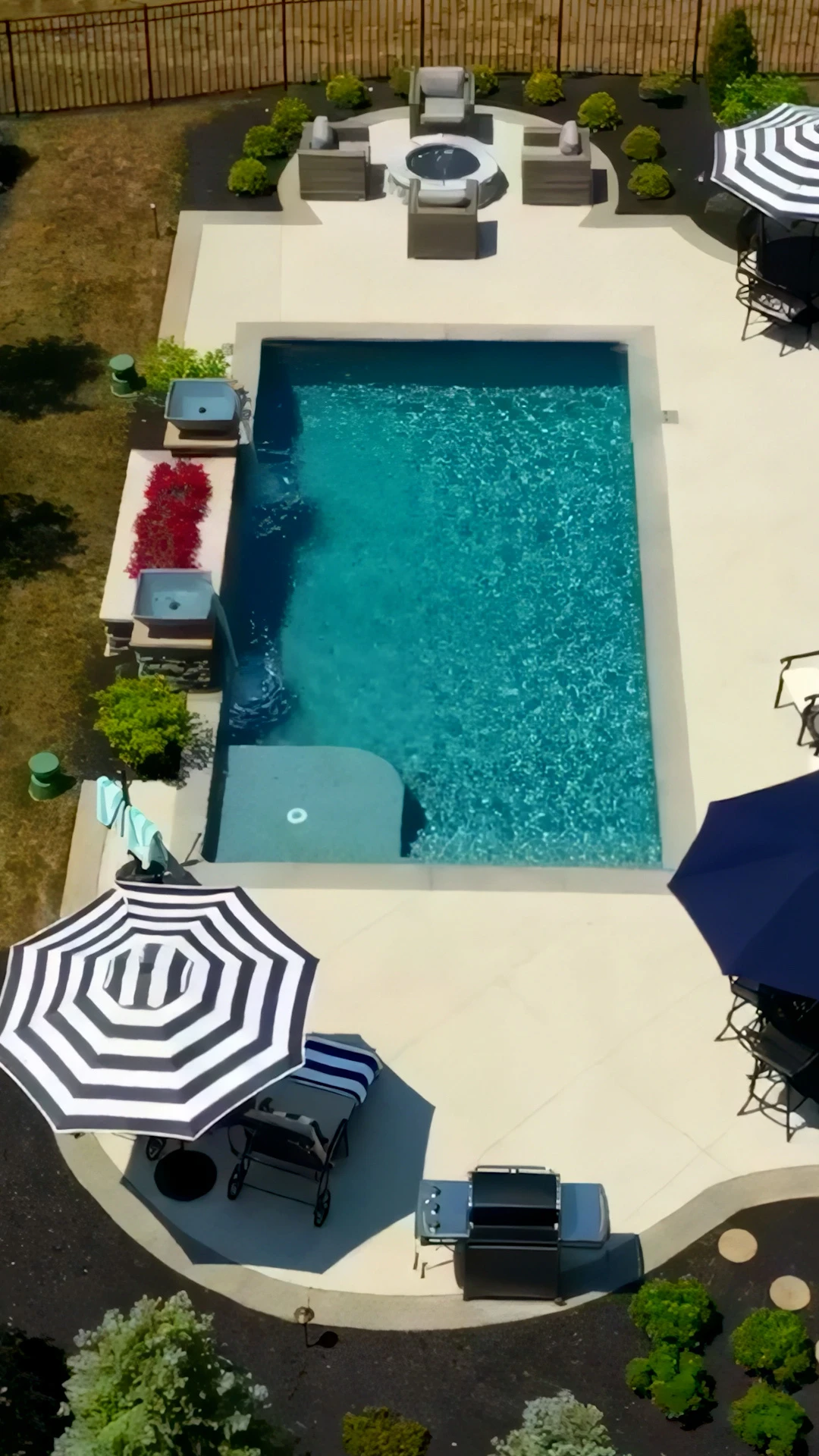
The 22×46 Freeform: Why This Specific Shape Works on Open Land
A 22×46 freeform is not a standard dimension. It is the specific size we keep landing on for Milton estate projects because it solves three problems at once.
First, it is large enough that the pool reads as the centerpiece of the back yard rather than a feature embedded in it. Below about 18×40, a pool on a three-acre lot starts to look lost — the scale of the yard overwhelms the water. At 22×46, the water surface covers roughly 1,012 square feet, which is visually substantial at the distance a pavilion sits from the pool (typically 18 to 25 feet off the coping).
Second, a freeform shape (soft curves rather than geometric angles) reads as resort-scale rather than subdivision-scale. Rectangles and Grecian pools read as architectural — they echo the house. On a rural preservation lot in Milton, where the aesthetic cue is the pasture and the tree line, a freeform reads as landscape: a body of water shaped to the land rather than to the building. That is the Milton brief almost every time, even when the house itself is traditional.
Third, the 22 ft width gives enough lateral volume to support the three features that make these pools work — a beach entry, a sun shelf, and an integrated raised spa — without crowding the swim corridor. On an 18 ft wide pool, a sun shelf and a spa eat the swim lane. At 22 ft, you get a full-width shelf on one long side, a spa on one short side, and still 14 ft of clear swimming corridor down the middle.
The beach entry: why 18 feet is the right depth
A beach entry (also called a zero-edge or walk-in entry) is a sloped plaster transition from deck level to full pool depth. Eighteen feet of beach entry is the length we design most often because it delivers a specific experience: the first 8 feet of slope takes you to 6 inches of water, the next 6 feet takes you to 18 inches, and the final 4 feet drops to 36 inches where the main pool bottom begins. That gradient supports toddlers standing, adults sitting on loungers in the shallowest zone, and a natural swim transition — all without feeling steep. Shorter entries (10-14 ft) feel cramped; longer entries (20-24 ft) start to eat the swim area. Eighteen is the number.
The 8 ft sun shelf
The sun shelf sits at roughly 9 inches of water — deep enough for umbrellas and chaise loungers to be partially submerged, shallow enough that children and pets can stand comfortably. Eight feet of shelf width accommodates two chaise loungers side by side with a small table between, which is the standard Milton brief. Below 8 ft, you can only fit one lounger; above 10 ft, the shelf starts to compete with the beach entry for visual dominance.
Materials: What We Specify on a Milton Estate Build
Material choices on a Milton estate pool are not neutral. The wrong coping color, the wrong plaster blend, the wrong decking texture — any one of them can cheapen a $500K project. Here is what we specify most often on Milton projects, and why.
Plaster and waterline tile
For a resort-style freeform, we specify a quartz-aggregate plaster blend (Wet Edge Signature Matrix or Pebble Tec mid-grade) rather than straight white marcite. Quartz adds a slight speckle to the finish, which softens the appearance of minor staining over time and produces the deep Caribbean blue-green water color that reads as resort rather than residential. The upcharge over white plaster is roughly $4,800-$6,500 on a 22×46 pool, and it extends the finish life from 8-10 years to 12-18 years.
Waterline tile is the band of tile at the water level that takes the brunt of calcium-line abrasion. On Milton estate projects we specify 1×1 glass mosaic in a blue-green blend that matches the plaster shift, typically Oceanside Glasstile or Lightstreams. Budget $18-$35 per linear foot installed; a 22×46 freeform has roughly 140 linear feet of waterline.
Coping
For Milton estate projects, we specify travertine or bluestone coping far more often than concrete. A bullnose-edge travertine in a Silver Shell or Ivory Classic finish — 12×24 pieces, honed and filled — reads as classical estate, which is the architectural language of the homes in Crooked Creek, White Columns, and The Manor. Budget travertine at $28-$42 per square foot installed, bluestone at $34-$52.
Decking
Pool decking on a three-acre build is never a small job. A pool that size, with a pavilion 20 ft away and a fire pit 45 ft off the deck, typically requires 2,400 to 3,600 square feet of connecting hardscape. The material has to work at that scale without feeling monotonous. We specify Techo-Bloc Blu Grande, Belgard Mega-Arbel, or a full-dimensional travertine tile — always sealed, always laid on a properly compacted Class 2 road-base substrate 6-8 inches deep over drainage fabric.
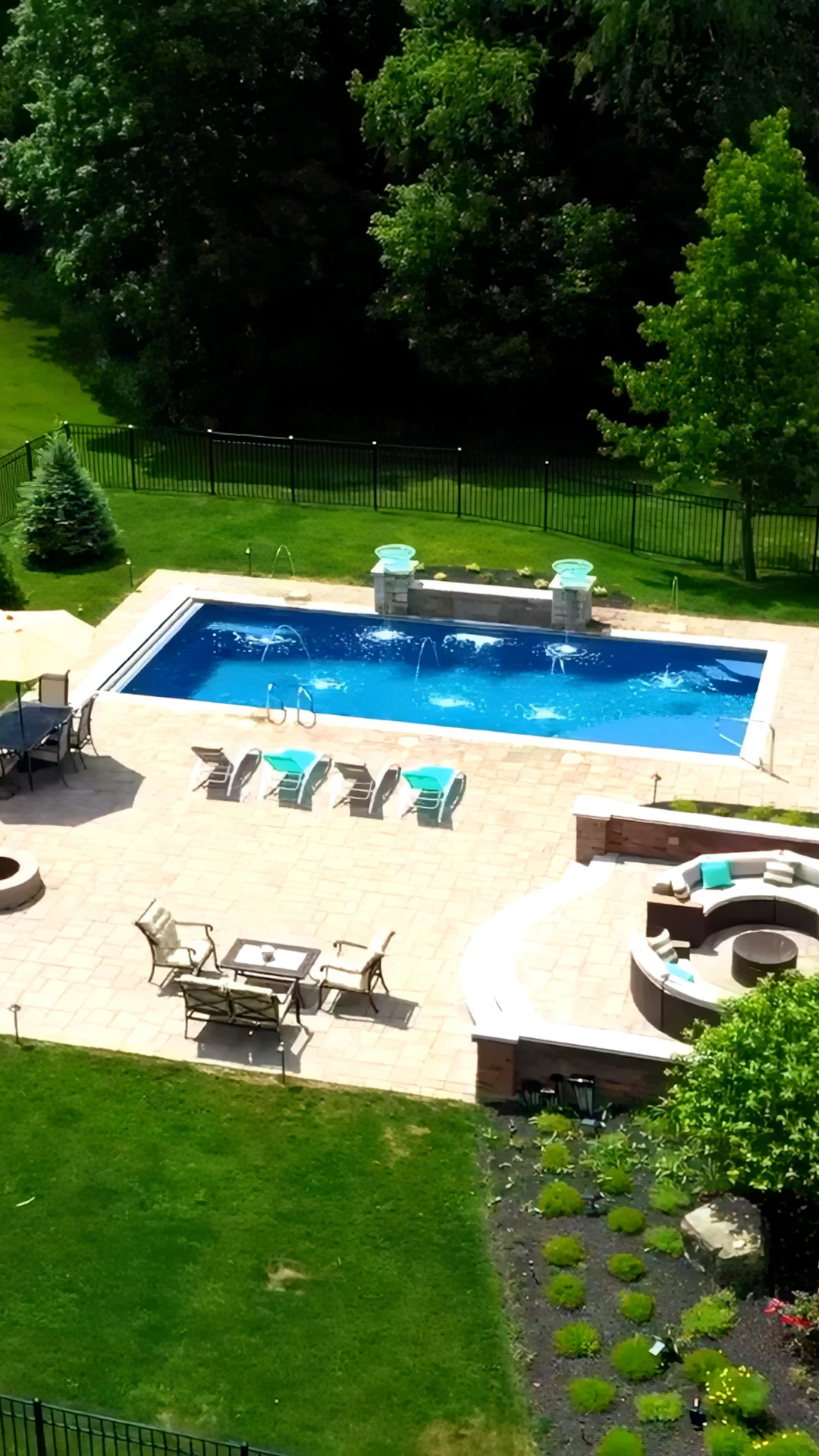
The Pavilion and Outdoor Kitchen: The Cross-Category Integration
This is the integration that makes a Milton build read as resort rather than subdivision. A 20×30 covered pavilion, sited 18-25 ft off the pool coping on the long axis, with a full outdoor kitchen underneath — it is the feature that transforms a pool project into an outdoor-living campus.
Structurally, the pavilion is a timber-frame or timber-look structure on 10×10 or 12×12 cedar or pressure-treated posts, sitting on isolated concrete footings that extend below the frost line (18-24 inches in USDA Zone 8a Milton). The roof pitch runs 6:12 or 8:12 with architectural shingles matching the main house; the ceiling is tongue-and-groove stained cedar or cypress, and we run two or three paddle fans down the centerline with recessed LED downlights on a dimmer circuit.
Underneath the pavilion sits the outdoor kitchen, and this is where the specs matter. The standard Milton outdoor-kitchen spec we quote runs:
- 36 to 42 inch built-in grill (DCS, Lynx, or Kalamazoo depending on budget) — $3,800-$12,000
- Side burner or power burner — $800-$2,400
- Built-in refrigerator, outdoor-rated — $1,800-$3,400
- Under-counter ice maker — $1,600-$2,800
- Stone or stucco-faced island with 24-30 linear feet of countertop (granite or leathered quartzite) — $4,800-$8,400 for counters, plus $3,500-$6,200 for the island base
- Dedicated 20-amp and 30-amp electrical circuits, GFCI-protected, run from the main panel — $1,200-$2,800 in electrical
- Gas line from the meter (typically a 3/4 inch line at 5-7 psi for a full kitchen) — $1,400-$3,200 in gas rough-in
The full outdoor kitchen with island, appliances, counters, and utilities typically lands between $28,000 and $58,000 installed, on top of the $65,000-$105,000 pavilion structure itself.
Pavilion siting rule of thumb: Set the pavilion 18-25 ft off the pool coping on the long axis (the side parallel to the pool’s longest dimension). Closer than 18 ft, the pavilion visually crowds the pool. Beyond 25 ft, the conversation between the two features breaks. This is true regardless of lot size.
Permits, Reviews, and the Milton Community Development Timeline
Milton incorporated as a separate city in 2006, and one of the practical consequences is that residential pool permits here go through City of Milton Community Development at 2006 Heritage Walk, not through unincorporated Fulton County. This matters for three reasons.
First, the turnaround is faster. A typical residential pool permit in Milton runs 10-14 business days from complete submittal to issued permit, compared to 18-28 business days in unincorporated portions of Fulton. Milton Community Development is a smaller department with a shorter review queue, and they treat standard pool + spa + pavilion packages as routine residential — not as commercial or specialty review.
Second, the review is stricter on preservation character. Milton’s equestrian-preservation zoning (AG-1) covers most estate neighborhoods, and the review will examine tree removal, impervious-surface coverage, and creek-buffer compliance closely. On an estate lot with mature hardwoods, we almost always submit a tree-save plan alongside the pool permit — and we often have to shift the pool envelope 6-12 feet to preserve a specimen tree that Milton wants kept. This is normal and expected.
Third, if the property sits in a subdivision with architectural review — The Manor Golf Club is the strictest example, with a structural review committee that meets monthly — the HOA review runs parallel to the city permit and typically adds 4-5 weeks on top of the city timeline. We submit both simultaneously on day one to compress the parallel review; we do not wait for one to finish before starting the other.
A realistic Milton estate pool timeline from signed contract to first swim:
- Design and engineering: 3-5 weeks
- Permit submittal + HOA review (parallel): 4-6 weeks
- Excavation: 1 week
- Steel, plumbing, electrical rough-in: 2 weeks
- Gunite shoot and cure: 2 weeks (14-day minimum cure)
- Tile, coping, decking: 4-6 weeks
- Pavilion framing, roofing, utilities: 6-10 weeks (often running parallel to decking)
- Outdoor kitchen install: 2-3 weeks
- Plaster, fill, startup, final inspection: 2 weeks
Total: 22 to 28 weeks from contract signature to first swim, with pavilion and outdoor-kitchen work compressing the apparent schedule because they run concurrent with decking.
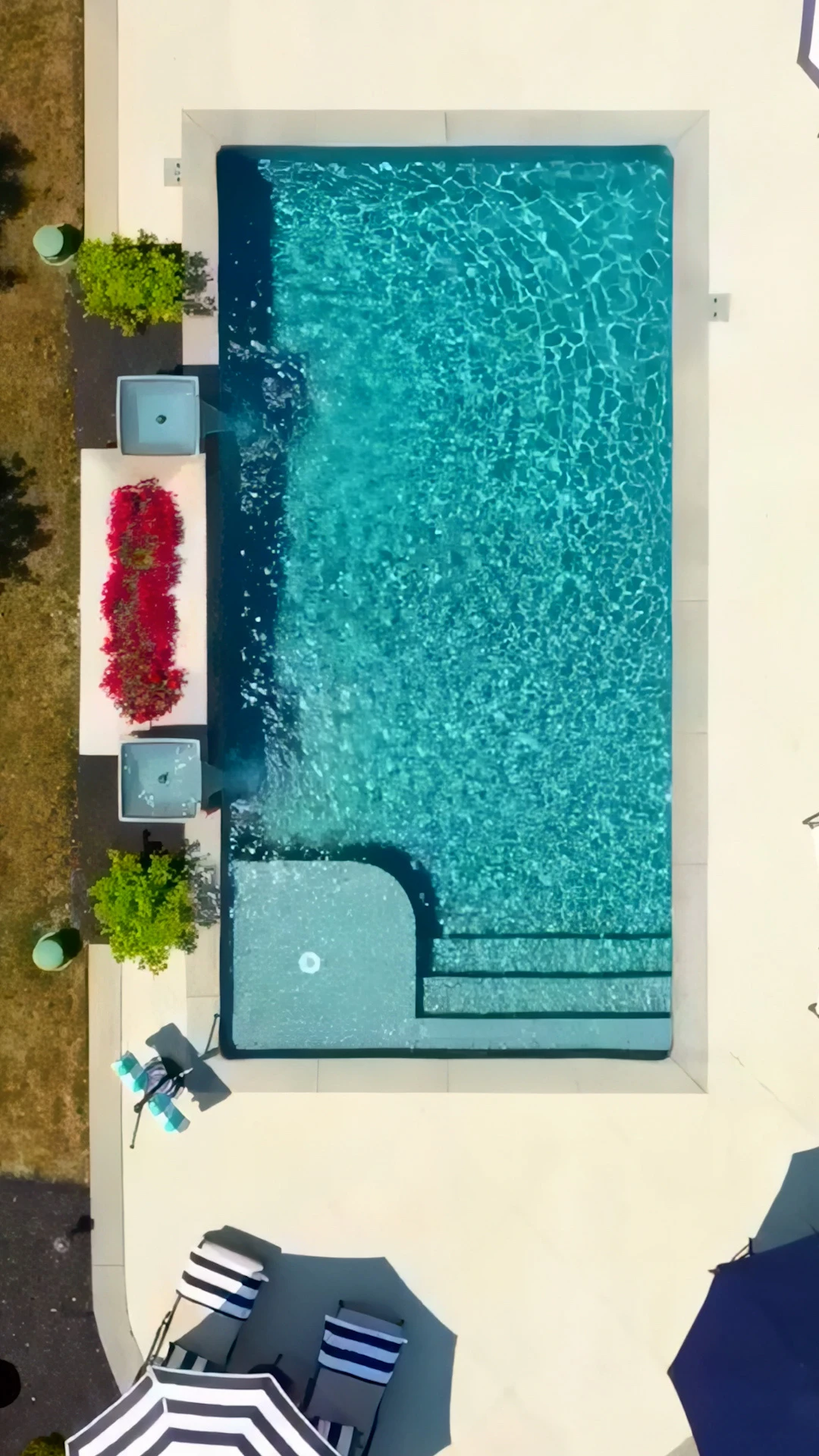
Engineering the Raised Spa and Spillover
The integrated raised spa is, in our experience, the feature that separates a well-designed Milton pool from an average one. It is also the feature most often specified wrong by builders unfamiliar with the details.
A raised spa is a 7×7 ft square or octagon (we slightly prefer octagon for resort-style freeforms — it echoes the pool’s curves rather than fighting them) raised 18 inches above the main pool deck. It sits on its own gunite shell with a shared plumbing vault, heated independently by a dedicated natural-gas or propane heater (Raypak or Pentair MasterTemp 400 is the typical spec for this size), and it spills into the pool over a weir — a straight-edge or sheet-flow spillover that drops water into the pool at a controlled rate.
Two engineering rules matter here. The first is the weir width. For a 7×7 spa with two jets on a 2.5 HP blower, the weir should be 24 to 36 inches wide. Narrower weirs cause turbulent, fountain-like water; wider weirs produce the smooth sheet of water that defines a resort-style spillover. Second is the heater sizing. Undersized heaters (below 250K BTU) will take two hours to bring a 7×7 spa to 102 degrees on a winter afternoon; a 400K BTU heater does it in 35-45 minutes. On a project where the homeowner is spending $500K, no one wants to wait two hours for the spa.
Automation ties it together. A Pentair IntelliCenter or Jandy iQ controller runs the pool pump, spa pump, booster pump, heater, LED color-changing lights, and waterfall feature on a single touchscreen panel with a phone-app backup. On a Milton estate project, automation is not optional — the homeowner will use the phone app 90% of the time, and the control panel becomes the physical backup.
The Fire Pit, the Pergola, and the Negative Space
The final two elements — the fire pit and the pergola-covered dining terrace — are what close the resort-style campus. Neither is expensive relative to the pool, but both are critical to the finished experience.
The fire pit sits 35 to 50 feet off the pool deck, which is far enough that the smoke does not blow across the pool on an evening breeze but close enough that the fire reads as part of the same outdoor room. We build it as a circular or square gas-fed pit (natural gas preferred on Milton estate lots with existing gas service — propane-tank-fed is fine but more maintenance) with a surrounding paver-bounded seat wall at seating height (18 inches). A standard fire-pit build lands around $12,000-$22,000 all-in.
The pergola sits between the pavilion and the house, typically over a dining table, and its job is to soften the transition from enclosed structure to open deck. Cedar or aluminum (the Struxure motorized-louver pergolas are increasingly the premium spec on high-end Milton builds at $18,000-$38,000), 10×14 or 12×16 footprint, with string lights and optional infrared heaters for three-season use.
The negative space between these elements — the expanses of paver or travertine that separate the pool from the pavilion from the fire pit from the pergola — is where most design goes wrong. Too tight, and the campus reads as cramped. Too loose, and it reads as disconnected. The spacing rule we follow: every functional element should be visible from every other element, with no wall or planting screen between them. If you can stand at the fire pit and see the pool, the pavilion, and the pergola simultaneously, the site plan is working.
What This Looks Like One Year Later
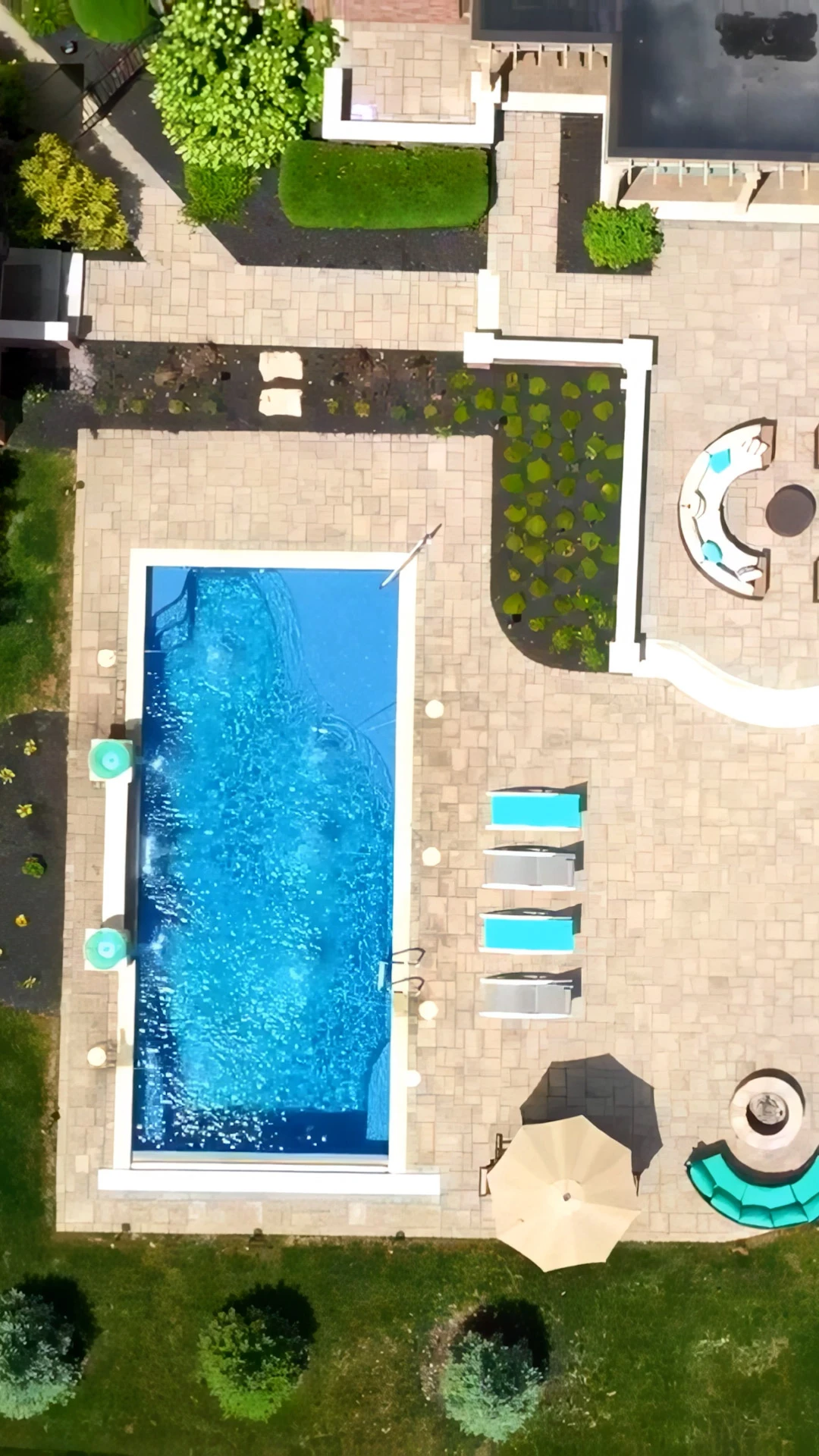
The point of designing an estate pool as a single cross-category build is that after the final inspection, the back yard does not look like a pool with add-ons. It looks like one place. The plaster cures in for 28 days, the travertine darkens slightly with sealer, the cedar on the pavilion weathers to a soft gray, and by the first spring after completion the landscape plantings have filled in the transitions between deck and lawn.
The families we build for in Crooked Creek, The Manor, White Columns, Cogburn Estates, and Hopewell Plantation use these pools differently than subdivision pools get used. They are hosting. They are grilling on weeknights under the pavilion while the kids are in the beach entry. They are running the spa at 102 on a 45-degree December evening while a fire burns in the pit 40 feet away. The pool is not a summer amenity; it is a four-season outdoor room, because the cross-category integration makes it one.
And the pool itself — the 22×46 freeform with the 8 ft sun shelf and the 18 ft beach entry and the raised octagonal spa — is the anchor of that room. It is what everything else is built around, not what everything else is built next to. That distinction is the design brief of every Milton estate build we take on, and it is why the pool on a three-acre Milton lot never ends at the coping.
Custom Pool Construction across 20+ cities within 30 miles of Winder, GA
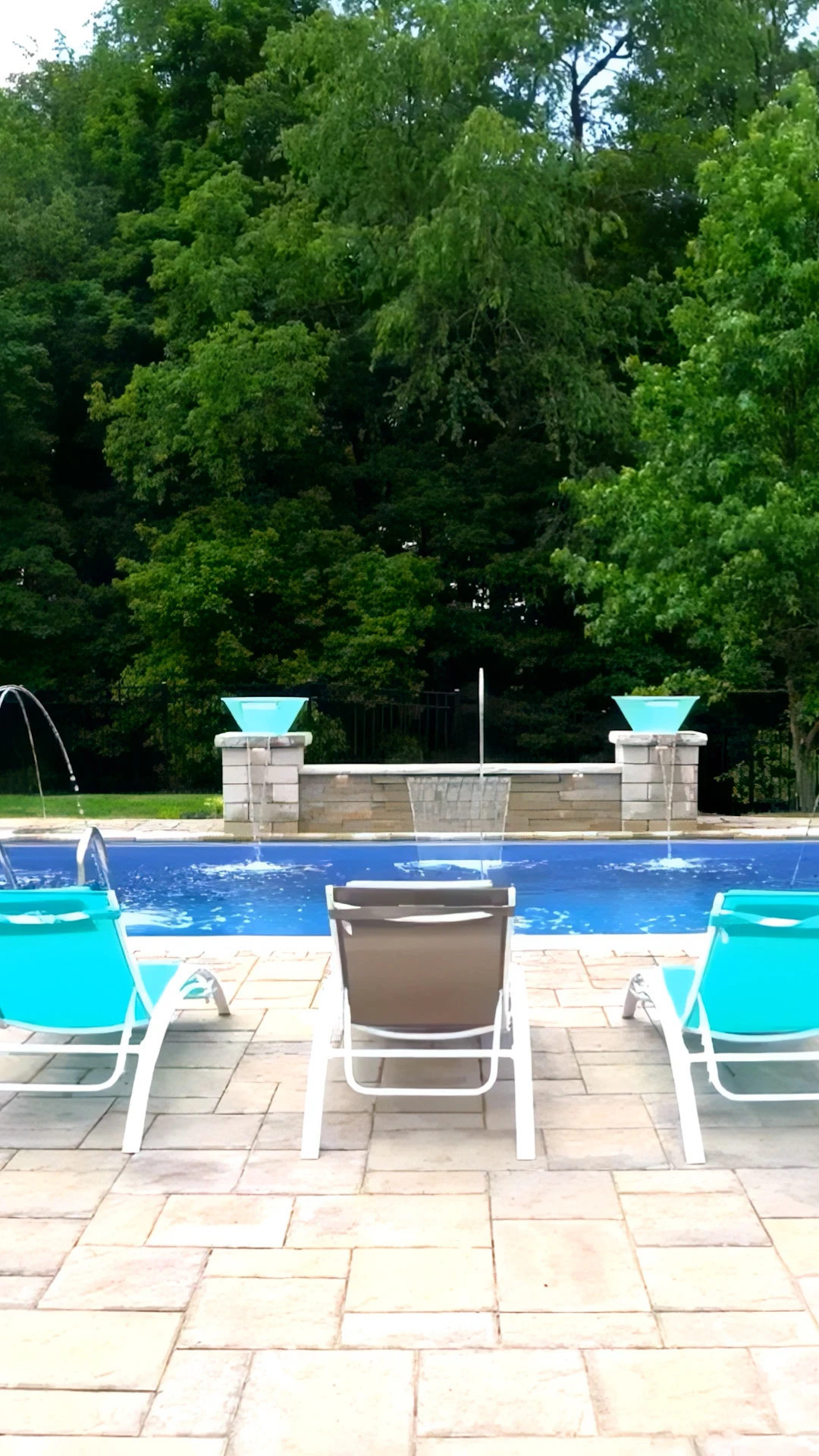
From Milton estate builds on 3-acre preservation lots to subdivision pools in Snellville, we design resort-style integrations that treat the pool, pavilion, and outdoor kitchen as one project from day one.