
By year nine, the patio you paid $16 a square foot for in a Cumming subdivision starts telling on itself — a dip under the grill corner, hairline lift along the soldier course, polymeric sand washing out after every thunderstorm. The pavers didn’t fail. The base spec did, because it was written for Atlanta, not for Forsyth County Cecil clay.
Cumming sits on a pocket of Piedmont geology that behaves differently than Decatur, differently than Marietta, and differently than the flatter red clay further south. The county is built on Cecil series clay, a hard-packed high-density soil that shrinks tight in August and swells wet in March. Drop Lake Lanier onto the eastern edge of that map and the annual humidity load pushes freeze-thaw events harder than textbook numbers suggest. The standard metro-Atlanta paver patio spec — 4 to 6 inches of crushed aggregate, 1 inch of bedding sand, polymeric joints — runs out of runway at year ten to twelve. Every installer in Forsyth County knows it. Most won’t tell you, because the fix costs more than the bid they want to win.
This piece walks through the 30-year Cumming spec we build for clients in neighborhoods like St. Marlo, Hampton Park, and Vickery — the exact base math, the exact layer count, and the exact reason a 600-square-foot patio at $16,800 outlives a 600-square-foot patio at $9,800 by almost two decades. Numbers named. Brands named. No hedging.
1. The Failure Pattern You See at Year 8–10 in Forsyth County
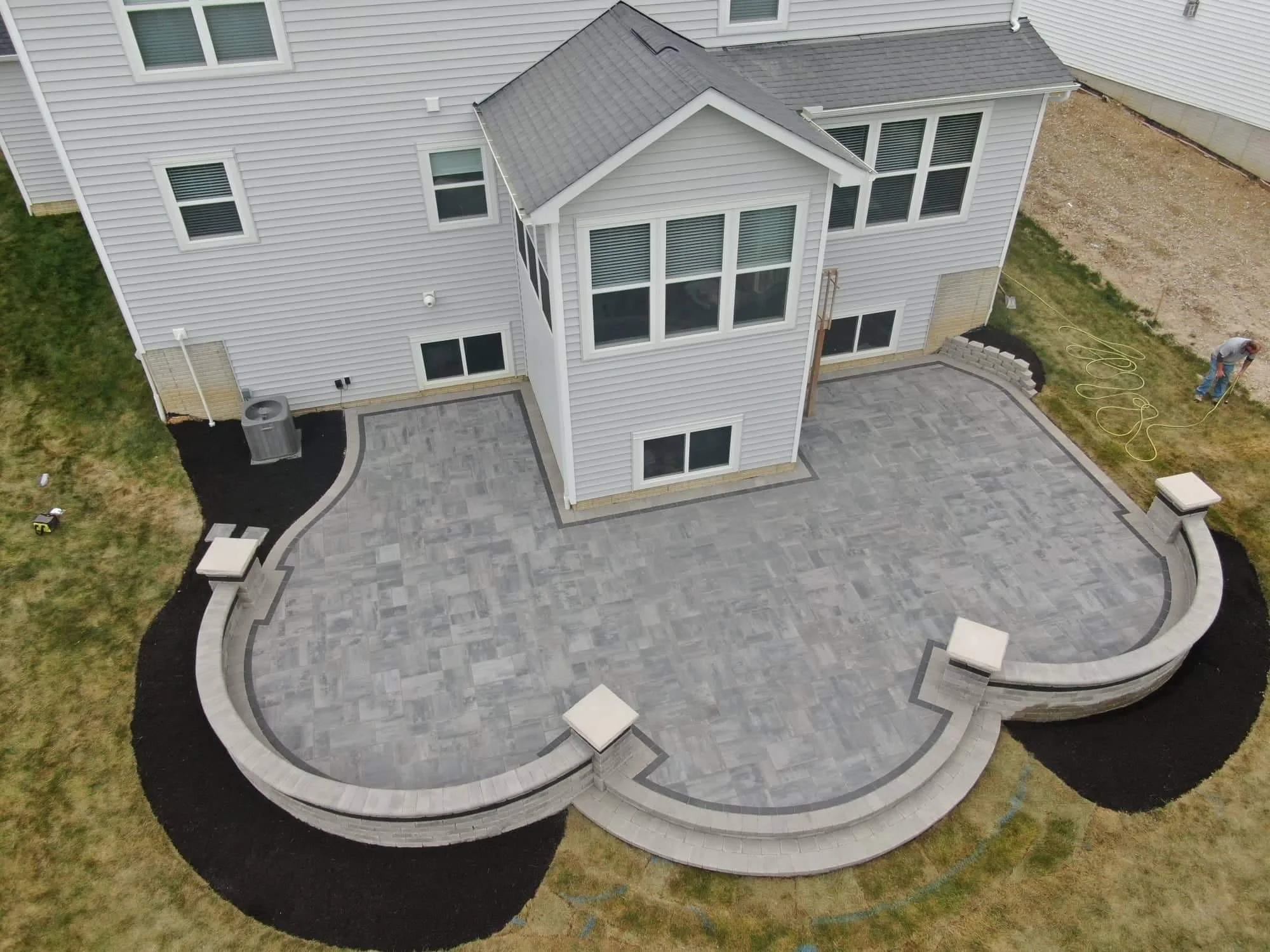
Before the spec makes sense, the failure mode has to. On a typical Cumming subdivision patio built to standard Atlanta practice — 4 inches of GAB crushed stone, 1 inch of concrete sand, polymeric joints, no edge restraint under the soldier — the story plays out in three stages.
Stage one, years one through six, the patio reads flawless. Pavers are tight, joints hold, water sheds. Stage two, years seven and eight, you start noticing surface deflection under heavy point loads — the grill corner, the table legs, wherever a homeowner repeatedly loads the same square foot. Stage three, years nine through twelve, the soldier course begins rotating outward one or two degrees, joint sand flushes during heavy rain, and differential heaving shows up along any seam that runs parallel to the house.
The cause is not workmanship. The cause is that Cecil clay in Forsyth County moves more vertically per freeze-thaw cycle than the base layer was designed to absorb. USDA Zone 8a gives Cumming roughly 22 freeze events per year, and Lake Lanier proximity adds moisture saturation that a drier Atlanta subdivision simply doesn’t see. The base doesn’t settle — the soil underneath it pistons.
2. Step One — Read the Lot Before You Price the Job
Every patio we spec in Cumming starts with a soils read and a grade read, not a sketch. A sharp-shooter shovel and a two-foot probe tell you in fifteen minutes whether you’re standing on Cecil clay, Appling sandy loam (more common in older farm parcels around Bethelview Rd and Post Rd), or fill dirt from the original subdivision grading. The three soils behave so differently that assigning the same base spec across all of them is how ten-year patios get built by accident.
The grade read matters more in Cumming than in flatter counties. Forsyth topography is gently rolling foothills — Sawnee Mountain at 1,963 ft anchors the northwest corner, and many backyards have a 3 to 8 ft grade drop toward South Forsyth drainage tributaries. If your patio is going in on the downhill half of a lot in Polo Fields or Mashburn Plantation, the base is carrying water movement as well as load. That’s a different engineering problem than a flat pad in The Collection at Forsyth.
What we measure on the lot visit:
- Soil type and depth to undisturbed subgrade (target: at least 12 inches below finish grade)
- Percolation — a half-gallon water test in a 6-inch auger hole, timed to empty
- Slope from house outward (minimum 1/8″ per foot, ideally 1/4″ per foot for Cumming humidity)
- Downspout and gutter discharge paths within 10 ft of the planned patio footprint
- Existing root mass — mature oak and pine within 15 ft adds a frost-heave wildcard
Cumming permit note: Paver patios under 400 sqft and under 30 inches of finish height typically don’t require a permit through Forsyth County Dept. of Planning & Community Development at 110 E. Main St. Anything taller, structural, or attached to the home may. HOA architectural review in St. Marlo, Polo Fields, and similar communities runs 2–3 weeks on average — build it into your timeline.
3. Step Two — The 8-Inch Base, and Why 4 Isn’t Enough
Standard Atlanta-metro paver spec calls for 4 inches of compacted crushed aggregate base. That works on stable, well-draining subsoil. Forsyth Cecil clay is neither. The 30-year Cumming spec starts at 8 inches of compacted GAB — roughly double — installed in two lifts of 4 inches each, compacted with a plate compactor rated at 5,000 lbf minimum, ideally a reversible plate for the second lift.
The math is not arbitrary. A 4-inch base against Cecil clay has roughly 1.5 times the soil’s own expansion coefficient to absorb per freeze cycle. An 8-inch base roughly triples that buffer. Over 22 freeze events per year times 30 years — 660 freeze-thaw cycles — the compounded vertical movement on a 4-inch base exceeds the joint tolerance of most modular pavers. On an 8-inch base, it doesn’t.
Aggregate selection matters as much as depth. We use GAB #57 washed stone for the lower lift — angular, self-locking, draining — then #89 screenings for the upper lift to set a tighter compaction plane. Pea gravel and river rock don’t lock under compaction and will not meet the 30-year spec no matter how deep you bury them.
4. Step Three — The Geogrid Middle Lift (The Move Most Installers Skip)
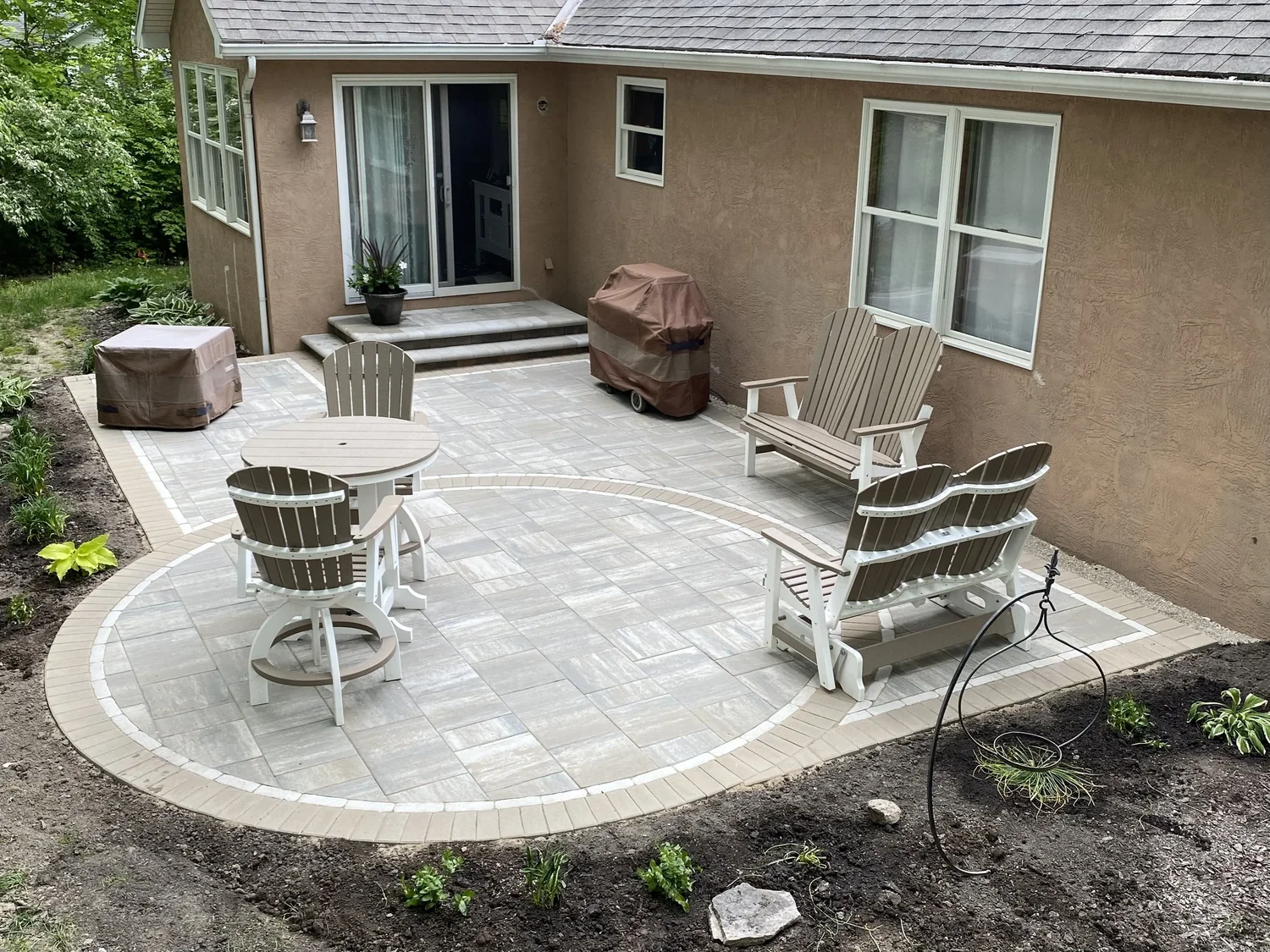
This is the layer that separates a 12-year Cumming patio from a 30-year one, and it’s the cheapest insurance in the entire build. Between the two compacted base lifts, we roll in a woven biaxial geogrid — typically Tensar BX1100 or a comparable Mirafi product — cut to the patio footprint with 12-inch overlap at any seam.
What it does: geogrid distributes point loads horizontally across the base rather than letting them punch downward into the clay. A 200-lb grill leg on a standard 4-inch base transmits roughly 90% of its load to a 4-inch-diameter circle of subgrade directly beneath it. The same grill on an 8-inch base with a mid-lift geogrid spreads that load across a 24-inch circle. Over three decades of concentrated point loading — grills, fire pits, table legs, pallet deliveries — the difference is the difference between a patio that reads flat at year 25 and a patio with two-inch depressions at year 12.
Cost on a 600-sqft patio: about $340 in material plus half a day of labor. Call it $600 all in. On a $16,800 total build that’s under 4% of the price — and it’s the single highest-leverage dollar in the spec.
5. Step Four — Bedding Sand, Pavers, and Why We Spec Thicker Than Manufacturer Minimum
Manufacturer minimum for bedding sand under modular pavers is typically 1 inch screeded flat. For the 30-year Cumming spec we screed at 1.25 inches of ASTM C33 concrete sand — not mason sand, not stone dust. The extra quarter-inch lives as a sacrificial buffer for the tiny seasonal pistoning Cecil clay will still transmit through the geogrid-reinforced base, and it preserves paver seating tolerances well past the point where a 1-inch bed would have compacted flat.
On paver choice, this is where Cumming clients usually over-specify or under-specify. The three we install most often in Forsyth County:
- Techo-Bloc Blu Grande in Shale Grey or Greyed Nickel — large-format 16×24, best for modern subdivisions like Vickery and The Collection at Forsyth. Cost: $5.80–$6.40/sqft material.
- Belgard Mega-Lafitt in Victorian or Bavarian Blend — three-piece modular, reads traditional, pairs with brick homes in Hampton Park and older Windermere sections. Material cost: $4.90–$5.40/sqft.
- Belgard Holland Stone tumbled in chestnut tones — smaller brick format, budget-conscious, shown on many St. Marlo back patios attached to red-brick traditionals. Cost: $3.60–$4.10/sqft.
All three hold the 30-year spec if the base math underneath them is right. None of them hold it on a 4-inch base.
6. Step Five — The Flexible Mortar Soldier Course (The Cumming-Specific Edge)
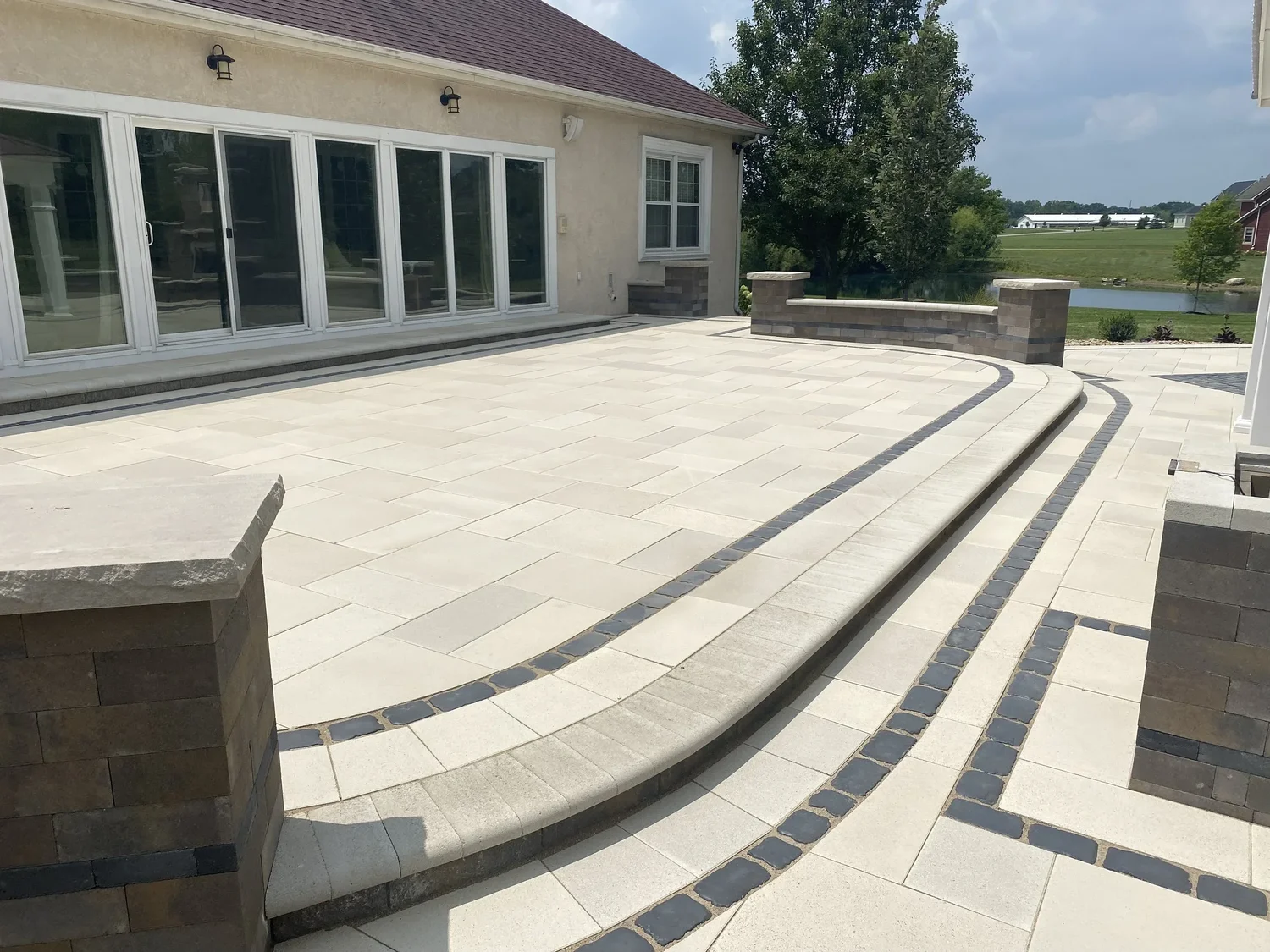
Standard practice for a paver perimeter is a plastic or composite edge restraint (Snap-Edge, Permaloc) spiked into the base at 12-inch intervals. For most of the metro area that’s sufficient. In Cumming, it’s the second most common failure point we see on ten-year patios — the spikes loosen as the clay cycles, the restraint rotates outward, the soldier pavers follow.
The 30-year spec swaps spiked restraint for a flexible polymer-modified mortar bed under the soldier course only — roughly 2 inches deep, 8 inches wide, running the full perimeter. We use a Laticrete or Mapei polymer-modified mix that cures to a flexural rather than rigid state. The soldier pavers set into that bed while it’s wet, and the cured mortar resists freeze-thaw rotation far better than a plastic L-channel spiked into clay.
It adds roughly $2.20 per linear foot to the perimeter, which on a 600-sqft rectangular patio (about 100 ft of perimeter) is $220. Over 30 years it eliminates the single most visible aging symptom on Cumming paver patios: the soldier course “opening up” along the long edge.
7. Step Six — Polymeric Joints, and the Annual Spring Check
Polymeric sand is the joint filler that activates with water and cures into a flexible solid. The common options in metro Atlanta are SEK Pave-Tech EnviroSEAL, Alliance Gator Super Sand, and Techniseal HP NextGel. All three meet the 30-year spec if installed correctly on a dry day, swept at 2/3 joint depth, misted lightly three times at 10-minute intervals, and allowed to cure at least 24 hours before rainfall or pressure washing.
The part nobody tells Cumming homeowners: polymeric sand is a maintenance item, not a set-and-forget material. Lake Lanier humidity drives more moisture cycling through the joints than drier counties see. Every spring — ideally late March, once the last hard freeze has passed — walk the patio, look for any joint that’s visibly dropped below the paver surface or washed out, and top-dress with fresh polymeric. It’s a 90-minute job and a $38 bag of product. Skip it five years in a row and the base starts drying unevenly, which compromises the geometry you paid for.
We offer this as a service at $180 per visit for any Cumming patio we’ve installed — not because the margin is meaningful, but because the 30-year spec assumes the maintenance happens. If you’d rather DIY it, the technique is the same as the original install: broadcast dry, sweep into joints, mist lightly, walk away.
8. The Worked Example — 600 sqft in Hampton Park, Priced Both Ways
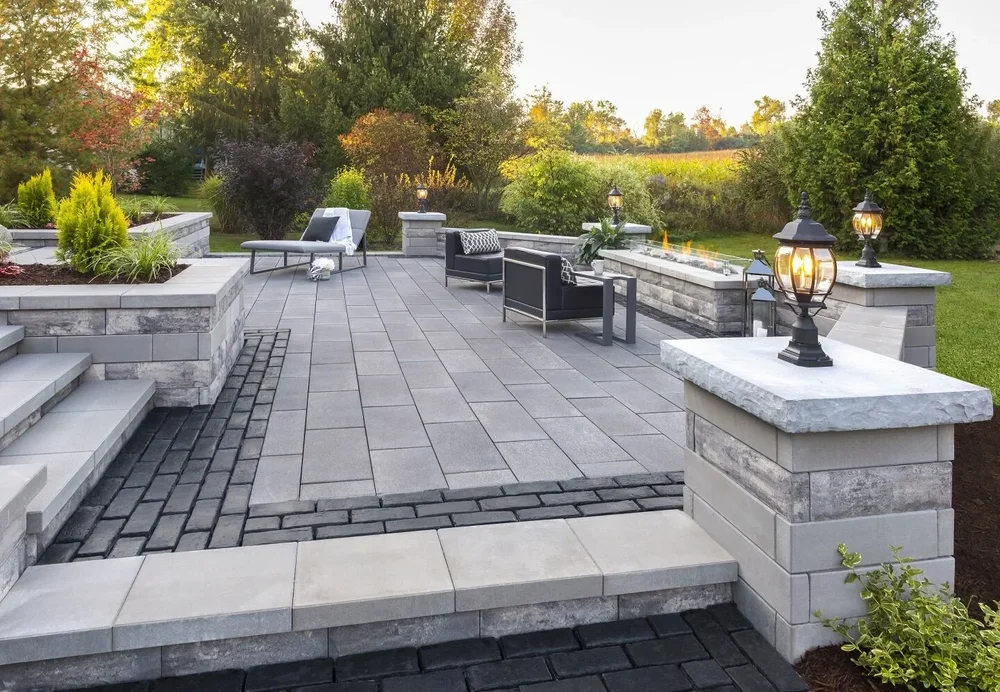
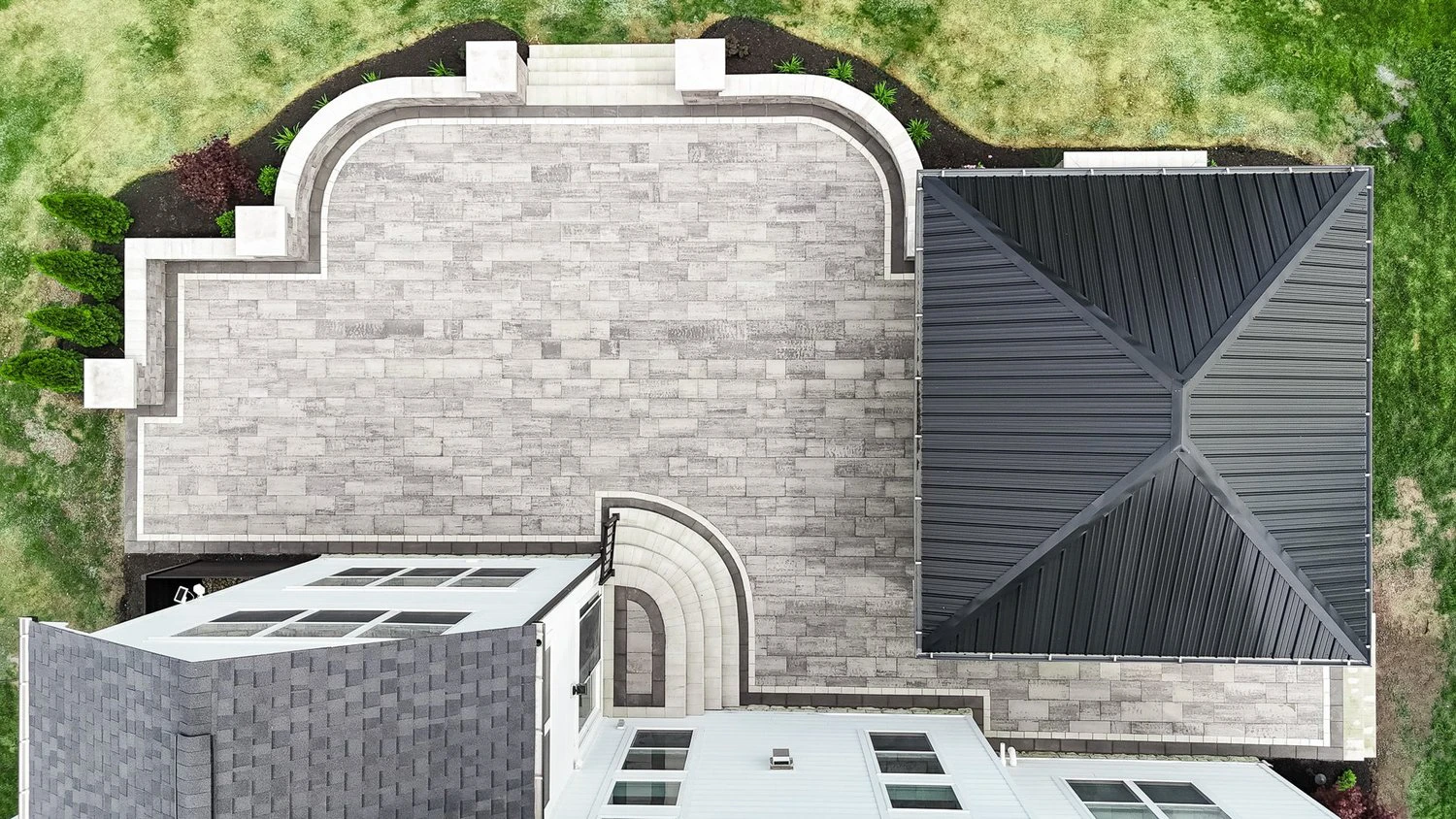
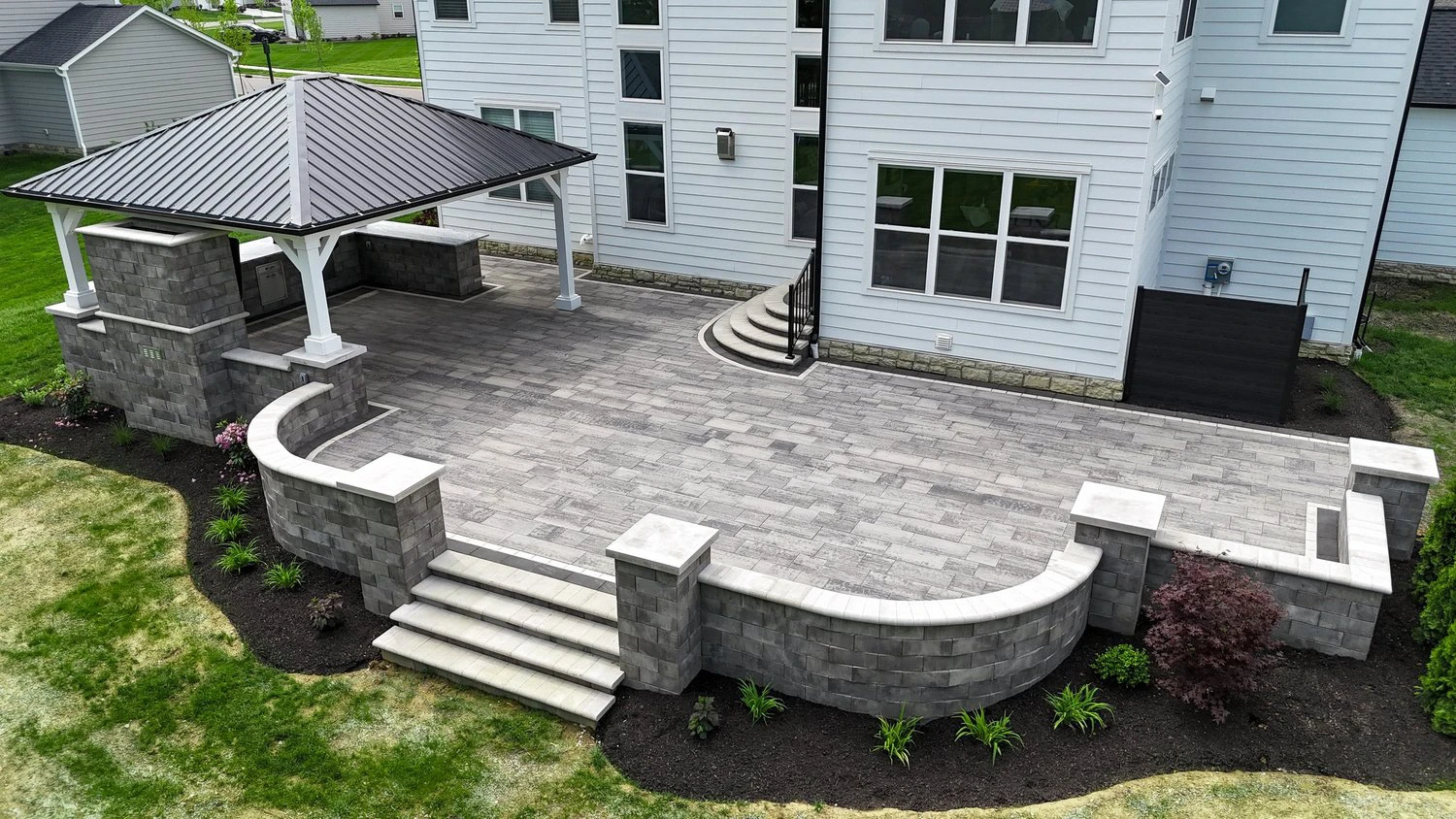
Numbers make the argument faster than adjectives. Here’s a 600-sqft rectangular paver patio, Techo-Bloc Blu Grande in Shale Grey, attached to the back of a two-story brick traditional in Hampton Park off McFarland Pkwy. Same footprint. Same pavers. Two base specs.
Standard Atlanta-metro spec (12-year design life)
- Excavation and haul-off: $1,400
- 4″ GAB base, single lift: $1,800
- 1″ concrete sand bed: $420
- Pavers (600 sqft @ $6.00): $3,600
- Plastic edge restraint + spikes: $280
- Polymeric joints: $320
- Install labor: $1,980
- Total: ~$9,800
30-year Cumming spec
- Excavation and haul-off (deeper): $1,800
- 8″ GAB base, two lifts: $3,400
- Tensar BX1100 geogrid mid-lift: $340
- 1.25″ concrete sand bed: $520
- Pavers (600 sqft @ $6.00): $3,600
- Flexible polymer-modified mortar soldier bed (100 lf): $1,100
- Polymeric joints, premium grade: $440
- Install labor (heavier scope): $3,600
- First-year spring polymeric check included: $0
- Total: ~$16,800
Net delta: $7,000 upfront for an additional 18 years of design life. Amortize the standard patio’s replacement cost at year 12 — demolition, haul-off, re-excavation, rebuild at inflated pricing, the second round of HOA review in St. Marlo or Polo Fields — and the 30-year spec saves roughly $18,000 in real terms over three decades. That’s before counting the value of not tearing up a mature landscape twice.
One detail worth naming. The 30-year spec includes a second under-the-surface cost most bids never show: the Sawnee EMC 240V service stub for future lighting, heater, or pergola fan loads. If your patio plan has any chance of hosting a pergola with ceiling fans, a permanent grill station, or low-voltage landscape lighting inside five years, pulling the conduit under the base during excavation costs $280. Pulling it after the patio is in costs $2,400 and a weekend of jackhammering. We spec it in by default on any Cumming build over 400 sqft.
A last note on warranty language. Any installer quoting a Cumming patio with a “lifetime warranty” line should be asked in writing: whose lifetime, which failure modes, and what’s the remedy. Most metro-Atlanta paver warranties exclude “normal settling,” which covers the exact failure pattern we’ve just spent 3,000 words diagnosing. The 30-year spec we build at Primetime Pools GA carries a 10-year workmanship warranty on the base assembly itself — meaning if the soldier course rotates, the joints wash, or the field deflects beyond a quarter-inch, we rebuild the affected zone at no charge. That warranty is possible only because of the base math above. On a 4-inch base, nobody writes that paper.
Thirty years is a long horizon to underwrite on anything outdoors in Georgia. The reason we can underwrite it in Cumming specifically — and not, say, on coastal sand or North Georgia mountain rock — is that Cecil clay, humidity from Lake Lanier, and Zone 8a freeze cycling are a known problem set. Solved, on paper, decades ago. The engineering isn’t secret. It’s just more expensive than the low bid, and most installers in Forsyth County have made the business decision to compete on price instead of on physics. The homeowners who want their patio to outlast their kids’ childhood end up here eventually. This is the spec they get.
30-Year Paver Patio Builds Across 20+ Cities Within 30 Miles of Winder, GA
Cecil clay, Lake Lanier humidity, and Zone 8a freeze cycling get the 8-inch base, the geogrid, and the flexible mortar soldier course. Every Cumming build. Every Forsyth County subdivision. No shortcuts.