
A quality LED pool fixture runs 60,000+ hours — roughly 23 years on a typical 7-hour-a-night estate schedule. A halogen at the same run time dies inside 10 months. On a full Alpharetta property, that single math problem rewrites the entire lighting budget.
When a homeowner in Country Club of the South or Hutchinson Farm asks what $22,000 actually buys in lighting, the honest answer is: a resort. Not a “nice backyard.” A resort. Three submerged pool LEDs that shift through a full color spectrum, four bubbler accents washing the tanning ledge, fourteen in-grade uplights carving the coping line into the night, twenty-two uplights pushed into the canopy of fourteen specimen trees, twenty-eight path lights walking the grade from pool deck down to fire pit, and one unified controller that runs all of it from an iPad on the kitchen counter.
That $22K figure isn’t a retail list. It’s the real, installed, permitted, commissioned delivered-price on a mid-to-upper Alpharetta estate — the kind of project that lands in the $1.4M–$3.5M home values along the GA-400 corridor between Windward Parkway and Old Milton. This post walks the entire package fixture by fixture, explains why LED beat halogen on a $32K–$48K lifetime-cost basis, and shows how the Alpharetta Community Development permit office and the Country Club of the South ARB both fit into a realistic 3–4 week pre-construction timeline.
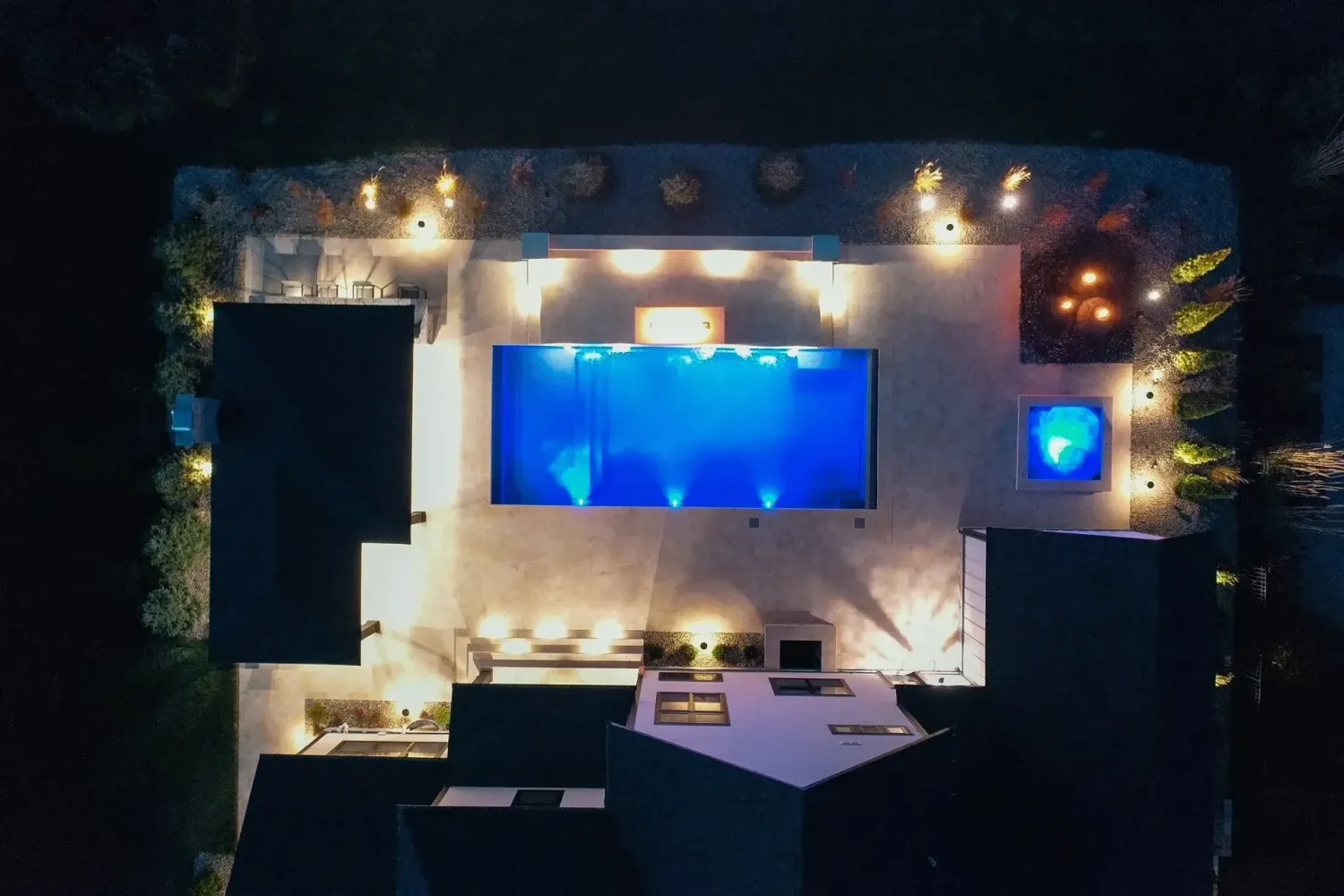
The $22K Package, Fixture by Fixture
The first thing to understand about a resort-grade Alpharetta lighting build is that the budget doesn’t break down the way most homeowners assume. Pool lights aren’t the biggest line item. Landscape uplights are. And the controller — the brain that actually makes all of this feel cinematic instead of random — is almost always under-spec’d in builder-grade bids. Here’s the real allocation on the $22,000 package we’re describing:
- 3 submerged pool LEDs — Pentair IntelliBrite 5G Treo, color-spectrum with 8 preset shows. Wall-niche mounted, 12V, roughly $780 each fixture plus conduit and transformer share.
- 4 bubbler accent LEDs — integrated in the tanning-ledge bubblers and sun-shelf deck jets. Small footprint, enormous visual payoff after dark.
- 14 in-grade deck uplights — FX Luminaire Zonda, brass body, buried flush to the coping stone. These carve the pool perimeter into the night and make the water edge read from across the yard.
- 22 landscape uplights — FX Luminaire Nox or Vernal, 3–7W LED modules, aimed into the canopy of 14 specimen trees. Japanese maples get narrow 30° beams; oak and hickory get wider 60°.
- 28 path lights across 2 runs — typical FX Luminaire PR or Pebble series, 22″ above grade, spaced 8–10 feet on center down the pool-to-firepit walk.
- Unified control — Pentair IntelliCenter for the pool equipment + pool LEDs, integrated via contact closure or Lutron RadioRA 2 for the landscape zones. Eight scene presets: Dinner, Swim, Party, Movie, Late Night, Security, Holiday, Off.
Everything is 12V low-voltage on the landscape side with dedicated transformers sized at 80% of rated load, plus a 120V GFCI-protected dedicated circuit for the pool-light niches. The deck uplights and pool LEDs both flow through the IntelliCenter so the homeowner tells Alexa “Swim scene” and the pool brightens, the deck uplights come on at 40%, and the path lights run at 60% — one command, one coordinated picture.
Budget split on the $22K package: ~$4,800 in pool-side LED fixtures + niches + transformer share; ~$11,400 in landscape fixtures (uplights + path lights + in-grade); ~$2,200 in controller and network integration; ~$3,600 in trenching, conduit, wire (typically 12-gauge direct burial), commissioning, and aiming. Permit fees through City of Alpharetta Community Development at 2 Park Plaza typically run $85–$240 for the electrical permit on a lighting-only scope.
Why LED Won This Conversation 15 Years Ago — and Why Halogen Still Shows Up in Bids
A halogen landscape bulb is rated for roughly 2,000 hours. Run that bulb 7 hours a night, 365 nights a year — which is exactly what happens on an Alpharetta estate with an IntelliCenter schedule — and it dies in about 10 months. A homeowner with 36 halogen fixtures in a full landscape package is replacing, on average, 3 bulbs a month forever. At $14–$22 a lamp plus $120 a service call for the ones that need a ladder or a tool, that’s $4,200–$6,800 a year in maintenance.
Over 25 years — the realistic lifespan of a well-built Alpharetta estate landscape — that halogen maintenance bill compounds to somewhere between $95,000 and $155,000. Energy cost adds another $18,000–$28,000 depending on Georgia Power’s schedule. An LED-equivalent package in the same 25-year window costs $0 in bulb replacement (the fixtures outlive the warranty on the house) and $6,200–$9,800 in energy. That gap — $32K to $48K saved over the property’s lifetime — is the number we put in front of every Alpharetta homeowner who thinks “LED costs too much up front.”
Halogen still shows up in bids for two reasons. First, the fixture itself is $40 cheaper. Second, some builders haven’t updated their spec sheets since 2012. Neither reason survives contact with a spreadsheet.
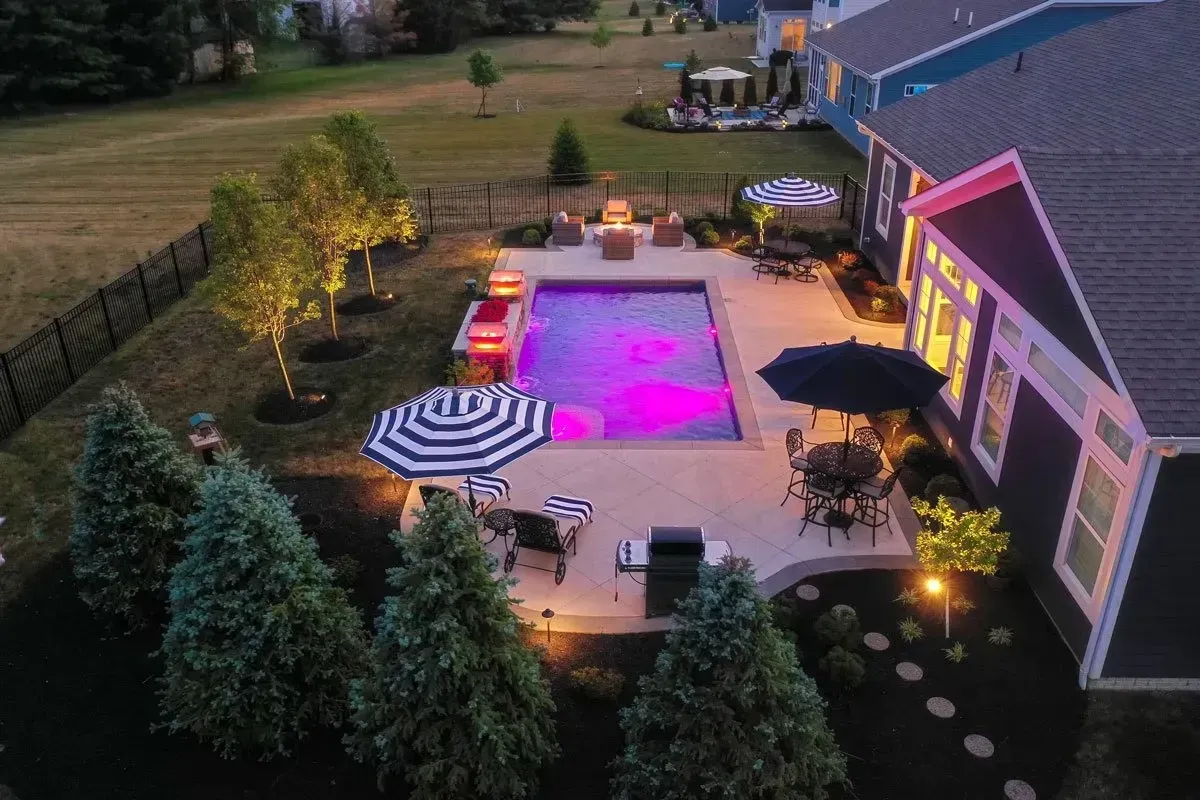
Pentair IntelliBrite 5G Treo: Why Three Is the Right Pool-Light Count on an Alpharetta Estate Build
Three submerged LEDs is the number that keeps coming back on estate-class Alpharetta pools, and the reason is geometry. A typical custom pool in Windward or Country Club of the South runs 18 by 40 feet with a tanning ledge and an attached spa. Two lights under-illuminate the deep end; four is overkill and fights itself on wall reflections. Three gives you one on each long wall plus one aimed across the shallow end from the spa-side wall.
The IntelliBrite 5G Treo is the current-generation fixture for this scope. Full-spectrum RGBW (red, green, blue, white) plus a dedicated amber channel, which is the channel that separates resort-grade from builder-grade. Amber is what makes the water glow like a Four Seasons lobby instead of a Las Vegas strip club. Eight factory color shows (Party, Romance, Caribbean, American, Sunset, Royal, and two seasonal shows) plus custom programming through IntelliCenter if the homeowner wants a specific blue temperature locked in for every-night use.
Wattage on the 5G Treo is 42W on the 120V version and roughly the same effective draw on the low-voltage model. Three fixtures running 7 hours a night comes out to about 322 kWh/year. At Georgia Power’s Residential Schedule R rate, that’s $38–$44 per year to light the pool. For context: a halogen pool light package with the same visual output draws roughly 1,500 kWh/year and costs $175–$200 annually.
FX Luminaire Zonda and Nox: The Landscape Fixtures That Do the Heavy Lifting
On the landscape side, the two workhorses are the FX Luminaire Zonda (in-grade) and the FX Luminaire Nox or Vernal (tree uplight). Both are solid-brass construction, both carry a limited-lifetime warranty on the housing, and both accept FX’s ZDC (Zoning, Dimming, Color) module, which means every single fixture on the property can be individually dimmed and color-tuned from the controller.
Zonda in-grade uplights get buried flush to the deck surface — typically at the coping-to-deck transition or along the back of the pool behind the waterline. On a 1,100-ft elevation Alpharetta lot with 3–6 feet of grade change across a typical backyard, the Zonda placement matters more than on a flat lot because beam angle has to compensate for the slope. We aim most of them at 25–30° off vertical for a soft wall-wash on the stone; the two or three that light the tanning ledge go closer to 45° for more drama on the water surface.
Nox uplights do the canopy work. On a Country Club of the South estate with mature 40-foot oaks and 15-foot Japanese maples, the rule of thumb is one fixture per 8–10 feet of canopy width for oaks, one fixture per tree for Japanese maples (they’re their own sculpture). Narrow-beam optics (25° spread) on the maples; wide flood (60° spread) on the big hardwoods. Twenty-two fixtures across fourteen trees is the exact count that makes a 1-acre backyard read cinematically after dark — fewer and you get dead zones, more and the canopy starts to feel like a parking lot.
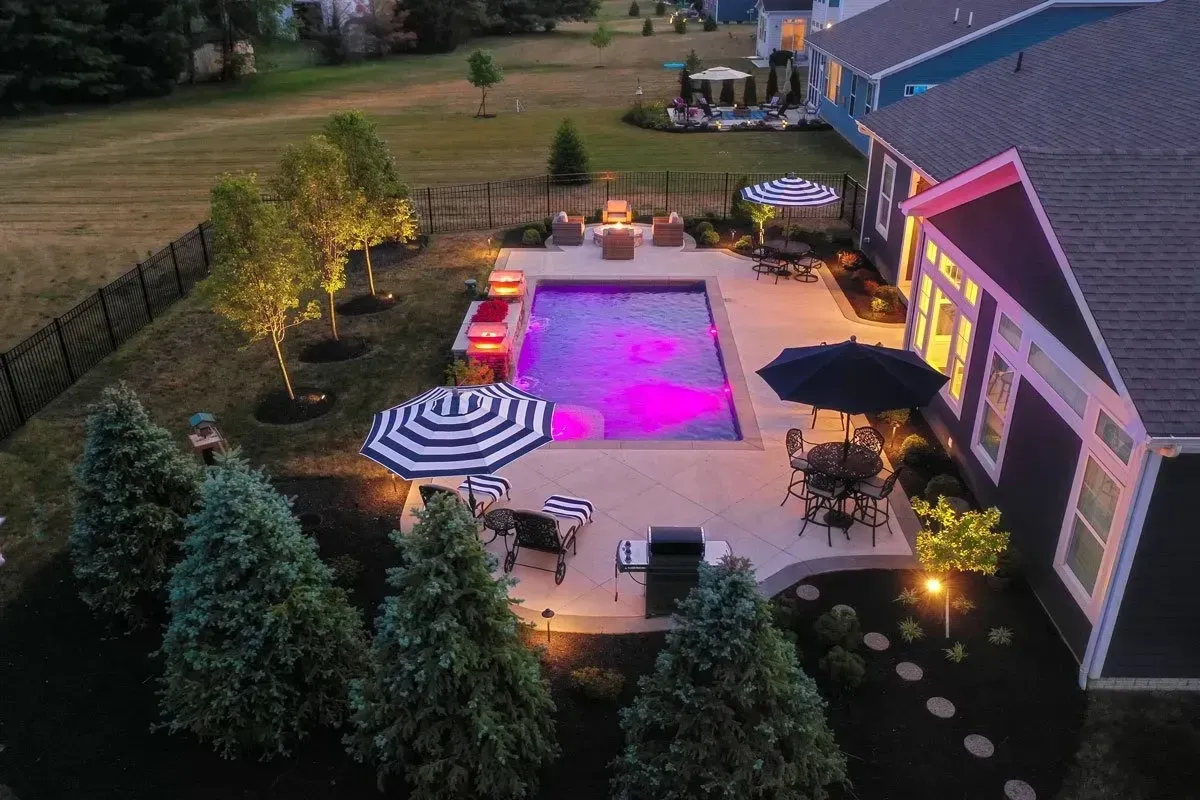
Control Architecture: Pentair IntelliCenter + Lutron RadioRA 2 + Eight Scenes That Actually Get Used
The single highest-leverage decision in a resort-grade Alpharetta lighting build is the controller. Without unified control, a homeowner ends up with three apps, two wall switches, and a transformer with a manual dial in the side yard. Nobody uses half of them. The fixtures go on at dusk at full brightness, stay there until the timer cuts them at 11 p.m., and the $22K investment gets used as “on” or “off.” That’s not a resort. That’s a Costco parking lot.
Pentair IntelliCenter handles the pool side — pumps, heaters, spa, pool LEDs, and waterfall pumps. Lutron RadioRA 2 handles the landscape side — in-grade uplights, tree uplights, path lights, and any architectural lighting on the house exterior. The two systems talk through contact closure so one button on the Lutron Pico keypad triggers a full sequence across both platforms.
Eight scenes is the right number. Fewer and the homeowner never uses the nuance; more and they can’t remember which one is which. Our default eight:
- Dinner (6 p.m.–9 p.m.) — pool LEDs at amber 40%, tree canopy at 55%, in-grade at 70%, path lights at 80%, no bubbler color.
- Swim — pool LEDs full white, bubblers blue, deck in-grade at 30% to keep the water the star.
- Party — pool cycling through the Party show, tree uplights color-tuned, deck at 80%, path at 100%.
- Movie — everything at 10–20% except the path lights at 40% so nobody trips on the walk back to the house.
- Late Night — pool off, bubblers off, tree uplights at 30% on just the four hero trees, path at 50%.
- Security — motion-triggered override from dusk sensors, all exterior fixtures to 100%.
- Holiday — programmable color themes for seasonal shifts.
- Off — everything dark, controller in standby.
Voice integration layers in through Alexa, Google Home, or Apple HomeKit depending on the homeowner’s existing household platform. The scene name is the command — “Alexa, dinner scene” — and the controller does the rest.
Permitting, Inspection, and the Country Club of the South ARB Reality
Lighting scopes in Alpharetta require an electrical permit pulled through the City of Alpharetta Community Development office at 2 Park Plaza. Unlike unincorporated Fulton County work, the in-city permit process is fast — typically 7–10 business days from submission to issuance on a lighting-only scope, compared to 14–21 days for equivalent work pulled through Fulton County’s unincorporated jurisdiction. Fees run $85–$240 depending on fixture count and circuit count.
The longer timeline item is the architectural review board. Country Club of the South ARB, Windward ARB, and White Columns ARB all run strict 3–4 week review cycles on any exterior lighting modification. That review is substantive — they want to see fixture spec sheets, aiming diagrams, photometric plans, and proof that the package won’t project light onto neighboring lots. On a typical Alpharetta estate lighting job, we submit the ARB package the same day the homeowner signs the contract so the permit and ARB timelines run in parallel instead of stacking.
Georgia Power is the primary utility for most of Alpharetta. A small pocket along the northern Alpharetta and Milton border sits inside the Sawnee EMC footprint — different inspection calendar, different locate call protocol, different service-drop coordination. On properties near the Birmingham Highway or Hopewell Road boundary, verifying the utility provider before trenching is step one, not step three.
Soil reality on the landscape trench runs: Alpharetta’s dominant Cecil-series Piedmont clay has moderately high shrink-swell behavior. That means direct-burial 12-gauge landscape wire gets buried at a minimum of 12 inches with a sand cradle, not laid in at 6 inches like some dry-climate installers do. The shrink-swell cycles over a full Georgia year — USDA Zone 8a with roughly 20 freeze events annually — will pull shallow-buried wire up through the topsoil within 3–4 seasons. The sand cradle and deeper burial prevent it.
Fire Features, Specimen Trees, and the Case Study That Defines the Package
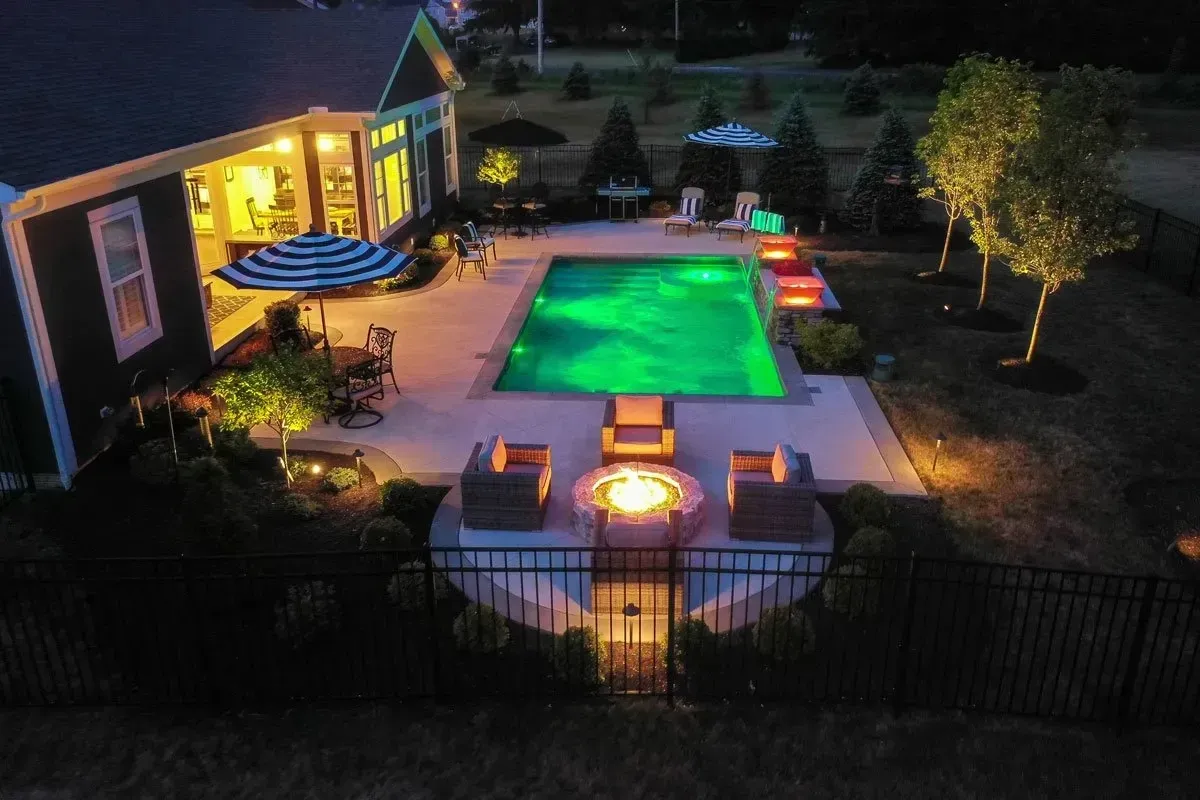
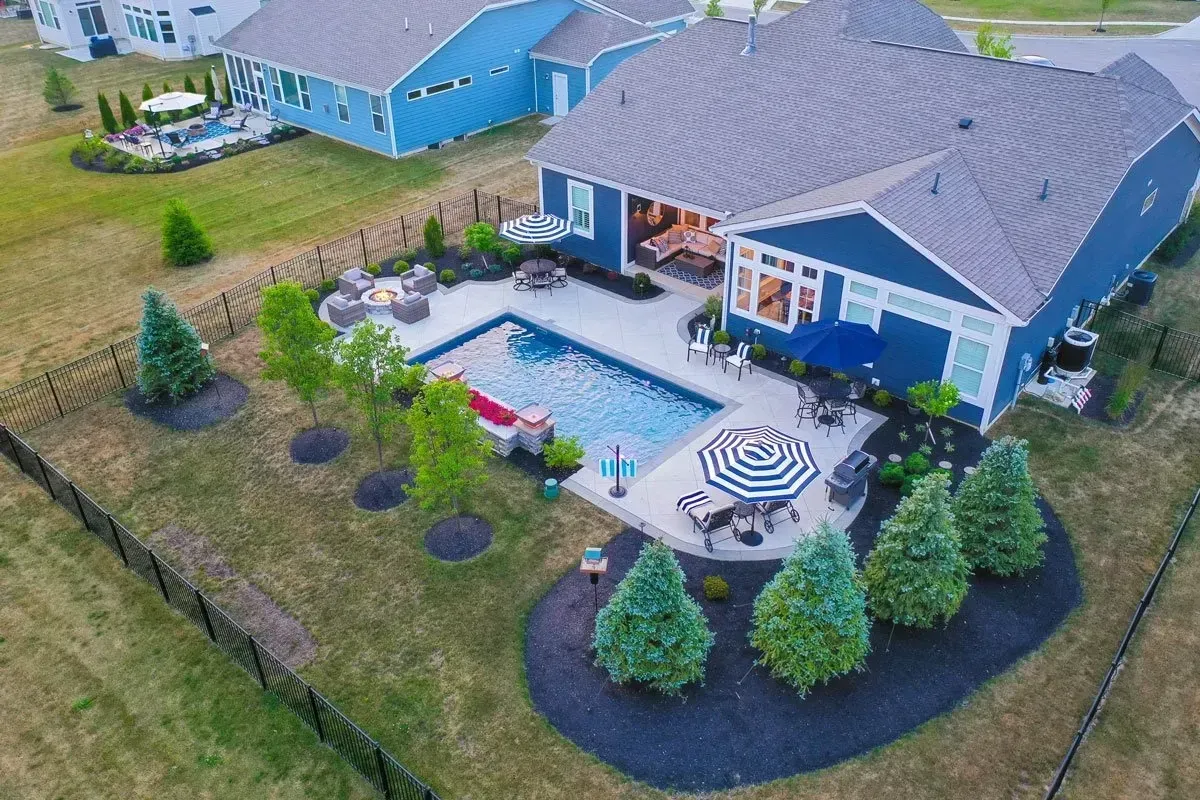
The cleanest way to understand a $22,000 Alpharetta lighting package is through a specific project. Late 2025, Hutchinson Farm estate, 1.2-acre lot backing up to a wooded greenway. The pool is 18-by-42 with a raised spa, a full tanning ledge with four bubblers, a floating stone bridge across the deep-end transition, and a fire pit 34 feet off the pool deck at a lower grade elevation. Fourteen specimen trees: three mature white oaks, two hickories, five Japanese maples, two river birches, and two dwarf Japanese maples flanking the spa.
The lighting scope came together in three passes. Pass one was pool-side: three IntelliBrite 5G Treos in the wall niches, four bubbler LEDs integrated in the tanning-ledge jets. Pass two was deck and pool perimeter: fourteen Zonda in-grade uplights along the coping, aimed 25° off vertical, color-tuned to a warm 2700K for the base scene with the ZDC module unlocking full RGB for party mode. Pass three was landscape: twenty-two Nox uplights across the fourteen specimen trees, plus twenty-eight path lights running the grade change from pool deck down to the fire pit.
The fire pit itself pulled the hardest visual weight at night because the flame gave the cameras a center of gravity, but the real trick was the uplights behind the fire pit on the three white oaks. Aimed up the trunk at 70% intensity, the oaks framed the fire feature like a theater set. That’s what separates a yard with fixtures from a yard that reads like a resort — the fixtures are aimed at something. Not just scattered.
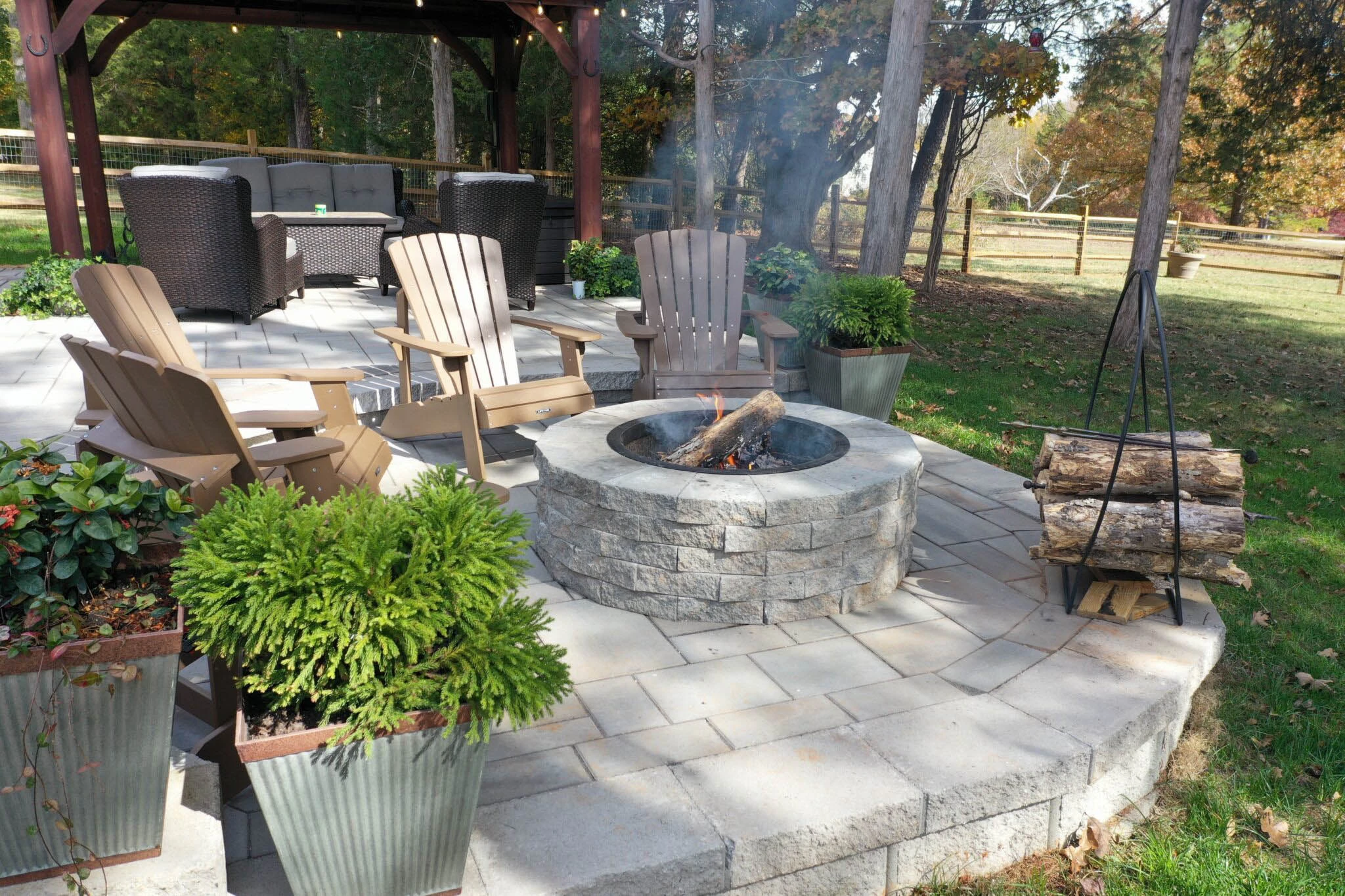
Total installed delivered price on the Hutchinson Farm project: $22,480 for the full lighting package, separate from the pool construction scope. The electrical permit was pulled through City of Alpharetta Community Development and issued in 9 business days. The Hutchinson Farm ARB package was approved in 19 days, running in parallel with the permit. Total project time from contract to final commissioning: 6 weeks, including 2 weeks of ARB review overlap.
The homeowner’s feedback after the first month of use: “We thought we’d use the pool lights. We actually use the tree lights more.” That’s the pattern on every one of these installs. The water lights sell the pool. The canopy lights sell the yard.
What the Package Doesn’t Include
Clear on the boundaries: $22,000 covers fixtures, wire, trenching, conduit, transformers, controller hardware, commissioning, and aiming. It does not cover major tree work if the canopy needs pruning to receive the aim (typical for older oaks), structural repairs to existing decking, pool equipment upgrades if the IntelliCenter replaces an older automation system, or house-side architectural lighting. Those scopes add $3K–$15K depending on what the property needs and get quoted separately.
Also not included: the low-voltage pathway lighting on a long driveway, which is a separate scope because driveway lighting has different aiming requirements and usually ties into a dusk-to-dawn photocell rather than the main scene controller. On a 300-foot Country Club of the South driveway with 14 path fixtures, that addition runs $3,800–$5,400 installed.
Maintenance Over the 20-Year Window
LED fixtures at this spec carry manufacturer lifespans in the 60,000-hour range. On a 7-hour-a-night schedule, that’s 23.5 years before the average fixture hits end-of-life. In practice, LEDs don’t fail suddenly — they drift in color temperature and dim gradually over the back third of the lifespan. Around year 15–18, we recommend a color audit: swap any fixtures that have drifted more than 300K off their original target, usually a handful of the older in-grade pieces that sit in standing water more than the rest.
The IntelliCenter and Lutron hardware needs a firmware update cycle of 1–2 times per year, handled remotely. The low-voltage transformers are the closest thing to a scheduled-replacement item — rated for 15–20 years, typically replaced at year 18–20 as preventive rather than reactive maintenance. Transformer replacement on a full $22K package runs $800–$1,400 in Year 18–20.
Path lights take the most physical abuse. Lawn equipment, kids on bikes, the occasional landscaping crew moving a wheelbarrow. FX Luminaire’s brass construction absorbs that abuse better than aluminum or plastic. Over a 20-year window, expect to replace 2–4 path fixtures out of 28 — about 10% attrition — at $180–$240 installed per fixture.
Resort-grade pool lighting across 20+ cities within 30 miles of Winder, GA
From Country Club of the South estates to Windward custom builds, Primetime Pools GA designs and installs Pentair IntelliBrite 5G and FX Luminaire lighting packages that outlast the house.